
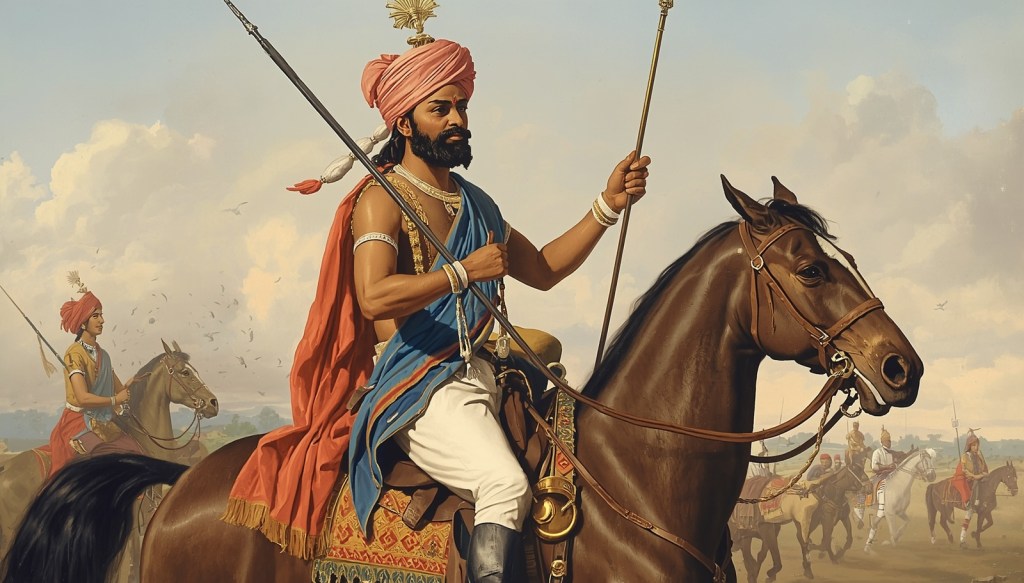
About: This is a fabulous story about one of India’s forgotten heroes, Dheeran Chinnamalai hailing from the Kongu region of western Tamil Nadu, South India. He is an early genuine hero, who fought the British, just when they were beginning to colonise India. The British stung by his courage and aura of invincibility-they finally got him-ensured Chinnamalai’s story did not become a household name by banning books or any re-telling of his challenge to the British, for a long period of time. They feared the example Chinnamalai had set.(Image Courtesy: Canva AI)
The British first arrived on India’s shores in the year 1608, at the port of Surat, Gujarat. India was renowned for its cotton, silk, calicoes, and muslins, and other textiles, which were hugely popular in Europe. As was Indigo, and saltpeter (potassium nitrate)-used for gunpowder-critical for Britain’s military needs. Add spices such as pepper from South India, and the British wanted to trade. They established the East India Company (EIA), as a trading company, to obtain goods from India and send them to Britain for gainful commerce.
The East India Company found its way to the Court of the then Mughal Emperor Jehangir and obtained permission to build trading factories and Forts in costal India, beside roads and bridges to facilitate movement of their goods.
Gradually, over the 1700s the EIA’s focus shifted from trade to political dominance: they spied many an opening to India’s riches. And at the Battle of Plassey in 1757, the British led by Robert Clive defeated a combination of the French East India Company and local Nawabs gaining control of the rich region of Bengal. Clive won by making a secret alliance with Mir Jafar, the Army Commander of the then Nawab of Bengal, Siraj-ud-Daulah. Mir Jafar deliberately held back his troops enabling the British to sneak through a victory. Mir Jafar was installed as a puppet Nawab, marking the beginning of British political dominance in India. Siraj-ud-Daulah escaped the battlefield, but was captured and later executed.
Mir Jafar’s name become synonymous with treachery and betrayal for enabling British colonial expansion through internal conspiracy. If he had not sold his soul to the British, maybe they could have been vanquished and sent back to Britain or at best continued functioning as a trading company. On the sidelines, the British learnt the art of pitting one Indian against another and using it as a vicious weapon to subjugate India. The multiple small Kingdoms, often at war with one another, in India suited that style.
Bolstered by its clever win, the EIA became a ruthless war-machine enjoying unbridled power in India, which eventually led to the first uprising against the British, the Indian Rebellion of 1857, also called the Sepoy Mutiny or the first war of Independence. The British Government watching the East India Company go roque, stepped -in, dissolved the EIA and assumed direct control of the Indian Sub-continent as the British Raj. Thereafter, it was the British Raj, all the way, that further colonised, ruled, and plundered its riches, until India’s independence in August 1947.
In the South of India, during the Robert Clive era, the British East India Company had only small trading enclaves, especially in Madras-now called Chennai. South India was ruled by independent regional powers such as, the Nawab of Hyderabad, the Maratha Confederacy, the Nawab of Carnatic, and the Kingdom of Mysore. These Kingdoms were the fragmented splinters of the glorious dynasties before them: The Vijayanagara Empire and The Chola Empire, to mention a few.
For around 300 years, a large part of present-day Tamil Nadu was ruled by warrior chieftains known locally as ‘Palayakkarars’ (heads of districts) or the Anglicized ‘Polygars’. Forgotten over time, these regional formations produced outstanding warriors who were probably the first to seriously challenge the British in South India, between 1700 and 1850. One of them being, Dheeran Chinnamalai. Others are, Maveeran Alagumuthu Kone -one of the earliest-the indomitable Veerapandiya Kattabomman, the courageous Puli Thevar, the amazing Rani Velu Nachiyar, and the remarkable Maruthu Brothers.
How did the Polygars come into being, who are they?
The Polygars were part of a unique three-tier administrative system created by one of the greatest Vijayanagara Emperors, Sri Krishnadeva Raya, who ruled between 1509 and 1529 CE. This simple but effective structure consisted of the Emperor at the top of the pyramid; the Nayakas or Viceroys, at Madurai, Thanjavur, Gingee, and other regions, forming the second tier; and the Polygars comprising the grassroots leaders, in the hierarchy. This one-of-a-kind system facilitated efficient administration of revenue, as well as created a mechanism for raising an army to meet the King’s war requirements, besides keeping generals, warriors, vassal rulers, and nobles gainfully occupied.
‘Palayam’ in Tamil and ‘Palamu’ in Telugu means an ‘army camp’ later stretched to mean an Administrative Division. At that time in Tamil Nadu, there were about 72 Palayams, each headed by a Polygar, who in turn reported to the Nayaka of Madurai. The Polygars functioned as semi-independent rulers operating from fortified centres, with a standing army-for the King- palaces, forts- in certain cases; they collected taxes, had private estates, dispensed justice, maintained law and order, held durbars, maintained water bodies, while expanding the land under cultivation, built and managed temples, and indulged in philanthropy. Over time, the Polygars became local rulers, ‘little Kings’. The paraphernalia of royalty was maintained by retaining a quarter of the collected revenue, while the rest was sent to the Nayakas.
The Polygars, also at times, founded villages, built dams, constructed tanks and built temples. They taxed regions according to the cultivable nature and fertility of the land. Their armed status served to protect the farming communities, trade & craft artisans, and ordinary civilians from robbers and dacoits who were rampant in those regions. And from invading armies, which often resorted to pillaging the villages and the countryside.
By the 18th century, while the northern Polygars fell under the Kingdom of Mysore, those in southern Tamil Nadu had to deal with the revenue demands of the British East India Company. The Nawab of Arcot had borrowed money from the EIA and had given the Company the right to collect taxes. All the Polygars, except Veerapandiya Kattabomman (1760 to 1799 CE) of Panchalankurichi, submitted to the East India Company.
While the year 1857 is often regarded as the first large-scale revolt against British rule in India, there were many localised revolts that broke out earlier. And one of them was the Polygar Wars, down South, between March 1799 and July 1805. These were some of the bloodiest revolts ever faced by the British, fought primarily in Tamil Nadu and the Malabar region. And the British did not have an easy run. The Polygar Wars were the most serious and deadliest challenge to their dominance in India. The 6 long years, saw a large number of losses on the British side, and they were defeated in many a battle. And the major players in the Polygar Wars actually challenged and outwitted the British, head to head. On the British side, in most cases, it took cunning, deceit, and treachery to capture and execute these warriors: they simply could not match their valour -directly.
The war between the British and Veerapandiya Kattabomman is called the First Polygar War (1799), while the second Polygar War (1800–1805)was fought by a much bigger coalition over the whole of western Tamil Nadu headed by Dheeran Chinnamalai and Maruthu Pandiyar.
In these times, on 17 April 1756, was born Theerthagiri Sarkarai Uthama Kaminda Mandradiaar, also called Theerthagiri Gounder, and later called Dheeran Chinnamalai, at Melapalayam in Erode district. His parents, Rathinaswamy Manradiaar and Periyaatha belonged to a noble, land-owning family of the Palaiyakottai Pattakarar (Mandradiaar title). He was the second of six children: elder brother, Kulandaisamy, younger brothers Thambi, Kilothar, and Kuttisamy, and a sister, Parvatham.
Theerthagiri’s grandfather, Kottravel Sarkkarai Mandradiaar, was one of the largest land owners, in the Kongu region, in present-day western Tamil Nadu. He was childless from his wife and took a second to beget children. However, he was childless from his second wife too; and thereafter he adopted two sons, first Senapathy and second, Rathanasamy, who he entrusted to each one of his two wives for upbringing. Both the sons were educated at the palace. In course of time, Senapathy and Ratanasamy got married and were given separate farm land regions to manage. As was the custom in those days, the first son Senapathi took the title of Manradiaar and continued to control the lands from Palaiyakottai. Rathnaswamy moved out-could be some kind of a partition plan between the Brothers-to a nearby village named Melapalayam and managed the family farm lands in that part.
During his childhood days, Theerthagiri attended the school within the Fort/Palace and was a bright, obedient, and disciplined student, excelling in Tamil literature, poems, and patriotic themes. He was introduced to the Tamil epics and the history of Tamil kings (Chola, Pandya, Chera), bravery, warfare, and governance, which inspired and instilled in him deep patriotism for the land, and leadership qualities from a young age.
Theerthagiri’s brothers, Kulandaisamy and Kuttisamy joined their father in farming, while Theerthagiri, with his other brothers, Thambi and Kilothar took on the responsibility of administration and safety of the villages under their jurisdiction, as Polygars.
The sister Parvatham was given in marriage to Ulagapuram Muthi Thirumalai Gounder, which strengthened the local Kongu Gounder network. Marrying into another Gounder family from nearby Ulagapuram (in the same Erode region) was typical for building alliances among chieftain families. The elder brother Kulandiasamy and the younger, Kuttisamy took wives, while Theertagiri, Thambi, and Kilothar never married, probably given the nature of their responsibilities.
The family managed extensive agricultural lands and ran the local administration. From a young age, Theerthagiri and his brothers received training in martial arts, including silambam, archery, horse riding, and techniques of warfare. Theertagiri gained experience in village panchayats, resolving land (and family) disputes, which further honed his leadership skills.
People of Kongu region traditionally practiced Hinduism under Shaivism- devotion centred on Lord Shiva. They followed Saiva Siddhanta traditions, emphasising Shiva as the supreme deity, along with associated rituals, temples, and philosophical teachings. They worshipped clan-specific kuladeivams (family or lineage deities), avatars of Amman (e.g., Mariamman, Periyachi Amman, or local protective goddesses), alongside major deities like Shiva, Murugan, and village guardian gods (e.g., Ayyanar or Karuppu Sami).
The then Kongu region, in the later half of the 18th century, was part of the Mysore kingdom, under Sultan Hyder Ali. The Diwan, Muhammad Ali, who was in charge of tax collection, followed unfair and unethical practices. He often humiliated farmers by confiscating their lands- their only means of livelihood – when taxes were not paid on time.
During one such tax-collection exercise, Theerthagiri and his brothers confronted Muhammad Ali, in an area between the hills of Sennimalai and Shivanmalai, recovered the forcibly collected taxes, and distributed them to the affected farmers. A furious Muhammad Ali, threatened Theerthagiri with severe consequences, once the Sultan learns about the incident. Theerthagiri shot back, saying Kongu Nadu will not accept Hyder’s rule, and it is capable of governing itself. He famously told the Diwan: “I am Chinnamalai, who reigns between Sennimalai and Shivanmalai” ( I am a small hill between two larger hills). And this was when he got the name of Chinnamalai, which means ‘small hill’ He earned the prefix ‘Dheeran’ meaning brave or valiant, for his courageous defiance.
Enter, Dheeran Chinnamalai.
Hyder Ali, as expected, sent an army to Kongu to teach Dheeran Chinnamalai a lesson. However, Chinnamalai met the Army on the banks of the Noyyal river and routed Hyder Ali’s forces. This only further enraged Muhammad Ali, and he vowed vengeance. Knowing Ali’s intentions, Chinnamalai began to build his own army. However, Hyder was preoccupied with the Nizam, British, and the Marathas, with whom he was in constant conflict, hence the return attack never happened.
Hyder Ali died in 1782 at his military camp near Chittoor during the Second Anglo-Mysore War, while actively fighting the British East India Company. Tipu Sultan, his eldest son, who was away on another military campaign, returned to Chittoor, assumed command, and took over as ruler of the Kingdom of Mysore.
Tipu Sultan adopted an even more aggressive policy towards the British and requested the Tamils of Kongu, to join forces with him to drive them out. Dheeran Chinnamalai responded, along with his brothers and trusted commanders, Velappan and Karuppan. Chinnamalai himself was made the commander of the Kongu regiment in the Mysore Army, and took active part in the 3rd and 4th Mysore Wars that initially helped repel British attacks on Tipu Sultan’s capital, Srirangapatnam. During his stint in Tipu Sultan’s Army, Chinnamalai received arms, combat, and battle training under the French, which served him well in the years ahead.
However, Tipu Sultan died in 1799, valiantly fighting the British, sword in hand, refusing to surrender. With the fall of Tipu Sultan, the British firmly declared, “India is ours”. And Dheeran Chinnamalai retreated home, along with Karuppan, as Velappan was captured by the British and he later became their agent.
Following Tipu Sultan’s defeat and the execution of Veerapandiya Kattabomman, Dheeran Chinnamalai emerged as a key leader in the Second Polygar War (1801 to 1805).
On his return to Kongu, Chinnamalai built a fortress at Odanilai, near Arachalur, south of Erode, Tamil Nadu, and began making recruitments and training his army, waiting for the right time to repeal any attacks by the British. He prepared his troops to use guerrilla tactics, especially hit-and-run warfare, to evade superior British firepower. He also reached out to the rulers of Malabar and Salem, hoping to build a larger alliance against the British.
Recognizing that Chinnamalai was a clear and present danger to their India ambitions, the British attempted to force him to sign a pact, where he was promised favours in return for accepting British sovereignty. He refused, knowing fully well that it would result in war. He mobilized and trained thousands of Kongu youth- up to 40,000-across religious and caste lines with loyal followers.
Chinnamalai’s bold defiance annoyed the British: a man with no title, technically not a ruler, yet refusing to accept their sovereignty, at a time when most of the Rajas, Nawabs, and Sultans had surrendered with much of a whimper.
In 1801, the British sent a troop of soldiers under Colonel Maxwell to tackle Dheeran Chinnamalai. However, Chinnamalai, having got advance information of the attack, defeated the British, again on the banks of the River Noyyal. Maxwell returned in 1802, and after a long siege of Odanilai fort, ended in yet another comprehensive defeat for the British, with Maxwell himself being killed-beheaded.
The British by this time were furious and waited for an opportunity to make a calculated assault. It came in the year, 1804, when having learnt that Chinnamalai and his followers would be attending the Arasalur Amman Temple festival, on a particular day, they made plans.
An army was dispatched to capture Odanilai Fort, under General Harris, who had led successful campaigns in Mysore. Chinnamalai through his network of spies learnt about the plan, and stayed back at the fort, with his main Army, while others went to join the temple festival. General Harris was taken by surprise when he attacked the fort, and Chinnamalai stormed-out, forcing him to retreat.
The British were now more determined than ever, and built a huge army to take down Chinnamalai, with cannons brought over from Madras. With 140 cannons and 30,000 men, Harris came back, attacked Odanilai, and surrounded the fort, demanding that Chinnamalai surrender. However, they found that the fort was abandoned, and that Velappan was acting as a double agent for Chinnamalai, while on the British side. Harris promptly had Velappan executed, and also razed Odanilai fort to the ground-the cannons were put to use.
The story goes that Dheeran Chinnamalai had a personal habit of wearing a new pair of slippers/sandals every day. Loyal informers and messengers exploited this routine to deliver secret notes/chits hiding them inside the soles of the sandals. Velappan would write critical intelligence – details of British troop movements, attack plans etc on a these chits. When he put on the new sandals in the morning, he would take-out and read the hidden messages and promptly destroy them.
One key instance involved storming the Odanilai Fort with cannons. Chinnamalai received the note and evacuated the fort to hide in the forests of Karumalai. After reading the secret note, Chinnamalai accidentally left it behind in the sandals, in the Fort. When the British arrived at the abandoned Odanilai Fort and while searching for Chinnamalai, they came across the discarded pair of sandals. Frustrated at finding the fort empty, General Harris picked up and threw the sandals against a wall in a fit of rage. The sandals broke open, revealing the hidden note. He then had the message read, which clearly pointed to intelligence information passed from Velappan warning Chinnamalai about the British attack plans (including cannons and timing).This exposed Velappan, leading to his execution.
Chinnamalai was deeply hurt by the incident, blaming himself for being careless, leading to the death of a true loyalist. The importance of spying is of paramount importance is getting the better of an enemy, in the asymmetric warfare of those times.
Chinnamalai, his brothers, and soldiers, now lived in exile, at a place called Karumalai near Palani, often disguising themselves to venture into towns. During such forays they became friendly with a local cook called Nallappan, who willingly offered them food, water, and refuge. It turned out that Nallappan was a traitor. He was enticed and bribed by the British to provide information on Chinnamalai’s whereabouts. He secretly informed the British about Chinnamalai’s daily routine of having meals in his house at the foothills. The British dug an underground tunnel leading to the house and waited for Chinnamalai.
One evening, following the usual routine, when Chinnamalai entered Nallappan’s house along with his brothers, and Nallappan proceeded to serve them. This time he cunningly asked all of them to keep aside their weapons as there was no danger while dining. The brothers trusted him and agreed, as they also did not sense an imminent danger. Once their weapons were taken away from them, Nallappan signalled the British who stormed the house both from the underground tunnel and from outside. A total of two hundred soldiers surrounded the house. The British soldiers quickly locked-on to Chinnamalai and his brothers. An enraged Chinnamalai managed to break-free, pounced upon Nallappan and strangulated him to death, on the spot.
The British arrested Chinnamalai and his brothers and kept them in a prison in Sankagiri Fort. Their loyal commander Karuppan who was in hiding at Melapalayam, also surrendered. A four person British Tribunal was formed, which demanded he accept British sovereignty and pay taxes. They also offered him amnesty if he tendered an apology. He refused defiantly and was sentenced to death.
On 31 July 1805, Dheeran Chinnamalai, his brothers, and Karuppan were hanged at Sankagiri Fort. He was about 49 years old. His body was brought back to Odanilai for burial.
The story goes that preparations were made to hang them by rope tied to a Tamarind tree located at the top of the Sankagiri fort. Chinnamalai, his two brothers and Karuppan were brought to the spot on the day of hanging. They asked the escorting British soldiers to move away, and each one tied the rope around their own necks and jumped to embrace death.
The whole of Kongunadu wept for the heroic deed on that day. The British ensured that Chinnamalai did not become a household name by banning books or any information on Chinnamalai for a long period of time.
Dheeran Chinnamalai symbolizes Kongu pride, valour, and early resistance to British rule. Today, statues and memorials stand in places like Odanilai, Sankagiri Fort, Chennai, Erode, Tiruchirappalli, and elsewhere. A commemorative postage stamp was issued by India Post in 2005. Though details vary across oral recounts and sources, his defiance remains a powerful part of Tamil and Indian history.
The story of Dheeran Chinnamalai, and his heroic battles with the British and the eventual sacrifice of his for the cause of freedom would have been completely consigned to oblivion, but of the tradition of oral story telling that existed in Tamil culture. The singular credit goes to Pulavar Kulanthai who heard this story from his grand father during the early 1900s and wrote it down, keeping the story alive.
I started with the treachery of Mir Jafar and ended with another kind of treachery by cook Nallappan. A brave, indomitable India (and sometimes casually over-confident) was defeated mostly from enemies within, rather than for those outside. Indian History is filled with them- like termites in the woodwork. Look around today, the story continues, albeit in different forms, wearing various political labels and colours.
Dheeran Chinnamalai, by any measure, was an extraordinary, fearless hero. He was against subjugation of any kind and stood-up for freedom, on his own free-will. He had no known mentor, nor was he of royal lineage. There is still so much we do not know about him. And the idea of Bharat- however loose it might appear with the many independent small Kingdoms-was long ingrained. Dheeran Chinnamalai could have been selfish ‘sticking himself to reigning between two large hills’, but he dared to fight the British along with Tipu Sultan. It’s now upon us to become our own chinnamalais, be counted, and stand up for India, always -in our own ‘chinna’ way. Small can actually be big. Jai Hind.

