

About: A travelogue, catching-up with permanent old friends of the Work-Place, after over 20 years, commingled with the history of the region we met-three of us, plus a revolutionary hero.
Over the years, you make friends in School, in College, and in your Work or Business Place: some close, many of the ‘Hi-Hello’ fleeting type. Call the ‘some’ permanent, and the ‘many’ temporary. I’m glad I had cultivated small circles of School and College permanent friends with, who I can just pick-up the phone and call, or meet, as if it was yesterday-never mind the gap, no questions asked!
The Work-Place friends are a leaner lot, as the relationship needs to expand beyond the office routine and enter the home. And the fact is, I have made better neighbour-friends, more than Work-Place friends – at the various places, all over India and abroad, where I lived, driven by the Job.
One such Work-Place, in India’s Tata Group, saw me catch, plant, and grow two friends-among others: one I call Bush and the other I call Monk. The three of us were Power-Plant Engineers at that time, making designs to pull electricity out of machines, now ‘officially’ retired. And surprisingly, we have been keeping in touch with each other through all kinds of ‘heedless’ ways, except physical, for near about twenty years!
Bush is now a successful Entrepreneur in Mancherial, Telangana. He runs a welding-electrode manufacturing Factory besides managing his farms spread over the region. Monk used to live in Koramangala, Bengaluru (‘his House still lives’ there) but now he lives ‘everywhere’: his biggest possession being a Nexa Blue, Suzuki Baleno car, stuffed with all his earthly belongings. And when he is not running his car and worshipping various Gods, he stays put in a one-room house somewhere in Mysuru. Having given it all up, including a wife and two sons (may be they have given him up?), he had grown a flowing beard, maintains a shinning top, and visits various Ramakrishna Mission Temples and Ashrams all over India. He is often on a Parikrama keeping and growing his faith in Hinduism. And at the same time he is an ambassador for his wife’s ‘Craft Your Wellness’ Plant-food based Regime, balancing mind, body, and spirit. That sure is one helluva job! He cleverly enticed me to buying his wife’s ‘Wellness’ book, of the name – on the return.
Bush’s son married about a year ago, and I could not be there, to sight the Pune-based bride before his son whisked her away to far-away Australia where they live. It was on short notice and too far to drive down quickly. I left a plan hanging, that perhaps one day we should meet at his newly built expansive mansion in Mancherial, Telangana – I called it Bush’s White House. Ever since, I have been looking at doors to open in that direction.
On a quiet Sunday afternoon, in the middle of July, Monk calls saying he will be in Telangana during his Everywhere Trip heading through the East, to the North Eastern States. And why not ‘have a three-state ( Tamil Nadu, Karnataka, and Telangana) summit at Bush’s White House in Mancherial? I looked up the Trains to Mancherial and found a comfortable ride on 29th July with a return booking available on 1st August. Bush then calls to confirm and without a second thought, I booked ‘em tickets, after which I told my wife that this is a Gentlemen’s Get-Together (she better stay at Home and manage our Women’s Boutique Business on her own). We then formed a Group-of-3 WhatsApp Group called ‘Bush GK(me) RSS(Monk)’ to synchronise, during the trip.
During our job days, Bush and I dreamed of starting our own manufacturing factories sometime in the future, and we made it: he runs a welding-electrode factory and I, a ‘blouse manufacturing’ factory!
It then flashed on that inward eye that about three months ago, I did another awesome Group-Of-3 Trip with permanent friends commissioned at the first Public Sector Company I joined as a Graduate Engineer Trainee in Neyveli, Tamil Nadu. That summit was in the picturesque Anchal, Kerala, and we, called the ‘three musketeers’ or sometimes ‘Terrorists’, at that time (because of our ruthless straightness in getting the job done) were meeting over the passing of the wife of the Kerala Musketeer. I could not attend the Funeral, and the trip was to make amends, share the sorrow, and re-tell the stories of the good and bad times. That was a Dilip-Kumar-GK Group and Kumar & I just jumped onto a Train, with the bookings done by Kumar, and tracked to Kerala. That was an unforgettable meeting, and I hoped this one too would top the charts!
Photos: The Three Musketeers; GK-Bush-Monk; and, the Triveni Sangamam


Coming back to this Trip, on the day of journey, from Salem Junction to Mancherial Station, the train arrived a whooping 8 hours late, which the Railways elegantly and smartly called ‘Rescheduling’. Instead of boarding at 10.20am, I boarded at 7pm and reached Mancherial the next day at about 1.30pm. It was ear-to-ear smiles and bear-hug time with Bush and Monk waiting on the Platform, and carrying me to a comfortable room in Bush’s White House. In that flash of a moment we closed the 20-year gap and spent the next two days cementing it.
Bush once won a competition of eating the most number of boiled eggs at one sitting and, I was hoping he would have a ton of eggs on the lunch table. He did not disappoint and served chicken instead-with just one boiled egg. Mrs Bush was a superb hostess, and she made sure we were well-fed for the time we stayed at Mancherial. And she struggled to meet Monk’s Food plan.
After a well-boiled lunch, we made a quick visit to Bush’s Welding-Electrode Factory, which wasn’t working that day, and just to mark attendance.
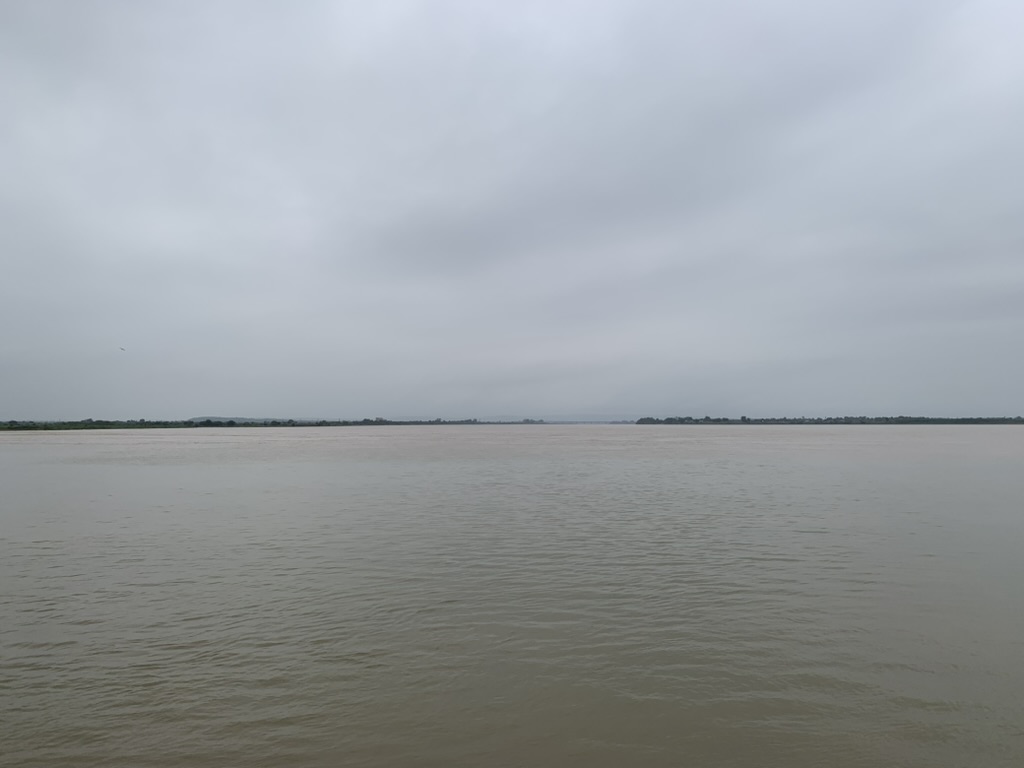
We then drove in Bush’s Tata Tiago hatchback, to Kaleshwaram, Triveni Sangaman, the confluence of River Praanahitha, River Godavari, and the mythical underground River Saraswathi. We could see the ‘shades of colour’ where the two mighty Rivers bumped into each other, while the other one silently flowed underneath. Near this spot there is a Temple – Muktheswara Alayam- which holds a Shiva Temple with a double-sivalingam. It was near about 6pm and the Temple had just closed. But we ‘prayed hard, on the double’ and mighty impressed by our devotion, the Priest opened the Gates for a quick glimpse of the sacred sivalingams. We had the Priest in our eyes and God in our minds -that made our day!
On the return, we spied a well-dressed lone-star lady running a road-side restaurant who, though the fires were yet to be lighted, promised to cook-up poori and chappati using fresh dough. We fell for it, and while Monk indulged himself in chappati, and sweet banter with the host (even handsomely tipping her in the end), Bush & I stuck to the poori-masala. It was late evening when we returned to the White House, and we called it a day and hit the bed.
The next day we started early 6.30am first trying to visit Bush’s farm(s). He tried his best to show-off his land holdings, but we could not get near as the road was too slushy after the previous night’s rain. And we saw his fields from a safe distance and measured it up.
We then left for the nearby Jodeghat Village, in Komaram Bheem District, to see Gond Tribal, Revolutionary Leader, lesser known Freedom-Fighter, Komaram Bheem’s Museum, which Bush said is a must-see (he himself had not visited until today). It was a wonderful drive through the sylvan forest road and the Museum itself was nestled among the dense greenery of the Hills, featuring a more than life-size statue of Komaram Bheem holding a rifle, at the entrance. ‘Gond’ means hill and the Gonds are essentially traditional hill and forest people.
I was flabbergasted to find that all the descriptions engraved or written about Komaram Bheem were only in Telugu-and there was no translation available in another language. Imagine if it were in the original Gondi language, would the people in the State understand? Should it not be in Hindi and English too, so that Tourists can read for themselves and live the story of Komaram Bheem? Language politics is awfully parochial and must be eschewed. On my front, thankfully Telugu-speaking Bush did the translation.
I was disappointed that we suddenly discover forgotten heroes, quickly build a memorial for them and even faster fail to upkeep them. It was disgusting to see a tooth-brush sticking out of a urinal in the Museum and this part was in abysmal condition. Wonder who brushes with what?
Photos: Komaram Bheem; a Tribal Dance; a Tribal Meeting; Bheem, his wife; and Bush’s waterfall.
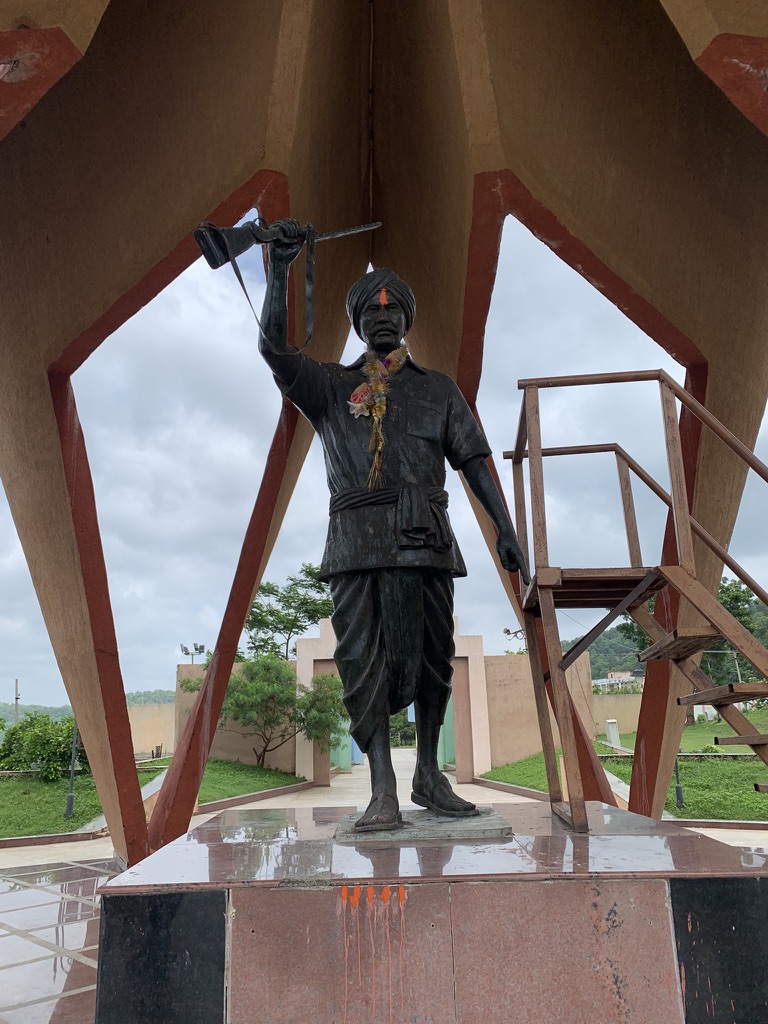

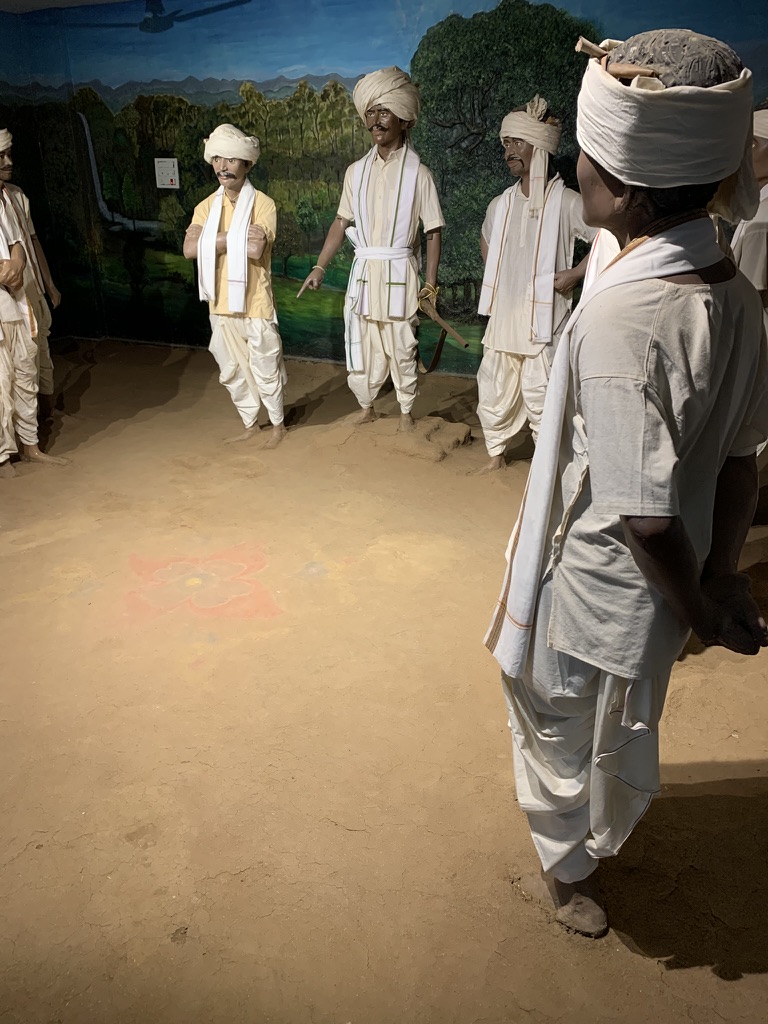
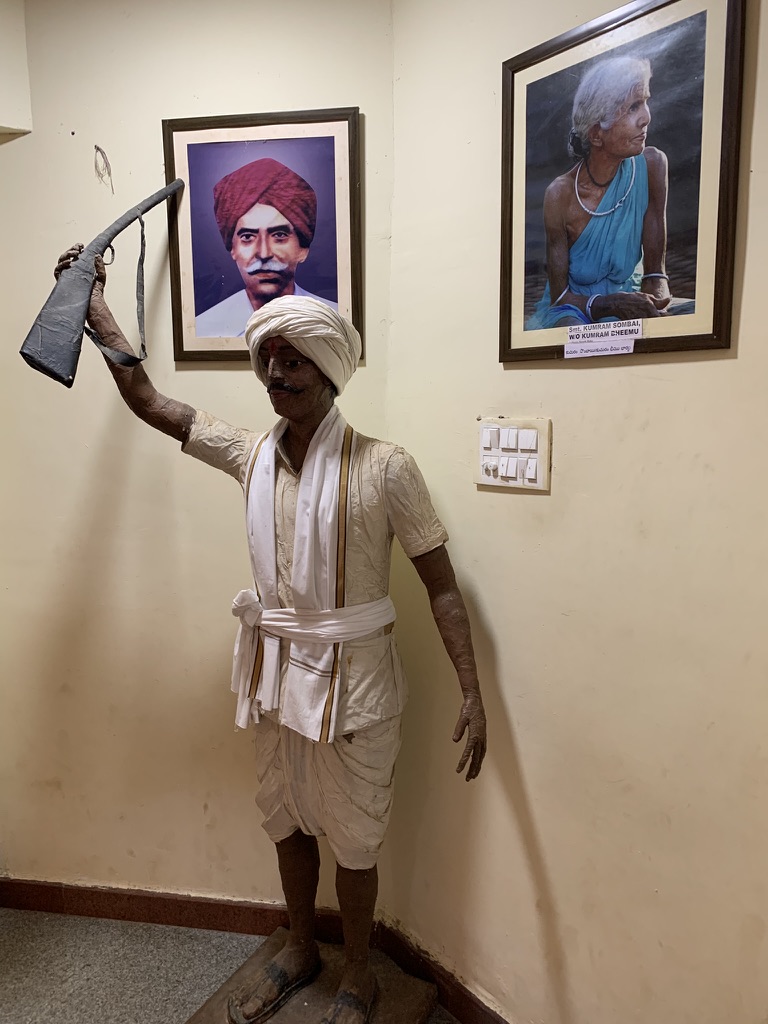

The story goes that Komaram Bheem, of the Gond tribe lived in the Hyderabad State of British India and fought for tribal rights, along with other Gond leaders, leading a protracted low intensity guerrilla rebellion against the feudal Nizams of Hyderabad during the 1930s, which contributed in the culmination of the Telangana Rebellion of 1946. This could also be a precursor to Telangana Statehood achieved in June 2014 when the State of Andra Pradesh was bifurcated into Telangana and Andhra Pradesh.
During the 1900s, pre-Independence era, under the Nizam and British Rule, there was expansion of mining activities and tightening of state authority in the Tribal Gond region of what is present day Telangana. Rules & Regulations that were enforced hampered the traditional subsistence activities of the Gonds, who lived off the Forest. Zamindars were granted ownership of lands in their regions who in turn imposed taxes on Gond farming activities. Non-compliance often resulted in extreme punishment measures such as forced amputations: cutting of fingers and hands. In fear, Gonds began migrating from their traditional villages and settling in barren lands, which also turned out to be owned by these Zamindars. This led to rebellion, retaliations, and protests. Bheem’s father was killed by the Nizam’s law enforcement in one such incident. And in a confrontation in October 1920, Bheem killed a Nizam official who was sent to confiscate crops during harvest time-in lieu of taxes.
To avoid capture, Bheem showed a clear pair of heels, running away on foot to a nearby city where he was granted refuge by a local publisher who also ran a printing press. Eventually, through the gateway of Mancherial Railway Station, he escaped to Assam where he worked in the tea-plantations for over four years. During this time, he involved and engrained himself in labour union activities, and was arrested and jailed. Bheem escaped jail within four days of his jail term, boarded a goods train, and returned to his native land-to make history.
Bheem married a woman named Som Bai and moved to the interior of the Gond lands to settle down and engage in farming. During the time of harvest, he was again taunted by forest officials who tried to force him to quit the area, arguing that the land belonged to the State. Bheem then unsuccessfully tried to lobby the Nizam directly and present the grievances of the Adivasis.
Inspired by a childhood hero Ramji Gond, Bheem decided enough was enough and began to engage in armed revolution, for the rights of the Adivasis and Tribals. He formed clandestine associations with the banned Communist Party of India, and mobilised the Adivasi population at Jodeghat, calling a Council of tribal leaders from the twelve traditional districts of the region. The Gond uprising began in 1928 with the Council deciding to form a guerilla army to protect their lands. And they attacked the Zamindars in Babejhari and Jodeghat. Bheem also proposed they declare themselves an independent Gond kingdom. Perhaps this was a predecessor to attempts to form an autonomous Gondwana State.
In response, the Nizam recognised Bheem as leader of the Gond rebels and sent the Collector of the region to negotiate with him, assuring land grants to the Gonds. Bheem rejected the offer and instead sought justice and demanded regional autonomy for the Gonds, eviction of the forest officials and zamindars, and the release of all Gond prisoners held by Hyderabad state. The demands were rejected by the Nizam and the conflict continued as a guerilla campaign for over a decade. Bheem directly commanded an ‘army’ of 300 men under him and operated out of Jodeghat.
Bheem’s whereabouts were finally discovered, due to betrayal (there are so many in Indian History) and he was killed in an ambush encounter with armed policemen, along with fifteen others, in October 1940.
His death anniversary is commemorated by the Gonds every year on ‘Aswayuja Powrnami’, where an event is organised at Jodeghat, the place of his death and the centre of operations during the rebellion. That’s where his Memorial stands today. Bheem is ‘deified as a pen’ in Gond culture and is credited for coining the slogan Jal, Jangal, Zameen (Water, Forest, Land) which, symbolised and evoked a sentiment against encroachment and exploitation, has been adopted by Adivasi movements as a call to action.
The Komaram Bheem district named after the Tribal Chieftain was created from the former Adilabad district and was previously known as Komaram Bheem Asifabad district before becoming the current Komaram Bheem district.
Bheem’s grandson, Komaram Sone Rao carries the legacy, and I did read about him protesting about how his grandfather was represented in the blockbuster movie RRR, where another Bheem was loosely based on the original. RRR is an entirely fictitious story incorporating the lives of two real-life Indian revolutionaries, Alluri Sitarama Raju and Komaram Bheem, who fought against the British Raj and the Nizam of Hyderabad respectively.
On the return, as Bush was harping that there was a famous ‘Mandakini’ waterfall (I dreamt of a ‘Liril’ one), but we found a common relative, navigating through a maze of ‘blind-snakes’ (Gond poop, I guess)while Monk stayed in the car. Bush and I gave it a splash-a poor stream trying its best to fall.
On the return, we visited Bush’s Welding Electrode manufacturing Factory. And this time I could see the assembly line working in full flow: plain rods at one end and coated electrodes at the other heading to be crowded into neat little packets stamped with all kinds of technical stuff. It sure must be able to join broken parts. Bush was also making simple nails in a noisy little room with women folk doing the job with effortless ease.
We then had lunch at a multi-cuisine restaurant, which had concept dining rooms; such as Goa-beach, Railway Station… We found ourselves in a ‘Jail Room’ locked inside and served Dum Briyani with spicy hot Chicken 65.
A trip to Telugu land is incomplete without watching a Telugu ‘masala’ movie. And after a ‘power-nap’ and we sat around Bush’s smart TV to watch the Mahesh Babu starrer, ‘Maharishi’ where the hero easily bashes the bad-guys to pulp with a stylish flick of the hand or a leg. And balancing the looks of the eyelash-filled heroine at a distance. Thank God we were ‘outside the TV’!
The next day, it was time for goodbyes and warmer hugs. True to nature of the Railways-on this Trip-the return train was also ‘rescheduled’ to be late by over 2 hours. When the train chugged in to Mancherial Station, Monk instinctively looked for a Chart, which would mention F-16’s, and could not find one-no charts these days. Though through the corner of my eye, I did see one sneak into my coach.
Remember the days when charts used to be pasted on Train coaches giving out the name of the traveller, berth no, male/‘F’emale, and age. It was definitely not a sin, and almost a ‘right’ to wish that an F-16 occupied a seat near about yours. Those were the days! Expectations were ‘peak’-high, and Monk helped bring it back!
I love the Number 3 and at the moment, I’m high on it. Let’s say, Three Cheers!
 Kumar Govindan's Words