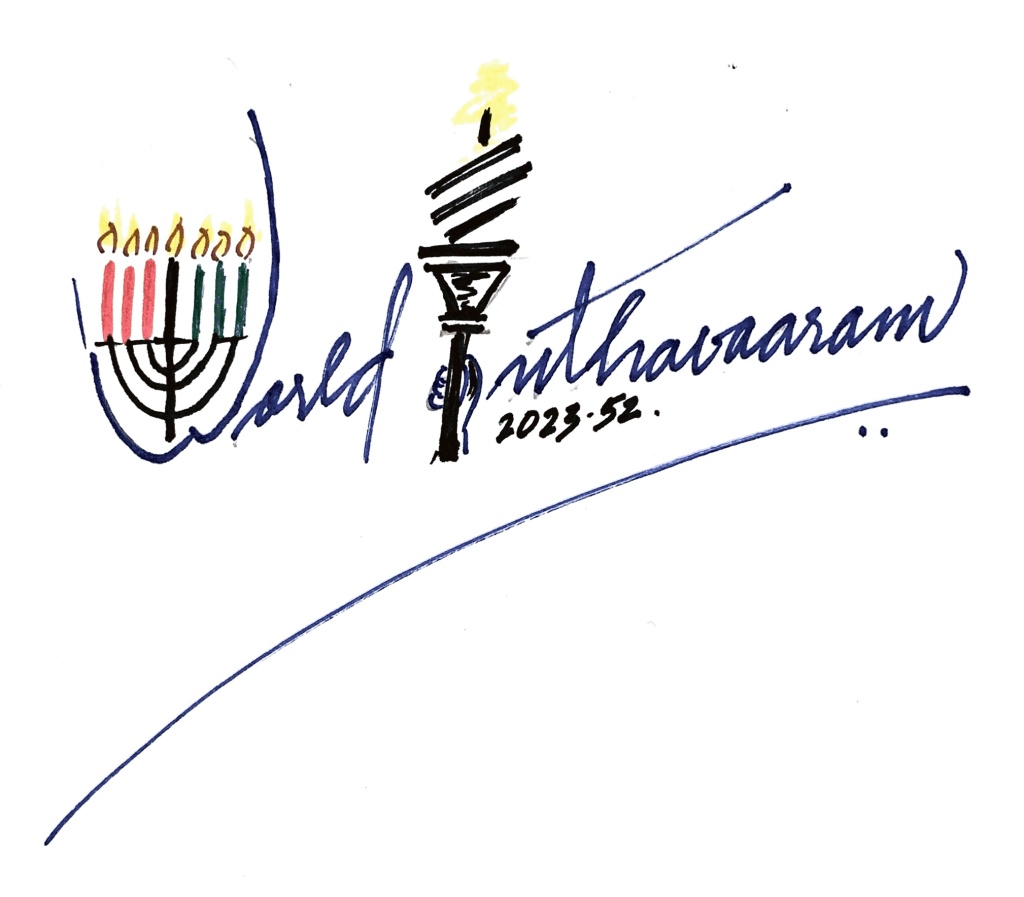
WORLD INTHAVAARAM, 2023-52

About: the world this week, 24 December to 31 December 2023; War & No Peace; Argentina; Zombie Deer Disease; a Captain departs; and celebrating Kwanzaa.

Everywhere

War & No Peace

This week, Egypt floated an ambitious plan to end the Israel-Hamas war. The plan called for a phased release of the hostages held by Hamas and the formation of a Palestinian ‘Government of Experts’ to administer the Gaza Strip and the West Bank. Egypt and Qatar would work with all Palestinian factions, including Hamas and the Palestinian Authority, to agree on the establishment of such a government. And this government would rule Gaza and the West Bank for a transitional period, while the Palestinian factions work towards holding presidential and parliamentary elections.

Israel and Hamas gave cool public receptions to the proposal. But stopped short of rejecting the plan altogether, raising the possibility of a new round of diplomacy.

The Egyptian proposal does not measure up to Israel’s declared goal of crushing Hamas to the bone. It also appears to be at odds with Israel’s insistence on maintaining military control over Gaza for an extended period, after the war. The rising death toll of Israeli soldiers during the ground operation also threatens to undermine public support for the war. More than 160 Israeli soldiers have been killed thus far.

Meanwhile, the terrorist Hamas continued with what it does best: launching a barrage of rockets, this time into the southern city of Ashkelon, Israel. Most of them were intercepted by Israel’s rocket defence system. Israel, on its part, expanded ground operations to the central part of Gaza. And almost every day kept discovering massive tunnel networks beneath Hospitals and Schools, used by Hamas to carry out terror activities against Israel. Most of them were promptly destroyed.

The other war, the Russia-Ukraine War, is only getting older, with no end in sight. There were some mumblings by Russia about leaning towards holding talks for a cease-fire. But it did not gain traction.

This week, Ukraine struck a large Russian landing warship, Novocherkassk, in Crimea, with cruise missiles in an overnight attack that killed at least one person, and could hinder any Russian attempt to seize more Ukrainian territory along the Black Sea coast. Russia admitted that the large landing ship was extensively damaged. Satellite pictures showed the ship partially submerged alongside its pier. Then, in a revenge act, Russia launched its biggest air-attack on Ukraine since the beginning of the full-scale invasion, using about 158 drones and missiles to strike targets in Ukraine’s capital, Kyiv.

If only these two wars would come to an end, the World would ‘appear’ more peaceful!

Argentina Rises

Argentina’s newly inaugurated President Javier Milei, is going great guns flashing his deadly uncombed hair-locks. He has brought-in sensible laws in what promises to be a shock & awe presidency. He had prohibited governmental institutions from using the word ‘free’ to promote any state service. Milei considers the use of the word ‘free’ a lie and feels citizens should not be lied to, since the service is always paid by someone, typically tax-payer money.

Then he has proposed a new law, that Argentina presently does not have, which affirms a right to self-defence. This would apply when someone tries to cause bodily harm to another person or where they try to invade his property. It also affirms that if the attacker dies in the process, their relatives cannot sue over the fact of defending oneself.

Oh Deer!

Since the Covid-19 saga, we are not done with the list of possible outbreaks of new diseases: the spillover from animals to humans. Joining this ever-growing list is ‘Chronic Wasting Disease’ (CWD), sometimes referred to as ‘Zombie Deer Disease’ which mainly affects free-ranging deer, elk, and moose. The affected deer is often called ‘Zombie Deer’ due to the neurological signs of the disease, which are, weight loss, lack of coordination, listlessness, and drooling. Although there have been no infections in humans, scientists are warning that the disease is a ‘slow-moving disaster’ for humans. And it is more transmissible to humans from animals – say Deer – than was previously thought.

CWD can have an incubation period of over a year, and signs of the disease may develop slowly. Scientists believe the disease spreads through contact with contaminated body fluids and tissue, or through the environment, including drinking water, and food.

Recall, ‘The Mad Cow Disease’ outbreak in Britain provided an example of how, overnight, things can get crazy when a spillover event happens from livestock to people.

Beware of Deer crossings!

A Captain Departs

This week, on 28th December, Tamil Actor and Politician, Vijayakanth passed away at age 71 due to pneumonia and Covid-19 complications. Over the past 4 years, he has been in and out of hospital on prolonged illness. In 2017, he had undergone an organ transplant. In June 2022, his toes were amputated following prolonged diabetes. In recent times, he had difficulty in walking and speaking, and if at all, his speech was often incoherent due to a liver ailment and a paralytic stroke. He is said to have a drinking problem. In early November of this year, he was admitted to a Hospital in Chennai and then again in December, finally succumbing to Covid-19.

Vijayakanth who started his film career as a ‘poor man’s Rajinikant’, was popularly known as ‘Captain’, ‘Karuppu MGR’ (dark MGR- because of his dark complexion) Puratchi Kalaignar (revolutionary artist).

Vijayakanth is one of very few Tamil actors to have stuck himself only to Tamil films – 154 of them – throughout a career spanning over three decades. Most of his films revolved around corruption, honesty, and honouring promises; playing the role of a patriotic, village do-gooder, and dual-role acting. He has played the highest number of roles by an actor-20 times-as a Police Officer.

He was best known for low-budget films that showcased gravity-defying stunts in which he would single-handedly beat his enemies to pulp. And he had a trademark ‘evil back-kick’, which he used to disastrous effects on villains. In the song & dance sequences, typical of Tamil films, his dance moves and gestures were a mimic’s delight.

Vijayakanth was the President of the South Indian Film Artistes’ Association between 2000 and 2006 during which time he achieved the remarkable feat of clearing all debts of the Association, by organising Celebrity Shows abroad. Until then, the Association was completely in the red.

Vijayakanth is known to have a heart of gold, always ready to answer a cry for help, with a natural philanthropic bend of mind. He was regarded as one of the most diligent actors of his era, even doing three shifts a day and working on multiple projects simultaneously to make sure none of his projects got canceled and his Producers did not lose sleep. He would claim his salary only after the success of his movies and often agreed to take a pay-cut if the movies didn’t perform well at the Box Office. Vijayakanth never charged for cameo appearances or supporting roles in some of his friends’ movies.

Some of his biggest movie hits were, Vaidehi Kaathirundal, in 1984; Amman Koil Kizhakkaale, in 1986; Pulan Visaaranai, and Chatriyan, in 1990; Chinna Gounder, in 1991; Sendhoorapandi, in 1993; Ramana, in 2002.

Then in the year 2005, he decided to kick himself out of cinema before the movie-goers did. And in September that year he founded a political party called the Desiya Murpokku Dravida Kazhagam (DMDK) in Madurai, as an alternative to the two Dravidian parties of, the Dravida Munnetra Kazhagam (DMK), and the All India Anna Dravida Munnetra Kazhagam (AIADMK), who between them, ruled the State for decades. He worked as the DMDK’s founder President until the time of his death. He was elected as a Member of the Legislative Assembly (MLA) twice from Virudhachalam, and Rishivandiyam.

Vijayakanth aimed to become Chief Minister one day, but the closest he could get was, Leader of Opposition in the Tamil Nadu Assembly, within six years of launching his party: the only actor-turned-Politician in Tamil Nadu to have achieved such a feat!

The DMDK made its electoral debut in the 2006 Tamil Nadu Legislative Assembly elections. The party contested independently and managed to win a significant number of seats, establishing itself as a force to reckon with. In the 2011 Tamil Nadu Legislative Assembly elections, the DMDK scripted history, winning more seats than the DMK and emerged as the principal Opposition Party that year. He had formed an alliance with the AIADMK contesting in 41 constituencies. His party saw stunning success, winning 29 seats. Vijayakanth himself became a MLA for the second time.

Vijayakanth did not have the cinematic charisma of MGR, or even, for that matter, of his own contemporary Rajinikanth, who has flirted with politics over the years, without ever joining a particular party and gave-up on the brink of starting one. Nevertheless, the DMDK debuted in the 2006 assembly election with an impressive vote share of around 8% and followed it up with a 10% share in the 2009 Lok Sabha election. Both results made observers sit up and take notice. But it has been a downslide since then.

Vijayakanth was born, Narayanan Vijayaraj Alagarswami, on 25 August 1952 Madurai, Tamilnadu. He and was one among four children of K N Alagarswami and Aandal. When he was an year old, his mother Andal passed away. With many children to take-care of, his Father was forced to re-marry, and thereafter had seven more children from his second wife. That’s a count of 10 siblings. And sibling rivalry was not heard of in the Captain’s family.

Vijayakanth studied up to Class 11 after which he quit School to look after his father’s rice-mill business. During this time he collaborated with a friend to take-up Film Distribution, which probably spawned a desire to become an Actor. He refused to heed to his father’s advice to continue running the family’s rice mill, and instead packed-up to sail to Chennai to try his hand in tinsel world.

After initial rejections and a struggle, mainly because of his poor dialogue delivery, in the year 1979, he was booked in his first film ‘Inikkum Ilamai’ (sweet youth), where he debuted as a villain. It failed at the box-office. After this, he acted in three other films, which did not bring noteworthy success. Then in 1981, he got a breakthrough hit in the film ‘Sattam Oru Iruttarai’ (the law is a dark room), which became a blockbuster success. It was later made in Hindi with his ‘richer version’, Rajinikant playing his role and Amitabh Bachchan doing a cameo, along with Hema Malini. This propelled him to fabulous movie hits, and the offers came in a flood.

Vijayakanth’s 100th film, in the year 1991, earned him the sobriquet ‘Captain’ after he portrayed an upright Indian Forest Officer sent on a mission to nab an elusive forest brigand complicit with a corrupt administration. After the yesteryear Tamil filmdom stalwarts of M G Ramachandran (MGR), Sivaji Ganesan, and Jayalalithaa, he was the only actor to have achieved a silver jubilee hit in his 100th film.

Meanwhile in the world of Politics, Vijayakanth’s public conduct has not left him with a very flattering image. Talks about a drinking problem have surfaced repeatedly and he was extensively criticised for getting drunk during public meetings. His wife has denied the drinking problem and even threw a challenge for tests to be done on him. His explosive and unclear speeches and ‘red eyes’ were hard to decipher causing confusion. He has also gotten into squabbles and brawls with his own party members and the media, many of which have been caught on video and circulated widely online. Apart from this, he was irregular in his attendance of legislative assembly proceedings in the decade or so that he was in politics. Increasingly, over the years, he was seen as a comic figure rather than a serious political player. Maybe he squandered an opportunity to captain Tamil Nadu?

He leaves behind his wife Premalatha, who he married in 1990, and two sons Shanmuga Pandian and Vijaya Prabhakar Alagarswami. A week ago Premalatha was made the General Secretary of the Party, maybe foretelling the Captain’s end was near. She, along with her brother, L K Sudheesh, have been steering the DMDK during the illness of the Captain. The ‘Captain Group’ runs TV Channels in the name, owns an Engineering College, among other businesses.

Whatever, Vijayakanth leaves behind a rich, colourful legacy, and perhaps there will be none like him.

Kwanzaa

Kwanzaa is an African American-Pan-African holiday created in 1966 by Africana Studies Professor Maulana Ron Karenga. His goal was to give Black people an alternative to the existing holidays; give them the opportunity to celebrate themselves and their history, rather than simply imitate the practices of the dominant society.

All the concepts of the holiday are traditionally expressed in Swahili, which is where the meaning of ‘Kwanzaa’ is derived from: ‘matunda ya kwanza’ which means first fruits. President Bill Clinton was the first US President to recognise it as a holiday.

Kwanzaa follows seven principles. When you see the table set in a Kwanzaa-celebrating home, you’ll notice a Kinara – a candle holder carrying three red candles on the left, one black candle in the middle, and three green candles on the right. Those candles are lit one by one, starting with the black one, as the seven days of Kwanzaa progress and each of them represent the seven principles of the holiday: Umoja (unity), Kujichagulia (self-determination), Ujima (collective work and responsibility), Ujamaa (cooperative economics), Nia (purpose), Kuumba (creativity), and Imani (faith).

Families do a number of things to celebrate the holiday, from creating art, donning African garments, attending festivals, or giving gifts. However, the biggest component to Kwanzaa festivities is the food. You can always count on a special meal being made while incorporating the flavours of Southern Caribbean, South American, and African dishes.

No person of any specific religion chooses to celebrate Kwanzaa. It’s not about religion. It’s more about Black people embracing one another, the rich culture they’ve created and the roots from which it comes from, as well as uplifting one another to learn and grow into the best ‘black-beauty’ version of themselves.

One more reason to celebrate. Strive to create a new and better version of yourself. Seasons Greetings, Happy Holidays, and Happy New Year 2024.

More new stories in the New Year. Celebrate with World Inthavaaram.

WORLD INTHAVAARAM, 2023-51

About: the world this week, 17 December to 23 December 2023; Israel and Hamas; Shooting in Prague, Czechia; Earthquake in China; the Pope and LGBTQIA; Parliament shakes in India; Floods in Southern India; and the Coronavirus and Kerala.

Everywhere

Israel-Hamas War

Late last week, in a tragic accident, Israel admitted mistakenly killing three hostages during a search and rescue operation.

An Israeli soldier stationed in a building in Gaza City’s Shejaiya neighbourhood, identified three suspicious people exiting the building several dozen meters away. All three were shirtless, with one of them carrying a stick with a makeshift white flag. The soldier, who believed the men moving toward him was an attempt by Hamas to lure Israeli soldiers into a trap, immediately opened fire and shouted “terrorists!” to the other forces. The hostages either managed to escape Hamas captivity or were abandoned, before they were mistakenly shot dead.

This is in the tense background of the Israel Defence Forces (IDF) having encountered several, seemingly unarmed civilians in the area, who turned out to be Hamas suicide bombers. There have also been countess attempts by Hamas to trick soldiers into an ambush. This is an awfully difficult and unforgiving war.

Over the week, Israel offered the Terrorist Hamas a deal, “Release 40 hostages – the old, woman, and children – and we stop bombing for a week”. Hamas did not take it.

Shooting in the Czech Republic

This week on the 21st December, in the deadliest attack in modern Czech history a gunman shot dead 14 people and injured another 25 at Prague’s Charles University.

The shooting started at the Faculty of Arts building, on Jan Palach Square. The gunman, who was studying Polish history at Charles University, murdered his father before shooting his classmates in a killing spree, and in the end possibly killed himself, after being shot-at by the Police. The motives were not immediately known.

The Police, who discovered a large arsenal of weapons at the building where the shooting took place, were tipped off earlier in the day that the suspect was likely heading to Prague from his town in the Kladno region, outside the capital, with intentions of taking his own life.

The gunman later identified as David Kozak had a gun permit and owned several weapons. He is also suspected of killing a man and his four-month-old daughter in Prague, a week ago. Police are also probing any connection between Kozak and a series of Russian-language messages posted on Telegram. One of the messages indicated that the attack may have been influenced by two previous mass shootings in Russia: one this month at a school in Bryansk near the Ukraine border, and the other in 2021 in Kazan. David Kozak was an excellent student and had not criminal history.

The Czech Republic has relatively liberal gun laws compared to the rest of Europe. To obtain a gun legally, a person needs an official licence, which requires a medical examination, a weapon proficiency exam, and no previous criminal record.

Charles University in Prague, founded in 1347 is the oldest and largest University in the Czech Republic -Czechia – and one of the oldest institutions in Europe.

Bless LGBTQIA

This week, Pope Francis relaxed controls, making the Church a little more LGBTQIA (Lesbian, Gay, Bisexual, Transgender, Queer, Intersex, and Asexual) friendly. He is allowing Priests to bless same-sex couples. This is a forward-looking step, and a walk back on a 2021 Vatican Ruling that banned blessing Gay couples, because ‘God cannot bless sin’. However, reading the fine print, the new rule clarifies that a blessing, which is typically, a prayer, should not be given at a Gay Wedding or Civil Ceremony. It also reaffirmed that marriage is between man and woman.

China’s Earthquake

A powerful 6.2 magnitude earthquake struck a mountainous region in northwestern China, resulting in at least 127 deaths and over 700 injuries, making it the deadliest earthquake in the area in nine years. Gansu province is severely affected, along with the neighbouring Qinghai province.

The affected area in Qinghai province is adjacent to the Tibet Himalayan region, prone to frequent earthquakes because of continental plate shifts.

Preliminary analysis shows that the quake was a thrust-type rupture, one of three above magnitude 6 to have struck within 200 km of the epicentre since 1900. At least 32 aftershocks were reported in the hour after the quake hit.

Infrastructure was severely impacted, leading to power and water supply disruptions, damage to rural roads, railway lines, and the cracking of a bridge across the Yellow River.

India’s Parliament: A Tumultuous Week

This week India’s Opposition Parties created a ruckus in Parliament, displaying placards, shouting, disruption the proceedings, and not allowing Parliament to function – all against the rules. They were demanding a statement from the Home Minister on last week’s ‘Smoke in The Eyes’ security breach, which was not forthcoming. This forced the Speaker of the Lok Sabha, and the Chairman of the Rajya Sabha, respectively, to take punitive action on the errant Members of Parliament (MP) by suspending them.

The string of suspension of Opposition MPs in the Lok Sabha and Rajya Sabha grew to a mammoth total of 146 – a first-time record. That’s almost two-third of the Opposition kicked-out of Parliament, for bad behaviour.

To make matters worse, the suspended MPs sitting on the steps of the Parliament premises got into a ‘College-Times Strike’ mode. They were entertained by one of the MPs mimicking and mocking the Vice-President (VP) of India, who is also the Chairman of the Rajya Sabha. The VP called it an insult on his background as a farmer and Chairman. Another MP was seen nonchalantly filming the episode on his mobile. This created a huge social-media storm that drowned other news, for days.

Meanwhile, the Government cooly went about its law-making business, slipping in path-breaking new Laws to replace the British-era colonial laws. And got them passed, ‘without breaking into a sweat’, in both Houses.

New criminal law reforms, replacing the old are: The Bharatiya Nyaya Sanhita Bill (BNSS) replaces the Indian Penal Code,1860; the Bharatiya Sakshya Bill (BSS) replaces the Indian Evidence Act, 1872; and the Bharatiya Nagarik Suraksha Sanhita Bill (BNSSS) replaces the Code of Criminal Procedure, 1898.

With these changes, the criminal justice system of India is significantly reframed, finally growing out of a colonial mindset. The old laws were centred around punishment and deterrence: the new bills shift the emphasis to justice and reformation, in keeping with the changes of modern-day India.

Some highlights of the new Laws:

Twenty new offences have been included in the BNSS. These include organised crime, terrorist acts, hit-and-run, mob lynching, sexual exploitation of a woman by deceitful means, snatching, abetment outside India, acts endangering the sovereignty, integrity, and unity of India, and publication of false or fake news.

In a first, the government has included ‘community service’ as a punishment for theft of less than INR 5,000 and five other petty offences. Adultery and homosexual sex are not listed as crimes. Attempting to commit suicide will no longer be considered a criminal offence.

The sedition law has been repealed, and the sedition provision has been redefined to contain actions against India-deshdroh– instead of actions against the Government-rajdroh. One is free to criticise the Government, but not say anything to demean the nation.

Police will have to register a First Information Report (FIR) within 3 days of the complaint and in cases involving a punishment of 3 to 7 years, the FIR is to be registered after preliminary investigation. Chargesheets will have to be filed in 180 days and the Magistrate will have to take cognisance within 14 days. Forensic science has been given a lot of importance in evidenced gathering, as is electronic evidence.

The Government said that it had received a total of 3200 suggestions from 18 States, 6 Union Territories, the Supreme Court of India, 16 High Courts, 27 Judicial academics, several MPs, and bureaucrats, in the mammoth exercise to make the new laws. And 158 meetings were held to consider the suggestions.

Also passed was the Telecommunication Bill 2023, replacing the 138-year-old colonial-era Telegraph Act, 1885, and other allied laws.

The Govt will allocate spectrum for telecommunications through the Auction Method and for Satellite communications through an Administrative Method. Companies will require an authorisation to start services instead of Licences that are issued at present. It is mandatory to issue SIMs after capturing verifiable biometric data of the applicant to prevent misuse. Obtaining a SIM or any other telecom resource through fraud, cheating, personation will entail a jail term up to three years or a fine upto INR 50 Lakhs per person.

India’s Down South Floods

The South Indian State of Tamil Nadu is having a tough time. Cyclone Michaung had unleashed mayhem in Chennai more than a week ago and just when the State was limping back to normalcy it was hit by the rains again – this time in the southern districts.

Unprecedented rains caused by a cyclonic circulation in the Bay of Bengal battered the districts of Tirunelveli, Tuticorin, Tenkasi, and Kanyakumari, inundating roads, flooding houses, affecting train services, and leaving authorities scrambling to rescue those stranded. Helicopters in the air, and boats on the water were pressed into service.

Tamil Nadu received almost 50 mm of rainfall between this Sunday and Monday, compared with the 2.50 mm that would be normal at this time of year. Kayalpattinam in Tuticorin received more than 95 cm in 24 hours, which sank the Town. Tuticorin City grappled with about 5 feet of water. More than 10,000 people had to be rescued. About 150 people have died, succumbing to the fury of the floods.

Entire neighbourhoods remained submerged, with houses appearing like lonely islands surrounded by murky, brown water. Lakes were overflowing and rivers were in spate. Towards the end of the week, the waters began receding, slowly.

There is this heart-warming story of a Train, which left Tiruchendur Station on Sunday at about 8.30 pm bound for Chennai. About 34 km into the journey it was stopped at Srivaikuntam Station by alert Railway Staff, when it began raining heavily, following a cloud burst. The Railways decided not to allow the train to go any further, which proved to be a wise decision. The rains then intensified and subsequently it was found that about 12 km of track was washed-away due to land eroded by the rains, in the route ahead of the Station. The Station itself was completely isolated as a water island after about 300 passengers had been evacuated. The remaining had to stay put in the Train as the escape route was cut-off. And the Railway Station staff did their darnest until help came, only after the waters receded. Food was dropped-in by Helicopters. Imagine, about 1000 lives would have been lost that day, if it weren’t for the Railway Men. Cheers to them.

Questions on better preparedness and early warning are being asked and hope to see a flood of improvements next time around.

COVID-19 Again, and Kerala

The SARS.CoV-2 coronavirus is on the prowl again, growing its family and trying to spike our lives. Reminds us that the virus continues to evolve in different ways.

This week, what is called the JN.1 variant of the coronavirus was detected in India for the first time.

The JN.1 is a descendant sub-lineage of BA.2.86 or Pirola sub-variant of Omicron, and carries an additional mutation on its spike protein. After Kerala, the JN.1 was found in Goa, then Maharashtra, Karnataka, and in some other States. A total of over 595 Covid-19 cases have been reported.

The JN.1 was first detected in Luxembourg in August this year and later reported in The United Kingdom, Iceland, France, and the United States.

JN.1 was previously classified a Variant of Interest as part of its parent lineage BA.2.86, but the World Health Organization (WHO) has now classified it as a separate Variant of Interest. Talk about a grown-up leaving the parents’ home, fully armed to take-on the World?

WHO said current vaccines will continue to protect against severe disease and death from JN.1 and other circulating variants of the COVID-19 virus. And it is best to continue to hold on to the masking and hand-washing techniques, learnt and executed so well.

Often, the State of Kerala is the first to detect a disease outbreak, wondered why?

Kerala recorded India’s first JN.1 Covid sub-variant in a 79 years old woman at the beginning of this month. Earlier, the State also recorded the first cases of Nipah virus, Monkeypox, and other diseases. There are many other reasons as to why Kerala is the first to record diseases and subsequently becoming a hotbed of them.

Kerala’s geography contributes to the frequency with its sizeable forest cover and intense monsoon pattern making it prone to outbreaks. The State has witnessed several zoonotic outbreaks owing to the shrinkage of natural habitats and proximity to human settlements, in a densely populated region. Take for example, the Nipah virus: a special investigation found that humanity’s drive for resources is destroying the wildlife habitat of bats – which carry tens of thousands of viruses – and creating conditions ripe for a bat-borne disease to spill over to humanity. Civet cats have almost become urban animals as their natural habitats have been wiped out. These animals are believed to be the mediators for the pathogen that caused Severe Acute Respiratory Syndrome (SARS). Bats, which lost their natural habitats, moved into human habitations. These animals are now considered as the reservoirs of Nipah and Ebola virus.

Another reason for Kerala being the home of such diseases is the State’s population. People of Kerala are spread across the globe, with a large number of students studying medicine and many expatriates working as doctors or nurses around the world. They face the occupational hazard of viral attacks and may unwittingly spread undiagnosed diseases to others when they return to India.

There’s also the State’s management and health system. The State has rigourous testing and its population is also highly aware. For e.g., when the first case of monkeypox was reported from Kollam in Kerala, the concerned person who returned from the United Arab Emirates (UAE) underwent a test. This, after he learnt that his contact abroad had tested positive, even though he was asymptomatic.

Many a time, Kerala has been criticised for reporting an outbreak. Experts say that should not be done. Its active surveillance mechanism, capacity-building exercises for healthcare workers, frontline staff, community engagement and strategic interventions have not just been helpful in detecting viruses, but also in keeping the disease outbreaks in control.

It is left to be seen if COVID-19 does make a strong comeback in the State, but Kerala is known for handling outbreaks and, in fact, virologists and epidemiologists have hailed its robust surveillance.

More stories will rain in the weeks ahead. Hold on to World Inthavaaram.

WORLD INTHAVAARAM, 2023-50

About: the world this week, 10 December to 16 December 2023; the United Nations tries for a cease-fire; India’s new State Chief Ministers; Jammu & Kashmir; and smoke in India’s Parliament.

Everywhere

The United Nations, Israel, and America

Late last week, the United Nations (UN) Security Council met to discuss and pass an immediate, cease-fire Resolution in the ongoing Israel-Hamas War. The Security Council consists of 5 permanent members, and 10 non-permanent (elected for a two-year term by the UN’s General Assembly) members. Only the permanent members have a veto, and for a resolution to be adopted all permanent members must vote in agreement. And a Resolution passed by the Security Council is binding.

The meeting was convened after UN Secretary-General Antonio Guterres invoked Article 99 of the UN Charter which says, he may bring to the attention of the Security Council any matter which in his opinion may threaten the maintenance of international peace and security.

The Security Council failed to adopt the cease-fire Resolution, put forward by the United Arab Emirates, due to a veto by the United States, following a debate earlier in the day. Thirteen Security Council members voted in favour while the United Kingdom abstained.

The US told the UN Security Council: “We do not support this resolution’s call for an unsustainable ceasefire that will only plant the seeds for the next war.”

The US and Israel opposed the ceasefire, saying it would only benefit Hamas, which Israel has vowed to annihilate in response to the deadly 7th October cross-border massacre of Israeli civilians.

Later, the United Nations, while still trying to build a consensus, adopted a non-binding resolution in the General Assembly: 153 votes for to 10 against, with 23 abstentions, to demand a ceasefire in Gaza. The same vote in October had got 120 for, 12 against, and 45 abstentions.

More than 17,700 Palestinians have been killed during the latest Israel-Hamas war. And as humanitarian concerns continue to rise, Israel and Hamas do not appear any closer to resolving the conflict than they were at the start.

Meanwhile, in America, over last weekend, University of Pennsylvania (Upenn) President, Liz Magill resigned. It comes almost a week after she, along with the Presidents of Harvard and Massachusetts Institute of Technology (MIT), participated in a congressional hearing on antisemitism on college campuses. And was unable to confirm that, ‘calling for the genocide of Jews’ would violate University policies on bullying or harassment. Harvard has said its President will not step-down, on account of this testimony. MIT is still thinking.

India’s New State Chief Ministers

This week, India’s ruling Bharatiya Janata Party (BJP) rolled-out its choice of Chief Ministers (CM) for the three States it overwhelmingly won when votes were counted and results declared last week.

In the State of Chhattisgarh, the BJP picked Vishnu Deo Sai, 59, a prominent tribal leader, as the next CM: he was elected as leader of the BJP’s legislative party. Sai comes from a family of former Jan Sangh -a precursor to the BJP- leaders, where two elder brothers of his father were MLAs (Member of Legislative Assembly). He started his political career as a village Sarpanch and rose to become Union Minister – Minister of State Steel & Mines – in an earlier BJP Government. He is a four-time Lok Sabha Member of Parliament (MP) and also the Chhattisgarh BJP President for about 4 years.

In the State of Madhya Pradesh, the BJP chose Mohan Yadav, 48, the Ujjain South MLA, as Chief Minister. The BJP legislature party elected him to replace Shivraj Singh Chouhan, the four-time outgoing CM. Mohan is a three-time MLA and worked as the Higher Education Minister in the outgoing Government. The party also named two Deputy Chief Ministers, Jagdish Devda, and Rajendra Shukla – the first time the State has such a combination.

Then, as if two surprises weren’t enough, the BJP came-up with a third: choosing first-time MLA, Bhajan Lal Sharma, 55, as Rajasthan’s next Chief Minister, ending days of speculation.

Bhajan Lal worked as the General Secretary of the BJP Rajasthan Unit, for four consecutive terms. In the year 2003, he contested the Assembly Elections for the first time from Nadbhai, Rajasthan. However, he finished fifth and lost his deposit with a vote share of 6.28%. This time, he won from the Sanganer Constituency. Diya Kumari, a member of the Jaipur royal family, and Prem Chand Bairwa were added as Deputy Chief Ministers in Rajasthan – in this surprising new CM + 2 Deputies ‘combo-offer’ of the BJP.

Jammu & Kashmir

The State of Jammu & Kashmir (J&K) has a deep troubled history going back to the time of India’s independence. In August 1947, the British partitioned India into the present-day India, and Pakistan, on religious lines – Hindu and Muslim respectively – before handing over governance and leaving. Freedom, it was, from colonial rule of 89 years, which began in the year 1858.

India, at that time, consisted of 562 Princely States, which had to be brought under the Indian Union by signing an Instrument of Accession-voluntarily, by a polite nudge, tough coercion, or even brute force. It was a Himalayan task successfully and deftly accomplished by the unforgettable ‘Iron Man of India’, Sardar Vallabhbhai Patel, and his Home Ministry team.

The State of Jammu & Kashmir had a majority Muslim population and was ruled by a Hindu King, Maharaja Hari Singh. There was a tussle between India and Pakistan for possession of this State, and finally, after initial dithering, the Maharaja signed the Instrument of Accession to India on 26 October 1947-making it a part of India. The Maharaja was hesitant to join any side, had ‘independent’ ideas, and signed only after Pashtun tribals, aided by Pakistan, invaded J&K and India agreed to help on the condition of accession. The Schedule appended to the Instrument of Accession clearly gave the Indian Parliament power to legislate for J&K on only three subjects – defence, external affairs, and communications.

Later, when the Constitution of India was written and came into force on 26 January 1950, Jammu & Kashmir was mostly exempted from the Indian Constitution – by Article 370, which was a ‘temporary provision’ that provided special status to the State.

J&K was allowed a Constituent Assembly for framing its constitution and restricting the legislative authority of the Indian Parliament. And the future of the State was to be determined by a ‘reference to the people’. Temporary also meant that except Article 1, which declared India as a ‘Union of States’, and Article 370 itself, no part of the Indian Constitution would apply to J&K. Article 370 itself could not be amended or repealed—unless the Constituent Assembly of Jammu & Kashmir consented.

After a five-year process, on 17th November 1956, the Constitution of J&K was made and adopted with a declaration: ‘The State of Jammu and Kashmir is and shall be an integral part of the Union of India’. On the same day, having completed its task, the Constituent Assembly of J&K dissolved itself.

Over the years there was unusual, persisting violence in J&K, mostly ‘angry’ Pakistan sponsored terrorism from across the border and supported by parties inside J&K, enjoying the special status. And a portion of J&K was occupied by Pakistan-Pakistan Occupied Kashmir(POK)-which India could not get back despite a War. India had to settle with a ‘temporary’, Line Of Control (LOC) drawn by the United Nations, which was called to resolve. The UN also passed a Resolution that Pakistan must vacate POK, which was never implemented. The Indian Army had a permanent presence in the State due to the volatile situation.

The present Indian Government embarked on a mission to get the bits and pieces of J&K’s history together. It had to navigate a minefield of officialese in documentation and interpretation, to fully integrate it with India, and pushed hard for a solution, culminating in Jammu & Kashmir’s complete integration with India in 2019. And its actions were legally approved by the highest court of India, this week, this year.

On 5 August 2019, the Government revoked the 70-year-old special status, or autonomy, granted to J&K under Article 370, bringing it into the fold of mainstream India, just like any other State. Jammu & Kashmir no longer has its own Constitution, flag, or anthem, or its people provided dual citizenship, as a result of the repeal of Article 370. J&K now abides by all legislation made by India’s Parliament. This was a decisive action by the Government, which no other Government attempted, or could not do, since India’s Independence.

On 6 August 2019, The President of India formally issued an order under the power of Article 370, overriding prevailing Orders and nullifying all the provisions of autonomy granted to J&K. The Home Minister introduced a Reorganisation Bill in Parliament, to divide J&K into two union territories to be governed by a Lieutenant Governor and a unicameral legislature. The resolution seeking the abrogation of Article 370 and the bill for the state’s reorganisation was debated and passed by both Houses of Parliament -Rajya Sabha, the upper house, and the Lok Sabha, the lower house – in August 2019. The original State of Jammu & Kashmir was divided into two Union Territories: Jammu & Kashmir, and Ladakh. That is how it stays today.

The Government’s decision was challenged by Parties opposed to the abrogation of Article 370 and the bifurcation of J&K, in the Supreme Court (SC) of India. This week, the SC, after hearing arguments, pronounced its verdict – a historic one – to complete the last remaining unfinished business of partition and legalise the Government’s actions. There is no going back.

The SC unanimously upheld the Government’s 2019 decisions to scrap the special status for Jammu & Kashmir under Article 370, and also approved bi-furcation of J&K. The question of relegating J&K to the status of a Union Territory was left for another discussion, as the Centre has promised to restore its statehood as soon as possible.

The five-judge Constitution bench headed by Chief Justice DY Chandrachud held that the President’s exercise of power under Article 370(3) to abrogate this Article was not mala-fide; that Article 370 was meant for constitutional integration and not for the disintegration of J&K with the Union of India; that the Article was temporary in nature, and that there was no need to hold consultations or collaborate with the elected Government of J&K before ceasing its operation; and that J&K didn’t retain any element of sovereignty when it joined the Union of India.

I’m glad the Supreme Court approached the complex issue in a clear Top-Down manner: Jammu & Kashmir is an integral part of India – last words by its now dead Constituent Assembly. All other word-play, Articles, procedural aspects, and other angles, in which this could have been done, does not matter, and at best is a subject of academic discussion.

Smoke in the Eyes

It was on 13 December 2001, when India’s Parliament came under a sudden and unexpected terrorist attack. Five armed terrorists drove their vehicle into the Parliament premises and began shooting, resulting in the deaths of six Delhi Police personnel, two Parliament Security Service personnel, and a gardener. All the five terrorists were killed by security forces. No lawmakers were hurt.

This year, on 13th December, on the 22nd anniversary of the 2001 Parliament Attack, the New Delhi weather was getting awfully cold with the onset of winter. And Parliament was in session in a spanking new Parliament building, with state-of-the-art infrastructure and security. It was a business as usual day. All was quiet on the Parliament front.

Then suddenly inside Parliament two people jumped into the well of the Lok Sabha from the Visitors Gallery, armed with yellow coloured smoke canisters, which they set-off. Meanwhile, outside Parliament two others began chanting slogans after releasing red coloured smoke from similar canisters. The canisters used were over-the-counter colour smoke release canisters, often used in Indian festivals.

The two – one could be seen monkey jumping over the desks – inside were quickly subdued, bashed-up, and manhandled by muscular Members of Parliament and handed over to the Security staff. The two outside were promptly arrested and led away by Police.

The stunning breach of an iron-clad Parliament security system took some time to sink-in, even while the yellow smoke, inside, and the red smoke, outside, settled down and dissolved in the much polluted New Delhi air.

The investigations began at a fantastic speed and the Police began knocking doors across the country. It came to light that an almost pan-India Facebook Group called the ‘Bhagat Singh Fan Club’ had been working on the plan for about a year, timed with the anniversary of Parliament Attack. And the plan to breach parliament security began with obtaining Parliament Visitors Passes – in this instance issued by the ruling BJP’s Member of Parliament from Mysuru, Karnataka. Looks like the motive of the Group was to highlight the unemployment problem in the country, inspired by Bhagat Singh and Che Guevara. At lease one of the Group had done a recce during the Budget Session of Parliament, when they learnt that security personnel did not not ask visitors to take off their shoes or check them. The smoke canisters were cleverly hidden in specially-made thick-soled shoes.

The members of the Group: Manoranjan from Mysuru, Sagar Sharma from Lucknow, Neelam Azad from Haryana, Amol Shinde from Maharashtra, and the believed-to-be kingpin Lalit Jha, a Teacher from Bihar, arrived in Delhi by separate means, and were hosted by one of their associates, Vikram and his wife, in Gurugram, early in the week. On the day of the episode, Sagar collected the passes from the MP’s Office and the Group – except Vikram – met at India Gate. Amol handed over one canister to each member. All of them then deposited their mobiles with Lalit Jha, before the intrusion. He fled the Parliament area soon after, when a man-hunt was launched to nab him.

In the middle of the week, Lalit Jha was arrested after he turned himself in at Kartavya Path, New Delhi, accompanied by another key suspect, Mahesh Kumawat.

The array of slogans bellowed by the Group, Bharat Mata Ki Jai (Long live mother India), Jai Bheem (Victory to Ambedkar), Tanashahi Nahin Chalegi (Dictatorship does not work), have been battle cries of diverse groups who have been often at odds with each other. And the slogans do not follow any particular pattern. Details are awaited on the actual motive and the real persons behind the Group.

The sensational episode has exposed loop-holes in what is claimed to be one of the strongest security arrangements in the country. Whatever, this should serve as yet another wake-up call for security agencies.

More sensational stories coming-up in the weeks ahead. Keep the smoke out of your eyes and stay with World Inthavaaram.

WORLD INTHAVAARAM, 2023-49

About: the world this week, 3 December to 9 December 2023; Depends on context antisemitism; Ukrainian Sniper; new Woman Chess Grandmaster; India State Election results; Chennai underwater; TIME’s person, athlete, and CEO of the year.

Everywhere

Last week, the temporary halt in the Hamas-Israel War was just that and Israel got back to raining its fire-power on Gaza. There are still 138 hostages – including men, woman, and children in the captivity of Hamas.

Meanwhile, every day, new heart-wrenching details of the savagery of Hamas was made public by Israel based on reports of the released hostages. And the stories of barbarism is blood-curling and horrific. Can humans ever do this to another of their kind?

Israel is now expanding its military operations to the South of Gaza and has also come up with a plan to flood the Hamas’ underground tunnels with sea-water pumped from the Mediterranean Sea, so that the Hamas rats would emerge from their holes.

The Israel Defence Forces (IDF) have stormed into the City of Khan Younis and are now operating in the heart of the City. It’s mostly house-to-house combat at this stage. The IDF has surrounded the house of Yahya Sinwar – the Leader of Hamas in Gaza – believed to the mastermind behind the 7th October attack on Israel. It’s a matter of time that they flush him out.

On Thursday the sea-water did its work and about 100 terrorist rats were caught, stripped down to their briefs (to prevent a show of any suicide vests) and taken way for ‘grilling’ and imprisonment.

Over 1200 people have been killed since the resumption of fighting.

Depends on the Context

This week, the Presidents of America’s Ivy League Universities, Harvard, Massachusetts Institute of Technology (MIT), and Pennsylvania (Upenn) spoke before America’s Congress. They were given one simple question to answer, “Does calling for genocide of Jews break the University code of conduct, and is it considered harassment?” It should have been a simple ‘Yes’. Instead, they said it ‘Depends on the Context’ and it depends on whether the speech turns into conduct. This damning reply caused a huge uproar and brought forth outright condemnation from America’s Leaders, across fields. Their failed moral leadership has led to moral decay of University campus culture. And these antisemitic incidents are seen as not just a mere anomaly.

There is a severe call for President Claudine Gay(Harvard), President Sally Kornbluth (MIT), and President Elizabeth Magill (Upenn) to resign, or be fired from their positions. Or does it depend on the context?

Ukrainian Sniper

The Ukrainian Sniper had lain still for hours in near freezing temperatures when the command came to take the shot at a Russian soldier almost 4 kilometres away. ‘You can’, his Spotter said, and Vyacheslav Kovalskiy, 58, pulled the trigger. The rest, they say, is history.

The bullet took about nine seconds to reach its target – the Russian soldier doubled down and fell. Ukraine said the shot set a new sniping distance record, breaking the previously acknowledged mark by more than 850 feet.

The record was also a shot heard around the world of snipers, group of highly skilled shooters who have long pushed the boundaries of just how far a bullet can travel with accuracy.

This is also a morale boost shot for Ukrainian forces, fighting to hold their ground against the invading Russians. Distances can kill.

Chess Grandmaster (GM)

The young Indian Chess prodigy, GM, Rameshbabu Praggnanaandhaa,18, has been all over the news in recent times and his elder sister was feeling left out. Then she must have decided ‘enough is enough’ and late last week, the sister – Vaishali Rameshbabu – became India’s third woman Chess Grandmaster. She achieved this with two consecutive victories at the Ellobregat Open Chess Tournament in Spain, which made her ride past the 2500 mark ‘Elo rating’ to become GM.

She said, “For many years I was living as Prag’s (Praggnanaandhaa) sister. Now slowly, I think it’s getting to Vaishali. I am very proud of being Prag’s sister, but I also want my name. I think I would like to be remembered as one of India’s greatest Woman Chess Players”. Prag became GM in 2018 at the age of 12 – the second youngest at the time to achieve this.

Vaishali’s inspiration has been the first and second Indian Woman GM’s before her, Humpy and Harika. Koneru Humpy is the world’s youngest female player to become GM, in 2002, at the age of just 15. Harika Dronavalli became GM in 2011. And there are about 80 Indian players, in total, who became GM’s, and are in the same league.

Vaishali and Prag also become the first-ever brother-sister duo in the history of chess to be GMs. Also the first time that we will see a brother and sister playing together as candidates. This will happen in April 2024.

What is the ‘Elo rating’?

The Elo rating system measures the relative strength of a player in games such as Chess compared to other players. Its creator Arpad Elo was a Physics Professor in the United States (US) and a Chess Master who worked to improve the way the US Chess Federation measured player’s skill levels. Each player’s Elo rating is represented by a number that reflects that person’s results in the previous rated games. After each game, their ratings are adjusted accordingly to the outcome of the encounter. As a general rule of thumb a player who is rated 100 points higher than his opponent is expected to win roughly five out of eight (64%) games. A player with a 200 point advantage will presumably win 3 out of 4 (75%) games. Most Grandmasters have a Elo rating of between 2500 and 2700. International Masters have between 2499 and 2400.

The Elo rating system was officially adopted by the US Chess Federation in 1960 and by FIDE (The International Chess Federation) in 1970. World Champion, GM Magnus Carlesn holds the record for the highest Elo rating ever achieved by a human player. He reached an impressive 2882 in the year 2014.

India Election Results

Counting of votes for seats in the Elections to the State Legislative Assembly of Rajasthan, Madhya Pradesh (MP), Chhatissgarh, and Telangana took place on Sunday, and it was a cool, thumping win for the Bharatia Janata Party (BJP). Most of the Exit Polls were off-target and at best they could sense the direction the wind was blowing. India’s grand old party, The Congress, won in the State of Telangana where the BJP, which was not expected to win, put up a good show, made inroads, and improved its seats from 1 to 8. The emphatic wins were also an affirmation of Prime Minister Narendra Modi’s hold on the electorate. And he is hoping to see his party, the BJP, win a third consecutive term in the parliamentary Elections coming-up in 2024.

In Chhattisgarh out of the 90 seats, the BJP won 54 and the Congress 35; in MP out of 230, the BJP won a historic never-before 163 against the Congress’ 66; In Rajasthan out of 199 the BJP won 115 to the Congress’ 69. In Telangana the Congress won 64 out of 119 with the local Party Bharat Rashtra Samithi (BRS) winning 39 and the BJP 8. The BRS was in power for a decade, since the formation of the new State of Telangana, and had grown arrogant and corrupt – shown the door by the people.

The counting in the State of Mizoram happen on Monday and a local party Zoram People’s Movement (ZPM) won a spectacular mandate of 27 out of 40 seats becoming a party other than the Congress (1) or the BJP (2) set to form the Government. Its Leader Lalduhoma is an ex-Indian Police Force (IPS) officer and served as security-in-charge of Prime Minister Indira Gandhi in 1982.

He then quit the IPS and became a Congress Party Member of Parliament (MP) in 1984. He later, resigned from Congress and became the first MP to be disqualified under the anti-defection law in November 1988. Lalduhoma played an active role in ending the insurgency in Mizoram, which paved the way for the signing of the Mizoram Peace Accord in 1986. He later formed the Mizo National Front (Nationalist) which was renamed Zoram Nationalist Party (ZNP) in 1997. In 2003, he won the assembly polls as a ZNP candidate. And later went on to form the ZPM as an alternative to the Congress and the Mizo National Front (MNF), which between them, always ruled the State of Mizoram.

Congress’ Revanth Reddy took oath as Chief Minister(CM) of Telangana on the 7th December and so did Lalduhoma in Mizoram. The other States are still to produce their CMs.

The Chennai Deluge

Cyclone Michaung originated as a low-pressure area in the Gulf of Thailand and crossed into the Bay of Bengal becoming a deep depression on 2nd December. It then developed into a cyclonic storm and was named Michaung (pronounced ‘Migjaum), which means ‘strength and resilience’. The name was suggested by Myanmar and named by the World Meteorological Organization.

This week, Cyclone Michaung found its strength and resilience wrecking havoc in Chennai, floating the city and challenging the storm water drain works done to prevent such kind of flooding. Areas were inundated with water and the wrath of the Cyclone knew no bounds, submerging homes, and drowning cars.

As heavy rains brought the city of Chennai to a crying halt, ahead of Cyclone Michaung’s landfall the rainfall was called historic and unprecedented, a 47-year high. This is said almost every year, with the previous one being left behind in all aspects. The rainfall, surpassed the figures of 2015, when intense floods had claimed 199 lives. This time Chennai received 44 centimetres (cm) of rain in Perungudi area and 43 cm at Meenambakkam in just 36 hours.

Chennai’s Southern suburbs were most affected with more than 1000 people evacuated from their homes in Pallikaranai, Perungudi, Thoraipakkam, and Sholinganallur. They struggled under 5 feet of water on day 3.

India’s Prime Minister, who is the head of the National Disaster Management Authority (NMDA), was quick to sanction INR 561.29 crore under the National Disaster Mitigation Fund (NDMF) for India’s first urban mitigation project focussing on Chennai. And represents a proactive measure to address challenges posed by urban flooding and enhance Chennai’s resilience to natural disasters.

Meanwhile, boats were playing on the roads with food and essentials being delivered to people caught in the waters. It would take a few days for the flood-water to recede and then the State Government is expected to be taken to task and face tough questions.

TIME Magazine’s Athlete, Person, and CEO of the Year

This week, Argentina’s Football Captain, Lionel Messi, 36, was named as TIME’s 2023 Athlete of the Year. Messi played a star role in Argentina winning their first World Cup title in 36 years when they beat defending champions France in the final in December last year. Messi also won the Ballon d’Or for a record-extending eighth time.

Messi wins the TIME award for the football influence he has brought over to the United State (US) since joining Inter Miami and elevating the profile of the sport in the US

Lionel Messi had no shortage of offers when he left Paris St Germain earlier this year, choosing to sign for Major League Soccer (MLS) Inter Miami despite being linked with his former team Barcelona and a big-money move to Saudi Arabia’s side Al-Hilal. Messi shocked the globe by turning down a contract from a Saudi club reportedly worth hundreds of millions of dollars per year and announcing in June that he was signing with Inter Miami.

It wasn’t just the move that was stunning, but the size and scope of the deal. In addition to the more than USD 20 million a year Inter Miami would pay him, he would be granted an ownership stake in the team upon retirement and an unprecedented cut of revenues earned by a league media partner—in this case, Apple. It was a deal that not only reflected Messi’s undiminished talent on the field but also set a new standard for athlete leverage and empowerment.

Messi wearing a pink Inter Miami jersey made an instant impact at Miami, scoring 10 goals in seven Leagues Cup appearances as he spurred them to victory in the tournament which features MLS teams as well as sides from Mexico.

Messi’s arrival in the US also made waves off the pitch, causing a massive spike in searches for match dates and tickets to see him in action, with fans also buying up his official pink Inter Miami shirt. The price of tickets to Inter Miami games skyrocketed, while Apple TV, which has a 10-year partnership with the MLS, saw a significant increase in subscriptions.

TIME said, “Messi managed to do what once seemed impossible: turning the US into a soccer country.”

His games took on the feel of a religious revival. After Messi scored a goal against the New York Red Bulls in August, rapper Fat Joe posted on Instagram a video of himself, nearly in tears, shouting “Messi! Messi! Messi!”

TIME has chosen American Singer-Songwriter, Taylor Swift as Person of the Year, and OpenAI CEO since 2019, Sam Altman as CEO of the Year.

Taylor Swift’s, The Eras Tour – now made into a film – occupied much of this year 2023. It began in Glendale, Arizona in March 2023, and is set to conclude in 2024. Each show spans three and a half hours, with a set list of 44 songs divided into 10 distinct acts that conceptually portray Swift’s ten studio albums. The tour was a commercial success and received critical acclaim. It became a cultural and economic phenomenon, bolstered by globally unprecedented ticket demand and fan frenzy.

TIME has this to write , “While her popularity has grown across the decades, this is the year that Swift,33, achieved a kind of nuclear fusion: shooting art and commerce together to release an energy of historic force”.

Taylor Swift beat Barbie and King Charles-III to the title.

I have written about Sam Altman in last week’s post World Inthavaaram – 48.

https://kumargovindan.com/2023/12/02/world-inthavaaram-2023-48/

The Person of the Year, Athlete of the year, and CEO of the year, reflects TIME’s assessment of the individuals who most shaped the headlines over the previous twelve months, for better or for worse.

More timely stories coming-up in the weeks ahead. Lift yourself with World Inthavaaram.

WORLD INTHAVAARAM, 2023-48

About: the world this week, 26 November to 2 December 2023; back to war; trouble in Ireland; artificial intelligence; rat-hole mining; Hindutva; and The Railway Men – TV series.

Everywhere

Farewell to Truce

The temporary pause in the Israel-Hamas war saw a steady stream of hostages, held by the terrorist Hamas, being releasing in painfully slow bursts, every day. In exchange, Israel also released Palestine prisoners held in its prisons. There cannot be a comparison between innocent civilians kidnapped, held in captivity and exchanged for convicted criminals locked-up in jails under the law. But then the terms are negotiated.

One of the released hostages revealed that he was held for nearly 50 days in an attic by a teacher from the United Nations Relief and Works Agency (UNRWA) for Palestine Refugees. The teacher who held him captive was a father of 10 children. He had barely been provided food or medical attention, and was locked away by the teacher. There is another story of a girl who was injured while being kidnapped on 7th October and was operated upon by a Veterinary Doctor, while in captivity. Then there is the story of two boys being branded on the leg by the heat of a motorcycle exhaust pipe so that they could be identified in case they escaped.

The hostages held in captivity has come down from 240 to about 140. And most of the women, children, and elderly have been released.

Meanwhile, Businessman, founder of Tesla and SpaceX, and owner of X, Elon Musk toured Israel with Israeli Prime Minister Benjamin Netanyahu to see a Hamas attack site, first-hand. The visit was also probably to set-right antisemitism accusations on Musk.

Musk agreed with Netanyahu that the only way for peace was to destroy Hamas, re-educate the people of Gaza, and bring prosperity. An awfully tough call.

In a horrific incident of terror in Jerusalem this Thursday, two heavily armed Palestinian terrorists opened fire on Israeli civilians waiting at a Bus Stop, killing three people – a 24 year old woman and two elderly persons – and wounding several others. However, the terrorists were quickly neutralised, shot-dead, by off-duty Israel Army personnel in the vicinity. Later, Hamas claimed responsibility.

The temporary pause in the war between Israel and Hamas, which was originally for 4 days was extended by 2 days and then by 1 more to its seventh day. And before anybody could think about further extension, Hamas violated the terms of truce and fired a rocket into Israel. Now it’s back to war and Israel has started its next stage of the fight with the objectives of getting back the remaining hostages, wiping out Hamas, and preventing a recurrence of such terror acts from the Gaza Strip.

Dublin

There is trouble brewing in Ireland’s capital, Dublin.

Three young children and two other people were injured in a knife attack in Dublin, last Thursday, which sparked unprecedented riots in the city centre. The stabbing incident happened outside a primary school, on Parnell Square, a busy thoroughfare that connects to Dublin’s main boulevard, O’Connell Street. A five-year-old girl and a female creche worker in her 30’s were critically injured. A five-year-old boy and a six-year-old girl were treated for less severe injuries.

Bystanders disarmed the suspect, who wielded a large knife, and pinned him to the ground until police arrived. He is being treated in hospital. Police said the motive remained unclear but ruled out any terrorist link.

As speculation about the suspect’s nationality spread online, anti-immigrant activists flocked to the city centre.

The suspect is originally from Algeria and has been an Irish citizen for many years. And the man who intervened and stopped the attack was a foreigner, from Brazil. Despite this, the anti-immigration rhetoric became high and grew violent. Bolstered by youth gangs, they breached the police cordon around the crime scene and roamed O’Connell Street, smashing windows, setting vehicles on fire and targeting some of the 400 police officers who tried to restore order.

“These are scenes that we have not seen in decades. But what is clear is that people have been radicalised through social media”, said an Official, who further described the rioters as, ‘a complete lunatic hooligan faction driven by far-right ideology.’

Artificial Intelligence (AI)

The company called OpenAI was founded in the year 2015 by American Sam Altman, Elon Musk, and others, as a non-profit research lab, prioritising principles over profit. It wanted to develop safe and beneficial AI tools, for the benefit of humanity as a whole, unconstrained by a need to create financial return.

But in 2018, Elon Musk quit the Board of OpenAI after he said he had already invested USD 50 million. Then AI’s leaders realised that developing and maintaining advanced AI models required an immense amount of computing power, which was incredibly expensive.

A year after Musk’s exit, OpenAI created a ‘for-profit arm’, technically known as a ‘capped profit’ entity, which means Investors’ possible profits are capped at a certain amount. Any the remaining money is re-invested in the Company.

The Company created two contrasting tribes within OpenAI: ‘the serve-humanity and not-shareholders credo’, and the traditional Silicon Valley modus operandi of ‘using investor money to release consumer products as rapidly as possible hoping to corner or create a new market and becoming an industry pace setter’.

Sam Altman struck a middle ground by unveiling new OpenAI tools gradually, first to smaller groups, then to large ones, to fine-tune and refine before making them public.

Then, OpenAI launched ChatGPT last year, creating a seismic shift in the tech industry. The Company’s most prominent investor Microsoft greatly increased its financial stake to the tune of USD 13 billion. And despite its sizeable investment it did not have a seat on OpenAI’s Board.

This probably set the stage for Sam Altman’s exit as CEO as he was seen as becoming bigger than the Company. On 17th November the Board sacked him on vague reasons. This saw Microsoft and others flare up as they believed that Sam Altman was crucial and called upon the Board to re-examine its decision.

At first the Board refused to buckle, but then 702 of the 770 employees of OpenAI signed a letter addressed to the Board threatening to quit en masse unless Altman were reinstated -a move that must be followed by the Board itself stepping down.

After 5 days Sam Altman was restored as CEO and was back in control, with most of the Board sent packing.

Turns out some Open AI researches had been concerned by the capability of a new AI model being worked on, before Altman was fired. Called ‘Q-Star’ which was able to solve maths problems it had not seen before, representing a potential break through in technology. This and other reasons of the famous ‘Facebook’ kind could be the reasons for the company Board trying to grow out of its skin and get ‘really intelligent’.

Extraction: the Rat-Hole Technique

With the best of technology machines brought from all over the world to rescue the 41 workers trapped in the Silkyara Tunnel on the Yamunotri-Gangotri Highway of the Char Dham, in Uttarakhand since 12th November having failed, it was finally left to simple ‘rat-hole miners’ to finish the job. Of course they rode on the shoulders of machines and technology that drilled before them.

A team of 12 rat-hole mining experts began manual drilling, on 27th November, to reach the trapped miners through the debris. And they did it the next day by horizontally drilling through the final 10 to 12 metre stretch of debris in the collapsed section of the tunnel. It was a stunning display of local ingenuity. This became necessary as the large Auger Drilling machine got stuck at about 40% of the necessary 86 metres of vertical drilling required to get to the trapped workers.

The rescue team then successfully pushed a series of 900 mm steel pipes through the 60 metres of debris and extracted the workers one-by-one. All the 41 workers were rescued on the night of 28th November, promptly given necessary medical attention, and driven off in waiting Ambulances.

We had these tricks up our sleeves, in India, all the time and wonder why we never used them the first instance. Interestingly, Rat-Hole Mining was outlawed by India’s National Green Tribunal in 2014 for being unscientific and unsafe.

What is Rat-Hole Mining?

Rat-Hole mining-as applied in coal mining-is a method of extracting coal by digging very small pits not more than 4-feet wide. Once the miners reach a coal seam, tunnels are made sideways to extract the coal, which is dumped nearby and later transported out. In rat-hole mining workers enter the mines and use hand held tools to dig. This is a common method abundantly used in India’s north eastern State of Meghalaya, where the coal seam is very thin and any other method risks being economically unviable. One man does the drilling while another collects the rubble and a third places it on a trolley to be pulled out. They use shovels and other specialist tools. And for oxygen, they simply use a blower.

Australian tunnel rescue expert Arnold Dix, who had rushed to the scene in the early stages, won praise for his optimistic, level-headed, and articulate approach to the rescue situation. And so did India’s National Disaster Management Authority (NDMA) – headed by the Prime Minister. India’s former Chief of Army Staff, General V K Singh, now a Minister of State in the Government, was on the scene bringing out the best of his soldier training. And standing shoulder to shoulder was the Chief Minister of Uttarakhand State, Pushkar Singh Dhami.

Arnold Dix, a lawyer and engineering professor is also the President of the International Tunnelling and Underground Space Association. He said he did not hesitate when authorities got on the phone with him after the collapse 17 days ago.

Overall, the Uttarakhand Tunnel Rescue has been an outstandingly well-coordinated rescue operation. Clarity of leadership ensured many agencies with overlapping capabilities worked seamlessly to rescue the trapped workers. Well done Team India.

Move over Hinduism, it’s now Hindutva

The World Hindu Congress (WHC) is a global platform for Hindus to connect, share ideas, inspire one another, and impact the common good. It is held once every four years. The inaugural WHC 2014 was held in New Delhi, followed by the second WHC 2018 in Chicago. The third WHC 2023 was held this year in Bangkok,Thailand between 24th and 26th November, with the theme ‘Jayasya Aayatnam Dharmah’, meaning, ‘Dharma, the abode of victory’.

The WHC 2023 adopted a resolution embracing ‘Hindutva’, or ‘Hindu Dharma’, over ‘Hinduism’, stressing that these terms should be used while referring to the faith in English. Consequently, it renounced the word ‘Hinduism’.

The word Hindutva is more accurate as it includes the spectrum of all that the word Hindu encompasses. In contrast, Hinduism misrepresents the global Hindu community and its inherent goodness; ‘ism’ is a suffix used with terms to define an oppressive and discriminatory attitude or belief. In the mid-nineteenth century, in the United States of America, the phrase, ‘the isms’, was used to collectively refer to radical social reform movements and various non-mainstream spiritual or religious movements in a derogatory manner. The term Hinduism should be understood in such a context.

In the term ‘Hindu Dharma’, the first word, ‘Hindu’ is an unbounded word. It signifies all that is ‘Sanatan’ or Eternal. And then there is Dharma, which means ‘That, which sustains’. Hindu Dharma, thus, signifies all that, which eternally upholds everything; an individual, a family, a community, a society, and even nature–both animate and inanimate.

The word Hindutva it is not a complicated word and it simply means Hindu-ness. And Hindutva has been wrongly portrayed as the antithesis of Hindu Dharma, because of hatred and biases against the Hindu community or for political agendas.

The term Hinduism was introduced in the popular lexicon by Sir Monier Monier-Williams, a British Scholar and Professor of Sanskrit at Oxford University, in his book ‘Hinduism’ published in 1877 by the Society for Promoting Christian Knowledge. It is said that this intellectually dishonest terminology is the seed behind the vicious anti-Hindu narratives over the last 150 years. And it is for such reasons that the term Hindutva is now preferred over Hinduism. Others have used the alternative ‘Sanatan Dharma’, often abbreviated as ‘Sanatan’. Here, the term ‘Sanatan’ works as an adjective indicating Hindu Dharma’s eternal nature.

On behalf of the global Hindu community the World Hindu Congress declared that malicious criticism of Hindutva, or Sanatan Dharma, or Sanatan, or Hindu Dharma actually targets Hindu society and all that is beautiful, just, good, and noble in it. In reality, these are attacks against goodness itself. It strongly condemned such attacks and urged Hindus worldwide for the manifestation of Hindutva through organised global efforts, and overcome those who are engaging in such anti-Hindu attacks and bigotry.

News Flashes

In India’s troubled State of Manipur, the United National Liberation Front (UNLF) the oldest valley-based militant group of Manipur, has signed a peace agreement with the Centre. And there are signs that the State will return to normally following months of violent unrest.

This week, Charles Munger, American businessman, investment genius, philanthropist and Vice Chairman of Berkshire Hathaway passed away at the age of 99. He is a close friend and right-hand business-partner of ace-investor Warren Buffet. He has timeless investing advice and wisdom to offer, and is considered a legend.

After 99 it is 100, and Henry Kissinger the former United States Secretary of State and Nobel Peace Prize winner died at the age of 100. His was a polarising legacy.

Please Yourself

The Railway Men: The Untold Story of Bhopal 1984

Over last weekend, I sat down to watch the eminently watchable and brilliantly made 4-Episode mini TV Series, The Railway Men, on Netflix. It is a compelling saga and an incredibly moving tale of ordinary heroism.

The story is inspired by true events that happened on 3 December 1984 when a deadly gas called Methyl Isocyanide (MIC) leaked from Union Carbide’s Chemical Plant in Bhopal in India’s central State of Madhya Pradesh. The gas killed more than 15,000 people, in one of the worst chemical disasters in the world.

The story unfolds in the background of the assassination of the then Indian Prime Minister Indira Gandhi on 31 October 1984, and the horrific Sikh riots that followed in which over 8,000 Sikhs were killed in a revenge act. Rajiv Gandhi had just taken over as Prime Minister and recall that he said, “when a mighty tree falls, it is only natural that the earth around it shakes a little”.

After the deadly gas leak, brave Railway Workers risked their lives to save others in the face of the epic chemical disaster that engulfed the city of Bhopal.

The story serves to tell us how people in Industry deliberately overlook safety, how the Government failed in its paramount duty of safeguarding precious human lives, and failing to act with speed and common sense. And it’s left to simple ordinary people who steadfastedly and heroically do their jobs in the face of unbelievable Himalayan odds, to save lives. And how Indian lives were treated as if they did not matter at all.

The Series stars, Kay Kay Menon- the Station Master at Bhopal; R Madhavan – the General Manager (GM) of the West Central Railway; Divyenndu – the dacoit; and Babil Khan as the trainee locomotive driver, among others. It is created & directed by Shiv Rawali, written by Aayush Gupta, and produced by Yash Raj Films (YRF) Entertainment.

The story is inspired by heroics of real-time Bhopal Station Master Ghulam Dastagir, Rajkumar Keswani – Journalist, and Gauri Sankar- GM of Northern Railway at that time.

More stories will be rat-hole mined in the weeks ahead. Breathe the fresh air with World Inthavaaram.

WORLD INTHAVAARAM, 2023-47

About: the world this week, 19 November to 25 November 2023; Hostage release; Two fiery far-right Politicians win in Argentina and The Netherlands; Tunnel rescue; World Cup Cricket; and the Emmys.

Everywhere

The Hostage Release Deal

Israel’s Operation Iron Swords fights-on, and this week Israel began unravelling the tunnels beneath the Al-Shifa Hospital in Gaza City. Video footage showed hostages being dragged into hideouts inside the Hospital, and it’s become a talking point that the United Nations and the Hospital Authorities knew all along that the Hostages were being held in the Hospital. And that there are certain portions of the Hospital that are strictly no-entry zones, with guns and ammunition being stored in them, and a command centre of the terrorist Hamas. But the onus is on Israel to prove it.

Israel on its part, arrested the Director of the Al-Shifa hospital and some Hospital Officials for interrogation and being complicit in allowing Hamas an ‘underground run’ of the Hospital.

During the week, Israel and the terrorist Hamas closed in on a deal to free hostages taken by the latter in exchange for Palestinian prisoners held in Israel and a temporary truce in the Gaza war. The State of Qatar brokered the deal.

The deal will see the release of 50 women and children hostages held captive in Gaza by Hamas. In exchange, Israel will release 150 Palestine women and children held in Israeli prisons. Most of the Palestinian prisoners listed as eligible for release are male teenagers aged between 16 and 18 and a handful as young as 14, about 33 are women. The names published by Israel also lists the charges under which the prisoners are being held. Throwing stones and ‘harming regional security’ are among the most common, but others include support for illegal terror organisations, illegal weapons charges, incitement, and at least two accusations of attempted murder. Israel is currently holding about 7,000 Palestinians accused or convicted of security offences, according to Israeli and Palestinian rights groups.

The deal includes a complete ceasefire on the ground for four days, with Israel allowed to fly sorties over Northern Gaza for 18 hours a day. The deal also provides for between 100 and 300 trucks of food and medical aid, as well as fuel, to enter Gaza.

The first hostage release is scheduled for Friday morning. The truce will begin at 7 am., local time, with an initial group of 13 civilian hostages set to be released around 4 pm. They will be handed over to the International Committee of the Red Cross and escorted by Israeli soldiers.

As soon as they are out, Israel will release 39 Palestinian prisoners held in Israeli jails. If all goes well, this process will be repeated over three more days, until 50 hostages are released in exchange for 150 Palestinian prisoners, and a substantial increase in aid and fuel for Gaza.

With Hamas and Israel having ‘absolutely no trust between them’ and not seeing eye-to-eye on anything at all, the deal was forged and hammered-in by experienced negotiators in Doha, Qatar.

Late on Friday, the truce held and hostages consisting of 13 Israelis, 10 Thai nationals and 1 Filipino were released in Egypt. And Israel released 39 Palestinian hostages on its part.

Making Argentina Great Again?

Argentina has a new President-elect and a very different one: swashbuckling in fact, with untamed hair that refuses the comb.

He is Javier Milei, a volatile far-right libertarian Politician, an Economist, an Author, who comes fully loaded with radical ideas such as, vowing to ‘exterminate’ inflation; using ‘a chainsaw’ to slash government spending; ‘blowing-up’ the Central Bank; and re-introducing the US dollar as Argentina’s official currency.

Javier Milei, often compared to America’s Donald Trump, secured 55.69% of the vote. Of course, Donald Trump was quick on the draw, congratulating him and saying he would ‘Make Argentina Great Again!’

Milei’s victory sends a clear message: Argentines wanted change, and he was the candidate most likely to deliver. His rise to the top was swift, and he was relatively unknown before winning the primaries back in August this year. But his brash manner, radical campaign proposals, as well as his unruly hairstyle, got the voters to notice him.

In a country mired in economic crisis, where annual inflation is now over 140% and two in five Argentines living in poverty, a drastic new approach to fixing problems is perhaps a clever move. Many Presidents before Milei have tried, and failed, to improve the situation, so there was nothing to lose. The challenge will be how Milei navigates a country in crisis, away from campaign promises, and deals with the reality of trying to improve the situation for millions of Argentines, not making it worse.

Milei is the son of a passenger transport businessman and a homemaker, and his childhood years were marked by a tense relationship with his father. The only family member with whom he has a close relationship is his sister, Karina Milei, who ran his campaign. He calls her ‘the Boss’, and has repeatedly characterised her as the architect of his rise to power.

When Javier Milei was growing up, kids called him ‘The Madman’ because of his energetic outbursts. At the age of 18, Milei, who was then a soccer player, gave up the sport to pursue a career in Economics. He became famous for debates where he would hurl insults at his rivals along with his ‘Madman’ energy.

In an incident in the year 2018, Milei called a journalist ‘a donkey’ and a local court ordered a psychological examination after he refused to apologise for exerting ‘gender violence’.

During his repeated television appearances, Milei didn’t just talk about Economics and Politics: he also delved into his personal life and once presented himself as an expert in tantric sex, openly discussing how he had repeatedly participated in group sex.

Milei hates wokeism, hates socialism, hates the media, hates excessive government spending, hates the political elite… and loves his country.

Javier Milei comes across as a snake-oil salesman who is promising to stare down inflation with drastic libertarian measures. Members of his party have already said they expect the drastic policies will result in massive protests.

The Netherlands

Quick on the heels of Argentina’s swing to the right, the Netherlands followed with its version of a ‘Dutch Trump’ – America’s Donald Trump, flowing hair ‘et al’, is indeed on an aggressive expansionist mode. And the Windmills are spinning.

This week’s General Election results in Netherlands shocked Europe and the world. Dutch voters have thrown their support behind the party of a far-right icon, Geert Wilders,60 years old, causing one of the biggest political upsets in Dutch politics since World War II, and one that is bound to send shockwaves through Europe. The Elections were held on 22 November 2023, for the 150 seated House of Representatives.

Geert Wilders, leader of the Party for Freedom (PVV), has claimed victory. He is often called the ‘Dutch Trump’ because of his bouffant platinum blonde hair, his firebrand rhetoric, his far-right leanings, and his anti-Islam stance.

With nearly all votes counted, preliminary results saw Wilders take 37 seats with 23.6% of the vote in the 150-seat lower house of parliament, more than double the 17 he won in the previous election. A jubilant Wilders said on the win, “I had to pinch my arm.” The GreenLeft Labour Party alliance (GL/PvdA) led by former EU commissioner Frans Timmermans finished second with 25 seats, 15.5% of the vote, and the liberal-conservative Party for Freedom and Democracy (VVD) led by the outgoing Justice Minister got 24 seats.

While Wilders’ PVV has come out on top at the polls, he will need the support of ‘many others’ to reach the magic number of 76 to govern the country. And he is wasting no time to stitch-together a coalition. He called on other Dutch parties to work together to form a government stressing that his PVV can no longer be ignored.

In politics since 1988, Wilders founded the PVV – the third-largest party in the Netherlands in 2004, placing anti-Islam policies at the heart of his party. He was initially a member of the VVD, which he later left owing to the party’s mild stance on Islam and immigration. He attributes his profound disregard for Islam to the time he spent in a kibbutz in Israel and also the assassination of the radical anti-Islam film-maker Theo Van Gogh, in 2004.

Wilders was born in 1963 in Southern Venlo, close to the German border, in a Catholic family, and has two brothers and a sister. His mother is half-Indonesian.

While he is known for his hardline politics, Wilders is also known for his pets. His two cats, Snoetje and Pluisje, have their own account on X with nearly 23,000 followers.

The focus of Wilders’ PVV is all things anti-Muslim. His manifesto says, ‘The Netherlands is not an Islamic country. No Islamic schools, Qurans and mosques.’ He proposes banning the headscarf in government buildings. On immigration, he has maintains a sharp anti-immigrant tone. ‘Asylum-seekers feast on delightful free cruise-ship buffets while Dutch families have to cut back on groceries,’ his party’s manifesto reads. And he has proposed immigration measures such as restoring Dutch border control, detaining and deporting illegal immigrants, returning Syrian asylum-seekers and re-introducing work permits for intra-EU workers. On foreign policy, the PVV proposes a ‘Dutch first’ approach that includes closing its representation in Palestine’s Ramallah and strengthening ties to Israel, including moving its Embassy to Jerusalem.

A ‘binding referendum’ on a ‘Nexit’ – the Netherlands leaving the European Union – is also in the manifesto, along with an immediate halt to development aid. Wilders is an outspoken Eurosceptic. He has also demanded the Netherlands stop sending arms to Ukraine.

Geert Wilders has often courted controversy for his opinions and even been convicted for his stance. In the year 2017, he called some Moroccans ‘scum’. “There is a lot of Moroccan scum in Holland who make the streets unsafe,” he had said. “If you want to regain your country, make the Netherlands for the people of the Netherlands again, then you can only vote for one party.” He was convicted in a hate speech trial over his promise to reduce the number of Moroccans in the country. His remarks and stance have made him a victim of death threats, and he has been living under round-the-clock protection for years.

In 2009, the British Government had refused to let him visit the country, saying that he posed a threat to ‘community harmony and therefore public security.’ He had been invited to Britain by a member of the House of Lords, to show his 15-minute film ‘Fitna’, which criticises the Quran as a ‘fascist book’.

Geert Wilders, is very popular in the American far-right circuit. In April 2015, he was invited to speak at the Conservative Opportunity Society, a coalition of right-wing politicians in the United States House of Representatives. “There is no moderate Islam. Islam has changed Europe beyond recognition,” Wilders had told the audience. “Our duty is clear: In order to solve the problem, we have to stop mass immigration to the West from Islamic countries.”

In India, Wilders gained prominence last year when he extended his support to the ruling Bharatiya Janata Party’s, Nupur Sharma, who had received flak for her comments on Prophet Muhammad. Wilders had said that Sharma was speaking “nothing but the truth about Prophet Muhammad and his wife Aisha” and even posted in her defence on X, hailing her as a hero. In one post, he wrote, “Appeasement never works. It will only make things worse. So, my dear friends from India, don’t be intimidated by Islamic countries. Stand up for freedom and be proud and steadfast in defending your politician Nupur Sharma who spoke the truth about Muhammad.”

Tunnel Trap

The 41 workers (updated from 40) trapped in the Silkyara Tunnel on the Yamunotri-Gangotri highway of the Char Dham, in Uttarkhand since 12 November are beginning to see light at the end of their tunnel of suffering.

This week a crucial development in the rescue mission was the successful construction of a 6-inch diameter pipeline through the debris in the collapsed portion of the under-construction tunnel. And in a breakthrough a video was captured using an endoscopic flexi camera sent through a 6-inch pipeline, showing workers in yellow and white helmets receiving food items and speaking to the rescue teams, providing assurance about their well-being. This pipeline facilitated the delivery of food and essential items to the trapped workers, marking a significant progress in the operation.

The rescue operations are being carried out on a war-footing, and it is confirmed that all 41 will be rescued in the next few days. The authorities have kept 41 ambulances, ready at the tunnel site, and facilities are in place to airlift workers in serious condition. The trapped workers will be pulled out on wheeled stretchers one by one through the pipe that is being drilled to reach them. Some of them are expected to crawl out on their own.

World Cup Cricket

This Sunday was pregnant with expectations in every Indian home, that the Indian Cricket Team would win the World Cup given their superb dominating form throughout the tournament – they never lost a match. But then, Australia showed the world how seasoned they were and it appeared that the struggle to stay alive in the tournament provided the strength in their wings for the final flight.

Australia comprehensively defeated India in the World Cup final, first restricting India to a score of 241 in 50 overs – when the famous Indian batting line-up failed to crack the fireworks when it mattered the most.

Australia made a poor start to their batting innings, losing three batsmen for 47 runs inside the first seven overs. And India had the whiff of a win in sight and tails were up! However, Travis Head and Marnus Labuschagne then built a partnership, adding 192 runs in 36 overs. Australia were within two runs of victory when Travis Head was dismissed by Mohammed Siraj for 137. Glenn Maxwell was the next batsman in, and hit the winning two runs to give Australia a 6-wicket victory.

One of the silent wonders behind the Indian team is Head Coach, Rahul Dravid – The Wall – who brought a calm and authoritative approach to the Indian Team. His influence resulted in India dominating the tournament except for that one bad day in office, in the Finals.

This is Australia’s sixth win – a record that would be hard to beat – and they have lots of lessons to teach India and the others aspiring to hold the World Cup.

Please Yourself

Emmys

The Emmy Awards or Emmys are an extensive range of awards for artistic and technical merit in the American and international Television Industry. A number of annual Emmy Award ceremonies are held throughout the year, and most popular are the Primetime Emmy Awards and the Daytime Emmy Awards.

This week the ceremony called the 51st International Emmy Awards 2023 was held in New York City and awards announced. The International Academy of Television Arts & Sciences presented the Emmys to television creators and performers from nine countries.

India’s Actor and stand-up comedian Vir Das made it a night to remember, in New York. He was nominated for an International Emmy for the second time for his Netflix special Vir Das: Landing. He was nominated alongside Le Falmbeau, El Encargado and Derry Girls Season-3 in the comedy category. Vir Das won and shared the prize with Derry Girls – Season 3.

Vir Das dives deep into his childhood in India, the perils of outrage and finding his footing in the world of his fourth Netflix stand-up special. Derry Girls – Season 3 is about a group of working-class teenagers coming of age in the 90’s in Northern Ireland.

India’s Amul Brand said it best in its typical special advertisement to mark such occasions, “Our Emmynent Comedian! AMUL wins everyday!” That’s the taste of India.

Vir Das is best known for his stand-up specials and has acted in films such as Delhi Belly, Go Goa Gone, and Shaadi Ke Side Effects.

India’s Ektaa Kapoor was presented the 2023 Directorate Award for her trailblazing career and impact on Indian Television. She is the co-founder of Balaji Telefilms. She received the award from the famous Indian-American author and alternative medicine advocate, Dr. Deepak Chopra.

More stories will be landing here in the weeks ahead. Taste the news, with World Inthavaaram.

WORLD INTHAVAARAM, 2023-46

About: the world this week, 12 November to 18 November 2023; Israel searching for the hostages; Ukraine-Russia stalemate; British Politics; a Dictator; Trapped in a Tunnel; World Cup Cricket.

Everywhere

Where Are The Hostages?

It’s over 40 days, and 240 Hostages-Men, Women, Children, Babies- of Israel and various other countries are being held by the terrorist Hamas following the barbaric invasion of Israel’s civilian territory on 7th October. And there is no safe word on the hostages, as yet. The number might have even gone up with a hostage who was heavily pregnant probably delivering her baby! The humanitarian cry simply isn’t loud enough. ‘

Israel’s Defence Forces are out on foot in North Gaza in the second phase of Operation Iron Swords-the all out war to eliminate Hamas.

This week, Israeli soldiers surrounded and stormed the Dar Al-Shifa (House of Healing) Hospital in Gaza City and are carrying out a precise, targeted operation to uncover Hamas and its infrastructure. Tanks have entered the premises and troops are inside Hospital rooms. Israel maintains the action is a must, as Hamas has made the hospital facility their base and has a command centre in tunnels underneath it, used to conceal military operations and possibly the hostages.

The Al-Shifa hospital is the leading medical centre in the Gaza Strip. The hospital comprises a group of six-storey buildings. It had between 600 and 900 beds and thousands of staff, and before the war, provided a range of services such as MRI scans, and dialysis that almost no other hospital in Gaza offered.

This Monday, Israel’s chief military spokesman showed footage of a Hamas weapons cache found in the basement of Gaza’s Rantisi Hospital for Children, another hospital in the enclave.

The United States (US) also reiterated Israel’s findings, saying that Hamas was storing weapons and operating a command node from the Al-Shifa hospital.

Under the laws of war, mandated by the Geneva Conventions, hospitals get special protections during war. However, according to the International Committee of the Red Cross (ICRC), they lose protection if combatants are using the premises to hide fighters or store weapons – exactly what Israel is accusing Hamas of doing at Al-Shifa.

International Law experts say that Israel carries the burden to produce evidence and prove its claim that the hospital has been used by Hamas as a base. ‘The object of the attack is a civilian object. Until such time that the Israelis provide proof that it has been converted into a military object, the civilian nature of the object does not change’.

Meanwhile, Israel is struggling to keep its side of the law allowing medical supplies, and food and essentials inside Gaza and the Hospital – in a controlled manner. The biggest challenge is keeping civilians out of the way.

What next? When will the hostages return home? People in Israel are on the streets demanding they be brought home.

Ukraine-Russia Stalemate?

Did Israel steal Ukraine’s thunder? Ukraine’s fight-back against the invasion of Russia seems to be entering a stalemate with both sides apparently not knowing which direction to take. Russia will benefit from a protracted war while Ukraine fights to keep its tail up.

The Commander in Chief of the Ukrainian Armed Forces said this week that “there will most likely be no deep and beautiful breakthrough” and each day that passes gives the Russians an advantage. This sombre assessment of the battlefield is not a surprise. It’s what Ukrainians have been hearing in conversations with friends, seeing on social media, and experiencing personally on the front lines, as Russia’s mindless war against their country drags on.

The Ukrainian counteroffensive against Russia is stalled as a hard winter looms. Russia still occupies nearly a fifth of Ukraine and front lines are static for the most part while both sides continue to churn through soldiers. Russia will have superiority in weapons, equipment, missiles and ammunition for a considerable time and Ukraine needs new, innovative approaches.

Ukraine launched a counteroffensive against Russia’s invasion in June this year, but it has so far failed to gain the momentum needed to turn the tide of the war in its favour.

British Politics: Like the British Weather

Britain’s Prime Minister Rishi Sunak carried out a dramatic Cabinet Reshuffle early this week, firing his Home Secretary and bringing back former Prime Minister, David Cameron, to the heart of government after a seven-year absence from politics. David Cameron’s own premiership set the course of 13 years of Conservative rule, but the self-inflicted chaos of the Brexit referendum and its aftermath threw his party into years of instability from which it is still struggling to emerge.

The hardline Home Secretary, Suella Braverman was fired after making inflammatory comments about the policing of pro-Palestinian protests in central London over the weekend. She had accused London’s police force of applying ‘double standards’ in the way they manage protests in an Op-Ed in the Times of London newspaper condemning a pro-Palestinian march. The Government said the Op-Ed was not cleared by the PM’s Office.

Her tenure was wrought with scandals and divisive remarks, which had long caused fractures in the government. Braverman has served as Sunak’s interior minister throughout his tenure, but her confrontational rhetoric towards migrants, protesters, the police, and even the homeless had caused rifts in the government and sparked speculation that she was plotting a future leadership bid.

On the homeless, Braverman said, “The British people are compassionate. We will always support those who are genuinely homeless. But we cannot allow our streets to be taken over by rows of tents occupied by people, many of them from abroad, living on the streets as a ‘lifestyle choice’. Unless we step in now to stop this, British cities will go the way of places in the US like San Francisco and Los Angeles where weak policies have led to an explosion of crime, drug taking, and squalor. Nobody in Britain should be living in a tent on our streets”.

In the Braverman rain, Sunak put out an umbrella – then announced he was bringing David Cameron back to frontline politics as Foreign Secretary, in a stunning move that has few parallels in recent British political history. Cameron served as Prime Minister from 2010 to 2016, resigning after Britain voted to leave the European Union in a referendum that he had called.

It was later confirmed that James Cleverly, formerly the Foreign Secretary, will take over from Braverman, a ‘clever shift’ that made space for Cameron’s remarkable return to the Cabinet.

The Dictator

This week US President Joe Biden and Chinese President Xi Jinping meet for a summit meeting in Filoli Estate, San Francisco, USA – their first in a year – primarily to restore military communications, which had gone cold, between the two countries. They agreed, among other things, that China would crack down on the production of ingredients for fentanyl- responsible for a deadly epidemic of opioid abuse in the United States. Last year alone more than 72,000 people in the US died from overdoses involving synthetic opioids like fentanyl.

Jinping on his part, warned Biden to stop arming Taiwan, adding that China’s reunification with the island nation was ‘unstoppable’.

After his meeting with Jinping, Biden told journalists he still considers the Chinese President a ‘Dictator’. “Well look he is, I mean he’s a Dictator in the sense that he’s a guy who’s running a country, a Communist country, that’s based on a form of government totally different than ours,” Biden said.

Biden’s post-summit ‘Dictator’ comment, expectedly sparked outrage and drew ‘dragon fire and fury’ from China.

Trapped in a Tunnel

The Char Dham Highway is an ambitious project of the National Highways Authority of India, aiming to connect four ancient Hindu Pilgrimage Sites through 890 kilometres (km) of two-lane roads. The project will connect the pilgrim towns of Badrinath, Kedarnath, Gangotri, and Yamunotri, in India’s northern State of Uttarakhand.

This week, 40 workers found themselves trapped in the 4.5 km stretch between Silkyara and Barkot on the Yamunotri-Gangotri highway of the Char Dham, following a collapse of a section of the under-construction tunnel, on 12th November.

The reasons for the tunnel caving-in, is not know as yet, but the region is prone to landslides, earthquakes, and floods. The project has faced criticism from environmental experts and some work was halted in January after hundreds of houses along the routes were damaged by subsidence. The Government on its part has said it is employing environmentally friendly techniques, in the design, to make geologically unstable stretches safer.

Since the tunnel collapsed, the trapped men have been supplied with food, water and oxygen via a pipe, and they are in contact with rescuers through walkie-talkies.

A six-bed medical facility has been put in place near the tunnel and hospitals nearby are on standby.

The rescue plan consists of using an ‘American auger’ machine to drill through the rubble of the tunnel’s collapsed portion and insert 800 mm and 900mm diameter sections of mild steel pipes — one after the other. Once this happens, the workers trapped on the other side of the rubble can crawl out to safety.

An auger is a spiral-shaped tool used for boring holes in different surfaces such as soil rock, stone, etc.

Rescue efforts are ongoing at a frenetic pace with experts from Norway and Thailand roped-in for consultation.

Cricket Tons

The Cricket World Cup – One Day International (ODI) – being played in India is coming to a close and its raining tons of centuries.

Last week, India’s Virat Kohli hit his 49th ODI century equalling the great Sachin Tendulkar’s record feat of most ODI centuries. And give the roaring form he was in, Sachin must have given-up any dreams of holding on to that record, which he achieved in 452 innings. And Virat Kohli did not disappoint, or keep us waiting any longer.

This week he slammed one more century in the semi- final match against New Zealand to climb to 50 centuries (in 279 innings) -the highest in the history of the ODI game. In the match, India made 397 runs for the loss of four wickets in 50 overs and beat New Zealand by 70 runs to march into the finals. Kohli made 117 runs and team-mate Shreyas Iyer made 105 of just 70 balls to give India a solid winning chance. Fast bowler Mohammad Shami took a magnificent seven wicket haul to send the Kiwis packing despite a brilliant fighting innings of 134 by Daryl Mitchell.

India look invincible thus far in the Tournament, having won all nine of the round-robin matches.

In the other semi-finals, Australia beat South Africa by three wickets, at Kolkata’s Eden Gardens, to set-up a final clash with India, to be held on Sunday at Ahmedabad.

South Africa won the toss and elected to bat first. But they could only set a modest target of 213. While David Miller scored a century and Heinrich Klaasen scored 47, others failed to cross a score of 20. The second innings turned into a nail-biting affair after Australia lost three wickets between the 22nd and 34th overs, still 49 runs short of the target. But they achieved the target within 48 overs, losing seven wickets.

This is the eighth time that Australia will play a World Cup final match. Of the seven played so far, they won five – the highest in the world.

This is the fourth time India qualified for the World Cup final. Of the three played so far, India won two.

On Sunday, 19th November, the Giants of Cricket will face each other again for the final match of a World Cup, after 20 years.

More battling stories coming-up in the weeks ahead. Tunnel-out with World Inthavaaram.

WORLD INTHAVAARAM, 2023-45

About: the world this week, 5 November to 11 November 2023; Israel hunting for the hostages; Nepal’s earthquake; Air pollution in India; Elections in India; and the Cricket World Cup.

Everywhere

Israel, Fighting to Bring Back Hostages

Israeli troops are on the ground in North Gaza taking measured steps to identify Hamas terrorists and surgically eliminate them. Israel has divided the Gaza Strip into two parts – North & South – and has completely encircled the North, encouraging civilians to migrate to the South through a corridor.

Israel agreed to implement daily, four-hour pauses in fighting in selected areas of northern Gaza. Each pause will be announced at least three hours in advance and will give civilians more time to evacuate.

It has become clearer than ever before that weapons and rockets lie beneath schools, hospitals, and homes in the maze of tunnels. And that Palestinian civilians are the human shields besides the hostages. Over 10,000 Palestinians have been killed in the ongoing war.

There has been no improvement in the hostage situation – about 240 are still held by Hamas for over a month now. Their whereabouts are still unknown and if there is anything the World needs to cry about it is, ‘Release of the Hostages’.

The Pro-Palestine front groups across the world called for an immediate cease-fire given the dire situation of civilians in Gaza. But Israel and its supporting counties, especially the United States (US) brushed it aside arguing that any pause will allow Hamas to re-coup.

US diplomacy efforts are on display with Secretary of State Anthony Blinken making his third visit to the Middle East since the start of the latest Israel-Hamas war. The US is trying to keep the conflict from spreading and is also talking about plans for Gaza’s future. Lebanon’s Hezbollah – the next worst thing to Hamas – is firing rockets into Israel and that is becoming a serious provocation.

Nepal’s Earthquake

Late last week a 5.6 magnitude earthquake struck the remote western region of Nepal. It was a shallow earthquake, meaning it happened closer to the earth’s surface.

More than 150 people have been killed and about 375 people injured. Rescue efforts are underway in the rugged districts of Jajarkot and West Rukum, 500km west of Kathmandu. Strong tremors were felt far away in the Nepalese capital and in cities in neighbouring India, including New Delhi. Jajarkot’s hospital is packed with the wounded.

Nepal is situated along the Himalayas, prone to seismic activity. Last month, a 6.3 magnitude earthquake was registered in the western district of Bajhang, resulting in injuries. In 2015, the country suffered two devastating earthquakes in which 9,000 people were killed and 22,309 injured. The first, on 25 April 2015, was a 7.8-magnitude quake which caused most of the damage and loss of life. A large number of aftershocks followed, including one that measured 7.3 in May of that year.

The Air We Breathe

Over the years, India’s Capital New Delhi has been having a severe air quality problem, with the air becoming unbreathable during festival season of Diwali. And the yet-to-smoke crackers get the blame, though crop stubble-burning in the nearby states of Punjab and Haryana is a major factor.

This week, the air quality of New Delhi remained in the ‘severe’ category for five consecutive days, with an Air Quality Index (AQI) of 423 this Monday.

The share of stubble burning on Monday was estimated at 26.30%. Though visibility improved during the day, relief from toxic air is unlikely till at least 9th November with AQI predicted to stay in the ‘severe’ zone.

An AQI between 0 and 50 is considered ‘Good’; 51 to 100 is ‘Satisfactory’; 101 to 200 is ‘Moderate’; 201 to 300 ‘Poor’; 301 to 400 ‘Very Poor’; and 401 to 500 ‘Severe’.

To fight air pollution, the Government of New Delhi has announced the odd-even scheme for vehicles on the road, from 13 November to 20 November, with a restriction on the movement of private vehicles. Electric and CNG-powered cars, and two-wheelers will remain exempted. Having been in force twice in 2016 and once in 2019, experts have questioned the efficacy of the odd-even scheme, saying the current lot of private cars are technologically advanced and don’t contribute much to vehicular pollution. Old two-wheelers, a major contributor to vehicular emissions, have always remained out of the odd-even rule ambit.

The Government had to hurriedly call off the odd-even plan last time after the National Green Tribunal refused to exempt two-wheelers from the scheme. With the exception of Classes X-XII, schools have been shut until 10 November, and Classes will go online. Teachers will be present in person in schools.

With allergies due to air pollution affecting a large majority of Delhi residents, nebulisers and masks are in great demand. Burning and itching eyes, breathing problems, sore throat, and cough are common.

While New Delhi was topping the charts on AQI, India’s ‘Maximum City’, Mumbai was trying to catch up with the air pollution crisis taking a serious toll on its people. Cases of respiratory conditions like asthma, inflammation, and tuberculosis have risen across all age brackets. This has led to hospitals setting up special Intensive Respiratory Care Units.

Mumbai’s deteriorating air quality, which has been overlooked amid soaring pollution levels in Delhi, but it is equally upsetting. On Sunday, the financial capital of India was ranked among the world’s most polluted cities.

The AQI in Mumbai on Wednesday morning was in the “moderate” category, with a reading of 149. Mumbai being a coastal city, was largely free of pollution related problems like haze or smog, due to its geographical advantage of being located on the coast and being surrounded by water on three sides. The strong sea wind eliminates most of the pollutants from Mumbai’s air, saving it from severe conditions like in New Delhi or Kolkata.

The Indelible Ink on our Finger

This week the Election bandwagon got rolling in India with the central State of Chhattisgarh and the north-eastern State of Mizoram heading to the polls for electing legislators to the respective five-year term State Assemblies.

Voting for all 40 Assembly seats of Mizoram- in a single phase, and the first phase of 20 constituencies of the 90 Assembly seats of Chhattisgarh began. The second and final phase for Chhattisgarh will be on 17th November.

In Chhattisgarh, the Indian National Congress (INC) is the incumbent, headed by its Chief Minister Bhupesh Baghel having won the previous elections, in 2018, with an absolute majority of 68 seats and about 43.9% of votes. In that election the ruling Bharatiya Janata Party (BJP) went into the Opposition with 15 seats and 33.6% votes. INC’s Bhupesh Baghel took over from BJP’s Raman Singh who was Chief Minister for an uninterrupted period of 15 years, from 2003 to 2018.

Presently, Mizoram is ruled by the Mizo National Front (MNF) with 27 seats; the main Opposition party is the Zoram People’s Movement (ZPM) with 6 seats; the INC has 5 seats and the BJP has 1 seat. The Chief Minister is Zoramthanga of the MNF.

This phase of voting ended with Mizoram seeing an impressive voter turnout of 78.04% and Chhattisgarh showing up at 71%.

Other States coming up will be, single-phase elections in Madhya Pradesh on 17th November, Rajasthan on 25th November, and Telangana on 30th November.

Votes for all the five States will be counted on 3rd December.

Re-making Cricket Records

The ongoing ICC Cricket One Day International (ODI) World Cup, hosted by India produced some memorable outcomes.

Glenn Maxwell’s sensational double century in the match against Afghanistan is being hailed as the greatest One Day Innings of all time. He scored an unbeaten 201 runs of 128 balls leading Australia to a three-wicket victory and securing a spot in the Semi Finals. It was a breath taking display of skill and determination. He broke many records on the way including becoming the first player in the world to score a double century on an ODI chase. The match was played in Mumbai’s Wankhede Stadium and Afghanistan set a score of 291/5 for Australia to hunt-down. Australia won, thanks to Glenn Maxwell’s blitzkrieg, putting up a score of 293/7 in 46.5 overs

Meanwhile India’s Virat Kohli smashed his 49th ODI Century equalling the great Sachin Tendulkar’s record feat of most ODI Centuries. He hit the 119 ball century against South Africa on his 35th Birthday. In this match India went on to win by 243 runs after skittling South Africa for just 83 runs. That’s King Kohli at his royal best.

At this stage of the tournament, India, South Africa, Australia, and New Zealand have entered the semi-finals. And Pakistan is looking to sneak in through some magic.

More stories coming-up in the weeks ahead. Stay with World Inthavaaram. Happy Deepavali.

WORLD INTHAVAARAM, 2023-44

About: the world this week, 29 October to 4 November 2023; Israel goes all out on terror; a bomb blast in India’s Kerala State; and the popular American TV series ‘Friends’ loses a friend.

Everywhere

Israel’s War on Terror

Israel got cracking with the second phase of its war on the terrorist Hamas. The ground attack began slowly unfolding keeping in mind the safety of the hostages and the treacherous network of Hamas’ underground Tunnels. And the land attack was supported with force from the Air and the Sea.

The Israel Defence Forces (IDF) also made their first successful rescue of one hostage, freeing a female Israeli soldier, Ori Megidish. Recall that Hamas has released four hostages since the horrific attack on 7th October.

Meanwhile, Israel confirmed the death of Shani Louk, a 23 years old German-Israeli citizen who was captured from the music festival during the 7th October attack on Israel. Her lifeless body was paraded, in a gruesome manner, on the back of a pick-up truck, in Gaza.

Every day, a new revelation on the chilling savagery of Hamas’ 7th October attack is being put-out by Israel, based on facts gathered and bodies of the dead identified and accounted for. And what crosses one’s mind is, ‘can a human being go to this extent of heinous cruelty. Why this blood-curling hatred for jews?’

The US Secretary of State shared this during a testimony:

“A family of four. A young boy and girl, 6 and 8 years old, and their parents around the breakfast table. The father’s eye gouged out in front of his kids. The mother’s breast cut off, the girl’s foot amputated, the boy’s fingers cut off – before they were executed. And then their executioners sat down and had a meal. That is what this society is dealing with.”

Head of Israel’s National Center of Forensic Medicine, said: “In 28 years, I can’t recall such infernal damage. Babies, young children, without heads, without legs. I can’t understand how the entire world doesn’t grasp the sheer cruelty of this situation”. His department is faced with the arduous, heart-wrenching task of identifying the dead. And each body-bag tells a story of unfathomable barbarism by Hamas.

Key to Israel’s goal of comprehensively defeating and disarming Hamas is destroying the extensive tunnel network, which Hamas has been secretly developing for decades. And allows it to smuggle goods, people, and weapons, and plan attacks on Israel. All at the cost of development of the civilians living above, on the land. By its own account, Hamas boasts more than 480 kilometres of tunnels, dozens of feet or more below the ground, snaking under the small strip of Gaza and invariably running under civilian residences, hospitals, and schools.

On another front, humanitarian aid is being allowed into Gaza, and since 21st October a total of over 300 trucks have entered loaded with water, food, and medical supplies. There is always the fear that Hamas ‘may tunnel these resources’ for making yet another attack on Israel.

Hamas still holds 242 Israeli and foreign hostages – including at least 30 babies and children – in Gaza, and their safe release is of paramount importance. And there seems to be ‘no light’ at the end of the tunnel-of their release.

Trouble in God’s Own Country

The Indian state of Kerala became known as ‘God’s Own Country’ taking-off from the tagline coined by a Creative Director, Walter Mendez, of the Advertisement Agency, Mudra Communications Limited (now known as DDB Mudra Group). This was in 1989, when the Kerala Tourism Department tasked it to spread the word on the natural beauty of Kerala, across the world. This is one of the longest, sustained iconic campaigns in the world, and promoted tourism in Kerala like none other.

The term turned out to be a natural fit for Kerala, blessed with lush green landscapes, crystal clear beaches, natural beauty, and ecological diversity. In another dimension, Kerala was actually created by the Gods, as per mythology.

Sage Parashurama, who was an incarnation of Lord Vishnu (creator of the World) – one of the holy Trinity of Hinduism’s Gods – created Kerala, with his axe. He threw his axe in the water, which receded as far as it reached to make the place of land, which is modern Kerala. The land which rose from the sea was filled with salt and unsuitable for habitation, hence Parasurama invoked the Snake King Vasuki, who spat out the holy poison and converted the soil into fertile land. Out of respect, Vasuki and all snakes were appointed as protectors and guardians of the land.

According to another mythological account, King Mahabali once ruled Kerala. He was a benevolent and generous king who ruled without discrimination, and people were honest, healthy, and happy under his rule. Even the Gods were jealous of the prosperity and wealth in the kingdom of those days.

Mahabali came to temporarily possess Amrita -nectar of eternal life- which allowed his subjects to bring him back to life after his death in one of the may wars he waged. Thus, Mahabali was immune from death and became invincible, eventually conquering heaven and earth. The Devas (celestial beings) approached Lord Vishnu to save them from complete obliteration. Though reluctant in the beginning – Mahabali being his ardent devotee – Lord Vishnu eventually relented, to re-establish the natural order of things. Mahabali was tricked and sent to the underworld through an incarnation of Lord Vishnu, called Vamana. However, Lord Vishnu granted Bali a boon whereby he could return to his homeland once every year. The harvest festivals of Balipratipada and Onam are celebrated to mark and commemorate the memories of King Mahabali’s yearly homecoming. It is the state festival of Kerala and is celebrated every year with joy and zeal.

Kerala also leads the country in various aspects like literacy rate-the highest in India at about 99%, sex ratio, lowest population growth, and travel & tourism. Kerala is the only Indian State ruled by a majority Communist Party, The Left Democratic Front (LDF), also known as Left Front (Kerala) which is an alliance of left-wing political parties in the state. It is the current ruling political alliance of Kerala, since 2016.

Now, there is trouble brewing in God’s Own Country. And I wish King Mahabali was around.

Early this week, on Sunday, two women and a child were killed and over fifty injured after multiple explosions took place at a prayer meeting of Jehovah’s Witnesses in the Kalamassery area of Kerala’s Kochi. It was confirmed that an Improvised Explosive Device (IED) caused the explosion. The blast took place in the central part of the hall, at Zamra International Convention and Exhibition Centre.

Surprisingly, the case was quickly resolved, when a few hours after the incident, a man named Dominic Martin who claimed to be a member of Jehovah’s Witnesses said that he was responsible for the blast. And that he belonged to the same group, which held the prayer meeting. He then voluntarily surrendered to the Police.

Dominic Martin published a video message on a social media platform claiming responsibility for the blasts and giving reasons for the same. He provided evidence to support his claims and the police are examining everything in detail-to confirm that it indeed is him. The man alleged that he took the decision as the teachings of the organisation were ‘seditious’. Martin further alleged that the organisation and its ideology were dangerous for the country and therefore, it had to be put to an end, in Kerala. He claimed that he had told the organisation several times to correct its teachings, but it was not ready to do so. And he took this extreme step.

Who are the Jehovah’s Witnesses?

Jehovah’s Witnesses hold a number of traditional Christian views, but also many that are unique to them. The Witnesses’ teachings stress strict separation from the Government. Although they are generally law-abiding, they refuse, on biblical grounds, to observe certain laws. They do not salute the flag of any nation, believing it an act of false worship; they refuse to perform military service; and they do not participate in public elections. They are known for door-to-door evangelism.

The Jehovah’s Witnesses have significant presence in Kerala. In 1986, India’s Supreme Court backed its followers, ruling that their children could not be compelled to sing the national anthem in schools.

Learn more about Jehovah’s Witnesses at:

https://kumargovindan.com/2023/03/11/world-inthavaaram-2023-10/

Please Yourself

Friends

Late last week, Matthew Perry, the 54 years old star who played ‘Chandler Bing’ in the famous TV sitcom series, Friends died in his home in California, United States.

The news of Perry’s death came almost one year after he published his memoir, opening up about his experience in Hollywood and his decades-long struggle with addiction. Investigators said there was no sign of foul play after Perry was found dead in a hot tub at his home.

Friends is an American television series created by David Crane and Marta Kauffman, which aired on NBC from, 1994 to 2004, lasting ten Seasons. It starred Jennifer Aniston(Rachel), Courteney Cox (Monica), Lisa Kudrow(Phoebe), Matt LeBlanc(Joey), Matthew Perry, and David Schwimmer( Ross): six unique friends in their 20s and early 30s who live in Manhattan, New York City. The series follows the eventful day-to-day lives of the group of Friends as they live, work, and love in the city. The show’s timeless humour allows people of any age demographic to relate to the characters and laugh at their jokes. Though it explores issues of friendships, family, love, and heartbreaks, the soul of the show lies in the superb comedy.

Friends, won six Emmy Awards, including outstanding comedy series, and from its second season until the end of its run maintained a top five or better Nielsen rating, hitting number one in its eighth season.

Chandler Bing is a fictional character portrayed by Matthew Perry. Chandler is notoriously sarcastic and has a terrific sense of humour, developed as a defence mechanism to overcome the trauma of his parents announcing their divorce to him, over Thanksgiving Dinner, when he was only nine years old. He was an only child born to an ‘erotic romance novelist’ and a ‘gay female impersonator’ and star of a Las Vegas drag show.

He works in ‘statistical analysis and data reconfiguration’, but loathes it, although it pays well. He is the highest earning member of his friends’ circle on account of responsible income management, having learned the value of money from a young age. Chandler suffers from commitment issues, but later marries Monica at the end of Season 7. In Season 10, Chandler and Monica go on to adopt twins.

The Friends theme song, ‘I’ll Be There for You,’ performed by the Rembrandts, was a minor pop hit in its own right.

Here are some memorable ‘Friends one-liners’:

Look at me, I am Chandler, could I be wearing any more clothes?

Well, the fridge broke, so I had to eat everything.

That’s a great story, can I eat it?

They don’t know that we know they know we know.

She’s your Lobster. It’s a known fact that Lobsters fall in love and mate for life. You can actually see Lobster couples walking around their tank, holding claws’.

Lips moving still talking.

More moving, words talking, stories coming-up in the weeks ahead. Be friends with World Inthavaaram.