CAPTURED: BLAZES

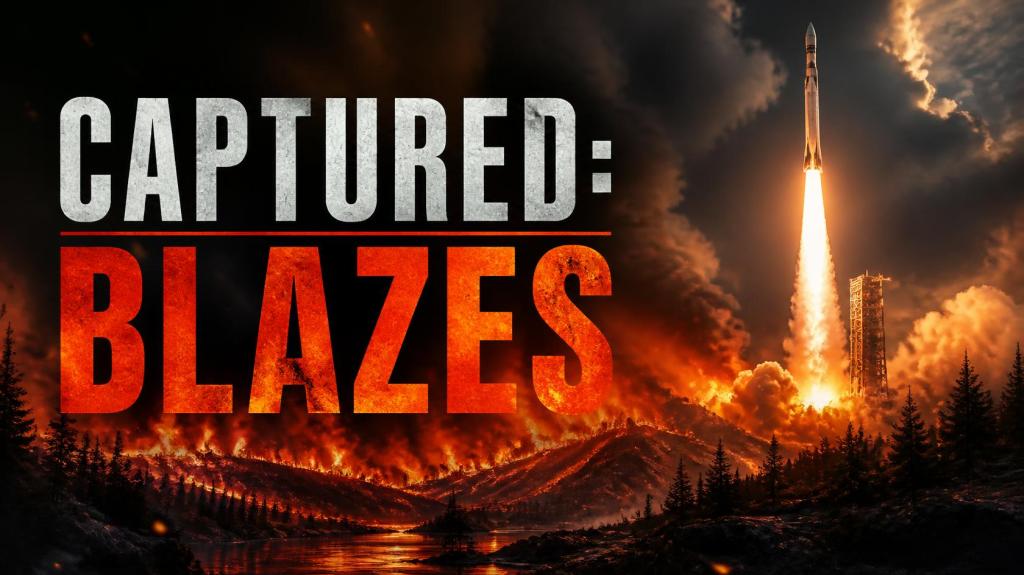
About: This is the third in my Captured series; about capturing various stories that blazed the world. Call it Season 1, Episode 3. While actual Wild Fires engulfed Europe – especially in France and Spain, India was blazing on another level – in Transport, Space, and Sport. And a quick short story about Independent India’s first scandal. (Image Credit: Canva AI, 1 August 2026).

WILD FIRES

The month of July 2026 has gone-up in flames, with Wild Fires ignited in France and Spain getting out of control. The reason behind the French fires is accidental -with one linked to a brush-clearing machine; Spanish origins were, extreme heat, drought, dry vegetation, and winds that rapidly spread the fires. Nothing to do with the heat of Spain winning the FIFA Football World Cup 2026 or France losing to Spain in the semi-finals.

Successive, sweltering heatwaves since late May, and a very hot June in Western Europe severely dried vegetation, perhaps inviting the Fire Gods for sumptuous meals: breakfast, lunch, and dinner served. The previous wet winter and spring season promoted abundant plant growth that then became ready fuel, on drying. Strong, shifting winds and low moisture accelerated the spread.

‘Rounding up the usual suspects’ of the ‘fire weather’ conditions is, human-caused climate change.

Typically, these fires become so extreme they create their own giant fire thunderstorm. A rare weather event, storms like these are formed when heat from the wildfires makes the air above the fire rise rapidly, carrying smoke, ash and water vapour high into the atmosphere. As the air rises, it cools, and the water vapour condenses into a cloud. If the fire is powerful enough and the atmosphere is unstable, that cloud can grow into the same type of cloud associated with thunderstorms.

This year’s Wild Fires were centred in southwestern France, especially Gironde near Bordeaux/Cap-Ferret and Landes; and Central Spain, west of Madrid, including Avila and related areas. The fires smoked-out over 200,000–300,000 people forcing them to evacuate, ravaged tens of thousands of hectares, and prompted European Union aid, military support, and emergency declarations.

Fires are also burning in Portugal, in the north-eastern district of Vila Real and also in Greece, on the island of Paros in the Aegean Sea and the southern town of Trifylia on the Greek mainland.

Both France and Spain are now seeing another sharp rise in temperatures, with peaks of 41 to 42 Degrees Centigrade expected in France.

In the United Kingdom, the London Fire Brigade had its busiest 24 hours of 2026 on 29 July, tackling 63 grass fires across the capital as temperatures topped 30 degrees centigrade. Control officers took over 1,300 emergency calls and crews rushed to more than 500 incidents. Almost 1,000 calls about grass fires have been made in the past week. It’s a European rage.

Investigations into the exact causes continue. Most wildfires require an initial spark-lightning is possible, but less common here than human causes, which then becomes catastrophic under the dry weather and plant fuel conditions.

The vast blazes that ripped through southwestern France burned so intensely they created a powerful, fire-generated thunderstorm. This rare phenomenon is sometimes seen in the Megafires that afflict the United States and Canada, but was unprecedented in France, until now. And it’s just one sign that Europe is entering a new fire era.

Europe has always had Wild Fires, but they are becoming increasingly frequent and extreme. Firefighters in France and Spain are currently trying to tame blazes more ferocious and more erratic than anything they have tackled before.

This follows the Europe’s record-breaking fire season last year and enduring back-to-back extreme fire seasons is becoming the norm. Experts say, “We have entered an era of fires that cannot be extinguished. These are fires that burn with the intensity of several atomic bombs.” Who needs Atom Bombs?

A BLAZING INDIA

There was a different kind of fire in normally ‘heat-friendly’ India, with a standout period in mid-to-late July 2026, during which India made spectacular advances in clean transport, private spaceflight, and women’s sports. Fuelling the tracks, burning the courts, blazing the field, and scorching the skies!These triumphs will be etched in India’s history, forever.

On 17 July 2026, Prime Minister Narendra Modi inaugurated India’s first indigenously designed and built hydrogen-powered passenger train under India’s Atmanirbhar Bharat (self-reliant India) mission. It is a 10-coach hydrogen fuel-cell based trainset powered by a 1,200 kW hydrogen fuel cell propulsion system, and currently the world’s longest of its kind. The fuel cells combine hydrogen and oxygen to generate the train’s own in-house electricity, with water vapour (and heat) as the primary emission-making it a zero-carbon alternative. The system rides with a dedicated hydrogen storage, refuelling and other necessary technical systems. It is especially useful for routes that are hard to fully electrify.

The ‘hydrogen train’ ran on the about 89 km Jind–Sonipat section of the Northern Railway in Haryana, covering the route in about two hours with intermediate stops. It has a passenger carrying capacity of 2600 people and operates at a speed of 75 kmph -the top design speed being 110 kmph.

From tracks on land to the free Space above.

On 18 July 2026 Skyroot Aerospace successfully launched Vikram-1, India’s first privately developed orbital-class rocket, from the Satish Dhawan Space Centre in Sriharikota, Andhra Pradesh, in its very first attempt. The mission was called Aagaman (meaning ‘arrival’ in Sanskrit) and Vikram-1 lifted off around midday Indian Standard Time and effortlessly reached the designated Low Earth Orbit- about 450km from the Earth’s surface. It then perfectly deployed technology demonstration payloads from over three customers, and Skyroot’s own satellite.

This made India only the third country (after the US and China) to successfully build a private orbital launch capability. And announced its ‘arrival’ into the commercial space business.

The name Vikram is in honour of Vikram Sarabhai, the father of India’s Space Programme.

Vikram-1 is mostly manufactured from carbon composites, which is five times lighter and stronger than the best rocket steel. Each stage is powered by the Kalam-series of Engines with a single Kalam-1200 engine being used for the first stage. The engines are named after India’s top Rocket Scientist and inspirational Ex-President of India, Dr A P J Abdul Kalam. The engine of the orbital vehicle, that enables orbital insertion, is 100% 3-D printed. The rocket stages are perhaps the longest monolithic carbon composite made in India, and combines with the first of the kind ultra-low-shock pneumatic separation systems. They all worked to perfection.

Skyroot Aerospace is a Hyderabad-based startup, founded in the year 2018 by two scientists-turned-entrepreneurs Pawan Kumar Chandana and Naga Bharath Daka. They asked themselves a simple question, “What if launching into space could be as accessible and routine as commercial air travel?” Skyroot was born from this vision.

A highlight of ‘team Skyroot’ is that the average age of its engineering team is 28 reflecting blazing young talent – Pretty Young Things, rooted to the ground but aiming for the skies.

Skyroot plans to increase launch frequency to one mission every month from next year onwards, while developing heavier launch vehicles and eventually, reusable rockets. And they hope, to be in the next wave of the space economy beyond satellite launches to include satellite broadband, direct-to-mobile communication and space-based computing. Elon Musk has ‘X, to the power India’, competition. Mind it!

Women’s Sports

Several high-profile successes by Indian women athletes clustered around the last weeks of July and called for a bonfire celebration.

On 19 July, India’s ace badminton player P V Sindhu won the Japan Open 2026 women’s singles title (a Super 750 event), defeating Japan’s Akane Yamaguchi in straight games. She became the first Indian shuttler to win the Japan Open crown.

Then on 26 July, in a rare moment, 18-years-old Anahat Singh hailing from Delhi, who is also the top seed, won the 2026 World Junior Squash Championships women’s singles title in Niagara-on-the-Lake, Canada. She defeated Egypt’s Ruqayya Salem 3-0 becoming the first Indian ever to win the junior world title and ending 15 unbroken years of Egyptian dominance in the event. Egypt climbs down from its pyramid top!

A day earlier, 31-years-old Manipuri Mirabai Chanu completed a hat-trick of Gold at the Glasgow 2026 Commonwealth Games, claiming her third consecutive title in the women’s 48 kg weightlifting event with a record-breaking total lift of 190 kg. It was also India’s first at the ongoing Games.

Then came Sharmila Dhankar, who at age 40, won Gold in the women’s shot put with a season’s-best throw of 9.81 m, becoming India’s first-ever Commonwealth Games gold medallist in Para-Athletics. She ended a 20-year wait for a Para-Athletics medal at the Games. Her climb to fame is heart-wrenching: a trail burnt with fire.

Sharmila Dhankar grew up in a poor farming family in a drought-prone Chitrauli village, Mahendragarh District, Haryana. Her father was a small-time farmer, and her mother was visually impaired. At age 2, a high fever led to polio that permanently affected one of her legs, leaving her with a lasting physical impairment. It was an extremely difficult childhood marked by poverty and limited opportunities.

Like many girls in her region, she was married off young at 18 years. The marriage involved severe domestic abuse, including physical violence linked to dowry demands and pressure for giving birth to two daughters, rather than sons. She was beaten for hours (one episode was from 11 pm to 3 am) and thrown out of the house at night. Thereafter, reaching a peak of despair, she left her husband’s house and returned to her parents’ home clutching her daughters.

To support her family she took various jobs, including as a maid, cleaner, and security guard; she briefly worked as a bus conductor during a transport strike.

She later remarried Ajit Singh, a businessman from Rewari, who encouraged her to venture into Para-Athletics, after learning about the immense opportunities. Sharmila then began training in shot-put and discus throw. Financial pressures continued; in the year 2023, the family sold their house in Rewari to fund her training and career. Sport gave her a ‘second birth’ and she hopes to buy a home again while providing better opportunities for her daughters-who are themselves budding athletes in javelin and long jump.

Earlier in the month, the Indian women’s cricket team achieved a landmark 270-run victory over England in the one-off Test at Lord’s—the first women’s Test win for India at the historic ground. Maybe, that heat was too hot for England to handle!

India is now powered by a new Nari Sakthi, which is blazing the tracks of progress and development. Bharat knows to handle its fire.

India’s First Scandal

With Glasgow becoming a Sports Inferno hosting the Commonwealth Games, there is another sidetrack story. I digress to another topic – nothing connected with Sports- that burned well in the late 1940s and early 1950s.

India’s first High Commissioner to the United Kingdom(UK), V K Krishna Menon earned, among other degrees, a Doctor of Laws degree from the University of Glasgow during his extensive higher education in the UK. And once upon a time he was the centre of Independent India’s first scandal, called the Jeep Scandal of 1948.

During the first Indo-Pakistan war, over the ownership of Jammu & Kashmir, the Indian Army found itself in urgent need of 2000 battle-ready Jeeps. India’s then High Commissioner in the UK, V K Krishna Menon bypassed standard procurement protocols to sign a ₹80 lakh contract with a small dubious, little-known firm, Anti-Mistantes, which had a capital of just £600. And India went out of the way to pay 65% of the total amount, upfront. Ultimately only 155 Jeeps were delivered and none were in usable condition. The best part is, then Prime Minister Jawaharlal Nehru shielded the fire than came upon Menon; the case was officially ‘dozed with water’ in 1955, and V K Menon was later appointed (rewarded?) as India’s Defence Minister. Strange are the ways of India’s Grand Old Party -the Indian National Congress (INC).

Today with the Cockroach Janta Party (CJP)- supported by the INC- firing up New Delhi’s streets, protesting ‘Exam paper leaks’ and calling for accountability, demanding (and obtaining) the resignation of India’s Education Minister, the hypocrisy is there for all to see.

After the Blaze come cooler things to capture. Tomorrow is another day.

CABO VERDE

About: The 23rd FIFA World Cup 2026, is being jointly hosted by three countries-a first in the history of the game-The United States, Canada, and Mexico. To measure the vastness of the game, this time the quadrennial men’s football event expanded into a 48 team format, with matches hosted in 16 cities, across the three countries. The first ball of the Tournament was kicked on 11 June 2026, in Mexico City and the kicking and heading will go-on until the final on 19 July 2026 in New Jersey, US. It is here that I discovered a tiny country called Cabo Verde -which I never heard about until now-skilfully playing the game and winning my heart: this is the story of the country, and how it got here (Image credit: Canva AI)

GEOGRAPHY & HISTORY

In geography, a ‘Cape’ is a stretch of land that juts-out into the sea from the mainland. It marks a sudden, sharp change in the direction of a coastline, hence it is a critical landmark for navigation. Capes are typically smaller and more pointed than ‘their cousins’, the Peninsulas: a Cape can appear on a Peninsula, but the reverse is not typical. Perhaps, the most popular Cape we know is the Cape of Good Hope-the southern-most tip of South Africa- and Cape Town, the city build around it.

The Cape of Good Hope was originally named the ‘Cape of Storms’ by Portuguese explorer Bartolomeu Dias in 1488 due to its treacherous waters. Thankfully, it was renamed ‘Cape of Good Hope’ by King John II of Portugal to give hope to a newly discovered sea route to India and the East. Bend it like the Portuguese?

With all good hope, when you navigate along the Western Coast of Africa you would bump into many more Capes and when you reach Senegal, you hit Cape Verde (French: Cap Vert, meaning Green Cape) the Western most Cape of mainland Africa. Pointe des Almadies, located on the Cap-Vert peninsula in Dakar, Senegal is the exact westernmost tip of Africa.

About 570 kilometres from this point- farther west- is Cabo Verde (or Cape Verde) a 10-Island volcanic archipelago with an area of about 4,035 square kilometres, and these days holding a population of around 530,000. It is named after-you guessed it-Cape Verde. It forms part of the Macaronesia ecoregion along with the Azores and Maderia (belonging to Portugal), and the Canary Islands (belonging to Spain), in the North Atlantic Ocean.

The islands of Cabo Verde are divided into, Barlavento group of islands to the north, consisting of Santo Antao, Sao Vicente, Santa Luzia, Sao Nicolau, Sal, and Boa Vista; and Sotavento Islands to the south, consisting of Maio, Santiago, Fogo, and Brava and the three islets called the Rombos-Grande, Luis Carneiro, and Cima. Nine of the ten islands are inhabited; only Santa Luzia-the smallest-has no permanent population.

Geologically, the islands are volcanic and relatively young-formed over millions of years on the Cape Verde Rise-a swell in the central Atlantic Ocean that elevates the seafloor. The terrain varies significantly across the islands, with the older eastern islands tending to be flatter, sandier, wind-eroded, and arid-ideal for beaches and tourism. The western islands are mountainous, rugged and rocky, with greater elevation leading to more vegetation in the higher areas due to what is called ‘orographic rainfall’. The islands thereby offer a striking contrast: from desert-like beaches to volcanic ‘moonscapes’ and fertile green highlands, all within a compact archipelago. The islands have a year-round tropical weather.

The Cabo Verde islands were mostly uninhabited until they were first colonised by Portugal in the mid 15th century. After centuries of Portuguese rule, Cabo Verde won its independence in 1975 and Praia, on the island of Santiago, became the country’s capital.

Cabo Verde was discovered in 1460 by Italian and Portuguese navigators. Santiago being the most favourable for settlement, colonisation began on this island in 1462. The largest Port is located at Mindelo on Sao Vincente, which is a deepwater harbour and had been used as a fuelling station since the 19th century.

Around the time of the discovery of Cabo Verde, lived Prince Henry, the third son of King John I of Portugal. Prince Henry was driven by a mixture of motives: crusading against Muslims, seeking trade-gold, slaves, spices-and finding the legendary Christian King, Prester John-who is considered a descendant of the ‘Three Magi’(Three Kings or Wise Men from the east who visited the infant Jesus) and ruled a Kingdom full of riches, marvels, and strange creatures. Though Prince Henry rarely sailed himself, his patronage transformed Portugal into a leading maritime power. He died in 1460, and rightfully earned the nickname ‘Prince Henry The Navigator’. The explorations he started continued and helped launch Europe’s global expansion.

Genoa, in Italy, is renowned for its long and influential maritime past. During the Middle Ages, it was one of the most powerful Maritime Republics, alongside Venice, Pisa, and Amalfi-all Italian Towns. Genoese sailors, merchants, and explorers dominated trade routes across the Mediterranean and beyond. Genoese navigators played a supporting, significant role in the maritime expansion sponsored by Prince Henry even though the expeditions were primarily Portuguese-led. Genoa had skilled sailors, shipbuilders, and merchants who often worked for other powers due to political rivalries at home and the then growing opportunities created by Portugal.

One such Genoese nobleman and navigator was Antonio de Noli who was exiled from Genoa due to political conflicts. About 1447, he sailed to Portugal with his family and entered into the service of Prince Henry, for exploring the African coastline. Then in the year 1456 Venetian Explorer Alvise Cadamosto, also working for Prince Henry, along with Genoese captain Antoniotto Usodimare, sighted some islands while sailing towards Africa’s Gambia River. This was probably the first inspiration to find Cabo Verde, lying westward.

Around 1460, Antonio de Noli accompanied by Portuguese captain Diogo Gomes were the first to discover the Cabo Verde archipelago. They explored the main islands, and founded a settlement at Ribeira Grande on Santiago—the earliest European overseas colony in Sub-Saharan Africa. Antonio de Noli was later appointed Governor, and continued as such, for decades.

In the period between the 16th and 18th centuries, Cabo Verde became a key hub for the transatlantic slave trade, due to its strategic location. Enslaved Africans were brought from the mainland, processed, and shipped to the Americas; the islands also served as a provisioning stop. The economy relied primarily on trade, with some agriculture thrown-in, though hampered by the arid climate. Attacks by pirates and rival powers occurred periodically (the famous explorer, navigator and privateer, Sir Francis Drake attacked Cabo Verde in November 1585 during his expedition to the West Indies). The first settlement of Ribeira Grande gradually declined, and Praia, on the island of Santiago, grew to become the largest city and present day modern capital of Cabo Verde.

In the 19th century following the end of the slave trade (fully abolished in the 1870s) Cabo Verde’s economy went into decline and it became a poor subsistence economy.

Meanwhile, the islands having no indigenous people or ancient Kingdoms(with tons of gold), a ‘Creole’ (a blend of community) society, language, and culture emerged from the mixing of Portuguese settlers and Africans. Free Europeans and enslaved people from the African coast merged into a single people, Cape Verdeans, with a unique way of being and living, and Creole emerged as the language of the predominantly mixed-race community. Emigration out of the Islands began due to repeated droughts and famines experienced while the economy was trying to grow.

In 1879, the joint administration of Cabo Verde with the Portuguese Guinea-Bissau ended, making Cabo Verde a separate colony. It stayed a subsistence economy while serving as a coaling and resupply station: coal-which arrived from other countries-was stored in the port of Mindelo on Sao Vicente island, for resale to passing ships.

In the 20th century, up to 1956, Portugal maintained control amid growing African nationalism. In 1951, Cabo Verde’s status changed to an ‘overseas province’, and full Portuguese citizenship was granted in 1961, but this was superficial and could not contain the desire for independence.

In 1956, Amilcar Lopes Cabral, a Bissau-Guinean and Cape Verdean revolutionary leader, agronomist, political theorist, and poet, founded the African Party for the Independence of Guinea-Bissau and Cabo Verde (PAIGC), in Bissau. This marked the start of organized resistance that would lead to full independence in 1975. Amilcar Cabral is one of the outstanding anti-colonial persons of the 20th century and the PAIGC that he founded and led, waged a successful armed struggle against Portuguese colonialism. He is revered as a national hero in both Guinea-Bissau and Cabo Verde.

On 20 January 1973, Cabral was assassinated in Conakry, Guinea-where PAIGC had its headquarters-by disgruntled PAIGC members. He was shot at a roadblock while returning from a reception with his wife. He was 48 years old – and left behind an ex-wife, a wife, and two daughters.

On 19 December 1974 an agreement was signed between PAIGC and Portugal establishing a Transitional Government. This Government would go on to prepare and hold elections for a National People’s Assembly, which on 5 July 1975 proclaimed independence.

Cabral’s ideas and example outlived him. On Guinea-Bissau and Cape Verde gaining independence he is honoured as a founding father in both nations. In Cabo Verde, Amilcar Cabral International Airport, on Sal island, is named after him. There are monuments, streets, the Amilcar Cabral Foundation in Praia, and ongoing cultural tributes. Heroes’ Day (20 January ) commemorates his assassination alongside other freedom fighters.

One of Cabral’s memorable quotes, goes like this:

“Hide nothing from the masses of our people. Tell no lies. Expose lies whenever they are told. Mask no difficulties, mistakes, failures. Claim no easy victories”. Cabral remains a symbol of principled anti-colonial struggle, intellectual rigour, and the fight for dignity and self-determination for African peoples—particularly resonant in Cabo Verde due to his personal and familial ties to the islands. His life bridged two nations and helped forge their paths to freedom.

After Cabo Verde gained independence from Portugal, it transitioned to a multi-party democracy in the early 1990s and has since been one of Africa’s most stable and developed nations. While Portuguese remains the sole official language, Cape Verdean Creole (Crioulo) functions as the national/vernacular language spoken by most people and used in everyday life.

The National Assembly -72 members, elected every 5 years by proportional representation- holds legislative power. The judiciary is independent. The country has a strong record of democratic stability, peaceful power transfers, free elections, and high rankings in governance and freedom indices in Africa. Major parties include the PAIGC and MpD (Movement for Democracy). It maintains a policy of non-alignment while fostering ties with Portugal, the European Union, African Union, and others.

A large diaspora -exceeding the resident population- lives mainly in the United States, Portugal, and elsewhere; remittances are economically important.

Cabo Verde has a unique Creole blend of African and Portuguese influences and is famous for ‘morna music’- the national music and dance of Cabo Verde. Morna music is deeply melancholic and poetic, characterized by themes of separation, migration, and a profound longing for home. Cesaria Evora, often referred to as the ‘Barefoot Diva’ is the most celebrated morna singer, globally. She took the soulful island music to international prominence and is a global ambassador.

The dominant religion of Cabo Verde is Catholic, with about 85% of the population identifying with the faith. Religion is generally moderate and tolerant; the Catholic Church plays a visible role in culture, festivals, and social life, with many traditional Catholic saints’ days and processions being celebrated.

Today, Cabo Verde’s economy is predominantly service-oriented, with services accounting for roughly 70-75% of GDP. Tourism is the standout sector and main economic driver along with agriculture, fishing, light industry, and remittances. It has limited natural resources and imports much of its food. It has graduated from least-developed country status and focuses on renewables and tourism. Challenges include drought, climate vulnerability, and limited arable land, but it boasts high stability and development metrics for the region.

Cabo Verde relies on a mix of thermal (fossil fuel-based) and renewable energy sources for its electricity, with a total installed capacity of around 160 to 220 MW. The country is a net energy importer with no domestic fossil fuel resources, so all petroleum products for electricity generation and transport are imported. Electricity access is high, though costs remain relatively elevated due to import dependence. Cabo Verde has no petroleum refineries. It only has storage and distribution facilities for imported fuels-diesel, gasoline, jet fuel, etc. All refined petroleum products come from abroad, primarily through companies such as Enacol.

Cabo Verde’s first President was Aristides Pereira- a founding member and Secretary-General of PAIGC. He was a close associate of Amilcar Cabral and played a key leadership role in the independence struggle. He led the country when it was a one-party state initially, before multiparty democracy was introduced. The first Prime Minister was Pedro Pires – a military commander and an important figure in the PAIGC. Pires worked closely with Pereira and Cabral. He later became President of Cabo Verde and is widely respected for his role in the independence movement and the country’s democratic transition.

In 2013, the country’s delegation informed the United Nations that only Cabo Verde (Portuguese pronunciation: ‘kabu verdi’ )and not other translations should be used for official purposes.

With this illuminated background lets go on to play football, with Cabo Verde.

FOOTBALL: THE 11th ISLAND PROJECT

Football has been played in the Cabo Verde islands since the early 20th century, introduced during Portuguese colonial times. The oldest and most successful football club is Clube Sportivo Mindelense (CS Mindelense), founded in 1919 and based in Mindelo on the island of Sao Vicente. A formal national football team emerged post-independence in 1975, nicknamed the ‘Blue Sharks’.

The team played its first international match in April 1978, losing 0–1 to Guinea in a tournament in Guinea-Bissau. The Cabo Verdean Football Federation (FCF) was established in 1982. It affiliated with the Confederation of African Football (CAF) and joined the International Association Football Federation (FIFA) in 1986, enabling official international participation.

In the early years, the Blue Sharks remained low-profile (in the deep waters), with limited matches and poor FIFA rankings-as low as 182nd in the year 2000. They entered Africa Cup of Nations (AFCON) qualifiers in 1992 and World Cup qualifiers in 2003, but progress was gradual. Success grew later through diaspora players and smart thinking, leading to their first real breakthrough at AFCON in 2013 and eventual World Cup qualification.

The Blue Sharks made one of the most remarkable underdog stories in recent football history by qualifying for the FIFA World Cup 2026, which is currently underway. This is their first-ever appearance-and advancing to the knockout stages as the smallest nation ever to do so.

Cabo Verde’s strong diaspora and its brilliant recruitment strategy is the cornerstone of the national football team’s remarkable rise, often called the ‘11th Island’ Project. With a population of only about 530,000 people, the country has a larger diaspora, which is estimated at 1 to 2 million people, living abroad, primarily in Portugal, the Netherlands (especially Rotterdam), the United States (mainly Massachusetts and Rhode Island), France, Brazil, and elsewhere. Many players with Cabo Verdean heritage play in Portugal, Brazil, Major League Soccer (MLS), and other leagues.This global community-shaped by historical emigration due to droughts, seafaring traditions, and colonial ties-has become a vital talent pool for the Blue Sharks – literally, hunting down blood.

The Cabo Verdean Football Federation formalized talent identification and recruitment strategies around the early 2000s, accelerating it after their first AFCON qualification in 2013. They built a competitive squad by scouting talent globally, including through unconventional methods such as LinkedIn.

Global Scouting Networks of the FCF, coaches, agents, and community figures actively track players of Cabo Verdean heritage (by birth, parentage, or ancestry) in foreign leagues. This includes second- and third-generation emigrants playing in Europe and beyond. FIFA funding supported the endeavour.

Under coaches like Bubista, who is in charge since 2020, emphasis was on resilience, organization, and leveraging dual-national players: many are dual nationals or eligible through ancestry. Recruiters emphasized national pride, cultural connection, and the opportunity to represent their roots.

A standout example is defender Roberto Lopes(Pico) (Dublin-born, who played in Ireland’s league and worked in a bank). He was contacted via LinkedIn around 2019; he initially thought it was spam, but joined and became a principal player.

Bubista focused on blending diaspora and homegrown talent into a cohesive unit, fostering brotherhood and shared identity. Many squad members play in European leagues bringing higher-level talent and experience to team Cabo Verde. In the squad for the 2026 World Cup, about 14 of 26 players were born abroad. In one major group-stage lineup, 6 of 11 starters were diaspora players (e.g., several from the Netherlands, plus others from Ireland, France, and Portugal).

Goalkeeper Vozinha (Josimar Jose Evora Dias) is a notable contributor. Players like Ryan Mendes, and others with roots in diaspora hubs made assists – towards the goal of selection.

This approach turned a tiny nation into a competitive side capable of drawing with Spain and Uruguay, reaching the knockouts, and nearly upsetting Argentina. Emigration waves created strong ties and early challenges helped in attracting top talent, but persistence paid off around 2013 onward. The strategy leveraged diaspora communities for not just players but also fan support.

While strong team spirit and tactical discipline Cabo Verde emerged as an impressive football team; recent AFCON performances added momentum. The expanded 2026 format of FIFA was a catalyst, but their group-topping qualification showed genuine merit.

Path to Football World Cup 2026 Qualification:

In the 2026 CAF qualifiers (Group D: Cape Verde, Cameroon, Angola, Libya, Eswatini, Mauritius), Cape Verde topped the group with 23 points from 10 matches (7 wins, 2 draws, 1 loss). Key results included: a decisive 3–0 win over Eswatini in October 2025, in Praia that sealed qualification. Beating Cameroon (a football powerhouse) 1–0. They finished ahead of fancied Cameroon.

Performance at the World Cup 2026:

Cabo Verde was drawn into Group-H with Spain, Uruguay, and Saudi Arabia, and defied expectations in their debut tournament: 0–0 draw vs. Spain – a stunning result against favourites. 2–2 draw vs. Uruguay. 0–0 draw vs. Saudi Arabia. They finished second in the Group with 3 points (all draws) and advanced to the Round of 32 — becoming the smallest nation ever to reach the World Cup knockouts.

In the Round of 32, they faced defending champions Argentina. It was an edge-of-the-seat thriller of a match and one of the finest in this World Cup. Argentina opened the score, but Cabo Verde promptly equalised. Argentina scored again and Carbo equalised, yet again. The match was stretched to extra time and Carbo Verde faced a 2-3 defeat with Argentina scoring to decide the winner. Throughout the match it was a heroic performance by veteran goalkeeper Vozinha, aged 40, who made standout saves. One of the greatest players of all time, Lionel Messi, scored a record goal, but Cabo Verde earned global admiration as neutrals’ favourites.

Cape Verde’s story symbolises pride of a tiny island nation, inspiring fans worldwide and large diaspora communities in the US and Europe. Players like Vozinha have become legends, and the run has put ‘where Cabo Verde is’ on the map for millions. It’s a classic World Cup fairy tale of planning, resilience and joy, from an underdog.

Cabo Verde’s strategy could well serve as a template for other small nations: smart, resourceful recruitment, combined with investment in identity and infrastructure can punch above population weight. The 11th Island has given Cabo Verde global visibility far beyond football-and of many things, pulled me into writing this article.

Cabo Verde, Curacao, Jordan, and Uzbekistan made their World Cup debut in this 2026 event and it’s pulsating to see the world – small and big – join together to celebrate the human endeavour in Sport. Nothing bridges people ‘of all makes’ better than Sports. Three Cheers Cabo Verde!

Good Bye, for now. Te logu / Ti manham.

BETWEEN THE LINES

About: a ‘write-down’ comedy on the news of the world. Who watches stand-up comedy?

The United Kingdom is beginning to see more Prime Minister(PM) changes than the infamous English weather. Is there an umbrella for this one? The UK is fast kangaroo-leaping into Australian style politics, where it is awfully hard to remember who the Prime Minister is-or was-with slick changes that’s peculiar only to Australia. Ask the duck-billed Platypus on what’s going on. Football Field player changing -with the name-board number always remaining No. 10-has been put to shame.

British PM Keith Starmer after over two years of wretched, mangled governance decided to quit-another one bites the dust in British Politics. He lost the ball of support of his Labour Party Members of Parliament (MP) and informed team Manager, King Charles that he is resigning-cannot clearly see the goal-post, any longer. Now, the Labour Party will labour to elect a new leader and therefore PM. His likely successor is Andy Burnham-calls himself more British than English-who recently screeched into Parliament in a By-Election and was officially sworn in as Makerfield’s new MP in the House of Commons. The 56-year-old made the right noises about leading the Labour Party and an orderly transition to becoming Prime Minister. There is some history here, when Andy Burnham tells that the ‘turning point’ in his political life came in 2009, when he was booed at a football ground in the north-west of England. Now, it’s three cheers!

The joke doing the rounds is that Airbnb is sponsoring No 10. Downing as perfect for short stays. I am garnishing that: cats and dogs are allowed, at no extra charges

Meanwhile, in a gilded hall at Versailles, Paris, United States President Donald Trump signed a 14-point Memorandum Of Understanding (MOU)with Iran, to halt the ongoing war. Israel never noticed, and not known to playing world-class football, went on with business as usual, trying to kick the militant Hezbollah out of the field. They, who are sprawled all over Lebanon. The Strait of Hormuz opened, closed, opened, closed, open, closed…leaving people in a tizzy and heading to the bar to open a bottle of Hormuz whiskey instead, and drink the Arabian spirits. I wonder, why should Iran bother about Lebanon when it has its own hair to keep and cover safely? Any why does the MOU not include any provisions requiring Iran to stop massaging the butts of the Hezbollah, Hamas, or the Houthis? Unalloyed support-call it bad refereeing? Show the Red Card.

India’s National Eligibility Cum Entrance Test (NEET) exam finally got off the air on 21 June 2026-after a mid-flight scare, the previous time. And India’s Prime Minister, who had just landed from the air, smiling like a Cheshire cat, stayed off the road, parking himself in the Airport, until the Exam started. What an idea, Sirji-helping heavily stressed students reach the exam centres without a sweat. Strange are the ways of India, with the Army, Airforce, among others, called-in to protect the exam question papers. If there is still a leak, the Navy might have to sail-in to plug, provide reinforcement and do further straight shipping.

Moving on to other things, in India, everyday 1200 to 1220 people die in accidents and there is no prize for guessing the killer cause: road accidents. It’s hard to swallow, but the fact is, the price of life in India in ZERO. Remember, India invented the zero, and we cannot help ourselves living up to it- and dying for it. What, with 1.4 billion people in bumper-to-bumper life. There is a story about the high density in the West Bengal’s capital of Kolkatta such that even dogs cannot wag their tail in the usual sideways swagger; instead they are finding space vertically-up and down. Dogs too are learning. Anybody making a movie called, Planet of the Dogs?

Then there is this particular species of Homo Sapiens, which thrives on driving a BMW, an Audi, or a Mercedes-Benz on the pavements meant for the walkers and putting people on them to sleep, forever. Never knew population control can happen this way. The Gates of Heaven are always open.

The Devil is definitely lurking in the details: in the pot-holes, on the great highways and the speed-breaker infested streets; in wedding dowry; in building collapses, in construction sites, in bridge failures; in the railways, trains going berserk, and especially unmanned crossings; in high-rise building fires; animal(street dogs included)-bites; death by suicide, rape, murder…it’s an endless, ever expanding list. Once, a Google Map route took a driver to the end of an unfinished bridge, and there was no looking back.

On 22 June 2026, 15 people, mostly students, were charred to death after a fire broke out in a 3-storey building in the heart of Lucknow, Uttar Pradesh. A day earlier, 8 died in an Ammonia Gas leak in a Food Export company in Tiruvallur, Tamil Nadu. Exporting death?

Joining the blood stream, The International Labour Organization says, every year more than 8.4 Lakh people die globally from health conditions linked to the workplace. It is a dangerous world we live in. We do not need Aliens from Space to conquer us: we are our own best beasts.

I recall a cousin of mine, now permanently living in the United States and making frequent strips to India saying, “Once you step out of your house, there is no guarantee that you will return home alive”. I reckon every day is an adventure! If Christopher Columbus was living in India, he would not have been able to cross the street alive, leave alone sailing through an open sewer. Oh, Santa Maria!

Nothing beats gossip about the Film World-Hollywood, Bollywood, Kollywood, Tollywood-in India and abroad. A top headline is, Actresses getting pregnant, and showing-off that glamorous well-rounded, shining baby bump. Recently, Actress Samantha Ruth Prabhu who was married to a popular Telugu actor and separated, tried again, married Raj Nidimoru-a Producer, Filmmaker Businessman, Writer- and now the home-production has been successfully rolled out. She is in the family way. Sure business works wonders and bumping into the right person definitely produces results. However, we are yet to see that magnificent bump, though the media went crazy over a tiny one, they thought they spied, when the wind was doing the only job it knows-blowing. These guys are unbelievable, in spotting curves and angles you and I just are stone and wind blind to. Hope, a full one appears soon-and the expectations are indeed Space High. Maternity leave is around the corner.

In another part of the world, across the oceans, working hard to keep Samantha company is Hollywood Actress Anne Hathaway-the Princess who kept a Diary. She is married to Actor Producer, and Jewel designer Adam Shulman and the couple probably heard Elon Musk’s clarion call to launch more babies-the American population is seriously declining-and two, they already have, not being enough, went back to production, and a third jewel is on the way. More entries in the Diary?

That’s already two bumps- that I know- to look-up to, all happening in June 2026. And this being football season, it’s raining goals everywhere! Move over Messi & Co.

The FIFA World Cup is kicking about in the United States of America, and it is a fabulous Discovery of America, and of football. Discovery Channel and the National Geographic have lost their footing. There is magic everywhere, on the American streets and on the football grounds. Probably the Greatest of All Time (GOAT), Argentinian footballer Lionel Messi, scored a hattrick, and then in another game scored two more to become the highest goal-scorer in World Cup history. It’s time they make the goal-posts smaller?

I am riveted to watching football and chasing all the clever goals- especially those going between the legs. And between the lines, I have an eye on that speed-breaker, baby-bump. I’m sure there’s much more to come. The dice is heavily loaded.

CAPTURED

About: We love to capture a lot of things, pictures of objects, songs, books, movies, memorabilia, experiences, news…and keep them with us, ‘cell them’ somewhere, in mysterious ways (some venture into capturing animals and humans too). I have captured these stories from the news of the world and am locking them down them. This time it’s about the United States in action, in Venezuela and Iran – along with its buddy, Israel- which captured my attention.

VENEZUELA

The whole of last year, 2025, we had a President, that of the United States of America, who began a 100 metre dash for the Nobel Peace Prize, then a 200m sprint, then a 400m run…growing gradually into a never-ending marathon jog, of sorts. Peace was still not in sight despite honestly bringing the Israel-Hamas war to an end, getting all the hostages released, and making Wild West claims of reigning-in India on its superb Operation Sindoor battering of, ‘living next-door’, Pakistan.

A new weapon called Tariff, was unleashed during 2025, by the US President. Never mind the US Supreme Court called the ‘Bluff’ (and India’s Priyanka Chopra fought hard, with an ancient Pirate blade, to keep the gold).

Meanwhile, the year turned a page and early on 3 January 2026 the President took the Peace Bull by the horns – actually working from behind, screwing its tail. If peace does not get one a Prize maybe surgical action could get one closer? Another President, Nicolas Maduro of Venezuela found himself captured in his sleep- thankfully with his wife Cilia Flores for great company-all in the blink of an eye, in the capital City Caracas. He was into narcoterrorism, drug-trafficking, and other highs affecting the American people and a New York Court wanted him captured and brought to America for justice. The US President’s men did just that. Justice at midnight-lights out, please. It did not matter he was the President of another country!

It was a ‘crack-oiled’ operation, which the Venezuelans could not see happening in the dark and where the world could clearly see the stealth and magnificent superiority of the US Armed Forces. Operation ‘Absolute Resolve’ was absolutely clinical – would make a surgeon proud!

Maduro’s government was purely authoritarian, with electoral fraud the name of the game and with human rights abuses, corruption, censorship, and severe economic hardship permanently up its sleeve: that was the order of the day, and stacking-up into a monumental heap of misdeeds. Those who were caught in the tyranny of the land were the thousands who died in extrajudicial killings and the about 7 million forced to flee the country due to economic collapse.

After the capture, Venezuelans celebrated, a new Government smoothly slid into place and began to seriously look inward at the world’s largest proven Oil Resources, perhaps to oil the US President and the world. That’s where were are.

IRAN

The Venezuelan dust on Nicolas Maduro’s boots had just begun to settle, when the roar of the Lions of Israel and the Eagle-eyes of the United States combined with deadly precision on, 28 February 2026, to send Iran’s Supreme Leader, Ayatollah Ali Khamenei, thousands of leagues into the sky. Nevermind he thought he was safe with a supremely reinforced concrete and heavily fortified bunker 200 feet below Iran’s ground level, within his reach. He never got to the lift that would take him down to the underground Bunker in a 5 minute ride, but was killed by Israel’s deadly, ‘Blue Sparrow’ missile while still above ground holding a meeting. His wife, daughter, a son-in-law, a grandchild, along with a few top generals joined him in his journey to the skies above. America’s famous bunker busting GBU-57 burrowing bombs were used later to clean-up the underground world should other Iranian rats use it as a supreme getaway. Sadly, none were captured, but sent to invisible parts of the world.

For over 47 years the fundamentalist Islamic Republic of Iran has been the single greatest prime mover of death in the Middle East. It has funded, armed, and directed terror across the globe. They built Lebanon’s Hezbollah, funded Gaza’s Hamas, armed Yemen’s Houthis, spending billions a year on terrorism. They specifically targeted Americans, Israelis, Jews, Arabs, and anyone standing in their way. ‘Death to America’, ‘Death to Israel/Zionists’, were popular war cries. Others were, ‘Death to hypocrites’, ‘Death to enemies of God/Islam’. All this, on the outside world.

On the inside, all the while, Iran was quietly building nuclear weapons while shaking hands with diplomats from other countries, and bullying its own people. Tens of thousands of Iranians were killed in domestic protests and crackdowns since the year 1979. During the recent, January 2026, crackdown on protestors of the Regime, ‘ssnipers on rooftops shot protestors in their heads. Islamic Revolutionary Guard Corps entered hospitals and shot and killed injured protestors in their beds. Relatives were handed over dead bodies on payment of a bullet fee-based on the number of bullets on the body. This January alone, Iran executed the largest massacre of civilians in its modern history.

They shot a 16-year-old girl, Nika Shakarami, in the street. Then snatched her body and tried to bury her in secret before her family could find her. Another 20-year-old man, Amirhesam Khodayarifard walked into a protest and was chanting peacefully. A government agent shot him in the head. They beat to death a 22-year-old woman, Mahsa Amini, over a headscarf issue, after The Guidance Patrol, the Religious Morality Police, had arrested Amini for not wearing the hijab in accordance with government’s ‘gold’ standards! Then there is the heart-wrenching story of Dr Aida Rostami, a 36-year-old Iranian General Practitioner working at the Shahid Chamran Hospital in Tehran who was secretly treating (only because she was true to The Hippocratic Oath) wounded protesters during the nationwide uprising sparked by Mahsa Amini’s death in custody. After tending to several injured people and realising she needed more supplies, she left to buy them. She called her mother earlier that evening, asking if she needed anything on her way home. She never arrived. The next day, police contacted her family claiming she had died in a ‘car accident’. They directed the family to collect her body from the forensics office. What they found instead was undeniable evidence of extreme brutality: a smashed face, broken arms, fractured shoulders, severe bruising on the lower torso indicating signs of sexual assault, and her left eye completely gouged out. The official forensics report vaguely cited death from being ‘hit by a hard object’. But medical examiners told the family privately that they had been ordered to conceal the real cause that she had been tortured and killed by security forces. Dr. Aida is one of the thousands of women who were killed by brutal anti-women Khamenei regime. These are just a few of countless horror stories of the kind. This is who they are. This is who they’ve always been.

The Israel-US joint strike on Iran was called Operation Epic Fury and the objectives centred on weakening Iran’s missile systems, naval power, and nuclear program. And disrupting the network of proxy forces that Iran has used in an asymmetric warfare to influence conflicts across the Middle East.

The strike happened even while negotiations were going-on with Iran, to prevent start of the present war. From the outset, the Iranians asserted that uranium enrichment was Iran’s inalienable right and declared their large stockpile of enriched material-about 9,980 kilograms-was off the table for negotiation. This could yield about 11 nuclear bombs if further enriched: that’s how close they are to a nuclear weapon. What killed any deal-making was probably when they told the negotiators, “We’re not going to give you diplomatically what you couldn’t take militarily.”

Experts in International Law (e.g., Natasha Hausdorff) say the war is legal and legitimate. This is especially in the background of the decades old ongoing armed conflict with Iran during which, it is well known, Iran has been consistently attacking US and Israel interests across the world. The US specifically invoked Article 51 of the United Nations Charter, saying the strikes were for self-defense and pre-emptive, and accused Iran of violating UN Security Council resolutions related to its nuclear activities. Seen in the context in which ‘Operation Roaring Lion’ was launched, Israel joining the US to strike Iran is in accordance with the international law of armed conflict.

Under International Law, the use of force by States is governed primarily by the UN Charter, Article 2(4) of which prohibits the use of force against the territorial integrity or political independence of any State. There are two main exceptions: 1-authorization by the UN Security Council under Chapter VII, or 2- self-defense under Article 51, which allows force in response to an ‘armed attack’ until the Security Council acts. Preemptive strikes (preemptive self-defense or anticipatory self-defense) refer to the use of military force by a State against another State (or non-State actor) before an armed attack has actually occurred, but when such an attack is believed to be imminent. Preventive strikes (also called preventive self-defense, preventive war, or preventive attack) refer to the use of military force by a State against another State to neutralise a potential future threat (such as acquiring nuclear weapons capability) that is not yet imminent.

At this time, the US has openly ruptured with the United Kingdom over Iran, base access, and broader British policies on energy and immigration, while treating Germany under Chancellor Friedrich Merz as a more reliable partner and moving to cut trade with Spain over NATO and base issues.

The UK did not join its ‘all-weather’ ally – the US- in the opening strikes and refused to allow its Diego Garcia base to be used by the US. However, later the UK relented and allowed limited use of other bases and even readied an aircraft carrier for duty in the Mediterranean. US President Trump castigated the UK for being very uncooperative and ruining relationships, saying – this is not the age of Churchill and they do not want the UK to join after they have won the war. He said about the same about Spain’s uncooperativeness.

On the other hand, in what never happened in about 50 years, almost all the Gulf countries of UAE, Saudi Arabia, Qatar, Bahrain, Kuwait of the Gulf Cooperative Council united against Iran. This is because Iran has triggered the Gulf countries to get involved. While primarily targeting US military bases and assets in the region Iran’s return-of-fire also affected civilian infrastructure in several Gulf countries due to direct strikes, interceptions, and falling debris. Overall regional impacts include few killed and over 100 injured across the Gulf, with widespread economic disruptions: thousands of flights canceled, oil prices rising due to halted production, and temporary closures of key ports and airspace. The anger in the Gulf reach a crescendo.

Then suddenly you find the Shia Muslims – Iran- on one side and the Sunni Muslims – Gulf countries on other, but united. The timeless fault lines are as visible as never before.

Looking from another angle, Trump is dismantling the British system of Imperial control, of keeping the Gulf in permanent turmoil through Britain’s much used colonial era divide & rule policy, using Islamist fundamentalism as a battering ram-obviously against Russia-and in the process keeping its commerce paying through the Lloyds Register of Shipping Insurance.

Insurance for nearly all oil tankers going through the Strait of Hormuz is provided by Lloyds and with Iran closing the Strait, Lloyds said it is terminating ‘war risk’ Insurance. Trump then outflanked the UK by ordering his Government, US Development Financial Cooperation, to provide Insurance and ordered the US Navy to ensure safe passage of Oil Tankers. This seems to be the most consequential outcome in the war, thus far, with 300 years of ‘British Crown Control’ broken in a single day.

The US seems to be digging up the former American President Franklin D Roosevelt’s (FDR) ‘America First’ Policy and re-organizing globalisation, to this end. Broadly, this plan is about using America’s methods of economic development and industrialisation on its allies, and is directly opposite to the British Imperial Rule System, which America blames is the cause for many conflicts in the World, beginning with World War I.

FDR saw the British Empire as a barrier to global peace and economic fairness, arguing that colonial systems bred resentment and instability. He advocated decolonization in regions like Africa, India (at that time under British Rule), and Asia, viewing imperialism as ‘unselfish’ only if it advanced civilization without exploitation-but he saw Britain’s model as selfish, exploitative, and outdated. FDR’s anti-colonial push was pragmatic: he feared that maintaining empires would alienate potential allies in the developing world and prolong global conflicts, harming US interests.

Donald Trump seems to be first US President who has seriously latched-on to FDR’s ideas…and is trying to make it work.

Wow, there are so many layers to the present conflict:more than what meets the eye. And surely the Middle East would look a lot different after the US & Israel – Iran War is over. Meanwhile, for Israel, it’s looks like it’s just another day in Office. And India is definitely on the right side of the conflict. India anyway is quietly dismantling the effects of British colonial rule within the country.

FREEWHEELING

About: A break free commentary on events on our Planet, anchored on the headline news of the world. Any comments beyond the storyline, are entirely mine, without prejudice -take it or leave it. This is a run of events from 30 November to 31 December 2025: War & peace; turmoil in Iran; humanitarian crisis in Sudan; cost of living crisis in Nigeria; and India news – especially about Thiruparankundram Temple in Tamil Nadu.

THE WORLD

December 2025 saw heightened geopolitical tensions, diplomatic efforts towards peace in ongoing conflicts, and military escalations, particularly in Europe and Asia. Many hostilities just meandered on, with probably the sole winners being the arms manufacturers and suppliers.

United States (US) President Donald Trump hosted Ukrainian President Volodymyr Zelenskyy at his Mar-a-Lago Resort, Palm Beach, Florida, on 28th December, for talks on a potential peace deal. It appears that progress was made on 15-year US security guarantees for Ukraine, though territorial issues (with Russia) remained unresolved. Ukrainian negotiators agreed to 90% of a 20-point peace plan cooked by Ukraine, US negotiators, and European countries. A deal seems close at hand?

In Russia, President Putin’s residence came under a drone attack and Ukraine was accused of orchestrating it. This, amid ongoing Russian missile and drone strikes on Ukrainian cities. Meanwhile, the European Union approved a Euro 90 billion loan to Ukraine for defense funding.

In the Israel-Hamas conflict, Trump met Israeli Prime Minister Benjamin Netanyahu on 29th December, to discuss the next phase of the Gaza ceasefire (including international peacekeeping forces) and warned Iran of potential strikes.

Israel approved new West Bank settlements-pushing for more ‘Israel’.

The US military along with Jordan launched airstrikes on multiple sites, targeted ISIS in Syria, following attacks.

Iran is witnessing its largest unrest in three years. And the Government grapples with its most serious challenge in years. Chants of ‘mullahs must leave’ and ‘death to the dictator’ echoed across major Iranian cities as protesters clashed with security forces of the Ayatollah Ali Khamenei-led theocratic regime. The eruption of anger and turmoil has been fuelled by a collapsing Rial, record inflation, and years of sanctions, amid renewed American pressure.

The country’s currency, Rial, plummeted to a record low against the US dollar, and the head of the Central Bank resigned. While traders and shopkeepers rallied in Saadi Street in downtown Tehran as well as in the Shush neighbourhood near Tehran’s main Grand Bazaar. Recall, merchants at the market played a crucial role in the 1979 Islamic Revolution that ousted the monarchy and brought the present crop of Islamists to power.

Turkey and Armenia agreed to simplify visa procedures as a step toward normalising ties between the countries.

China conducted its largest military drills to date, Justice Mission 2025, encircling Taiwan with live-fire exercises, simulated strikes, and port blockades starting late December. This followed a major US arms package to Taiwan and came amid broader regional frictions.

Thailand and Cambodia held talks, mediated by China, to address border clashes. The Southeast Asian neighbours agreed on a ceasefire that took effect at noon on 27th December, stopping 20 days of fighting that killed at least 101 people and displaced more than half a million on both sides. The ceasefire included a halt to fighter-jet sorties, exchanges of rocket fire, and artillery barrages. The Thailand-Cambodia conflict was sparked by a skirmish in late May 2025, that left one Cambodian soldier dead. The incident stemmed from a long-running dispute over ownership of ancient temples and their surrounding land, and contributed to a broader escalation of tensions that later developed into sustained fighting.

The ongoing, seemingly, never-ending humanitarian crises in Sudan persisted with limited international attention (need someone to pay ‘attention to the matter’?) Over 30 million people, almost two thirds of Sudan’s population, are in need of humanitarian assistance. Almost 25 million people, are facing acute hunger, with 637,000 of these classified as on the brink of famine. The civil war erupted amid tensions over the integration of the Rapid Support Forces (RSF)-a Sudanese paramilitary force formerly operated by the Sudanese Government- into the Sudanese Army following the 2021 coup. It started with RSF attacks on government sites in Khartoum and other cities. The capital region was soon divided between the two factions.

Nigeria is experiencing severe security challenges, including a sharp rise in mass abductions of schoolchildren in the north, and ongoing insurgencies by groups like Boko Haram and the Islamic State West Africa Province (ISWAP). This instability, along with other factors, has led to a major hunger crisis, particularly in the northeast, and displacement of millions of people. Economically, the country faces its worst cost of living crisis in 30 years due to 2023 reforms, and has also seen issues like inflation and social unrest.

In late November, armed bandits kidnapped 303 children and 12 teachers from the St. Mary’s Private Catholic school in the country’s north-central Niger State. The students are both male and female, some as young as ten. About 50 managed to escape-soon after the abduction- and during December all students and teachers were released from captivity, first 100, then the remaining. Nigeria is home to some of the world’s largest Muslim and Christian populations with the northern region predominantly Muslim and the southern region largely Christian. Indigenous religions, such as those native to the Igbo and Yoruba ethnicities, are in the minority. The country’s Constitution guarantees freedom of religion.

Myanmar’s civil war intensified in late 2025, with the military junta facing significant setbacks against a unified resistance of Ethnic Armed Groups and People’s Defence Forces, losing control over vast territories, particularly in border areas, leading to major displacement, increased humanitarian needs, and the junta attempting to legitimise its rule through contested elections amidst escalating violence, airstrikes, and ground offensives. Over 3 million people have been displaced, and nearly half the population needs aid, with ongoing conflict disrupting lives and essential services. Triggered by the 2021 military coup, the war is a culmination of long-standing ethnic tensions and resistance to military rule. In essence, Myanmar is in a full-blown civil war where the military is losing ground and struggling to maintain control against a determined, though often fragmented opposition.

INDIA

India came up with a new Rural Employment Law: The Viksit Bharat – Guarantee for Rozgar and Ajeevika Mission (Gramin) (VB-G RAM G) Act, 2025, was enacted to replace MGNREGA (The Mahatma Gandhi National Rural Employment Guarantee Act), guaranteeing 125 days of wage employment per rural household. The Rural Development Ministry began coordinating with States to prevent fake demands during the transition.

The Election Commission extended the Special Intensive Revision (SIR) of electoral rolls in multiple states, amid opposition demands for discussions on voter lists and national security during the Winter Session of Parliament. The SIR is doing the job of weeding-out very well. For e.g., in Tamil Nadu, the Chief Electoral Officer said that 97.37 lakh names have been dropped from the electoral rolls under the categories of Absent, Shifted, and Dead.

India’s Supreme Court stayed the suspension of Kuldeep Singh Sengar’s (a former BJP MLA) life sentence in the Unnao Rape Case. The case is about the gang rape of a 17 year old girl in Unnao Uttar Pradesh State in June 2017. Kuldeep Singh was convicted and sentenced to life imprisonment in December 2019.

The Supreme Court also put its earlier Aravalli Hills definition on hold amid environmental concerns and sought the opinion of an expert committee under the Union Environment Ministry for a fuller, comprehensive, definition. The aim is to prevent unregulated mining in ecologically sensitive areas. The criteria defined ‘Aravalli Hills’ as a landform with an elevation of 100 metres or above the local relief. Two or more such hills within 500 metres of each other constitute an ‘Aravalli Range’. The Aravalli Hills and Ranges are among India’s oldest geological formations stretching from Delhi through Haryana, Rajasthan, and into Gujarat, in a span of about 650-800km.

In business news, the Index of Industrial Production rose 6.7% in November 2025, a 25-month high, driven by manufacturing and capital goods. Australia announced duty-free access for all Indian exports from January 2026 under the ECTA’s (India-Australia Economic Cooperation and Trade Agreement) third anniversary. India’s Lok Sabha passed a bill raising Foreign Direct Investment FDI in insurance to 100%. New Free Trade Agreement, including with New Zealand, were concluded amid global tariff challenges. The Reserve Bank of India stepped in with reductions in the repo rate to 5.25% in December, part of multiple cuts in 2025 supporting economic recovery. New Labour Codes were notified; Digital Personal Data Protection Act implemented.

People in India’s capital ‘continued to see pillar-mounted water tanks as UFOs’, as Delhi vanished under severe Air Pollution, recording its worst December Air Quality Index (AQI) since 2018 (average 349), with ‘severe’ levels persisting.

India’s largest (by passenger traffic and market share) Airline IndiGo faced massive disruptions in early December due to new flight duty rules, and fog, cancelling over 1,600 flights in a day. The Government promptly rolled back the new rules, and looking through the eyes of a stranded passenger in a Terminal Building, the Airline clearly showed the middle finger to the Government.

The Subramaniya Swamy Temple in Thiruparankundram Hill located in a suburb of Madurai, Tamil Nadu, is a Hindu temple dedicated to Hindu God Lord Murugan. It is one of the six abodes (Arupadai Veedu) of Lord Murugan, a set of foremost and sacred Hindu temples, dedicated to the Lord. The original temple was built by the Pandyas during the 6th century CE. It is a rock-cut temple carved into the side of a large monolithic hill. The temple is under the control of the Hindu Religious and Charitable Endowments (HRCE) Department of the Government of Tamil Nadu. According to Hindu mythology, Lord Murugan killed the asura Surapadman at Tiruchendur and later married Deivanai, the daughter of Indra, at Thiruparankundram.

It is customary during the Festival of Karthigai Deepam– a ceremonial holy lamp-to light a lamp (and Diyas) at the Temple. For over a century, the lamp had been lit at a lower elevation near the Uchipillaiyar Temple to avoid the upper peak, which houses a Dargah (Sufi Shrine) containing the grave of Sultan Sikandhar Badushah. The temple’s hilltop includes an ancient Deepathoon pillar, and a year 1923 decree (upheld by the then Privy Council – now abolished, in 1949) confirmed the temple’s ownership of unoccupied portions of the hill.

In early December a petitioner approached the Madras High Court (Madurai Bench) seeking permission to light the lamp at the hilltop Deepathoon pillar, arguing that periodic rituals at the spot assert ownership rights. Justice GR Swaminathan issued an order directing the temple’s executive officer (under the HRCE) to light the lamp at the hilltop by 6pm that day, with Central Industrial Security Force (CISF) protection to ensure safety, emphasising that this would not infringe on the Dargah’s rights and that failure to act could lead to loss of temple claims. The judge stressed the importance of upholding Hindu devotees’ religious rights under the Indian Constitution.

The Tamil Nadu Government under the Dravida Munnetra Kazhagam (DMK), disobeyed the ruling by lighting the lamp only at the traditional lower spot, claiming no historical evidence supported hilltop lighting and that over 100 years of practice justified the lower location. Authorities failed to make arrangements for the hilltop ritual, blocked devotees from accessing the site, imposed prohibitory orders to prevent gatherings, which led to clashes between police and devotees attempting to comply with the order.

The temple administration filed an appeal against the directive on the same day, which the court viewed as a deliberate tactic to evade implementation, noting that the Dargah (the potentially affected party) did not appeal.

Later the High Court accepted contempt petitions against Madurai district authorities, including the District Collector, Superintendent of Police, and temple executive officer, for ‘wilful disobedience’. Justice Swaminathan sharply criticised the state for ‘cocking a snook’ at the court’s authority, stating that the breach was ‘deliberate’ and that defying judicial orders ‘sounds the death knell of democracy itself.’ He warned that no one is above the law, ordered the officials to appear personally to explain the violation, and permitted the petitioner and 10 associates to symbolically light the lamp at the hilltop under CISF escort to affirm the order. The court reiterated that administrative excuses like law and order concerns cannot override judicial directives unless stayed by a higher court, and condemned the actions as a gross infringement on Hindus’ fundamental rights.

Perhaps, taking a cue from IndiGo the Govt of Tamil Nadu looked at its fingers and showed the middle to the Courts. And did not implement the Court Order, a second time.

The worst part is India’s Opposition Members of Parliament moved to impeach Justice Swaminathan. The impeachment will fail because the Opposition does not have the numbers, but the attempt is to browbeat anyone who dares back Hindu rights. However, a group of 56 judges joined together to slam the ill-thought out move. Hope, a better sense of justice prevails in the new year.

I think the Govt at the Centre needs to find its backbone: it should unflinchingly dismiss a State Government that fails to honour a Court Order – not once but twice. Would not this lead to an anarchy stand where one says, “Why should I follow the Laws, Rules and Orders? I’ll appeal to God – wherever he is. Until then, wait”.

Normally, the rowdies on the street are the ‘traditional’ Rule-Breakers. Now, how can we allow a State Govt to become rowdyish? How can a Rule-Maker become a Rule-Breaker?

Lots to think about as we close down the year 2025. Mankind should solve more problems that it creates.

I’ll be transitioning to a newer way of spreading the news of the world in 2026. A forged-on-iron format is in the works. It will be worth the wait.

Happy New Year 2026. Take full responsibility for your life on Earth.

FREEWHEELING

About: A break free commentary on events on our Planet, anchored on the news of the world. Any comments beyond the storyline, are entirely mine, without prejudice -take it or leave it. This is a run of interesting events from 1 November to 29 November 2025: Downfall of a Prince; India’s Bahubali; India’s Bad Doctors; Stunning Bihar Elections; and India’s Women’s Cricket on a high.

A Prince is Taken Down

The scandalous Jeffery Epstein story has been telling in the media over many years and this October it took down a Prince-who was blamed for being ‘sincerely’ involved.

Jeffrey Epstein, an American financier and convicted sex offender operated a vast sex trafficking network of underage girls for himself and his elite associates. His death by suicide in a New York jail in 2019, while awaiting trial, triggered widespread outrage and conspiracy theories.

On 31st October, Prince Andrew of Britain’s Royal Family, brother of the reigning King Charles, was stripped of his royal titles and duties and asked to move out of his royal residence at Windsor Mansion, Royal Lodge, following weeks of intense scrutiny over his links to Jeffrey Epstein. Prince Andrew will now be known simply as Andrew Mountbatten Windsor.

He will now live in private accommodation in Sandringham Estate, which is privately funded by the King. Andrew’s two adult daughters, Eugenie and Beatrice, will retain their titles as Princesses. Sarah Ferguson, his ex-wife, will also move out of Royal Lodge.

Earlier in October, Andrew gave up his other royal titles, including the Duke of York. In a separate development, it has come to light that Andrew hosted Jeffrey Epstein at Royal Lodge as part of his daughter Beatrice’s birthday celebrations in 2006 – two months after a US arrest warrant had been issued for Epstein for the sexual assault of a minor. What perhaps was the final ‘gold’ nail on the coffin of Andrew’s sacking as Prince arising from his misadventures, was the memoir of Virginia Giuffre who repeated allegations that, as a teenager, she had sex with Andrew on three separate occasions.

Virginia Giuffre was an American and Australian advocate for survivors of sex trafficking and one of the most prominent accusers of Jeffrey Epstein. She founded Victims Refuse Silence, a US non-profit organization dedicated to supporting survivors. Giuffre provided elaborate details about being trafficked by Epstein and his partner-in-crime, Ghislaine Maxwell.

Giuffre pursued criminal and civil actions against Epstein and Maxwell while appealing directly to the public for justice and awareness. She sued Ghislaine Maxwell for defamation in 2015 and the case was settled in her favour in 2017 for an undisclosed sum. In July 2019, the United States Court of Appeals for the Second Circuit ordered the unsealing of documents from Giuffre’s civil suit against Maxwell. The first batch of documents was released in August 2019, further implicating Epstein, Maxwell, and their associates. The following day, Epstein was found dead in his prison cell.

In December 2019, Giuffre described being trafficked by Epstein to the Royal Lodge, which shifted public opinion against Andrew. She later sued him in a New York civil court. The suit was settled in February 2022 with Andrew paying Giuffre an undisclosed amount and also making a substantial donation to her charity. Giuffre died by suicide in April 2025. Her memoir ‘Nobody’s Girl’ was published posthumously in October 2025 and perhaps galvanised the King to act.

The Royal Family is bound to be, and set, an example in all aspects of life in the Kingdom, and there are no ifs and buts.

ISRO’s Bahubali

India’s, Indian Space Research Organisation (ISRO), after being quiet for quite some time, is back with a bang and a new swag.

On 2nd November, ISRO successfully deployed GSAT-7R, a next-generation communication satellite for the Indian Navy, using its LVM3-M5 heavy-lift launch Vehicle Rocket, nicknamed as ‘Bahubali’. The launch took place from the time-tested Sriharikota, and with this success India’s space capabilities received a mighty upgrade. ‘Bahubali’ means ‘one with strong arms’ and the name reflects the Launch Vehicle’s immense lifting strength and consistent reliability across missions.

The name Bahubali is most famously associated with a revered figure in Jain mythology. Bahubali also known as Gomateshvara was a prince who renounced his kingdom after winning a nonviolent duel with his elder brother. Thereafter he meditated for a long time, eventually leading to his spiritual liberation. And the name became famous after a movie – nothing to do with the original -was made showing Bahubali as one of immense physical strength and of heroic character. He is worshipped across India and especially in the State of Karnataka with huge statues showing his full form. One even had creepers crawling up his body, while he was lost in meditation.

Bahubali is India’s heaviest operational rocket, earlier known as GSLV Mk-III with a payload capacity of up to 4,000 kg to Geosynchronous Transfer Orbit (GTO) and up to 8,000 kg to Low Earth Orbit (LEO). It is configured as a three-stage launch system consisting of S200 solid strap-on boosters for liftoff thrust; L110 liquid core stage powered by twin Vikas engines; C25 cryogenic upper stage-developed entirely in India.

Bahubali will serve as the baseline launcher for India’s Moon venture – Gaganyaan Human Spaceflight Mission, where its modified version is called Human-Rated LVM3 (HRLV).

The Bad Doctors

India’s capital New Delhi has been relatively free from terrorism for over 14 years. The last time there was a bomb blast was in September 2011 when Dr Manmohan Singh was Prime Minister of India. It took place outside Gate No. 5 of the Delhi High Court, where a briefcase bomb was planted. The blast killed 15 people and injured 79. The Terrorist group Harkat-ul-Jihad al-Islami (HuJI) ) claimed responsibility, carrying out the attack with the support of the Indian Mujahideen-an Islamic jihadist group and designated terrorist organisation. Its signature weapons are timed Improvised Explosive Devices (IEDs) made from Ammonium Nitrate. To complete the connections, HuJI is a Pakistani Islamic fundamentalist organization affiliated with Al-Qaeda and the Taliban.

The motive for the attack was the commuting of the death sentence, ordered by India’s Supreme Court, for the 2001 Indian Parliament attack convict Mohammed Afzal Guru. The demand was that Afzal Guru should not be hanged. Later, Afzal Guru was indeed hanged, in February 2013, in Tihar Jail.

Over to the present.

In early November this year, Jammu & Kashmir (J&K) police stumbled upon wall posters that appeared in Nowgam, Srinagar, expressing support for Jaish-e-Mohammad- yet another Pakistani militant group active in J&K. Until 2019, posters glorifying terror groups were a common sight in Kashmir. The police would usually remove them, but not every time was there a serious investigation into who put them up.

This time, an alert Indian Police Service (IPS) Officer Sundeep Chakravarthy, currently Senior Superintendent of Police (SSP) Srinagar, had a hunch that it might be something more than the usual, and began probing. He started the hunt for the man who put-up the posters. And what followed was not routine. It was a revelation.

From those wall-posters unraveled a terror web, 2900 kilograms of IEDs, a chain of sleeper cells, and a treacherous plot meant to tear through India.

Sundeep didn’t just see paper on a wall, he saw the writing on it and acted before it became an epitaph. The rest never saw it coming. The probe led to the busting of Faridabad’s – what is now termed- White-Collar Doctor (Medical) terror module. That single decision, to investigate promptly, set off a butterfly effect. CCTV footage led to Dr Adil Ahmed Rather of Saharanpur, which led to Dr Muzzammil Shakeel, the seizure of IED-making material, and finally to a full-blown terror module stretching from Kashmir to Delhi and Faridabad.

It’s abundantly clear that had the J&K Police not acted when they did, those explosives, ten to fifteen times more than the one that happened in Pulwama in 2019, could have unleashed devastation on a scale India has not seen since 26/11.

In the following days a joint operation by J&K police, Intelligence Bureau and Haryana police lead them to the residence of Dr Muzammil Ahmad Ganai, a Pulwama native and faculty member at Al-Falah Medical College in Dhauj, Faridabad. Adeel Ahmed Rather of Kulgam, employed at a private health facility in Saharanpur, Uttar Pradesh, is arrested soon after. On Monday, 10th November around 2,900 kg of explosive material, including 360 kg of ammonium nitrate, is seized from Dr Ganai’s rented home in Faridabad along with an assault rifle, ammunition, batteries, remotes, and timers. An AK-47 rifle and some ammunition are recovered from a sedan car owned by a female doctor, Dr Shaheed, from the same medical college. Several arrests are made in connection with the terror module, all linked to Jaish-e-Mohammad.

Meanwhile, on the same day, 10th November, during peak hours near New Delhi’s Red Fort in the evening, a Hyundai i20 car came to a halt at a traffic signal near Gate No. 1 of Lal Qila Metro Station, roughly 300 metres from the Red Fort, in the midst of slow-moving traffic. The time was 6.52 pm; the signal had turned red. Just then, the car exploded. Several people nearby were blown apart, their body parts strewn. Multiple other cars caught fire, windowpanes were blown, buildings trembled. The explosion killed 13 and injured several others, leaving nearby vehicles gutted, but no shrapnel or pellets were found at the site. It took about three minutes for someone to call the fire brigade.

Then the police and India’s National Investigation Agency (NIA) swiftly began a hunt for the attackers and piece-together the ‘doctored’ plan. The multiple-times -sold i20 Hyundai car is traced through registration records and the driver is identified as Dr Umar Mohammad alias Umar Nabi, from Pulwama, J&K. The Bad Doctor was part of the terror module, and panicked after the arrests and seizure of the Ammonium Nitrate, earlier in the day. And turned himself as a suicide bomber driving the i20 Hyundai Car across Delhi, staying put in a parking lot, probably waiting for the busy evening, and then moving into the traffic, for the kill.

Dr Umar was working as an Assistant Professor in the general medicine department at Al-Falah University in Faridabad. His identity was established forensically by the NIA.

Ammonium Nitrate is an odourless, white crystalline chemical widely used as a fertiliser but is also a powerful oxidiser that, under the right conditions, can cause a powerful explosion resulting in fires that burn at high temperatures for sustained periods. Ammonium Nitrate by itself is not considered an explosive. It needs to be mixed with a secondary substance-in this case, fuel oil, which is a petroleum-based product- and triggered by an external detonation that gives off immense heat to explode. And it can be mixed with almost any kind of volatile substance. But the quality is important; pure Ammonium Nitrate is chemically and thermally stable, meaning it requires that external detonation. When combined with fuel oil, it becomes ammonium nitrate fuel, or ANFO, which is a commonly used bulk explosive in the construction and mining industries. It is popular because it is an inexpensive and simple explosive to manufacture and, if handled correctly, safe to store.

The J&K Police quickly arrested Dr Shaheen, a member of the Faridabad terror module, from Al-Falah University in Faridabad and later took her to Srinagar for questioning. Dr Shaheen confessed during interrogation that she and her group of doctors were plotting terror attacks across India. Shaheen told the Police that they had been collecting explosives for the last two years. She was in direct contact with Saadia Azhar, the sister of Jaish-e-Mohammed chief Maulana Masood Azhar, and was an active member of Jamaat-ul-Mominat, the women’s wing of the JeM terror outfit. The wing was established by Saadia in October 2025 to avenge her husband’s death during India’s Operation Sindoor, earlier this year.

Dr. Shaheen completed her MBBS from Allahabad Medical College (1996–2001) batch and later earned an MD in Pharmacology. From 2006 to 2013, she worked as an Assistant Professor at Kanpur Medical College after being selected through the UP Public Service Commission. After that, she suddenly disappeared. She was later dismissed in 2021 for not responding to college notices. After this, she started working at Al-Falah University and where she came in contact with Dr Muzammil.

To sum up, the NIA identified the accused as Dr Muzammil Shakeel Ganai, Dr Adeel Ahmed Rather and his brother Mufti Irfan Ahmad Wagay of J&K and Dr Shaheen Saeed of Uttar Pradesh. The Bad Doctors involved in the Delhi blast were radicalised over the last five years and freely operated from a room in the campus of the Al-Falah University. Of course, the College denies any knowledge, but it’s their job to know what’s happening on its campus. The heat turned on the Medical College itself and further skeletons began tumbling from the proverbial cupboard. The origins of the College had a dubious history. Maybe we need more Sundeep Chakravarthys in the right places?

The Indian Press had a blast of a week with terms such as White-Collar Terror, Home-Grown Terror, gaining traction. Meanwhile, recall that the Government had vowed to treat any terrorist action from the Pakistan side as an ‘act of war’. For the moment we have to wait as the investigation works its way and finds inconvertible evidence to nail the people or country behind. The Bad Doctors had links to Turkey and that would an interesting angle.

Bihar Elections

The Assembly Elections in the State of Bihar was one of the most anticipated this year. When the counting of votes was done on 14th November and final results tumbled out it was an unbelievable, stunning, landslide victory of the India’s ruling Bharatiya Janata Party (BJP) led National Democratic Alliance (NDA).

The NDA secured 202 of the 243 seats, defeating the Rashtriya Janata Dal (RJD)-led Mahagathbandhan (MGB) Alliance, which secured just 35 seats.

In the NDA, the BJP won 89 seats (20.08% votes); JDU (Janata Dal-United)- 85 seats (19.25%); LJPRV (Lok Janshakti Party-Ram Vilas) -19 (4.97%); HAMS -5 (Hindustani Awami Morcha-Secular); RLM (Rashtriya Lok Morcha) -4.

In the MGB, the RJD won 25 seats (23% of the vote); INC (Indian National Congress -6 (8.7%), plus others.

Incumbent Chief Minister Nitish Kumar took the oath for a record tenth time. Incumbent deputy chief ministers Samrat Chaudhary and Vijay Kumar Sinha took the oath as the deputy chief ministers for the second consecutive time. For the first time, the BJP won the most seats in a Bihar Legislative Assembly election. The RJD, led by Tejashwi Yadav, fell to third for the first time since 2010, while Nitish Kumar’s JDU recorded its best result since 2010. The LJPRV and RLM secured seats for the first time. That’s a great making of new records.

The Congress’ Opposition Leader in Parliament who made wild, baseless statements and allegations against the Prime Minister and the Election Commission of India suffered his record 95th defeat in elections. He left abroad – perhaps of a yet another holiday – tail firmly between his legs.

Sports

India’s Women’s Cricket Team captained by Harmanpreet Kaur clinched the ICC Women’s World Cup in a first-ever win, on 3 November 2025, at the DY Patil Stadium, Navi Mumbai. India beat South Africa by 52 runs in the Finals.

South Africa won the toss and chose to field. India made 298 for the loss of 7 wickets, in 50 overs. That total was the second-highest ever achieved in a Women’s World Cup final.

India’s Shafali Verma, in an extraordinary batting display made 87 off 78 balls to set-up a total of 298 for South Africa to chase down. Deepti Sharma, a world-class off spinner who has raised her batting to a new level this year, backed up with a run-a-ball half-century, making 58 runs.

In reply, South Africa were bowled out for 246 in the 46th over, despite a superb 101 runs off 98 balls, by Captain Laura Wolvaardt. Again, India’s Shafali Verma took two unexpected wickets of characteristic cheek at a crucial juncture, while Deepti Sharma took a five-wicket haul that combined old-school overspin with new-age defensive skills to power the historic win. Perhaps it was the day for Indian all-rounders to discover their class.

India’s has been a campaign of redemption and resilience. From three straight defeats in the group stage to a flawless knockout run, India’s turnaround was as dramatic as it was defining. For a cricket-mad nation long waiting for its women to stand shoulder to shoulder with its men, this triumph felt epochal! Hope, it is the bellwether of a new era!

Overall, sports in India has seen an upswing in recent years, with people making their mark in various games across continents.

More wonderful stories coming-up in the weeks ahead. Stay with Freewheeling.

FREEWHEELING

About: A break free commentary on events on our Planet, anchored on the news of the world. Any comments beyond the storyline, are entirely mine, without prejudice -take it or leave it. This is a run of events from 11 October to 31 October 2025: The return of Israel hostages; Ireland’s new PM; the Trump roll in Asia; the heist of the century; and India Women’s Cricket.

HOSTAGE RETURN

On 13th October, after ‘Trumped-up’ efforts and execution of the agreed and signed first phase of the United States mediated 20-Point Peace Plan, all 20 living hostages were released by the terrorist Hamas. They were handed over to the Red Cross and subsequently transported home to Israel for medical check-ups, and rejoining with families. With this, there is not one living hostage under captivity, ending the 736 hostage saga, in the Israel-Hamas War in Gaza.

Recall, the hostages were taken on 7th October 2023 during that barbaric attack on Israel, by Hamas. Israel breathed in relief after two years of unbelievable agony, especially the families of the hostages-dead and alive.

However, Hamas did not fully keep its promise of handing over the bodies of the 28 dead hostages at one time. It delayed, with only 4 bodies being handed over at the start and now the count has tortuously reached 15. And tensions swelled again.

President Donald Trump arrived in Israel to receive the hostages, address Israel’s Parliament, and receive its highest civilian honour-the Israeli Presidential Medal of Honour. This, of course, is for his role in brokering the Gaza ceasefire and securing the release of Israeli hostages.

The honour is to individuals who have made an outstanding contribution to Israel or to humanity. Former US Presidents, Barack Obama received the award in 2013, and Joe Biden in 2022, for promoting friendship between Israel and America and in building up Israel’s military capabilities.

The ceasefire deal moves to more treacherous grounds of-return of the bodies of the remaining dead hostages is a carry forward item- execution and further phases of the Peace Plan. Israel’s forces remain inside the boundary designated by a Yellow Line, as agreed. Any default by Hamas could result in an immediate strike by Israel. And there was indeed a strike in Gaza on the 28th October after Israel accused Hamas of killing a soldier and staging the discovery of a deceased hostage. The strike killed at least 105 people, making it the deadliest day since the ceasefire.

It’s beyond my comprehension on how anybody can take the side of Hamas in the name of Palestine in the present conflict. For e.g., Ireland’s newly elected President (she won by a Landslide), Catherine Connolly has in the past labelled Israel as a ‘Terrorist State’ and defended Hamas as ‘part of Palestine society’. She is an outspoken critic of Israel’s actions in the Gaza and probably needs to be put on ‘a program to change her mindset’ as is envisaged in the Peace-Deal with Israel. A civilisational, transformational, mindset change is require across borders – not only in Gaza.

Staying with Ireland, the 68 years old Catherine Connolly secured 63% first preference votes-a record in Irish presidential election history. She takes over from Michael Higgins who completed two terms. Irish Presidents are elected directly by the people for a seven-year term and can be elected for a maximum of two terms.

Catherine Connolly comes from a family of 14 children. Her mother died when she was nine years old, when the youngest child in the family was a one-year-old baby. Her two elder sisters stepped into the breach, spending their teenage years looking after and raising their younger siblings.

Catherine Connolly has worked as a clinical psychologist before becoming a barrister, and then entering politics. She is a passionate Irish speaker and a keen sportswoman who ran marathons and played competitive badminton. She is married to Brian McEnery-a woodwork teacher-and has two grown-up sons. The couple have been married for a ‘wood solid’ 33 years.

JAPAN: A NEW PM

In September this year, Japan was engulfed in a political crisis when its Prime Minister Shigeru Ishiba stepped down after less than a year in office, following two major election losses. This came a day before his Liberal Democratic Party (LDP) was expected to vote on whether to hold an internal leadership vote that could have forced him out. The LDP has governed Japan for most of the past seven decades, but under Ishiba it lost its majority in the Lower House for the first time in 15 years and then lost its majority in the Upper House, as well, in July, this year.

Then stepped-in Sanae Takaichi, a former government minister and TV host, and once a drummer in a heavy metal band, who announced her candidacy for the LDP Presidency, in the resulting leadership election. Her challenger was the agricultural minister in government, Shinjiro Koizumi.

In the election held on 4th October, Takaichi received 183 votes (31%) during the first round, the most of any candidate. Koizumi came in second with 164 votes (28%). As no candidate achieved a majority in the first round, a run-off election was held between Takaichi and Koizumi. Takaichi won the runoff by a 54.25% to 45.75% margin, becoming the first woman to hold the post of LDP President.

Meanwhile, Tetsuo Saito, the leader of Komeito party announced, on 10th October, that his party would break with the LDP and leave the governing coalition, citing disagreements with Takaichi’s leadership and the LDP’s handling of a recent government scandal. This led to the collapse of the 26-year-old LDP–Komeito coalition: as a result, the parliamentary election to choose Japan’s next prime minister was pushed back from 15th to 20th October.

Takaichi then replaced her coalition partner-Komeito Party-with the right-wing Japan Innovation Party, known as Ishin, led by Hirofumi Yoshimura. The leaders of both parties signed a coalition agreement on 20th October, clearing Takaichi’s path to the premiership.

At the 21st October meeting of Japan’s Parliament-the Diet-both houses nominated Takaichi to be the country’s first female prime minister. Takaichi avoided a runoff in the Lower House, garnering 237 votes against Constitutional Democratic Party leader Yoshihiko Noda’s 149. She was officially appointed Prime Minister by Emperor Naruhito in a ceremony at the Imperial Palace later that day.

Japan’s first female leader is an admirer of Britain’s conservative Prime Minister ‘Iron Lady’ Margaret Thatcher, and hopes to take some leaves out of her book. In her first speech as PM, Takaichi said that defence is a priority for her country as the region experiences uncertainty with Russia, China and North Korea.

THE HEIST OF THE CENTURY

If you haven’t heard by now, the Louvre-the world’s busiest museum-was cooly robbed on Sunday, 19th October. But this wasn’t the stuff of an Ocean’s Eleven film or The Da Vinci Code, conducted in the middle of the night and avoiding laser security systems.

In a daring well-planned operation, lasting less than 10 minutes, a group of four thieves broke into the Louvre Museum, in broad daylight, within an hour of opening. They parked a truck right out front with a retractable ladder, did a smash-and-grab of the King’s Jewels, and then drove away from the centre of Paris on scooters: in what can be described as the ‘slowest escape and the one with the highest visibility’.

The four Robbers arrived with a vehicle-mounted mechanical lift to gain access to the Gallery of Apollo, leading to the first-floor, via a balcony, close to the River Seine.

Two of the thieves got inside by cutting through the window with power tools, including an angle grinder, to smash two display cases containing priceless jewels. This after threatening the guards, who evacuated the premises.

It was later revealed that one in three rooms in the area of the museum raided had no CCTV cameras. The thieves were inside for four minutes and made good their escape on two Yamaha TMax scooters promptly waiting outside.

Eight items were stolen including diadems (a jewelled headband), necklaces, ear-rings and brooches. All are from the 19th century, and once belonged to French royalty or imperial rulers. A tiara and brooch belonging to Empress Eugenie, wife of Napoleon III; an emerald necklace and a pair of emerald earrings from Empress Marie Louise; a tiara, necklace, and single earring from the sapphire set that belonged to Queen Marie-Amelie and Queen Hortense; a brooch known as the ‘reliquary brooch’. Between them, these pieces are adorned with thousands of diamonds and other precious gemstones.

Empress Eugenie’s crown was found damaged on the escape route, apparently having been dropped during the escape. The stolen jewels are described as priceless and of immeasurable heritage value.

What will the thieves do? The jewel thieves are not going to keep them intact; they are going to break them up, melt down the valuable metal, re-cut the valuable stones and hide evidence of their crime. Crowns and diadems can easily be broken apart and sold in small parts. If the Police cannot recover the stolen jewels within a week’s time they are probably gone forever!

Let’s look at the history of similar Museum thefts. And it’s quite interesting.

In 1911, an Italian museum employee was able to make off with the Mona Lisa under his coat after lifting the painting-which was then little-known to the public-straight off the wall of a quiet gallery. It was recovered after two years and the culprit later said he was motivated by the belief the Leonardo da Vinci masterpiece belonged in Italy. Fewer chances are taken with the Mona Lisa these days: the painting, one of the most renowned in the museum’s collection, hangs in a high-security glass compartment. In 1998, the Le Chemin de Sevres – a 19th century painting by Camille Corot – was stolen and has never been found. The incident prompted a massive overhaul of museum security. In November 2024, seven items of ‘great historic and heritage value’ were stolen from the Cognacq-Jay Museum in Paris. Only five were recovered recently. The same month, armed robbers raided the Hieron Museum in Burgundy, firing shots before escaping with millions of pounds worth of 20th century artworks.

Sometimes the truth is stranger, or in this case, funnier than fiction, and the ‘snakes & ladders were out’ on social media. There were plenty of references to Inspector Clouseau of the famous Pink Panther series, others climbed to Knives Out’s, Benoit Blanc (starring Daniel Craig), and of course, Agatha Christie’s legendary Hercule Poirot. I had Sherlock Holmes, Enola Holmes, and even James Bond, in mind, as the best fit to catch the thieves!

While thieves made merry and decamped with French Jewels former French President Nicolas Sarkozy become the first French ex-President to go to jail, and he started a five-year sentence for conspiring to fund his election campaign with money from late Libyan dictator Muammar Gaddafi. His singer, songwriter, and fashion model wife, Carla Bruni, walked him down the steps leading to jail, holding his hand. Sarkozy, who was President from 2007-2012, has appealed against his jail term at La Sante prison, where he will occupy an unfashionable small cell in the jail’s isolation wing. Lots to think over!

US President Donald Trump’s on a roll, literally. He arrived in Asia for a whirlwind week of diplomacy which included a much-anticipated meeting with China’s President Xi Jinping on trade-and area where tensions between the countries has been soaring.

He first landed in the Malaysian capital, Kuala Lumpur as a summit of the Association of Southeast Asian Nations (ASEAN) began on Sunday, 26th October.

He oversaw the signing of a ‘historic Peace Deal’ between Thailand and Vietnam on a long standing border dispute-that’s another step closer the next Nobel?

He then flew to Japan where the newly-minted Japanese PM rolled out the red carpet, promising-you said it-a Nobel nomination, and foreign investments in the US. The also signed a deal on rare earth minerals and a document heralding a new golden age of US-Japan ties. Sanae Takaichi basked in Trump’s sunshine and it was a show of white teeth and cryptic smiles all over.

In the last leg, finally Trump met Xi Jinping in the City of Busan, South Korea – a first in over 5 years. Trump declared that the US’ dispute with China over the supply of rare earths had been settled, China would resume buying US soybeans, and the US would reduce its tariffs on China. He said President Xi Jinping had agreed to work ‘very hard’ to prevent the production of the synthetic opioid fentanyl – blamed for many American deaths. And in exchange the US would reduce fentanyl-linked tariffs from 20% to 10%, lowering China’s overall tariff burden from 57% to 47%.

WATER WORLD

Cyclone Montha and Hurricane Melissa occupied space and news in the sky.

Rains before, during, and after Montha got into the skin of people living in Tamil Nadu-off the Bay of Bengal- especially the capital Chennai. Despite promises of usefully using INR 4000 crore, many parts of the city went underwater and people were left searching for the money that went down the drain.

Not to be left unnoticed, Hurricane Melissa ripped a path of destruction in the Caribbean storming through Jamaica after making landfall as one of the most powerful and devastating hurricanes on record. It lashed the Island nation with brutal winds- at speeds of about 200km per hour-and torrential rain before taking aim at Cuba.

INDIA’s WOMEN

India stunned title holders, Australia, in a record run-chase to reach the final of the 13 edition of the ICC Women’s World Cup. The One Day International (ODI), Cricket World Cup is being hosted jointly by India and Sri Lanka. It is India’s fourth time hosting -after the 1978, 1997, and 2013 editions- and Sri Lanka’s first. The tournament began on 30th September and will close on 2nd November.

In the opening ceremony, Bollywood singer Shreya Ghoshal performed the official World Cup anthem, ‘Bring it Home’ and it looks like India’s women have taken the theme song seriously. India hopes to dance to it on 2nd November!

Set 339 runs to win after a wonderful century from Australia’s opener Phoebe Litchfield, India’s women cooked their nerves well in a mammoth pursuit, with Jemimah Rodrigues and skipper Harmanpreet Kaur firing the way with a 167-run stand. This game in Navi Mumbai will go down as an instant classic and with the defending champions dumped out, there will be a new name on this year’s trophy.

Harmanpreet fell for 89, with 113 runs still needed, but Rodrigues remained, reaching her hundred from 115 balls, and she was there up to the very end as the highest successful chase in women’s ODI history was achieved with nine balls to spare.

This will be the first Women’s World Cup final to not feature either Australia or England, as India will face South Africa on Sunday, 2nd November, at the DY Patil Sports Academy, Navi Mumbai.

More thrilling stories playing-out in the weeks ahead. Watch the world with Freewheeling.

FREEWHEELING

About: A break free commentary on events on our Planet, anchored on the news of the world. Any comments beyond the storyline, are entirely mine, without prejudice -take it or leave it. This is a run of events from 27 September to 10 October 2025: Peace at last in the Middle East; Terror in the UK; a killer stampede in India; and an expert on Chimpanzees climbs a higher tree.

PEACE

United States President Donald Trump, taking along Israel’s Prime Minister Benjamin Netanyahu, hammered and forged what appears to be a comprehensive 20-Point Plan to end the ongoing Israel-Hamas conflict. It is the best attempt, so far, at stopping this over two-year old war, and perhaps progressing to everlasting peace in the region. Since the Plan was first in made in end September, it has now crossed many deadlines, but without any significant changes in the points. It included a ‘go to hell’ deadline of 5th October if Hamas did not accept.

All 48 hostages-alive and dead are to be released within 72 hours of Israel’s acceptance. That was many 72 hours ago. The Hamas side delayed, trying to draw thin wire from thick bar stock metal, even while almost all Arab nations and other countries approved the Plan. Then Trump had to deploy his special Middle East Envoy Steve Witkoff, and outside Trump adviser and son-in-law Jared Kushner to squeeze out a breakthrough. And finally the signatures were made, and the ceasefire effected, with Israel’s forces withdrawing to the first, of many lines of control – a Yellow Line – on Friday, 10th October. This marks the beginning of the 72 hour count-down to the release of all the hostages.

There was instant jubilation on both sides: while Israel began making preparations to receive the hostages, the Palestinians began crawling back to Gaza. At this stage, Israel still controls about 53% of Gaza.

All the living hostages are to be transferred to the Red Cross, then to Israeli custody for medical care and reunification with families. This is expected to take place on Monday, 13th October. The remains of slain hostages will be returned to Israel with full military honours and forensic identification. A special Israel Defence Forces (IDF) engineering unit will inspect every coffin to ensure they do not contain explosives.

Now, with the first point kicking-in, Israel on its part gets ready to release 250 life sentence prisoners plus 1700 Gazans. Israel will not free members of the Nukhba Force—Hamas’s elite commando unit responsible for the 7th October massacre and mass kidnappings—nor Marwan Barghouti, the mastermind of the Second Intifada, who is currently serving five life sentences.

Other points of the Plan are as follows.

Those, of Hamas, who commit to peaceful co-existence and to decommission their weapons will be given amnesty. Those who wish to leave Gaza will be provided safe passage. For the other Gazans, no one will be forced to leave and those who wish to leave will be free to do so and free to return. People will be encouraged to stay and use the opportunity to build a New Gaza. Full aid will be immediately sent into Gaza through the United Nations and Agencies not associated with Israel or Hamas. Gaza will be made a ‘deradicalized’ terror-free zone that does not pose a threat to its neighbours. And Gaza will be redeveloped. The IDF will withdraw to the agreed upon lines, starting from the release of the hostages. During this time, all military operations will be suspended, and battle lines will remain frozen until conditions are met for the complete staged withdrawal.

Gaza will be governed by a temporary transitional governance of a technocratic, apolitical Palestinian committee, responsible for delivering day-to-day running of public services. This committee will be made up of qualified Palestinians and international experts, with oversight and supervision by a new international transitional body, the ‘Board of Peace,’ which will be headed and chaired by Donald Trump, with other members and heads of State to be announced, including Former British Prime Minister Tony Blair. This body will set the framework and handle the funding for the redevelopment of Gaza until such time as the Palestinian Authority has completed its reform program, as outlined in various proposals.

A Trump economic development plan to rebuild and energise Gaza will be created by convening a panel of experts who have created modern miracle cities in the Middle East. A special economic zone will be established with preferred tariff and access rates to be negotiated with participating countries.

Hamas and other factions agree to not have any role in the governance of Gaza, directly, indirectly, or in any form. All military, terror, and offensive infrastructure, including tunnels and weapon production facilities, will be destroyed-not rebuilt. Gaza will be demilitarised under the supervision of independent monitors. The New Gaza will be fully committed to building a prosperous economy and to peaceful coexistence with its neighbours. A guarantee will be provided by regional partners to ensure that Hamas, and its factions, comply with their obligations.

The US will work with Arab and international partners to develop a temporary International Stabilisation Force (ISF) to immediately deploy in Gaza. The ISF will train and provide support to vetted Palestinian police forces in Gaza in consultation with Jordan and Egypt. This force will be the internal security solution. The ISF will work with Israel and Egypt to help secure border areas, along with newly trained Palestinian police forces.

Israel will not occupy or annex Gaza. As the ISF establishes control, the IDF will withdraw based on standards, milestones, and timeframes linked to demilitarisation that will be agreed upon between the IDF, ISF, the Guarantors, and the US. Practically, the IDF will progressively hand over the Gaza territory it now controls to the ISF. This will be according to an agreement they will make with the transitional authority until they are withdrawn completely from Gaza, save for a security perimeter presence that will remain until Gaza is properly secure from any resurgent terror threat. In the event Hamas delays or rejects the Plan, the above, including the scaled-up aid operation, will proceed in the terror-free areas handed over from the IDF to the ISF.

An interfaith dialogue process will be established based on the values of tolerance and peaceful co-existence to try and change mindsets and narratives of Palestinians and Israelis by emphasising the benefits that can be derived from peace. While this advances and the reform program is faithfully carried out, the conditions may finally be in place for a credible pathway to Palestinian self-determination and statehood – the aspiration of the Palestinian people.

UNITED KINGDOM: TERROR

Yom Kippur is the holiest day in the Jewish religious calendar. It is a solemn time of fasting and atonement, thought to be the day God seals the fate of each person for the coming years. Traditionally, Jews ask for forgiveness for wrongdoings over the past year, from both God and fellow humans. Work is forbidden on the day and is set aside for prayer and reflection.

This year on 2nd October Jews were gathering for a prayer service at the Heaton Park Hebrew Congregation Synagogue in the Crumpsall area in north Manchester. A man-later identified as 35-year-old Jihad Al-Shamie- driving a car rammed it directly at people outside the Synagogue, got down and began stabbing people before being shot dead by Police who arrived within seven minutes of a call being made to emergency services. The Police gave the attacker, then holding a knife a couple of warnings before they opened fire, killing him.

Two members of the Jewish community died, while a fourth has been hospitalised with severe injuries.

The head of Counter Terrorism Policing says they believe Jihad Al-Shamie may have been influenced by extreme Islamist ideology. The attacker was on police bail for an alleged rape before this incident-he was yet to be charged with the crime.

INDIA: A KILLER STAMPEDE

On 27th September a tragic crowd crush occurred during a political, ‘Meet The People’ Meeting, organised by the newly formed Political Party, Tamilaga Vettri Kazhagam(TVK) ahead of the State Assembly Elections due in 2026. TVK is founded by popular Tamil film actor Joseph Vijay. 41 people were killed and over a 100 were injured, which included 18 women and 10 children (aged 5 to 15).

The tragedy happened in Velusamypuram, on the Karur–Erode Highway, Karur District, Tamil Nadu. This was the third leg of Vijay’s bellowing campaign tour, following successful, staggering, crowd-pulling events in districts like Tiruchi, Ariyalur, Nagapattinam, Tiruvarur, and Namakkal. The Karur rally was permitted by the Police between 3pm and 10pm, with an expected crowd of around 10,000–15,000, but turnout swelled to over 25,000.

TVK organisers initially proposed venues in densely populated areas of Karur town, which the Police rejected for safety reasons, suggesting Velusamypuram instead. Supporters began arriving from 9am from neighbouring areas-mostly to see the Actor rather than listen to him-creating early congestion on the arterial roads. TVK announced Vijay’s arrival at noon, but he reached the venue around only 7pm. This delay was seen as a cause for restlessness in the crowd.

When Vijay’s convoy finally reached the venue, a massive surge occurred. Supporters rushed toward his campaign-bus to catch a glimpse, causing people to squeeze sideways and trample each other. People climbed nearby trees and mounted the tin-roof of shops for a better view. The crowd pushed toward an electricity generator enclosure, triggering a power outage that plunged the area into darkness and heightened panic, exacerbating the chaos. Ambulances in the vicinity were pressed into service to carry away those fallen or fainted and providing a getaway path for them became a serious challenge for the Police. In this melee, the stampede unfolded rapidly around 7.20 pm while Vijay was beginning his speech. The Police were overwhelmed by the sheer volume of the crowd. The incident lasted minutes but resulted in suffocation, crush injuries, and trampling.

Vijay was quickly escorted away to de-escalate the situation and he ‘fled the scene’, taking a chartered plane from Tiruchi Airport to Chennai. It appears that this was done to prevent ‘see crowds’ gathering again and enable relief efforts?

Should Vijay have stayed back and helped get the injured to Hospital instead of abandoning them? I think he should have stood his ground and ensured every possible relief to the affected, at that point of time. Never mind, he could be lynched, but then he has his safety bouncers around him. And what is a Hero for?
A one-member commission under retired judge Aruna Jagadeesan was formed to probe and submit its findings within two months. On 5th October a Madras High Court-appointed Special Investigation Team (SIT), led by IPS officer Asra Garg, began investigations.

Will this yield results and a means of ‘Lessons Learning’? The illicit liquor tragedy which occurred in June 2024, when people in Tamil Nadu’s Kallakurichi district consumed illegal liquor contaminated with methanol, leading to the deaths of 68 people is still under investigation.

Actor Vijay alleged a vendetta by the ruling State Government ahead of elections, questioning why the incident happened only in Karur (a stronghold of the Govt). TVK blamed a power outage, police lathi charges, and stone-pelting, slipper throwing incidents. A probe by Central Bureau of Investigation (CBI) is being sought to unravel the reasons behind the stampede.

It is said that the request for a Meeting at the same, for another Political party, was denied on the grounds of that Standard Operation Procedures (SOP) for such kind of meetings was under development. Whatever, we should know once the reasons are found and are published.

This incident highlights risks in celebrity-driven politics: over-reliance on star power without robust second-tier leadership or safety protocols. It echoes past tragedies like the 2024 Hathras stampede but underscores Tamil Nadu’s history of actor-politicians managing crowds. The probe’s findings could impact Vijay’s 2026 prospects, with calls for stricter rally guidelines. TVK maintains the ‘truth will emerge’ vowing to continue with greater strength. Families continue to grieve, with ongoing treatment for survivors.

Responsibility for safety at Election Meetings is a shared one, the Party Meeting Organisers, the Police, and the people themselves. Ultimately the buck stops at the desk of the Chief Minister of the Govt, for maintaining law & order – they have the experience to tackle such crowds. It’s their job to gather intelligence and make swift changes or even cancel a Meeting seeing a seemingly uncontrollable surge in crowding. And law & Order has failed time and again in multiple dimensions in Tamil Nadu.

On the other hand, Vijay’s TVK cannot absolve themselves. If he cannot ‘govern’ a meeting, how can he govern the State? Serious questions! The TVK chooses Saturdays for its Meetings and Vijay is hardly a talker. He doesn’t seem to have built up a political team around him and appears to be a one-man show. The second-rung of leadership is glaringly missing. This could well be a wake-up call.

Finally, nothing beats self-control: the people are driven crazy and lose control of themselves ‘to see their Star Leader’.

Another reason for the stampede is abysmal civic facilities – an open sewer swallowed kids and people falling in them! Infrastructure should be able to absorb any ‘growth in people’. And the Government has a responsibility here as well.

People, especially in Tamil Nadu, should shun the frenzy to see movie stars – their outward glamour and shine does not help in anyway. Watch the movies, whistle and shout in the theatres, but when you return home you must learn to forget the stars and focus on living your life well. Become the star of your own life.

JANE GOODALL

Over six million years ago lived the last grandmother of humans and chimpanzees – Yuval Noah Harari, Sapiens – A Brief History of Humankind.
On 1st October, primatologist, ethologist, conservationist, animal advocate, and educator Dr Jane Goodall died at age 91. Goodwill founded the Jane Goodall Institute (JGI) and is a United Nations Messenger of Peace. She passed away in her sleep due to natural causes in Los Angeles, California, while on a speaking tour in the United States.

The JGI promotes understanding and protection of the Great Apes and its habitat and its goal is to inspire individual action by young people of all ages to help animals, other people, and to protect this shared world of ours.

JGI’s research continues the world’s longest-running field research on chimpanzees. This research provides ever-new insights into the daily lives of chimpa nzees, and has developed a deep knowledge of the lives and behaviour of over 200 chimps since Jane’s early work in it’s over 55 years of study. The research plays a unique role in understanding our closest living relatives, providing essential information for the conservation of chimpanzees and contributing to a myriad of other scientific discoveries that benefit humans and chimpanzees alike.

Jane Goodwill is considered the world’s preeminent chimpanzee expert. And was best known for more than six decades of field research on the social and family life of wild chimpanzees in the Kasakela Chimpanzee Community at Gombe Stream National Park in Tanzania. Beginning in 1960, under the mentorship of the palaeontologist Louis Leakey, Goodall’s research demonstrated that chimpanzees share many key traits with humans, such as using tools, having complex emotions, forming lasting social bonds, engaging in organised warfare, and passing on knowledge across generations. This redefined the traditional view that humans are uniquely different from other animals.

While observing one chimpanzee feeding at a termite mound, she watched him repeatedly place stalks of grass into termite holes, then remove them from the hole covered with clinging termites, effectively ‘fishing’ for termites. The chimpanzees would also take twigs from trees and strip off the leaves to make the twig more effective, a form of object modification that is the rudimentary beginnings of toolmaking.

Goodall set herself apart from convention by naming the animals in her studies of primates instead of assigning each a number. Numbering was a nearly universal practice at the time and was thought to be important in avoiding emotional attachment to the subject being studied. Among those whom Goodall named during her years in Gombe were: David Greybeard, a grey-chinned male who first warmed up to Goodall; Goliath, a friend of David Greybeard, originally the alpha male named for his bold nature; Mike, who through his cunning and improvisation displaced Goliath as the alpha male; Humphrey, a big, strong, bullysome male; Gigi, a large, sterile female who delighted in being the ‘Aunt’ of any young chimps or humans… to mention a few. Wonder, if there was an Uncle around?

Said about her by the CEO of the National Geographic Society, “Dr. Jane Goodall brought so much light into this world, demonstrating beautifully what one person can achieve. To know Jane was to know an extraordinary scientist, conservationist, humanitarian, educator, mentor and, perhaps most profoundly, an enduring champion for hope”.

Goodall was married twice. In March 1964 she married Baron Hugo van Lawick, a Dutch nobleman and wildlife photographer in London. She was known during their marriage as Baroness Jane van Lawick-Goodall. The couple had a son. They divorced in 1974. The following year, she married Derek Bryceson, a member of Tanzania’s parliament and the director of that country’s national parks. Bryceson died of cancer in October 1980. Owing to his position in the Tanzanian government as head of the country’s national park system, Bryceson was able to protect Goodall’s research project and implement an embargo on tourism at Gombe.

Goodall said that dogs, and not the chimpanzees she studied, were her favourite animal.

LAST WORD

US President Donald Trump had probably set himself the goal of receiving the Nobel Peace Prize. And he seems to have almost done it with the Israel-Hamas Peace Plan , which is slowly beginning to shape-up.

Meanwhile, the Noble Peace Committee thought it could not wait any longer and awarded the prize to Venezuela’s Opposition Leader, who promptly dedicated the Award to Donald Trump. Did the Nobel Committee miss something here?

On 10 October, the Norwegian Nobel Committee decided to award the Nobel Peace Prize for 2025 to Maria Corina Machado, who it said is ‘a brave and committed champion of peace – to a woman who keeps the flame of democracy burning amid a growing darkness’. She is receiving the Nobel Peace Prize for her tireless work promoting democratic rights for the people of Venezuela and for her struggle to achieve a just and peaceful transition from dictatorship to democracy.

Venezuela’s authoritarian regime under Nicolas Maduro has been in power since the death of former President Hugo Chavez, in 2013. In the Election held in 2024, Machado was the opposition’s presidential candidate, but the regime blocked her candidacy. She then backed the representative of a different party, Edmundo Gonzalez Urrutia, in the election. And though the Opposition won in a landslide Maduro refused to accept the results and only tightened his grip on power.

The next STOP for Trump must be the Russia-Ukraine War. If he indeed does it, he might have just booked himself the next Nobel?

In the good old days, in my part of the world, when you wanted to book a seat in a Bus, which just entered the Bus Stand, you ran alongside it and dropped a handkerchief through the window on a seat – to occupy it – while you body-massaged yourself through the crowds. I reckon Donald Trump did just that. Hope the hankie stays its course.

More war and peace stories coming-up in the weeks ahead. Stay alive with Freewheeling.

FREEWHEELING

About: A break free commentary on events on our Planet, anchored on the news of the world. Any comments beyond the storyline, are entirely mine, without prejudice -take it or leave it. This is a run of events from 16 September to 26 September 2025: Rumblings of a Palestine State; Trump at the UN; more Tariffs on India; Leprosy concerns; and a cure for Huntington’s Disease.

Rumblings

France’s President Macron is clearly off the grid, saying, “The recognition of a Palestinian State is the best way to isolate Hamas”. Well, without anyone asking, that was what Israel did- albeit in a different way-in the year 2005. It unilaterally, and with the best intentions, wholly vacated the Gaza Strip, even going to the depth of digging up graves of buried Israelis and shifting them to mainland Israel. It left behind flourishing businesses, especially modern Green Houses, which were destroyed and parts cannibalised for making and sending rockets into Israel, in an endless cycle of violence. The Palestinians in the Gaza Strip voted for Hamas to rule them, and look what’s happened. Instead, Macron needs to be schooled-maybe even slapped on the face by his once-upon-a-time Teacher wife, to say, “Release the 48 hostages, give-up arms, show us you can peacefully co-exist alongside Israel, and we’ll think about recognising or helping you establish a peace-loving Palestine State”. Some sense does prevail in the world with countries such as Singapore, Japan, New Zealand saying exactly that. I wished India, which recognised Palestine way back in the 1980s, would re-consider and ‘de-recognise’, on similar lines. Diplomacy is a tough task; some things cannot be undone?
Some States are formed on pure love; some on unalloyed hatred.

US President Donald Trump stormed the United Nations (UN) with a commonsensical, blunt speech, after he and wife Melania Trump were almost knocked off an Escalator, which suddenly stopped working. And thanks to their great fitness levels, they stood standing. Trump used the Escalator malfunction to talk about the ineffectiveness of the UN in preventing wars. He boasted of having stopped seven wars and it being the UN’s job to stop wars, it was nowhere in sight, did not even call him to ask; only writing letters of condemnation. And not paying attention to the matter.

He flung Climate Change out of the Sky back onto Planet Earth, saying the ‘Go Green’ initiative is the biggest cheat and fake thing happening in the world: with all the noisy windmills and acres of solar panels stifling real green vegetation. Become friends with coal- fall in love with it – gas, and oil and use these resources to grow and develop. And he had a word on Immigration that each country should safeguard its borders – else they will find themselves heading to hell. What with people who have nothing to do with your culture and faith entering your country – built on the shoulders, the blood, sweat, and tears of your forefathers (wish Churchill was around – he would have imposed a 100% tariff on stealing his famous lines)? He rambled on to say, the jails of Germany, Austria, and beautiful Switzerland are filled with immigrants, who refuse to follow your rules!

The load on India cannot get heavier. Donald Trump, with his Bull-in-China-Shop attitude, imposed at $100,000 fee per H1 B Visa for ‘talent’ coming into the US, from India. That works out to about ₹89 Lakhs. Initially, it was thought that it would apply annually and to everyone, but then it was said to be a one-time fee and only for the newcomers. Better India keeps its good stuff within its borders. And why did India not think of holding its great talent pool, incubated in its superb Institutions, instead of letting them walk to America? Do we need a Trump to show us what is wrong with our systems?

The Dadasaheb Phalke Award is India’s highest award in the field of cinema, given by the Government of India and presented annually at the National Film Awards. The recipient is honoured for outstanding contribution to the growth and development of Indian cinema and is selected by a committee consisting of eminent personalities from the Indian film industry. The award comprises a Swarna Kamal (Golden Lotus) medallion, a shawl, and a cash prize of ₹1,000,000. It is named after Dadasaheb Phalke, who is regarded as the father of Indian cinema. He directed India’s first full-length feature film, ‘Raja Harishchandra’ in the year 1913.

This year, the Dadasaheb Phalke Award Selection Committee selected Malayalam Actor Mohanlal Viswanathan, 65, for the Award. Mohanlal is a legendary actor, director, and producer, who with his unmatched talent, versatility, and relentless hard work has set a golden standard in Indian film history. The Award was presented at the 71st National Film Awards ceremony on 23 September 2025.

Mohanlal predominantly works in Malayalam cinema, and has also occasionally appeared in Tamil, Hindi, Telugu, and Kannada films. He has a prolific career spanning over four decades, during which he has acted in more than 400 films. The Government honoured him with Padma Shri in 2001, and Padma Bhushan in 2019, Mohanlal was named as one of ‘the men who changed the face of the Indian Cinema’ by CNN.

A little known fact is, he is married to famous Tamil Actor and Filmmaker K Balaji’s daughter Suchitra. The couple have two children.

Leprosy

The World Health Organisation’s (WHO) latest update, which recorded nearly 182,815 new Leprosy cases world-wide rings alarm bells. A tails-up approach is required. India reported 107,851 of these, a 59% share of the world’s new cases. 20 years earlier, the global tally stood at 451,325 and India’s share then was even more, at 81 %, with 367,143 cases.

Leprosy is a Neglected Tropical Disease, which still occurs in more than 120 countries with about 200,000 cases reported every year. As per Year 2023 data, Brazil, India, and Indonesia continue to report over 10,000 new cases, every year.

Leprosy, also known as Hansen’s Disease, is a chronic infectious disease caused by a Bacteria, Mycobacterium Leprae, which affects the skin and peripheral nerves (nerves and ganglia which lie outside the Brain and Spinal Cord – the Central Nervous System), mucosa of the upper respiratory tract, and eyes. If left untreated it may cause progressive and permanent disabilities.

Transmission is via droplets from the nose and mouth during close and frequent contact with untreated people having the disease. It does not spread through casual contact such as shaking hands, hugging, sharing meals or sitting next to an affected person. Leprosy is curable with Multi-Drug Therapy (MDT). And the best part is, the person stops transmitting upon initiation of treatment.

Leprosy manifests itself through skin lesions and enlargement of the peripheral nerves. Cardinal signs are, definite loss of sensation in a pale or reddish skin patch, thickened peripheral nerves with loss of sensation or weakness of muscles supplied by that nerve. And by microscopic detection of the bacilli is a slit skin smear.

India has set itself a target of year 2027 for eradication of Leprosy through The National Leprosy Eradication Programme (NLEP). The aim is to achieve zero transmission, zero disability, and zero discrimination by 2027.

Leprosy was declared a Notifiable Disease in 2025. Any disease that is required as per law to be reported to the Public Health Authorities is a Notifiable Disease. Besides Leprosy, eleven other notifiable diseases in India are: Cholera; Diphtheria; Encephalitis; Plague; Malaria; Measles; Hepatitis A, B, C, and E; Meningitis; Dengue; Tuberculosis; and AIDS.

Huntington’s Disease

One of the most devastating diseases in the world, Huntington’s Disease, has been successfully treated for the first time, marking a break-through milestone in medicine. It is a genetic disease-hence hereditary-runs through families, and is known for killing brain cells. The symptoms resemble a combination of dementia, Parkinson’s, and motor neuron disease.

The disease gets its name from George Huntington, an American physician who contributed a classic, clinical description of the disease. We do not get to know about a lot many things until someone catches it by the collar and effectively pins it down by an understandable description. By George, Huntington did just that!

He described this condition in the first of only two scientific papers he ever wrote in 1872, when he was just 22, a year after receiving his medical degree from Columbia University in New York. It is said that, “In the history of medicine, there are few instances in which a disease has been more accurately, more graphically or more briefly described.”

It is a throughly wretched disease, characterised by the jerky movements of the sufferers. The first symptoms of Huntington’s disease appear in your thirties or forties, and progresses without control leading to senility and premature death within two decades of its onset.

Huntington’s Disease is because of a gene, gone rouge-one mutation in the HTT gene-which produces a protein called huntingtin. The mutation turns the gene into a ’neuron-killer’.

The huntingtin protein is one of the most complex proteins in the human body, and we have no idea what it is actually for. Somebody will hunt it down, one day!

In the United Kingdom, Huntington’s Disease Centre Professor Sarah Tabrizi spoke after the disease had been successfully treated for the first time. The Research Team said the data showed that the disease slowed by 75% in patients. The decline patients usually expected in one year would ultimately take four years after treatment, giving patients decades of a ‘good quality’ of life.

The new treatment is a type of gene therapy given within 12 to 18 hours of a delicate brain injury. It uses cutting-edge genetic medicine combining gene therapy and ‘gene silencing’ technologies. It starts with a safe virus that has been altered to contain a specially designed sequence of DNA. The virus then acts like a microscopic postman – delivering the new piece of DNA inside brain cells, where it becomes active. This leads to lower levels of mutant huntingtin in the brain. In the new treatment there’s a 50% chance that one will inherit the altered gene. The future looks bright and promising.

More healthy stories coming-up in the weeks ahead. Stay watchful with Freewheeling.