
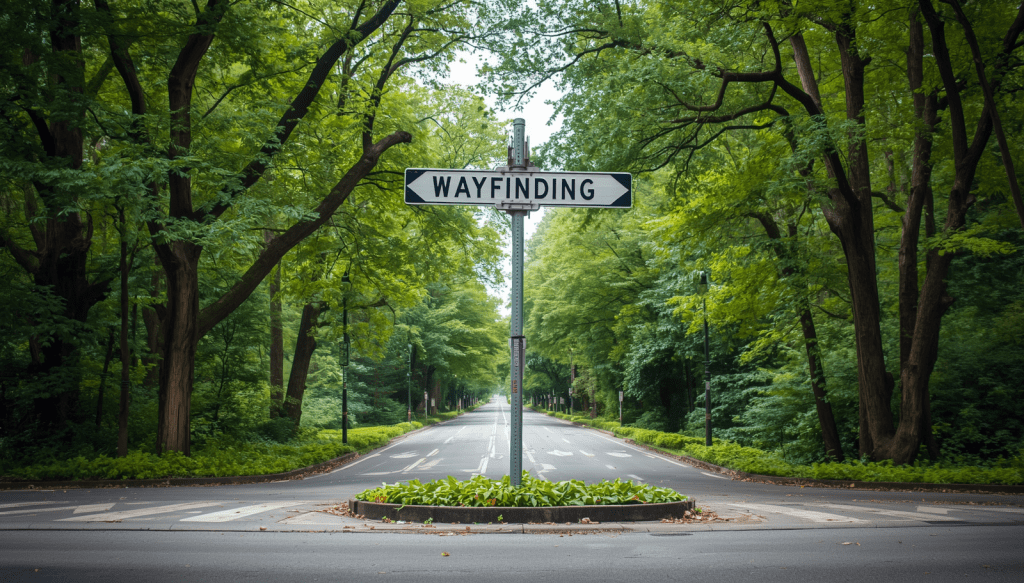
About: Once in a while, or many a time, we may feel we are losing our way in life, or are stumped in making a choice-taking a decision, or are driven mad in a relationship, or are almost on the verge of giving up. Enough is enough. And then, we search for something to latch on to – anchor our thoughts- to keep going. For most of us it is, faith-religion, family, friends, books, movies, music, love, inspirational quotes… goes on. But then, what’s the meaning of life? Is life some awesome rewarding treat? How do you find your way through the complex world we live in? How do we keep ourselves together and pull-through? This is an attempt to put together facts and some tales, from Books that I have read, or seen or heard, and my own experiences- to find our way. Consider this a Guidepost when you find yourself at the crossroads.
When I was a Project Manager working against many deadlines to modernise New Delhi’s horribly congested International Terminal-2, in the year 2007, one of the things that fascinated me was Signage. The Signage in an Airport Terminal is meant to be so simple that even a child is able to find his way from Check-in, through Departure to Boarding the Aircraft, without actually having to ask anybody for help. The colour scheme and placement is purposely designed for easy visibility, reading, understanding, and following directions in a commonsense manner.
Often, as we travel through life, we find ourselves at crossroads-with or without signage-and the road that we take is what matters. Robert Frost famously wrote in the Poem, ‘Road Not Taken’, “Two roads diverged in a wood, and I took the one less traveled by. And that has made all the difference”. Hidden in the woods, beneath the leaves, the signage is, the necessity of choosing. Robert Frost creates a multiplicity of meanings and describes how choice is inevitable.
Of course, we broadly need to know where we want to go. Reminds me of that iconic scene in Lewis Carroll’s, ‘Alice in Wonderland’, when Alice comes to a forked road and does not know which road to take. She spots a Cheshire Cat sitting at a nearby tree and asks, “Where does this road go”. “Where do you want to go”, asks the Cat. Alice replies, “I don’t know”. The Cat replies, “In that case any road will take you there”. Well, the story humorously explores direction, purpose, and sanity in life. If you don’t have a destination or goal in mind, any road will do.
Viktor E Frankl in his brilliant, must-read book,’Man’s Search for Meaning’ says we all experience what is called, The Existential Vacuum – a feeling of total and ultimate meaningless of life. No instinct tells us what we have to do, and no tradition tells us what we ought to do: sometimes we do not even know what we wish to do. Instead, we wish to do what other people do-conformism-or we do what other people wish us to do-totalitarianism. Typically, we fall in to this vacuum on weekends, when cut-out from a job that we are tied-up throughout the week, we sometimes feel listless and aimless.
Viktor Frankl goes on to say Man’s search for meaning is the primary motivation in his life. This meaning is unique and specific in that it must and can be fulfilled by him alone; only then does it achieve a significance. Each situation in life represents a challenge to man and presents a problem for him to solve. Ultimately, man should not ask what the meaning of his life is, but rather he must recognise that it is he who is being asked. Every man is questioned by life; and he can only answer to life by answering for his own life; to the life he can only respond by being responsible.
The meaning of life is to be discovered in the world, rather than within man or his own psyche, as though it were a closed system. We can discover the meaning of life in three different ways: (1) By creating a work or doing a deed: these are the people who have passion and fire in their bellies to something outstanding, like a Bill Gates, a Steve Jobs, a Jeff Bezos, a Elon Musk, to name a few; (2) By experiencing something or encountering someone: say sublime love. Here each one helps the other in actualising the potential that they saw in each other, when truly falling in love; (3) By the attitude we take towards unavoidable suffering: say, when someone in terminally ill and the only option is taking care of them as best as we can, to challenge death head-on.
Goes the famous saying by German Philosopher, Friedrich Wilhelm Nietzsche, “There is nothing in the world that would so effectively help one to survive even the worst conditions as the knowledge that there is a meaning in one’s life”. He who has a ‘why’ to live for can bear almost any ‘how’.
Famous author, Ayn Rand with her philosophy of objectivism presents us the ‘Ideal Man’. She says, “It is not the nature of man – nor any living entity- to start out by giving up, by spitting in one’s own face and damning existence; that requires a process of corruption whose rapidity differs from man to man. Some give up at the first touch of pressure; some sell out; some run down by imperceptible degrees and lose their fire, never knowing when or how they lost it. Then all of these vanish in the vast swamp of their elders who tell them persistently that maturity consists of abandoning one’s values; practically, of losing self-esteem. Yet a few hold on and move one, knowing that that fire is not to be betrayed, learning how to give it shape, purpose and reality. But whatever their future, at the dawn of their lives, men seek a noble vision of man’s nature and of life’s potential”. Ayan Rand’s novel, The Fountainhead is easily a rare guidepost, as well as, ‘Atlas Shrugged’, which is even better.
Ayn Rand goes on, “Man cannot survive except through his mind. He comes on Earth unarmed. His brain is his only weapon. Animals obtain food by force. Man has no claws, no fangs, no horns, no great strength of muscle. He must plant his food or hunt it. To plant, he needs a process of thought. To hunt, he needs weapons and to make weapons- a process of thought. From the simplest necessity to the highest religious abstraction, from the wheel to the highest skyscraper, everything we are and everything we have comes from a single attribute of man-the function of his reasoning mind”.
Lisa Feldman Barrett in her brilliant book, ‘Seven and a Half Lessons About the Brain’, writes, “Have you ever noticed that many newborn animals are more competent than newborn humans? A newborn snake can slither on its own almost instantly. Horses can walk shortly after birth, and an infant chimp can cling to its mother’s hair. In comparison, human newborns are pretty pathetic. They can’t even control their limbs. It takes weeks before they can swat their tiny hands with intent. Many animals emerge from the egg or womb with brains that are more fully wired to control their bodies, but little human brains are born under construction. They don’t take on their full adult structure and function until they finish their principal wiring, a process that takes about twenty-five years. And these writing instructions come not only from the physical environment, but from the social environment, from caregivers, and people like you and me. Cleverly summarised, on how the living environment shapes a child, and wires his brain.
Most of us consider the Brain’s job as, ‘thinking’. But it does not work that way, says Lisa Feldman Barrett. Your Brain is not for thinking, but running your body that has become extremely complicated. It does what is called ‘Body Budgeting’-automatically predicting and preparing to see the body’s needs before they arise. Your brain runs a budget for your body that regulates water, salt, glucose, and many other biological resources inside you. When it comes to body budgeting, prediction beats reaction.
An especially useful feature of the mind, and one of the closest things we have to a universal mental feature is Mood – the general sense of feeling that comes from your body. Scientists call is affect Feelings of affect range from pleasant to unpleasant, from idle to activated. Affect is not emotion: your brain produces affect all the time, whether you’re emotional or not and whether you notice it or not.
Affect is the source of all your joys and sorrows. It makes some things profound or sacred to you and other things trivial or vile. If you’re a religious person, affect helps you feel connected to God. If you’re a spiritual person but not necessarily religious, affect becomes the transcendent feeling of being part of something larger than yourself. If you’re a skeptic, affect is what drives your certainty that others are wrong.
Affect is like a barometer for how you’re doing. Remember, your brain is constantly running a budget for your body. Affect hints at whether your body budget is in balance or in the red. Ideally, evolution would have given you something more specific, like an app or a smart-watch to regulate your body budget precisely. Unfortunately, affect is not so precise. It just tells you, Beep! You feel like crap. Then your brain must predict what to do next to keep you alive and well.
Even though every human culture produces minds that feel pleasure, displeasure, calmness, and agitation, we don’t necessarily agree on what makes us feel these things. What the brain does to regulate the body may be universal, but the resulting mental experiences are not. Your kind of mind is just one among many, and you are not stuck with the mind you have. You can modify your mind. People do it all the time. For longer-lasting modifications, you can try new experiences or learn new things to rewire your brain. A particularly challenging way to modify a mind is by moving it to another culture-Acculturation. You change cultures when you switch between work life and home life, and when you change jobs and have to learn different norms and jargon of your new workplace.
In a pretty straight book, ‘Thinking Straight’, Darius Foroux says, you have the ability to decided what you think. And since the result of your life depends on your thoughts, it’s the most important thing in life. When we improve the way we think, nothing is impossible to achieve. That simple realisation changes everything. You become what you think all day long. And you must develop a Free Will – the sustaining of a thought because I choose to when I might have other thoughts. The first act of free will is to believe in free will. Change your thoughts; change your life.
Darius’s focus is on having useful thoughts. Only think about things you can control. That automatically eliminates about 99% of our thoughts because there’s very little you control in life. He makes a case of Thinking Straight at all times by staying grounded, looking at facts, listening to other people’s perspectives and then drawing practical conclusions. Thoughts should serve a useful purpose. If they don’t, they are useless. That’s thinking straight. Darius warns his about Cognitive Biases – a systematic thinking error that impacts judgements, and therefore, our decisions. And finally, thinking is not enough, you must put thoughts into action.
One of the most challenging things is for man to live with another of his species.
That’s where the importance of relationships, kick-in. And the best way to do it peacefully is defining and setting boundaries. Mark Manson’s book, ‘The Subtle Art of Not Giving a F-ck’ is a must read to delve into the art of staying cool and living your life the way you want to.
He says, Boundaries mean delineation between two people’s responsibilities for their own problems. People in a healthy relationship with strong boundaries will take responsibility for their own values and problems and not take responsibility for their partner’s values and problems. People in a toxic relationship with poor or no boundaries will regularly avoid responsibility for their own problems and/or take responsibility for their partner’s problems. The setting of paper boundaries doesn’t mean you can’t help or support your partner or be helped and supported yourself. You both should support each other. But only because you choose to support and be supported. Not because you feel obligated or entitled.
Entitled people who blame others for their own emotions and actions do so because they believe that if they constantly paint themselves as victims, eventual someone will come along and save them.
People can’t solve your problems for you. And they should’t try, because that won’t make you happy. You cannot solve other people’s problems for them either, because likewise won’t make them happy. The mark of an unhealthy relationship is two people who try to solve each other’s problems in order to feel good about themselves. Rather a healthy relationship is when two people solve their own problems in order to feel good about each other.
For a relationship to be healthy, both people must be willing and able to say ‘No’ and hear ‘No’. Without that negation, without that occasional rejection, boundaries break down and one person’s problems and values come to dominate the others. Conflict is not only normal, then: it’s absolutely necessary for the maintenance of a healthy relationship. If two people who are close are not able to thrash out their differences openly and vocally, then their relationship is based on manipulation and misrepresentation, and it will slowly become toxic.
Trust is the most important ingredient in any relationship, for the simple reason that without trust, the relationship doesn’t actually mean anything. For more, read Mark Manson’s book – a No 1 International Bestseller. It’s worth your time- build a ‘relationship’ with it!
Another book which enables you find direction and meaning is The Bhagavad Gita, which oozes with timeless wisdom. Every time you read it another window of thought opens. And it only enriches you. How did I miss that one?
It begins with a warrior prince on the battlefield, ready to fight a war to the regain his Kingdom denied by his blood relatives, who dishonoured an agreement to this effect. Seeing the Battle Array of the armies of both sides, his mind wavers and ponders on whether it is worth fighting to kill people he had grown up with and known all his life: friends, relatives, teachers, gurus. He is comprehensively overwhelmed by the situation, becomes a moral wreck, says he would rather renounce, retire in quietude, and throws down his arms, refusing to fight.
This is a classic existential crisis combining empathy, guilt, confusion about right and wrong, and loss of purpose. Lord Krishna later calls it a form of delusion born of ignorance (though he addresses it with profound wisdom).
Lord Krishna is the Charioteer of Prince Arjuna and the Gita is all about one’s calling, duty, maintaining equanimity of the mind and how to overcome such listlessness, in what is called the ‘Arjuna Affect’. At the end of the discourse Arjuna wakes up the reality of the situation, abandons regressive thoughts, realises his duty is to find fulfilment as a warrior on the battlefield, and fights to destroy evil – the enemy. That’s living true to his nature, and skilled and trained in the art of war.
Going back in time, in Homer’s Iliad, Achilles slays his life with honour, glory and immortality in battle. “If I remain here, continuing the fight against the Trojans’ city, that means I won’t be going home, but my glory will never die. But if I go back home, my fame will die, although my life will last a long time—death will not end it quickly”.
We all face the Arjuna Affect in various stages of our lives, say, when we are in a situation, where blinded by kinship, love or other factors, we are unable to decide on a course of action, feeling tied down. Leaders freezing before a necessary but painful decision then questioning just about everything and being swayed by various factors of the situation that we find ourselves in, and abandoning action. This was the same Arjuna who when aiming for the eye of the fish from a reflection in a mirror saw nothing but the target and hit it spot-on.
The Gita says, always perform actions without attachment. Do what is obligatory in your present social status, in your domestic situation, as a member of your community, and the nation, in a spirit of detachment and self-dedication. Do the work for the sake of the work. It is so important that one focuses on enjoying the journey, fully presen, rather than dreaming about the outcome or beneficial results of actions.
That which determines one man’s personality as distinctly different from another- it is very well known- is the texture of the thoughts entertained by him. To act according to one’s own inborn nature, is the only known method of living in peace and joy, in success and satisfaction. To act against one’s own inborn nature is fraught with danger. It’s dangerous to suppress one’s one personality and copy the activities of someone else, even if he is living a more noble and divine life. Be unapologetically authentic, says the Gita. Dharma essentially means the ‘the Law of Being’, of anything in the world and one has to find his own Dharma, his innate qualities and nature, and courageously live by it.
There is another directional story from Ayn Rand’s, The Fountainhead, which has always stayed with me. Remember, a man’s self-dignity is the fountainhead of human progress.
A young man had just graduated from College and in a moment of desperation he was riding his bicycle down a forgotten trail through the hills of Pennsylvania, where he had never been before. And he hoped he would not have to die (he was planning exactly that). He wanted to decide whether life was worth living. His thoughts were only to find joy and meaning in life-and none had been offered to him anywhere.
He did not like the things they taught him in College: about social responsibility; about a life of service and self-sacrifice. Everybody said it was beautiful and inspiring. Only he had not felt inspired. He felt nothing at all. So he felt anger that he should find exultation only in the wilderness, that this great sense of hope had to be lost when he would return to men and men’s work. He thought this was not right; that a man’s work should be a higher step, an improvement on nature, not a degradation. He did not want to despise men; he wanted to love and admire them.
He had always wanted to write music, and he could give not other identity to the thing he sought (apparently his family wanted him to do something else)
He saw a blue hole ahead, where the road ended on the crest of a ridge. He reached the edge and closed his eyes. But instead of being swallowed by the blue emptiness ahead, he woke up to find himself on the ground. He opened his eyes and stood still.
In the broad valley far below him, in the first sunlight of early morning he saw a town. Only it wasn’t a town. Towns did not look like that.
The sight was stunning. There were small houses on the ledges of the hill before him flowing down to the bottom. He knew the ledges had not been touched, that no artifice had altered the unplanned beauty of the graded steps. Yet some power had known how to build on the ledges in such a way that houses became inevitable, and he could no longer imagine the hills as beautiful without them. It was as if a series of changes, over centuries, that produced these ledges had waited for their final expression, which was these buildings, part of the hills, shaped by the hills, yet ruling them by giving them meaning.
There were many houses, they were small and they were cut off from one another, and no two of them were alike. But, they were like variations of a single theme, like a symphony played by an inexhaustible imagination, and one could still hear the laughter of the force that had been let loose on them, as if the force had run, unrestrained, challenging itself to be spent, but never reached its end. Music, he thought, the promise of the music he had invoked was there before his eyes. He did not see it, he heard it in chords. He thought that there was a common language of thought, sight and sound, and then it dawned upon him: ‘Architecture is music in stone’. The sight shocked him, it was unreal. In a way, it seemed proper; this was not part of known existence, and it made him dizzy.
A few steps away he saw a man- tall, gaunt, and with orange hair- sitting on a boulder, looking down at the Valley, fully absorbed in the sight. He walked over and asked him, pointing down, “That isn’t real, is it?” “Why, yes, it is, now”, replied the man. “It’s not a movie set or a trick of some kind?” “No, it’s a Summer Resort. It’s just been completed. It will be opened in a few weeks”. “Who built it?” He asks. “I did”, says the man. “What’s your name?” Howard Roark, came the reply. “Thank you”, said the young man. He lifted his bicycle and wheeled away-gaining the inspiration and the courage to face a lifetime. Ayn Rand strings the music so beautifully that you feel, this is the only way man should live, as a Creator, an Inventor, for which he requires independence. No man can live for another. Man’s fight duty is to himself.
I end this essay with the haunting lines from Donna Tartt’s bewitching masterpiece, ‘The Goldfinch’.
“That life-whatever else it is-is short. That fate is cruel, but maybe not random. That Nature (meaning Death) always wins, but that doesn’t mean we have to bow and grovel to it. That, maybe even if we’re not always glad to be here, it’s our task to immerse ourselves anyway: wade straight through it, right through the cesspool, while keeping eyes and hearts open. And in the midst of our dying, as we rise from the organic and sink back ignominiously in to the organic, it is a glory and a privilege to love what Death doesn’t touch.

 Kumar Govindan's Words