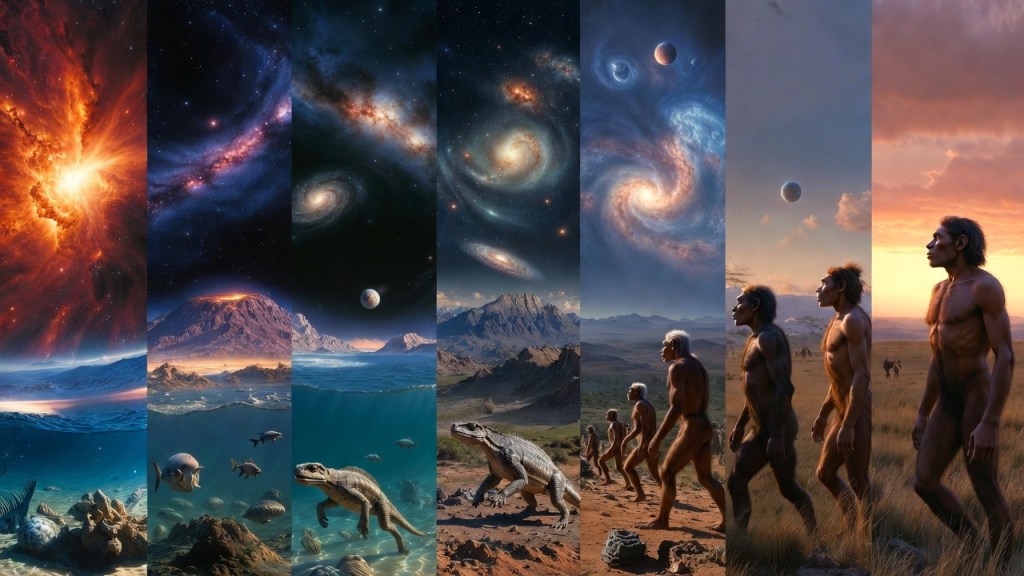
ORIGIN: BIG BANG to HUMANS

About: we have read about the origins of the Universe, our Milky Way Galaxy, the solar system, and our Planet Earth, of the beginning of time; of the beginning of life and everything as we know it today. With so many stories swirling about us, I was fascinated and wanted to pin-down our origins in about 15 minutes. This is an attempt to present how it all began in a simple manner, leaving alone much of evolutionary and scientific jargon – that’s for you to connect the dots. (The image shown is Grok AI generated).

Scientists describe the Universe beginning as an extremely tiny, incredibly hot, and unimaginably-dense point-called Singularity: where density and temperature is infinite. Everything-space, time, matter, and energy-was squeezed into something smaller than an atom. Then, suddenly, it began expanding very rapidly and finding its own ‘Space’. This expansion is what we call the Big Bang – so well explained by astrophysicist and cosmologist Stephen Hawking (almost to the point that we believe he owned it). It wasn’t an explosion in space; it was space itself stretching out everywhere, all at once.

We do not know exactly what caused or triggered the Big Bang, which occurred about 13.70 billion years ago. Current scientific knowledge breaks down at that extreme point, so ‘what came before’ or ‘what caused it’ may not even make sense in the usual way. Time itself began with the Big Bang-there was no ‘before’ because time didn’t, exist yet – like asking what’s north of the North Pole. Hence, Time is Zero, when the Big Bang happened.

The first lively second produces gravity and other forces that govern physics. In less than a minute the Universe is a billion kilometres across and growing fast. All done in about the time it takes to make a sandwich.

Immediately after the Big Bang, things began cooling-down and scale-up, step-by-step: in the first moments and within about 3 minutes a soup of super-hot particles came into being. Then the Universe cooled just enough for the first protons and neutrons to form simple atomic nuclei-mostly hydrogen and helium. About 380,000 years later it cooled more, electrons joined nuclei and the first full atoms formed. Light could travel freely: we see this today as the cosmic microwave background-leftover glow from the early universe. In the next few hundred million years gravity pulled tiny differences in density into bigger clumps. The first stars and galaxies formed from gigantic clouds of hydrogen and helium gas. Stars ‘cooked’ heavier elements. Inside the stars itself, nuclear fusion created carbon, oxygen, iron, etc. When massive stars exploded as supernovae, they spread these elements into space.

About nine billion years after the Big Bang (4.6 billion years ago) in our Milky Way Galaxy, a cloud of gas and dust-enriched with those heavy elements from old stars-collapsed under gravity eventually leading to the formation of the Solar System: the centre became our Sun (a star that started fusing hydrogen). Around it, a spinning disk of leftover gas and dust formed. Tiny particles that stuck together grew into planetesimals (solid, rocky, or icy bodies ranging from a few kilometres to hundreds of kilometres across) collided and merged into planets.

About 4.5 to 4.6 billion years ago Planet Earth formed from rocky material in the inner part of the disk (closer to the Sun). Early Earth was molten from impacts and heat. A big collision with a Mars-sized object blasted debris that formed the Moon and also tilted the Earth’s Axis, causing the seasons we know. Over time, it cooled, water arrived (likely from comets and asteroids), oceans formed, and eventually life began. Then, about 3.8 billion years ago, the first organisms emerged.

Every scenario we know concerning the conditions necessary of life involves water. ‘Origin of Species’ scientist Charles Darwin hypothesised a small, shallow, warm body of water-a pond or tidal pool on early Earth-where a cocktail of simple chemicals could concentrate and react under energy sources like sunlight, heat, and other catalysts to form complex organic molecules, such as proteins, eventually twitching into the first primitive life forms. That’s the ‘warm little pond concept’. And some theories suggest that deep-sea hydrothermal bubbling vents could have done the same.

Once life existed, any new proto-life would be quickly consumed by existing organisms, explaining why such spontaneous generation doesn’t happen today. Everything that has ever lived, plant or animal, began from this primordial twitch. But this ancestral packet of life did something additional and extraordinary: it cleaved itself and produced an heir. And a tiny bundle of genetic material passed from one living entity to another, and has never stopped moving since. It was the moment of creation for all of us. Biologists sometimes call it the Big Birth. All living things use the same code.

The Earth’s surface did not become solid until about 3.9 billion years ago. There was no oxygen to breathe back then than there is on Mars today. About 3.8 billion years ago the first bacterial organisms emerged, and for two billion years they were the only forms of life: they lived, reproduced, and swarmed, but did not show any particular inclination to move on to another more challenging level of existence.

At some point in the first billion years of life on Earth, a kind of bacteria called Cyanobacteria, or blue-green algae, learned to tap into a freely available resource – the hydrogen than exists in spectacular abundance in water. They absorbed water molecules, supped on the hydrogen and released oxygen as waste, and in doing so, invented photosynthesis. This is undoubtedly the most important single metabolic innovation in the history of life on the planet. And it was invented not by plants, but by ‘smart’ bacteria.

Now, finally, we had oxygen in the Earth’s atmosphere, but it took awfully long for life to grow into the mind-boggling complex variety we know today. As the world had to wait until the simpler organisms had oxygenated the atmosphere sufficiently. Animals could not summon up the energy to do work. And it took about 2 billion years for oxygen levels to reach more or less modern levels of concentration in the atmosphere.

With the oxygen stage thus set-up brilliantly, quite suddenly an entirely new type of Cell arose, containing a nucleus and little bodies called organelles. The process is thought to have started when some blundering or over-adventurous bacterium either invaded or was captured by some other bacterium and it turned out that it suited them both. Call it a win-win situation. The captive bacterium became, it is thought, a mitochondrion, which made complex life organisms possible. In plants, a similar invasion produced chloroplasts, which enable plants to photosynthesise.

The uniqueness of mitochondria is that they are powerhouses, which use oxygen to breakdown food and release molecular energy. And without this ability, life on Earth would be nothing more than a sludge of simple microbes. They are also unique in that they have their own genetic material.

With the cell firmly established and having a means- an in-house power plant- of producing energy for its functions through the mitochondria, life naturally took the next step to building complex ‘skyscraper’ beings. Starting with a single cell, splitting to becoming two, and the two becoming four…life raced to build-up like crazy. Each cell carries the complete genetic code-the instruction manual for the living being it makes: it knows how to do its job and every other job of the body of the being. All living beings possess hundred of different types of cells. And the genetic code that enables them to be itself is the molecule called DNA (Deoxyribonucleic Acid)- the stuff of life- a legend in its own right and the blueprint of life. DNA exists for just one reason: to create more DNA.

Quickly, ‘sizing-up’ the DNA: It holds the complete set of instructions for building and operating an organism and carries genetic instructions from parents to offspring ensuring traits are passed down the assembly line. DNA is responsible for making proteins-vital for life. But they do not speak the same language as the proteins they engineer. Enter the RNA (Ribonucleic Acid) which acts as an interpreter between the two, working with a ‘chemical clerk’ called a Ribosome to carry out the instructions of the Big Boss – the DNA. That’s it, we built this animal.

To give a timeline, the great oxygenation event occurred 2.4 billion years ago, which transformed the atmosphere into one capable of enabling life. Multicelluar algae appeared about 1 billion years ago and the first soft-bodied multicellular organisms appeared about 550 million years ago leading to organisms with hard parts (shells, exoskeletons), then marine invertebrates, which dominate for a period of time; then the first vertebrates (jawless fish), first land plants, then we reach the age of fishes, progressing to the first four-limbed vertebrates that venture onto land; forests appear; amphibians diversify, first reptiles evolve. And then the mighty Dinosaurs evolve from archosaur (vertebrate, four-legged)reptiles; early mammals and crocodilian relatives appear.

At the beginning of the age of Dinosaurs, about 230 million years, ago the continents were arranged together as a single supercontinent called Pangea. Dinosaurs lived on Earth for a fabulous 165 million years and during their existence the supercontinent slowly broke apart. Undoubtedly, they are one of the most successful groups of animals to have roamed the planet. But despite their long evolutionary history, the origin of Dinosaurs remains shrouded in mystery. They went extinct when an asteroid the size of a mountain slammed into Mexico’s Yucatan Peninsula with the force of 100 trillion tons of TNT. The impact created a crater about 185 kilometres across and several kilometres deep and sent tons of rock, dust, and debris into the atmosphere. A darkness descended across the planet that, along with other related catastrophes, wiped out an estimated 80% of life on Earth. Whatever the causes, the huge extinction that ended the age of the Dinosaur left gaps in ecosystems around the world. And these were subsequently filled by the only Dinosaurs to survive – birds – and mammals, both of which went on to evolve rapidly.

After the Dinosaurs became extinct small, surviving mammals thrived in the empty ecosystems. Over millions of years, these shrew-like creatures evolved into primates, then Apes, and finally, after about 60–65 million years of evolution, early hominids emerged in Africa around 4 to 7 million years ago, eventually leading to Homo sapiens, 200,000 to 300,000 years ago. Humans did not appear immediately after the dinosaurs; rather, they are the result of a long, 65-million-year, evolutionary process of mammals that survived the Dinosaur extinction event. And Dinosaurs and Humans never lived together – as show in fantasy movies.

Having come thus from simple organisms to complex Dinosaurs, how did even more complex Humans appear? Human prehistory is still under an intensive investigation with all kinds of discoveries and debatable theories evolving from the pools, vents, mysterious caves, fossils, and what not? Whatever, what we roughly know is that for almost 100% of our history as organisms, we were in the same ancestral line as Chimpanzees. Hardly anything is known about the prehistory of Chimpanzees, but wherever they were, we were.

Then about 7 million years ago something monumental happened: a group of new beings emerged – walked – out of the tropical forests of Africa- somewhere in the Great Rift Valley – and began to move about in the open savanna. They were called the Australopithecines, or Hominina (Southern Ape) and for the next five million years they would be the world’s dominant hominid species. They were capable of walking upright and existed for over a million years. The most famous hominid is the about 3.18 million-year old Australopithecine discovered in Ethiopia, East Africa, in 1974, called Lucy, named after the Beatles song, ’Lucy in the Sky with Diamonds’. Lucy is our earliest ancestor – the missing link between Ape and humans-said Donald Johanson the leader of the team that made the discovery. Lucy was tiny, just three and a half feet tall. She could walk and was evidently a good tree climber. She and her kind came down from the trees and out of the forests and did the walk of life. Now, being out in the open, calls for more survival skills and all the elements would appear to have been in place for rapid evolution of a potent brain, and yet that seems not to have happened. For over three million years Lucy & Co scarcely changed at all. Their brain did not grow and there is no sign of them developing simple tools despite the fact that they lived alongside other early hominids who did use tools.

At one point between three million and two million years ago there were as many as six hominid types co-existing in Africa. Only one outlasted all of them: Homo, which emerged about two million years ago. The relationship between Australopithecines and Homo is unknown, but they co-existed for over a million years before Australopithecine vanished mysteriously, and possibly abruptly. The Homo line begins with Homo habilis and concludes – rather continues – with us, Homo sapiens (the thinking man). In between there have been other Homo species: Homo ergaster, Homo neanderthalensis, Homo denisova, Homo rudolfensis, Homo heidelbergensis, Homo soloensis, Homo antecessor, and Homo erectus.

One group of tool users, Homo erectus, who seemed to arise out of nowhere, overlapped with Homo habilis and is said to be the dividing line: everything that came before them was apelike in character; everything that came after them was humanlike. Homo erectus was around for almost 2 million years, making them the most durable human species ever. Remember we, Homo sapiens are only about 200,000 years old, and we are still a long way from beating the record of Homo erectus.

Homo erectus was the first to hunt, the first to use fire, the first to fashion complex tools… and the first to look after the weak and frail. They were unprecedentedly adventurous and spread across the globe with breathtaking rapidity. Ultimately, Homo erectus and all other human species became extinct and Homo sapiens -outwitting all of them, probably with a thinking brain- was the only surviving human species, from about 13,000 years ago. And that’s all Out Of Africa.

To sum up, human evolution in over five million years from the distant puzzled Australopithecine to the fully modern human, produced a creature that is still 98.4% genetically indistinguishable from the modern chimpanzee.

So finally, what are human beings made-up of? We are fundamentally made of stardust forged inside ancient stars, or during their-supernova- explosive death, of course, billions of years ago. Humans are constructed with about fifty-nine elements. The top being – Carbon, Hydrogen, Nitrogen, Oxygen, Phosphorus, Sulphur, and Calcium, which account for over 99%. They are the building blocks of life. We are incomplete without molybdenum, vanadium, manganese, tin, copper, cobalt, chromium, and others. The biggest component in any human, filling over 60% of available space is, Oxygen, which is bound up with say Hydrogen and other chemicals to stay in the body.

Let’s go back to the mitochondria story and talk about man and woman – the male and female of us, the Homo sapiens species.

I’m not delving into the structure of the DNA, the genome, or the 46 Chromosomes-23 pairs-each half coming to us from Mom & Dad and XX being female and XY being male. That’s for you to read-up. But, remember, each human cell defined by a cytoplasm boundary wall has a nucleus (holding the DNA) and specialised organelles such as Mitochondria, Endoplasmic Reticulum, Golgi, Ribosomes, Lysosomes, Cytoskeleton, among others.

Women are the sacred keepers of human mitochondria. Sperm pass on none of their mitochondria during conception, so all mitochondria information is transferred from generation to generation through mothers alone. Such a system means there were many extinctions along the way. A woman endows all her children with her mitochondria, but only her daughters have the mechanism to pass it onwards to future generations. That leads us all the way to a Mitochondrial Eve from whom all of us descended. And they say, the last common grandmother of humans and chimpanzees was about 6 million years ago.

Mitochondrial Eve is defined as the most recent woman from whom all living humans descend in an unbroken line purely through their mothers and through the mothers of those mothers, back until all lines converge on one woman. Scientific studies place Mitochondrial Eve in Africa, likely in the Great Rift Valley, roughly 160,000 to 200,000 years ago. Mitochondrial Eve was part of a contemporary population of humans. Other women alive at that time may have descendants living today, but their unbroken female lineages failed to persist, or they only had sons who could not pass on her specific mitochondrial DNA.

Here we are, Homo sapiens, with such great ancestry coded in our genes, in every cell of our body-made of star dust. And to be born with all this stuff inside us, is by itself a great achievement. And remember women have a place in the scheme of things, carrying the storyline onwards.

I quote Richard Dawkins’s, Unweaving the Rainbow, “…the set of possible people allowed by our DNA so massively exceeds the set of actual people. In the teeth of these stupefying odds it is you and I, in our ordinariness, that are here”. Make the best of it. Make it count.

The next 15 minutes story coming up is about the first human civilisations, how they evolved, the various ages of human knowledge…up to the Industrial Revolution. Watch this Space-without dust in your eyes.

WORLD INTHAVAARAM, 2021-52

About: the world this week, 19 December to 25 December 2021, the thing of the year, the country of the year, signs of an invasion, bad behaviour by lawmakers, an antediluvian egg, and movies – in and out of prison; and a stylish, smashing brother helps.

Everywhere

My ‘Thing Of The Year’, the coronavirus and its evolving mutations, continues to hold the world in thrall, and by the throat. The latest avatar, Omicron, is already dominating infections in the United States (US), the United Kingdom (UK), and most of Europe. To give a statistic: Covid19 deaths in the US now exceed all deaths, military and civilian, in all American wars since the Revolutionary War (1775-76).

India is watching with ‘masked breath’, the cases are slowly growing in numbers and that dreaded word, ‘lockdown’ is unlocking in our minds. Many of us hope it dare not get a stronghold, the way it tossed us up, gasping for breath, in the so-called second wave.

Latest studies say that the Omicron variant isn’t as bad as the Delta variant, but certainly more infectious. We just need to keep ourselves ahead of the spikes: do what it takes to stay safe this Holiday Season – get and wear that armour.

With Christmas approaching, I hope everyone’s wish is a ‘stocking filled with the belief that the world will see the last spike of the coronavirus in 2022 – and others of its kind’. It may be a tough load for Santa to reindeer-in through the chimney, but faith is everything.

Italy

Italy was crowned the ‘Country of the Year’ by The Economist newspaper, in its annual honouring of the country that, in its view, improved the most in the year 2021: mind it, the award is not given to the biggest, the richest, or the happiest country! Central to the honour was Mario Draghi, described as a ‘competent, internationally respected Prime Minister’. Meanwhile, disgraced former Prime Minister Silvio Berlusconi is modelling a comeback! Auguroni (Best Wishes).

Russia and Ukraine

Russia invaded the headlines this week, firing the eternal question, ‘is Russia going to annex Ukraine -like it did Crimea-are Russian forces getting ready for war in Ukraine?’ Oops, since when did invasions become fashionable again; ask the Vikings in Valhalla?

It was only seven years ago, in 2014, that Russia seized and then annexed the southern Crimean Peninsula from Ukraine, when Ukrainians were busy deposing their pro-Russian President. And Russian-backed separatists captured large swathes of Ukraine’s two eastern regions collectively known as the Donbas.

There is a mind problem here with Russia developing a mindset that Russia and Ukraine are one nation, after the fall of the Soviet Union: a twin brothers-separated-at birth-thing. Russian is the second most spoken language in Ukraine after Ukrainian. Another cause for Russia’s concern is that Ukraine is ‘sleeping with’ NATO (North Atlantic Treaty Organization) and may marry into the Western Alliance. And Russia is demanding guarantees that the wedding will never happen.

NATO is a defensive alliance and its Secretary General, has made clear that any military support would be purely along those lines. The UK is set to help Ukraine build two naval bases, at Ochakiv on the Black Sea, and at Berdyansk on the Sea of Azov. The US’ anti-tank Javelin missiles have also been sent to Ukraine and two US Coast Guard patrol boats have been given to the navy. And Russia’s President Vladimir Putin is watching closely.

Meanwhile, Ukrainian President Volodymyr Zelensky is looking for a clear timeline from the alliance. Wedding bells adding sound to the jingle of Christmas?

Russia is threatening military measures, and the US says if it invades Ukraine it will hit back with sanctions on an unprecedented scale. This is a place to watch. Maybe it’s just a Russian posturing, to prevent NATO from marrying more nations and bringing many children into the world opposed to Russia…and in Russia’s backyard.

India

India’s Opposition continued to ‘dishonour’ Parliament – in my view – sulking and striking over a well-deserved suspension of 12 fellow Members of Parliament (MP) for unruly, unacceptable behaviour, in the previous session. And wasting tax-payer’s money. Late in the week, another Quiz-Master turned MP joined the gang after flinging the Rule Book at the House Speaker. The best part is, these MPs wore the suspension as a badge of honour and along with ‘their partners in crime’ ensured Parliament work was disrupted.

MPs should set an example by setting in motion thoughtful discussions, artful debates and, agreeing to agree and agreeing to disagree.

Meanwhile, the Government rammed through Lower & Upper Houses of Parliament some much-needed electoral reforms, linking the unique Identification, Aadhar Card, with the Voter’s Identity Card – an obvious attempt a controlling election voting fraud.

The Government also tabled a bill, after Cabinet approval, to increase a woman’s age of marriage to 21, from the earlier 18, bringing it on par with a man. Women should be able to make better choices at this age and overcome a constant Indian pressure to marry-off the girls when they are just beginning to get the hang and the bang of things.

Dinosaurs

Over the years, we have become used to news of Dinosaur bones being discovered while digging in some corner of the World and put together to find a big name for it: many have landed up in museums where we can see the past ‘assembled and standing still in front of us’. Dinosaurs were real.

Now comes a more real story, announced by Scientists this week, about an unprecedented fossil, a perfectly preserved baby dinosaur curled up, almost life-like, inside its egg and obviously preparing to hatch, just like a chicken. The fossil is about 70 million years old.

The egg is around 17 centimeters (cm) long and the Dinosaur is estimated to be 27 cm long from head to tail. The researchers believe as an adult, had it lived, it would have been about two to three meters long. The fossil preserves the embryonic skeleton of an Oviraptorid Dinosaur, which has been nicknamed ‘Baby Yingliang’ after the name of the Chinese museum which houses the fossil. Baby dinosaur bones are small and fragile and are only very rarely preserved as fossils, making this a very lucky find, indeed.

All birds directly evolved from a group of two-legged dinosaurs known as Theropods, whose members include the towering Tyrannosaurus Rex and the smaller Velociraptors. This find is expected to shed more light on the links between dinosaurs and birds, among other things.

The specimen was among several fossils discovered about two decades ago in the China’s City of Ganzhou in the south-eastern province of Jiangxi but not recognised to be fossilised dinosaur eggs until 2015, when evaluated by an expert. The fossils were acquired in the year 2000 by a director of a Chinese stone company called Yingliang Group and ended up in storage, largely forgotten until about 10 years later, when museum staff sorted through the boxes and came across the fossil during the construction of Yingliang Stone Nature History Museum. Eventually, the egg shell slightly cracked and the fragile bones inside became visible, prompting a peek-in.

Researchers then led a study of the fossil, which was published in the journal iScience this week. Well, they hatched the egg for us to see.

Please Yourself

Over the week I watched the magnificent Sandra Bullock movie, The Unforgivable’ about a woman who tries to re-enter society, after serving a 20 year sentence in prison: to a society that is unforgiving and refuses to allow her to forget her past. Her only hope for redemption is finding her younger sister who she was forced to leave behind without a care-taker. Her mom dies in childbirth after giving her a little sister. And upon the death of her Dad she brings up the sister in her childhood home until ‘the crime’ when the Sheriff who comes over to evict them is shot dead in the ensuing war of words.

The end brought tears to the eyes with the sisters ‘closing the gap’ with a simple hug and the body language doing all the talking. Brilliant. Before the end there is a twist, which tells us what actually happened on that fateful day. Watch the movie and find out for the sacrifices made by a sister to protect her 5 years old sibling and the never give-up spirit in finding and connecting with her again. Give purpose to life on Earth!

I had also watched the Rajinikant Tamil movie ‘Annaantthe’ and found it dumb to the core. But, I loved the way a brother does everything possible to be understanding, and building back the life of his sister, without showing himself-until the end, when the job is done. Here too the story ends with a hug, though a noisy one.

The sister elopes with her lover, when the brother fixes-up a marriage, and thereafter suffers terrible misfortune in business due to an ‘underworld rowdy gang’. And the brother comes to the rescue, unnoticed by the sister. Again, the brother raises the sister from a young age, when the parents die. He dotes on her expansively and refuses to fall in to the age-old trap of ‘finishing off a runaway bride’ to save the ‘family honour’.

Any sister would love to have such a brother watching over from behind and giving you the muscle to face and climb out of a treacherous situation. Call it strengthening the wings for the flight of life. And a permanent life support.

The superb Actor that Rajinikant is, there are not many film makers and directors who have done justice to his capabilities, calmly using his unique style. And Rajini has allowed himself to be dragged along the beaten path…punching dialogues, flicking cigarettes, and other things as well. He can do better.

More stylish sibling love stories coming up in the weeks ahead, hug World Inthavaaram. Careful when you break those eggs for breakfast – there may be a baby Dinosaur sleeping inside.

Season’s Greetings, Happy Holidays, Merry Christmas, and a Happy New Year 2022.

WORLD INTHAVAARAM, 2021-24

About: the world this week, 6th June to 12th June 2021, how a Group of wealthy Nations met, a butcher of people punished, classic Tennis played, the pandemic cornered, and Animals on the Planet drawing our attention, in mysterious ways.

Everywhere

The Group of Seven (G7)

The G7 is an informal group of seven of the world’s wealthiest democracies, which meet annually to discuss the economy, peace, security, climate change, and of course, this year in particular, the coronavirus pandemic.

The Group consists of the United States of America (USA), Canada, the United Kingdom (UK), Germany, France, Italy, and Japan. The Annual Summit is normally held in the country which holds the rotating Presidency and this year it was the turn of the UK to play host. Leaders of four other prominent democracies have also been invited to attend: Australia, India, South Korea, and South Africa.

In a prelude to the main G7 Summit, a meeting of G7 Finance Ministers was held on 5th June, at Lancaster House, London to discuss economic policies, and perhaps reach an agreement on something. They did. The attending Finance Ministers decided on a Global Corporation Tax rate of 15%, which can ultimately be applied by all nations. This creates a new right for countries to tax the profits, of large multinational companies, based on where they make their sales.

The landmark deal, signed last Saturday, is intended to prevent digital companies such as the Google, Amazon, and the Facebook kind, from finding and exploiting tax-avoidance or minimisation loopholes in the national tax system of countries. And also to tackle the huge inequalities between such digital firms, and the rest of the business community, a divide which has grown wider during the ongoing pandemic.

International tax deals are rare, and usually thwarted by countries that either charge low levels of tax, such as Ireland, Hungary, and Cyprus, or that have close ties to tax-havens, such as the UK and the Netherlands.

There are significant details yet to be worked out, and the deal is not sufficient to see the new rules applied globally. For that to happen, it would require support from the Group of 20 (G20) leading economies, which includes China and India, as well as the backing of the 135 countries that have been negotiating the new rules as part of what is known as the Inclusive Framework.

Finance Heads of the G20 countries are due to meet in Venice, Italy, on 9th and 10th July 2021 to make hay on the new G7 tax sunshine.

Taxing large companies is awfully taxing, but that’s where the wealth of nations lie!

Meanwhile, the main G7 Summit is being held this week, between the 11th & 13th June at the Carbis Bay Hotel, Cornwall, United Kingdom, in which leaders of G7 nations are meeting each other, to hold face-to-face discussions. And see, meet, and get to know the better halves-if around, on the sidelines.

The ever-brightly dressed Queen, all of 95 years, sharing her childhood name, Lilibet, with her freshly minted great-grand daughter, posed for a photo with the G7 Kings, and cheekily posed the question, ‘Are you supposed to be looking as if you are enjoying yourself?’ Watch this space.

The Butcher of Bosnia

Bosnia and Herzegovina, often known simply as Bosnia, is a country located within the Balkans in South-East Europe with capital as Sarajevo, its largest city. It is bordered by the countries of Croatia, Serbia, and Montenegro, with a narrow coast to the Adriatic Sea.

Recall that the countries of Bosnia, Croatia, Serbia, Montenegro, Macedonia, and Slovenia was once a federation of republics called Yugoslavia, which eventually disintegrated into separate countries, much like the Union Of Soviet Socialist Republics (USSR) did.

In the year 1992 Bosnian Muslims, called Bosniaks, and Croats voted for independence in a referendum boycotted by the Serbs. The region then descended into an ugly war with the Bosniaks and Bosnian Croats on one side and the Bosnian Serbs on the other, fighting for control over ethnic territory, in what was called the Bosnian War, which lasted four years. Several other former Yugoslav Republics also declared Independence about this time.

Ratko Mladic, a Bosnian Serb Military leader-nicknamed ‘the Butcher of Bosnia’-who was fanatical about ethnically cleansing Bosnaiks from Bosnia, led the Bosnian Serb Army in the war, which left about 100,000 people dead and displaced another 2.2 million. He orchestrated a campaign to slaughter and annihilate more than 8,000 Muslim men and boys in the mountain Town of Srebrenica, in July 1995, in the worst massacre to have taken place in Europe since the Second World War.

When the Bosnian War came to an end in 1995, Mladic facing an indictment of war crimes, went on the run and for 16 long years evaded capture until his arrest, finally, in May 2011. He was then extradited for trial in the Netherlands.

For years he was offered protection by Serbian President Slobodan Milosevic, and the Serbian and Bosnian Serb military and police. Milosevic was himself a master-mind behind ethnic cleansing of non-serbs and when he lost power in October 2000 was sent packing to The Hague War Crimes Tribunal.

Mladic was captured in the village of Lazarevo, near the town of Zrenjanin in northern Serbia, after an anonymous tip-off to police was made by someone who had seen a man who looked like Mladic and was carrying documents bearing that name.

He was put on trial in 2012 at The Hague, Netherlands, for crimes committed during the Bosnian War, with a total of eleven charges including genocide.

In 2017 he was found guilty and convicted to life in prison on one count of genocide and nine crimes against humanity and war crimes by an international criminal tribunal. He was found ‘not guilty’ of one only charge of genocide.

Ratko Mladic had appealed against the ruling and this week he lost. The International United Nations Court dismissed the appeal and upheld his Life Sentence.

Mladic’s behaviour was absolutely reprehensible during the trial. In the 2017 conviction he shouted the choicest and ‘most colourful’ obscenities, gesticulating at the relatives of the victims. This time he scowled and showed little emotion. He was the only person in court not wearing a mask.

He joins his one-time master and boss, former Bosnian Serb President Radovan Karadzic who is also convicted and serving a life sentence for being a key architect in ethnic cleansing and civil war that followed the break-up of Yugoslavia.

Ratko Mladic’s name is consigned to ‘the dustbin list’ of history’s most depraved, ruthless and barbaric figures.

French Open 2021

Switzerland’s Tennis ace and Legend, Roger Federer, had a gruelling, clay-grinding time at the French Open given that he is coming-back to the game from two back-to-back knee surgeries in 2020. He played over three hours to defeat Germany’s Dominik Koepfer in a five-set match including three tie-breaks sets, to set up his next encounter with Italy’s Matteo Berrettini for a place in the quarterfinals. Back and Knee breaking for sure.

Federer then proceeded to ‘talk to his knees’ and came out with an unanimous decision to quit the French Open and save his knees for Wimbledon, where he is targeting a 9th Title, later this month, on his favourite grass court surface.

Wimbledon’s Pride, French Open’s Envy? See you in Wimbledon.

Meanwhile, in yesterday’s Men’s semi-final, Tennis fans were enthralled seeing almost perfect clay-court, classic Tennis being played when Serbian Novok Djokovic beat – the until then, undefeatable, 13-time hero of the Roland Garros-Spaniard Rafal Nadal, to reach the Finals in an absolutely gripping four-set match. The third set will go down in History as one for the best ever and should be framed. Djokovic meets Greek Stefanous Tsitsipas in the final, to be played on Sunday, for a possible 19th Tennis Grand Slam Title.

In the Woman’s Final, an unlikely match as been set with unseeded Czech, Barbora Krejcikova reaching the final to challenge Russian, Anastasia Pavlyuchenkova for the title. Well, that’s open!

India Looks Up

India is steadily looking up from the second wave of COVID19 with diving daily infections, but there is an alarming increase in deaths as previously unaccounted data is being added. However more lives are being saved and many States have started a process of awfully slow unlocking.

With the Vaccines of Covishield, Covaxin, and Sputnik V already rolled out, India placed an advance order worth Rs 1,500 crore for 300 million doses of Hyderabad, India, based Biological E’s CORBEVAX Vaccine.

Corbevax is a protein subunit vaccine, which comprises only spike proteins that are injected into the body to trigger an immune response. Such vaccines are considered to be one of the safest and time-tested, juxtaposed to mRNA based Vaccines, which is relatively new technology. Further, it does not involve injecting a whole de-activated virus. The Vaccine is currently undergoing Phase-3 trials and is expected to be ready for regulatory authorization and launch in August 2021.

India’s homemade Vaccine, Covaxin, is struggling to get approved abroad as its Phase-3 clinical trials are yet to be published-made public. Recall that India had approved Covaxin for Emergency Use, in January 2021 without waiting for the phase-3 clinical trials. Subsequently interim results were published in April, which showed satisfactory efficacy, justifying their use. More than 29 million doses of Covaxin have already been administered. The manufacturer, Bharat Biotech, Hyderabad, has said the results will be released in a couple of weeks. I’m sure it will pass with distinction.

In the background of a seemingly mangled Vaccination Policy, which the States compounded by acting like Rambo’s, trying to buy Vaccines on their own, India’s Prime Minister rightfully went on national Television to give a new direction to the Vaccination Drive. Enough is enough. He announced that the Centre will, in addition to the 50% it is already buying from the Vaccines manufacturers will also buy out the 25% State quota – a total of 75% production of Vaccines- and give it free of cost to the States, to distribute. The remaining 25% will go to Private Hospitals who can charge a fixed service fee of Rs 150 over the declared cost of the Vaccine. The new plan unfolds from the 21st June.

Lets have our eyes on the needle.

It’s Raining Babies in Africa

In World Inthavaram 2021-19, I talked about a Population Explosion, when a 25 years old woman, Halima Cisse, from Mali, gave birth to nine babies in a single delivery. This challenged the ruling eight-babies world record of Nadya Slueman, California, USA, in the Guinness World Records.

The record did not change heads or stomachs, not yet, as there is a weighty competition from a 37 years old woman in Pretoria, South Africa, Gosiame Thamara Sithole, who this week gave birth to 10 babies-five through natural birth and five through Caesarean section, seven boys and three girls, in a single delivery. In her previous adventure Gosiame Sithole had given birth to twins, who are now six years old.

Wonder where we are heading? Better start getting that flight to the Moon or Mars ready?

Meanwhile, in Nigeria the Town of Igbo-Ora has an unusually high birth rate of twins, where you might think you are seeing double. The Town has one of the highest birth rates of twins in the world.

China, which is struggling with birth rates and recently upgraded itself to a three-child policy, needs to send a team out to Africa in general, and Nigeria in particular, to penetrate the secret that makes the twins-show tick. Beg, borrow, or steal twins-making technology? China Can!

Animal Planet

24,000 Years Under the Ice

Heard of something called Bdelloid Rotifer? I haven’t until today.

They are unique microscopic, multicellular freshwater invertebrates with complex anatomies that are one of Earth’s most radiant-resistant animals. They can withstand extreme acidity, starvation, low oxygen, years of dehydration, and just about any form of torture.

They are solely female, reproduce entirely asexually and have avoided sex for nearly 80 million years. That’s loneliness to the limits. They have a complete digestive tract that includes a mouth and an anus and have the ability to halt all activities and almost entirely arresting their metabolism. At any point in their life cycle they can be completely dried-out and ‘vanish’ in to a sublime dormant state. And can spring back to life – alive and kicking- after tens of thousands of years in deep freeze.

The closest relatives of the Bdelloid Rotifer are the Tardigrades or ‘water bears’, which are impossibly cute animals and perhaps the hardest animals alive and known to survive incredibly inhospitable conditions. That’s toughness written all over them.

This week, Scientists in Siberia discovered Bdelloid Rotifer that have survived 24,000 years frozen in Siberian Permafrost at a time when Woolly Mammoths still roamed the planet. Scientists collected samples by drilling about 11 feet below the surface of permafrost in northeastern Siberia. They found living Bdelloid Rotifers locked in the ancient permafrost, whose average temperature hovers around 14 degrees Fahrenheit. They then successfully ‘revived’ the animal, after all these years of ‘sleep-walking’.

Sleeping Beauty and Snow White could have been ‘distant relatives’? But the Bdelloid Rotifer dwarfs them by thousands of years.

Dinosaurs Down Under

Scientists have confirmed a new dinosaur species in Australia as one of the largest in the Continent, fourteen years after it was first discovered in 2007 when cattle farmers uncovered bones of the animal on a farm in South-West Queensland. Farming can be productive to the bone.

The Australotitan Cooperensis or the ‘Southern Titan’, nicknamed ‘Cooper’ is one among the 15 largest dinosaurs found worldwide, joining an elite group of Titanosaurs previously only discovered in South America. It reaches a height of nearly 6.5 metres at the hip and 25-30 metres in tip-of-nose to tip-of-tail length, making it as long as a basketball court and as tall as a two-storey building.

Cooper, the plant-eating long-necked sauropod lived in the Cretaceous Period between 92 million and 96 million years ago when Australia was attached to, and a part of Antarctica.

The time taken to confirm the find, since the first find, is itself ‘dinosaurian’! Meanwhile Australia continues to amaze us with mind-boggling animals grabbing our attention week after week.

Elephants Get Lost in China

While China is within striking distance of ‘herd immunity’ against the coronavirus, a different kind of herd-15 wild Asian Elephants, including three calves, decided to do the Elephant Dance and steadily marched from China’s South-West province of Yunnan, escaping from the Nature Reserve of Xishuangbanna-near the border with Laos and Myanmar-to the North, Jinning District, on the outskirts of Kunming.

That’s a distance of over 500km: the journey of which began about 15 months ago, early last year. Drone photos showed ‘the gang’ taking a well-deserved, cute rest, sleeping on their sides with calves snuggling to find the cosiest position to curl their young trunks.

The Elephant trek has captivated millions of people who are herding themselves remotely with the Elephants, enjoying the journey, watching their every move – thanks to a ‘herd of drones’ buzzing above them.

Along the way the Elephants have had a whale of a time on land, breaking into Villagers’ homes, eating their food, drinking their water and destroying their crops. They have showed a growing interest in alcohol laden wooden barrels, and last month one of the baby elephants passed-out on trunking one such barrel, and was able to join the herd only the next day. Another broke into a car dealership and obviously couldn’t find itself a seat to drive. On the last count 400 separate incidents of break-in’s and damages were reported on the route costing over a million bucks.

Local Authorities have tried to steer the Elephants in directions away from Villages, Small Towns, and Cities by laying cobs of corn, bananas, and pineapples. They pounced on the corn, but largely ignored the pineapples, and kept the direction.

No-one seems to have any idea why the Elephants left their home. Did they sense an Earthquake or smell a Volcano, or another kind of disease Outbreak? Or did they simply run out of their favourite foods? Maybe the Leader of the Elephant Herd is lacking in experience and led the whole group astray. A loss of head?

Herd yourself for updates and stories in the coming weeks.