
About: In my previous post I wrote about the origin of the Universe, from the Big Bang, through the beginning of life, up to the sole surviving human species: Homo sapiens-that’s who we are. In this post, I take you from the Hunter-gatherer mode through the formation of the first human Civilizations and Empires, up to the beginning of the Roman Empire. Again, this is an attempt to bring together various stories on our ancient history, with brevity mostly on my side and minimum technical jargon. (Image Credit: Canva AI).
First, a quick chronological recap of my earlier post – years from the present:
Big Bang: 13.70 billion; Formation of our Galaxy The Milky Way, the Solar System and Planet Earth 4.6 billion; First Bacteria-3.8 million; Oxygenation of Earth-2.4 billion: Multi-cellular Algae-1 billion; Multicellular organisms-550 million; Dinosaurs-230 million; Hominids, Southern ape, Last Common Grandmother of Humans and Chimpanzees-4 to7 million; Homo species-200,000 to 300,000; Only surviving Human species, Homo sapiens-13,000. In case you missed the story, or you want to go back in time and read again, you can do it at:
https://kumargovindan.com/2026/02/05/origin-big-bang-to-humans/
Hunter-Gatherers to Agriculture
We humans lived as simple hunter-gatherers for the vast majority, about 95%, of our existence, as small, nomadic groups foraging wild plants, hunting animals; using increasingly sophisticated stone tools; learning to make and control fire; creating art-mostly as cave paintings; developing complex social structures and, most importantly, language. Population remained low (a few million globally), with high mobility and intimate knowledge of the environment.
Language was key, used to communicate among humans, describe things, anchor learnings, build knowledge (where to hunt?), and share information, which other animals could not do as smartly as humans did, thanks to man’s ability to think. The languages that emerged in different parts of the world, from grouping of humans, and growth of civilizations, are very different from each other, though there are hints of some co-mingling in common-sounding words. This period is also called the Cognitive Revolution.
Modern humans migrated out of Africa in waves, reaching Eurasia, Australia (65,000 years ago), and eventually the Americas (15,000 to 20,000 years ago). Hunter-gatherer lifestyles continued, adapting to diverse environments, until the end of the last Ice Age, specifically the last glacial period -Peak Cold or Last Glacial Maximum – which occurred approximately 115,000 to 17,000 years ago. During this time, massive ice sheets, often 3 to 4 kilometres thick, covered large parts of North America and Europe, lowering sea levels by about 125 meters.
Recall, Dinosaurs ruled our Planet Earth for a ‘massive’ 165 million years, and humans had still not evolved at that time. But during the Ice Age, man was around with other kinds of ‘Dinosaur-sized’ animals.
The Ice Age animals were mostly large-bodied megafauna adapted to freezing, shifting environments, with iconic species, including Woolly Mammoths, Glyptodon -an extinct group of large, herbivorous Armadillos- Saber-toothed Cats, Mastodons, Woolly Rhinoceroses, and Giant Ground Sloths. These animals coexisted with early humans including the Human species of Neanderthals, in Europe and North America before going extinct roughly 10,000–13,500 years ago, due to environmental changes and maybe because of the dominating force of Homo sapiens. Could man have wiped-out the Mammoths (for their tusks, wool, and meat, for survival)?
The single most transformative shift occurred after the Ice Age ended. Humans began domesticating plants for food, such as, wheat, barley, rice, and maize; and animals such as sheep, goats, cattle, and pigs. Call it the Agricultural Revolution. This allowed sedentary, permanent settlements and food storage of surpluses, population growth, specialisation of labor, utensils making-pottery, cloth making-weaving, and more advanced tools. This transition from foraging to farming was gradual, but revolutionary, enabling the rise of villages, and eventually towns and cities. Agricultural surpluses supported larger, denser populations and social complexity.
On the tools front, man gradually transitioned from using stone tools to those made from advance metalworking. The Bronze Age, about 3,300 BCE to 1,200 BCE, saw the use of copper-tin alloys for tools and weapons. The Iron Age followed with man learning to make and use Iron, and eventually leading to making of steel-man needed steel-blade swords to fight his own kind, and for survival.
Then came the first human civilizations, made up of urban societies with writing, monumental architecture, centralised governance, and social hierarchy. These were founded predominantly in river valleys-for life-giving water, enabling cultivation of flora, and raising fauna, for human consumption.
On the sidelines, there is substantial evidence suggesting man did eat man, his own kind-cannibalism-throughout human evolution, in multiple contexts such as nutritional survival, ritualistic purposes, or cultural reasons. Cannibalism wasn’t universal or constant and was prevalent in early species such as Homo erectus, Neanderthals, and early Homo sapiens.
Ancient Civilizations
The earliest human civilization sprung in what is called the Fertile Crescent Area, which is a crescent-shaped region in the Middle East, often called the Cradle of Civilization, where early agriculture and settled societies began. It included: Mesopotamia-the land between the Tigris and Euphrates rivers, mostly modern-day Iraq, plus parts of Syria, Turkey, and Iran; the Levant-modern Syria, Lebanon, Jordan, ancient Israel; and some extensions to the Nile Valley in Egypt.
There were also 5 other pristine Cradles of Civilization across the World: 1-Ancient Egypt along the River Nile; 2-Mesoamerica-the region spanning southern Mexico through Central America (Belize, Guatemala, El Salvador, Honduras, Nicaragua, and northern Costa Rica); 3-Andes, Lake Titicaca; 4-Indus Valley, India; and 5-China, the Yellow River.
The first ever human civilization was that of the Sumerians, in southern Mesopotamia, which emerged about 4,500 to 4,000 BCE. It is often regarded as one of the world’s first true civilizations, with development of independent City-States such as Uruk, Ur, Eridu, Kish, Lagash, and Nippur, which had their own rulers called Ensi or Kings, temples, governments, writing-cuneiform- irrigation systems, and organized society. They also had conflicts for dominance.
The Sumerians were later conquered by the Akkadians leading to the establishment of The Akkadian Empire-probably the first Empire or Superpower of the World-of Mesopotamia, founded by Sargon the Great. The Empire’s capital city was Akkad, which was the seat of a centralised government, uniting the Sumerian and Akkadian regions. This Empire was built upon the Sumerian culture and was multi-ethnic, blending semitic Akkadian with Sumerian. It had a system of taxation, planned economy, and engaged in military conquests. It marked a shift from City-States to Imperial Rule.
The political hegemony that was decisively taken-over by the Akkadians reached its peak when King Hammurabi of Babylonia united all of southern Mesopotamia and Babylonia, which became the great and influential centre of Mesopotamian culture. One of the first ever laws of society, called the Code of Hammurabi, was written in old Babylonian cuneiform. The Sumerian cuneiform writing system – the world’s first writing system-was adopted by the Akkadians. Cuneiform writing is characterised by wedge-shaped impressions pressed on soft callus tablets using a reed stylus. The Akkadian Empire collapsed about 2,150 BCE, due to internal rebellions, weak successors, economic strain, severe drought, and invasions by other Rulers.
The very first spoken language used by humans cannot be identified with certainty, and there is no direct evidence of what it was, which Civilization spoke it, or an exact year it began. Anthropologists estimate that the complex, fully modern human language (with grammar, syntax, and the ability to express abstract ideas) emerged gradually as Homo sapiens evolved.
Meanwhile, the Egyptian Civilization grew along the River Nile, and they developed a form of writing known as hieroglyphs – a pictorial writing system consisting of hundreds of symbols representing sound, ideas, and objects. Ancient Egypt is the second cradle of civilization: it was a remarkably stable society defined by magnificent architecture- the great Pyramids of Giza and the Valley of Kings- divine pharaohs, and rich cultural, artistic, and scientific advancements. The civilization flourished due to the predictable Nile flooding, creating a wealthy agricultural base and a powerful and enduring culture. Egyptians believed in after-life, which led to mummification of their dead. The Egyptian civilization fell under foreign rule, starting with the Persians, and later became part of the Roman Empire.
About this time in what was undivided India, was the third cradle of civilisation – the Indus Valley Civilization(IVC) which emerged in the cities of Harappa, Mohenjadoro, Dholavira, Ganweriwala, Lothai, and Kalibangan – all going back to as far as 3,300 BCE. It spanned much of northwestern India, Pakistan and northeastern Afghanistan, along the River Indus. I am expanding more on the India story, digressing into Genetics, in an attempt to clear the cobwebs on the origins of the people of India.
When the ancient, out-of-Africa hunter-gatherers spread out and migrated to India -and beyond- about 65,000 years-ago, those who settled in the southern peninsular India formed what is called the deeply indigenous Ancient Ancestral South Indians (AASI) hunter-gatherers. The ‘undisturbed’ tribals (e.g., Sentinelese) of Andaman & Nicobar Islands are ‘living proof’ of this ancient unalloyed ancestry. The population of the IVC developed from this AASI, Neolithic farming communities in northwestern South Asia, and Iranian farmer-related ancestry (from earlier migrations). It had zero detectable Eurasian Steppe ancestry. In the IVC, people practiced early agriculture, animal domestication, and led a settled village life. The civilization was indigenous, with technologically advanced farmers and traders. They built the world’s first planned urban cities with sophisticated drainage systems and baths. They were largely a peaceful war-free civilization, but had fortified cities.
Then the IVC mysteriously collapsed about 1,900 BCE, probably due to change in course of rivers, drought, and other environmental factors, which caused the IVC people to migrate to other parts of India. Those that went northern/western mixed with incoming migrants from the Eurasian Steppes (Ukraine, Kazakhstan, Uzbekistan – Yamnaya culture), to form the mixture that we call the Ancestral North Indians (ANI). Those who went southern/eastern mixed further with local AASI groups, forming Ancestral South Indians (ASI) (whose direct descendants today include many southern tribal groups).
The Vedic Aryans, language, and culture emerged within this newly admixed ANI, during the post-IVC period. There was no ‘Aryan race’ per se, in any biological, genetic, or anthropological sense. The term Aryan (Indo-Aryan or Vedic Aryans) represents a cultural linguistic group, and not a race of people. It means people who lived in what was called Aryavarta (described in Vedic texts as the land of the Aryas), historically referring to as the northern Indian subcontinent, primarily the Indo-Gangetic Plain, which boundaries included regions between the Himalayas and the Vindhya mountains. The Aryans composed the Vedas and spoke early forms of Sanskrit, and Vedic culture flourished in this region. The Rig Veda, one of the first regions scriptures, was composed between 4,000 and 3,000 years ago in old Sanskrit and passed down orally for 2,000 years before being written down. The Aryans practiced a Vedic Religion widely regarded as a major precursor or one of the key foundational strands that eventually evolved into what we now call Hinduism. They worshipped a plethora of deities (Indra, Agni, Varuna, Soma) and conducted Fire sacrifices (Yajnas), recited Ritual hymns and had priestly traditions. They had concepts like rita (cosmic order) and early ideas of dharma.
Around this time, corresponding to the Vedic Aryans, in the north (1500 BCE onward), the ASI populations practiced indigenous animistic and folk traditions-not anything resembling organized Vedic religion. These local beliefs gradually blended with incoming Vedic elements to form the diverse synthesis of the Hinduism, or Sanatana Dharma, of today.
Over time, the ANI and the ASI mixed dramatically in India, producing the genetic gradient seen in modern India and South Asia. The result is that everyone in India today is a mix of ancestry related to West Eurasians, diverse East Asian and South Asian. No Group in India can claim genetic purity. Most Genetic studies have come to the conclusion that all Indians north, south, east, west have IVC genes. Most of the migrants that came into India were male, and they mixed with the women of mostly the ANI and ASI to form the collision that is India- in fact it leans almost all towards the ASI.
The Dravidian region- primarily southern India- typically have higher ASI ancestry and lower ANI compared to northern Indo-European speakers. Genetic evidence links higher ASI proportions strongly with Dravidian languages today. The emergence of Dravidians as a linguistic and cultural group is tied to the formation of the ASI. More information will be out, once the ‘formal reports’ on the discoveries at Keeladi, Sivagalai, and Adichanallur, and other spots, near present-day Madurai, Tamil Nadu State, is published.
Going back to the Aryans. If you heard something called the Aryan Invasion Theory, forget it: there was nothing of the sort, at best migration and mixing of various lineages of people to form the Aryan culture.
The fourth cradle of civilization is that of the Chinese along the Yellow River. Ancient agricultural societies flourished such as the Yangsho and Longshan cultures leading to early dynasties such as the Xia and Shang around 2,100 to 1,600 BCE. The Yellow River provided fertile soil especially for millet farming, but was also called China’s Sorrow due to catastrophic, frequent flooding and shaped future complex water management techniques.
One of China’s first dynasties, the Xia Dynasty was founded by not by a conqueror or a warrior, but by a simple public servant, an Engineer, Da Yu, who incredibly ‘tamed’ the Yellow River. Legend says that his father called Gun, was given the task of controlling the seasonal devastating floods of the River, by the then King of the region. He failed with his technique of building dykes across the river, and was ordered by the King to be put to death-cut to pieces. His son Da Yu, who later became the ‘Great Yu’, then took on the job, and working ferociously hard, found a way. He confused the River by dividing it, having channels dug alongside to whisk the flood water to other rivers, and in turn to lakes. He came upon the idea by using the native intelligence of Villages along the river. The King was mighty impressed by his diligence and passed on the throne to him. And Da Yu founded the Xia Dynasty, the first in China.
The fifth is the Mesoamerican Civilizations flourishing around 1,500 BCE in present day Mexico and Central America. They were advanced interconnected societies known for majestic architecture, complex calendars, astronomy and writing systems. The harboured the Olmec, Maya, Zapotec, and Aztec cultures and Empires.
The sixth is the Andean Civilization of South America. They stretched down the spine of the Andes Mountain range from Southern Colombia to Ecuador and Peru. The Caral or Norte Chicho Civilization of coastal Peru is the most ancient dating back to 3,500 BCE. It relied on maritime-coastal fishermen- and agricultural resources- inland trade. It is best known for awe-inspiring architecture. The site of Caral contains six large pyramids, structures with the largest measuring over 60 feet. They lacked writing or pottery but used a system called quipu – knotted textiles- for record keeping. They were largely peaceful with not much evidence of warfare. The Andean Civilization like the other pristine civilizations developed independently of external influences. They are noteworthy for domesticating a wide variety of crops such as potatoes, peppers, peanuts, manioc(cassava), chocolate and coca. They figured out irrigation systems for desert farms. They were also known for building an extensive road system and textile weaving.
Kingdoms & Empires
Going back to the Fertile Crescent, and diving into the world of early Kingdoms, in the region covering much of Canaan (modern-day Israel, Lebanon, Syria, Jordon) the Ancient Kingdom of Israel emerged. It was established around 1,020 BCE, formed by uniting 12 tribes as a United Monarchy under King Saul; consolidated under King David; and expanded under King Solomon before splitting around 922 BCE, into Kingdom of Israel in the north and the Kingdom of Judah in the south (according to the Hebrew Bible). The northern kingdom lasted until its conquest by Assyria in 721 BCE. The ancient Israel religion was known as Yahwism, which is a predecessor to Judaism. It began as polytheism and shifted towards monolatry. Yahweh was the primary deity. Judaism is the world’s oldest Abrahamic religion, and the way of life is based on the Torah- the compilation of the first five books of the Hebrew Bible. It is based a covenant between God and the Jewish people.
After the fall of the Akkadian Empire, came the Assyrian Empire (900 to 600 BCE). The Assyrian King Ashurbanipal was its last great king and was known as one of the most barbaric rulers of his time. But one of his greatest achievements is the construction of the Library of Ashurbanipal -a collection of texts and documents of various genres, perhaps comprising over 100,000 texts at its height. It was not surpassed until the construction of the Library of Alexandria, several centuries later. The Assyrians used new warfare techniques to win wars and conquer lands. They paved the way for the foundation of the Achaemendian Empire by Persia’s, Cyrus the Great.
Cyrus’s reign defined the history of Iran for well over a millennium and future Persian empires often viewed the Achaemenid era with respect and as the ideal example to emulate. To this end, he remains a cult figure in modern Iran, with his tomb serving as a spot of reverence for millions of the country’s citizens. When Alexander the Great conquered Persia and passed by his damaged tomb he stayed a long time, thoughtfully looking at the inscribed words (in Persian), “…I am Cyrus the Founder of the Persian Empire. Envy me not the little earth that covers my body” and promptly ordered the tomb to be repaired. Darius the Great, who followed Cyrus was known for his administrative genius, building great projects, and his benevolence toward the diverse peoples in his rule.
Ancient Persia gave the world one of the oldest continuously practiced monotheistic faiths, Zoroastrianism. It was founded by Prophet Zoroaster and centres around worship of one God- the Creator- Ahura Mazda. It emphasizes a cosmic struggle between good and evil urging humanity to choose ‘Asha’ (truth) through good thoughts, good worship, and good deeds. Wow, awfully simple to follow!
Meanwhile, the Ancient Greek Civilization was getting its foot-hold in Greece, limping out of its Dark Ages (1200 – 800 BCE) which saw collapse of its civilization. The Greek civilization, arising around the 8th century BCE, was a foundational Western culture. Known as the birthplace of democracy (specifically in Athens), it was a collection of competitive Aegean City-States like Athens and Sparta that shared a language and religion. Much of the world’s cultural heritage descends from a very small population of landowners, farmers, and sailors during a surprisingly short space of time. They organized themselves into a radically democratic government, held as a high ideal the dignity and freedom of an individual free man, produced sculpture and architecture, which set the standards by which these arts are still measured. And they laid the foundations of much of the World’s philosophy, mathematics and sciences through great thinkers such as Socrates, Plato, Aristotle, Pythogoras, Euclid, and Archimedes. It also saw the origin of Theatre, the Olympic Games, and advanced epic poetry such as Homer’s Iliad and Odyssey. Ancient Greeks had a pantheon of Gods led by 12 Olympians: Zeus, Hera, Poseidon, Demeter, Athena, Apollo, Artemis, Ares, Hephaestus, Aphrodite, Hermes, and Dionysus who resided on Mount Olympus in Greece.
The Persian Empire came to an end with the rise of Macedon, Greece, and foundation of the Kingdom of Macedonians by King Philip who himself had an extraordinary career in building his Kingdom. His son Alexander the Great went on to establish one of the largest Empires in history stretching from Greece to northwestern India. Alexander is considered one of history’s greatest and most successfully military commanders-in a career of about 20 years he never lost a single battle. He was tutored by the ancient Greek Philosopher, Aristotle. The story goes that whenever news was brought that his father Philip had captured a Town or won a great battle, Alexander would worry, “My father will go on conquering until there is nothing extraordinary left for you and me to do”. Alexander brought The Achaemenid Persian Empire to a fatal end with the defeat of its last king, Darius III in the Battle of Gaugamela in 331 BCE. The defeat led to the collapse of the Achaemenid Empire and Alexander was able to capture key Persian cities such as Babylon, Susa, and Persepolis. Alexander died young, at the age of 33, and in many ways he made the history of the world. The Greek Empire peaked in the 5th to 4th century BCE before being conquered by Rome in 146 BCE.
The Early Roman Empire was founded in 625 BCE as a City-State, in the areas of ancient Italy knows a Etruria and Latium. It went through a Period of Kings (ruled by about 6 Kings) phase, a Republican Rome phase (510 to 31 BCE) leading to the mighty Imperial Roman Empire after 31 BCE. I’ll cover the Roman Empire in the upcoming, next article.
About this time in the 5th Century BCE, Buddhism originated in India in the ancient Kingdom of Magadha- region in the Eastern Ganges Plain. Its founder Siddhartha Gautam, was born a Prince. He renounced his royal life, sought enlightenment through asceticism and meditation, and attained awakening (bodhi) under the Bodhi tree in Bodh Gaya (in modern-day Bihar State of India).
To conclude this part of history, a quick story on numerals.
The system of numerals with the use of zero first originated in India. At that time its tremendous potential in science, mathematics, engineering and trade was not widely realised – not universalised. E.g. Archimedes struggled with a number system and had to invent one on his own to fit his ‘wild numbers’. He did not know about Indian numerals then. It was left to the Arab Scholars to embrace the Indian system brought to their lands by Arab Traders who travelled to India. Yet, it was not generally used in the Arab World until a thousand years later. Later medieval Europe adopted the Indian numerals from the Arabs – resulting in the misnomer ‘Arabic Numerals’. But then it took centuries for Indian numerals to come into everyday use – the way we use it today.
In summary, humans lived as:
Hunter-gatherers – about 290,000 years ago; Farming and a settled life – about 12,000 years ago; First Civilizations, Kingdoms, and Empires – about 5,500 years ago.
Each transition dramatically increased population, complexity, and environmental impact, shaping the world we live in today.
We are at the doorstep of the Roman Empire. Once the door opens we run through other Empires such as the Mauryas of India; building of the Great Wall of China, Genghis Khan, the Cholas…and the beginning of Christianity and Islam.
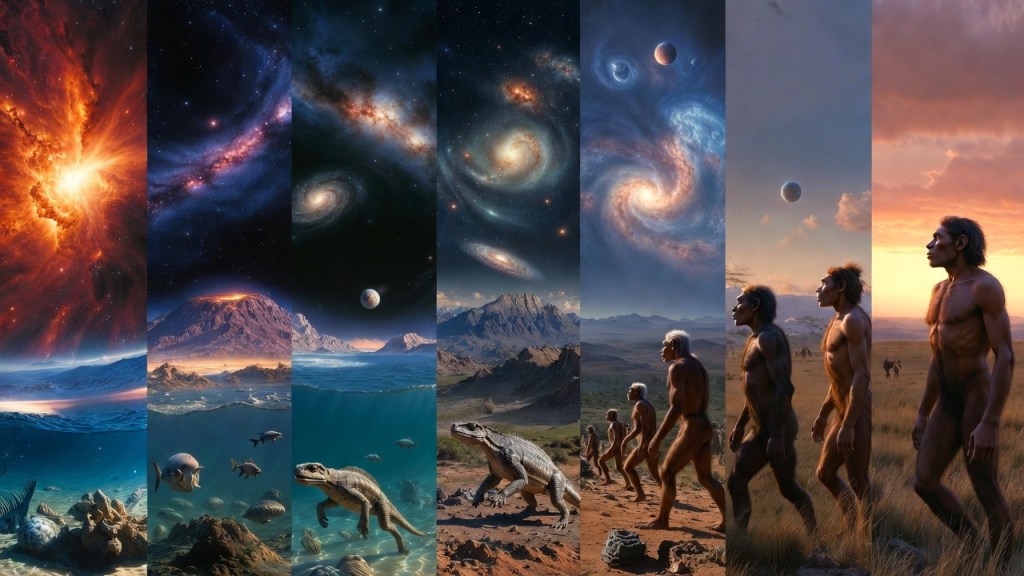



 Kumar Govindan's Words