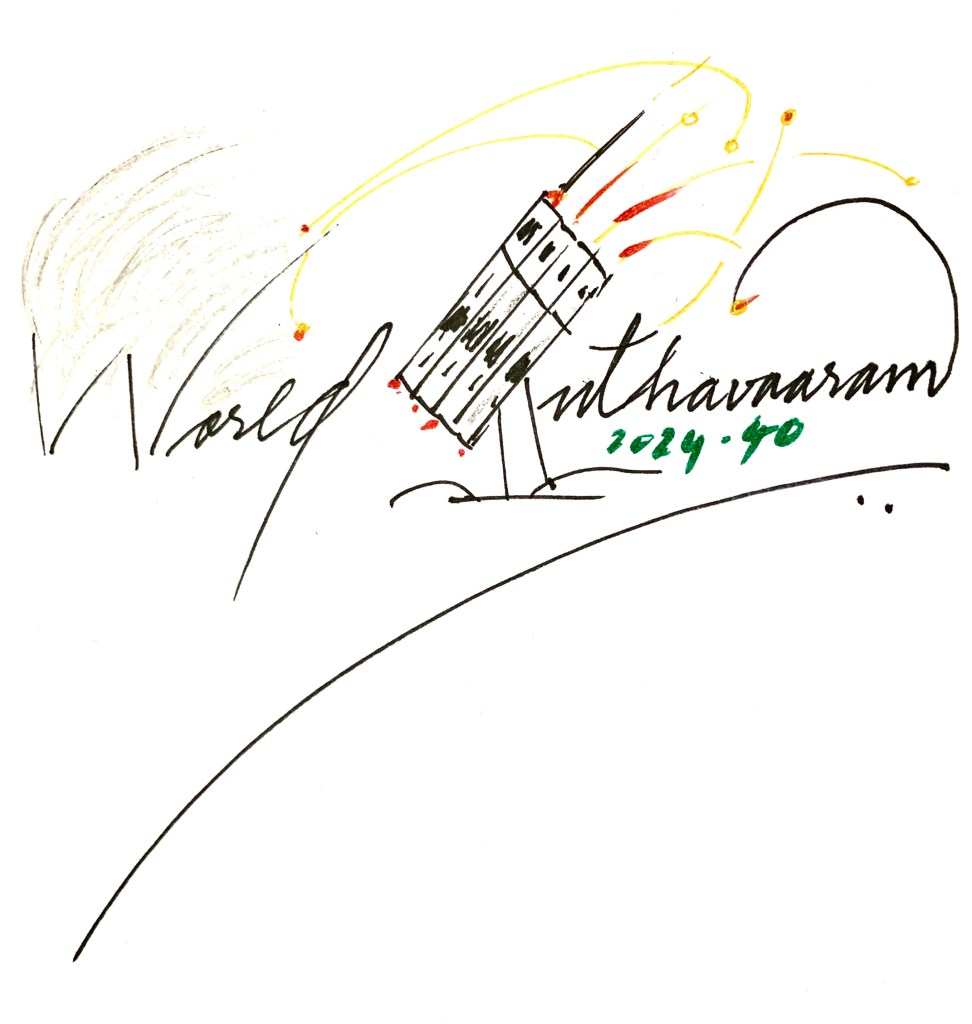
WORLD INTHAVAARAM, 2024-40

About: the world this week, 29 September to 5 October 2024: Hydra-headed Hezbollah; US Election Debates; India State Elections; Hurricane Helene; SpaceX’s Dragon docks with the ISS.

Everywhere

Hezbollah in Lebanon, and Iran

Last week, the Israel Defense Forces (IDF) carried out a brilliant, precise strike on the terror organisation Hezbollah’s central headquarters, embedded under residential buildings in the heart of Dahieh, Beirut, Lebanon. Hassan Nasrallah, 64, the leader of Hezbollah – was without-doubt – the target of the attack. Initially, there were confusing reports that he had survived, however, after several hours, his death was confirmed by both Israel and Hezbollah. Nasrallah suffocated to death from toxic gases inside his secret bunker after it was demolished by about 80 tons of ‘bunker-busting’ bombs. A number of other commanders, including Ali Karaki, the commander of the southern front, who had all probably come over for a meeting, were also eliminated in the strike. This is a significant, game-changing development in the region terrorised by Hezbollah-which is solidly backed by Iran.

Hassan Nasrallah himself became the leader of Hezbollah after the Israelis knocked-off the previous leader, Abbas al-Musawi, in 1992. Nasrallah is well-known for his strident anti-Israel actions and has repeatedly called for the end of the State of Israel. He also has the blood of United States (US) citizens on his hands with Hezbollah being involved in numerous anti-US terrorist attacks in Beirut: the suicide truck bombings of the US Embassy in April 1983, the US Marine barracks in October 1983, and the US Embassy Annex in September 1984. Naturally, the US ‘welcomed’ his elimination.

Nasrallah played a pivotal role in various attacks and wars against Israel. In particular, the 2006 Lebanon War against Israel solidified his status as a resistance leader in the Arab world. He was also involved in regional politics, supporting the Assad regime in Syria during the Syrian Civil War. Under him, Hezbollah transformed from a guerrilla group focused on resisting Israel into a significant political player in Lebanon, holding seats in the Lebanese Parliament and participating in government coalitions.

Nasrallah believed that Islam holds the solution to the problems of any society, once saying, “With respect to us, briefly, Islam is not a simple religion including only prayers and praises, rather it is a divine message that was designed for humanity, and it can answer any question man might ask concerning his general and personal life. Islam is a religion designed for a society that can revolt and build a community”.

Israel has done the world a huge favour, and after Osama Bin Laden was killed in a special military operation by the United States, Hassan Nasrallah was one who deserved the same treatment.

Nasrallah’s immediate successor, Hassan Khalil Yasinm was also ‘instantly’ taken down by the IDF. This is a culmination of a recent trend in which Israel has repeatedly targeted Hezbollah’s leadership structure and has wiped-out the entire command structure.

Hashem Safieddine, a cousin of Nasrallah is now Hezbollah’s new leader. The third since Nasrallah was killed. Wonder, how long he will last, but there is chance that all Hezbollah members will become leaders, one by one. But this is a hydra-headed problem, cut one head off another grows, and takes its place.

In Greek mythology, the Hydra is a gigantic water-snake-like monster with about nine heads, one of which is immortal. The monster’s haunt was in the marshes of Lerna, near Argos, Greece, from which it periodically emerged to attack people and livestock. Anyone who attempted to behead the Hydra found that as soon as one head was cut off, two more heads would emerge from the fresh wound.

The destruction of Hydra was one of the 12 Labours of Hercules. For that and other labours, Hercules enlisted the aid of his nephew Iolaus. As Hercules severed each mortal head, Iolaus was set the task of quickly cauterising the fresh wounds so that no new heads would emerge. When only the immortal head remained, Hercules cut it off too and buried it under a heavy rock. Further, he dipped his arrows in the monster’s poisonous blood to be able to inflict fatal wounds. It’s now up to Israel to find the cauterising fire… and the poison.

Israel’s breathtakingly ballsy strike on Hasan Nasrallah has opened up the possibility of a brand new Middle East: one where Iran doesn’t call the shots. Israel is making the moves the West hasn’t for decades: demonstrating that aggression will be countered with complete evisceration.

This week, Israel also begun the ground invasion in Southern Lebanon-a limited ground operation-against terrorist targets and infrastructure of Hezbollah. The start was bloody with eight Israeli soldiers being killed in combat as its forces pushed into Lebanon.

What has Iran got to do with all of this? Iran has probably crossed many a red line in supporting, arming, and providing safe haven for terrorists such as Hamas, Hezbollah, and the Houthi’s of Yemen, in an anti-Israel stance known as ‘The Iran–Israel proxy conflict, The Iran–Israel proxy war or Iran–Israel Cold War. In the Israeli–Lebanese conflict, Iran has supported Lebanese Shia militias- the Hezbollah. In the Israeli–Palestinian conflict, Iran has backed Palestinian groups-the Hamas.

In turn, Israel has supported Iranian rebels, such as the People’s Mujaheedin of Iran, conducted airstrikes against Iranian allies in Syria and assassinated Iranian nuclear scientists in a long history of tit-for-tat tactics.

Israel’s Prime Minster made a direct appeal to the people of Iran to throw out their tyrant rulers and work towards peace with Israel. But then someone else seems to have heard-got the opposite message-and on Tuesday Iran dispatched about 200 ballistic missiles into Israel, earning the wrath of Israel and the world. The war now grows in yet another direction.

Israel countered the aggression of the ‘Iran missile rain’ with perfect activation and synchronisation of its famous missile defence systems: The Iron Dome detonated the short range missiles within the 70 km range; The David’s Sling system dealt with the mid-range missiles up to about 300 km; and then the Arrow system, which can literally detonate missiles that can fly outside of the earth’s atmosphere in a range of about 2,400 km! The United Kingdom and the United States fell behind Israel and helped shoot-down some of Iran’s missiles.There were no deaths reported on the Israel side except for a lone Palestinian, in the West Bank.

Iran is definitely a menace in the region – a nation gone astray. They need to be dealt with, in a calibrated and wise manner. Maybe Israel (and the US) are upto the task this time around. Meanwhile, the world waits for Israel’s ‘promised’ response.

Towards the end of the week, in yet another attack, Israel not only eliminated Hezbollah’s new leader, but also the entire Shura Council, the committee that nominates Hezbollah leaders.

US Elections: Debates

This Tuesday’s vice-presidential debate between running-mates, Republican J D Vance and Democrat Tim Walz felt like a civil and relatively restrained conversation about the issues at the top of American voters’ minds going into the 5th November election. In that, it was unlike the two fiery presidential debates earlier this year.

If Vance was picked because he puts ideological meat on the bones of Trump’s conservative populism, during the debate he put a polite, humble face on them, as well. And the debate’s lasting impact may be to convince members of his party that the young, only 40 years old, Ohio Senator has a future in national conservative politics, given his ability to clearly advance their ideological priorities on the brightest of stages.

The overall view was that Vance trumped over Walz and made meat of him.

India’s State Elections

Elections in India’s State of Jammu & Kashmir (J&K) ended on 1st October, which was the third and last phase for the 90 member Legislature. The first was on 18th September and the second on 25th September. Counting of votes will be on 8th October. This is the first assembly election since J&K’s special status was revoked and fully integrated with the rest of India. However, J&K remains a union territory and statehood is expected to happen sometime after the assembly elections.

The State of Haryana goes to the Polls in a single phase on 5th October for 90 seats. Counting of votes will also be on 8th October.

It’s a coincidence that it’s 90 seats in both States. Going by opinion polls the ruling Bharatiya Janata Party (BJP)-at the Centre-is unlikely to win in any of these States. Despite the fact that in J&K, it should be rewarded for bringing back peace after abrogation of J&K’s special status under Article 370 of India’s Constitution. In Haryana anti-incumbency again the ruling BJP is high. The results could be knocking.

Elections seem to be taking place all the time in India, and the Government is hell-bent on pushing through its new legislation of ‘One Nation One Election’ through the Parliament benches and making it law. That’s a work in progress.

Hurricane Helene Devastates

Hurricane Helene, a large, deadly, catastrophic, and fast-moving tropical cyclone, the strongest on record to strike the Big Bend region of Florida devastated parts of southeastern United States(US). It is the eighth named storm, fifth hurricane, and second major hurricane of the 2024 Atlantic hurricane season. Helene developed gradually from a mid-September disturbance in the western Caribbean Sea within a broad area of low pressure known as the Central American gyre. And then Helene moved inland for the kill.

Some of Helene’s deadliest, most catastrophic flooding unfolded in western North Carolina. It turned the western part of the state into a ‘post-apocalyptic’ landscape.

At least 130 people have died across six states and the death toll can rise. Many more remain missing, perhaps unable to leave their location or unable to contact family where communications infrastructure has been washed away.

Among the demolished towns was the tiny hamlet of Bat Cave, about 160 km west of Charlotte, where in what climate scientists are describing as a 1,000-year event, the Broad River rose to unprecedented levels, washed away homes and broke through the town’s bridge. “It’s so overwhelming. You don’t even know how to fathom what recovery looks like, let alone where to start,” said a survivor.

SpaceX Docks with ISS

This week, SpaceX’s Dragon Spacecraft successfully docked with the International Space Station (ISS), and when it returns after a few months it is expected to bring back stranded Astronauts Sunita Williams and Barry Wilmore. The incoming spacecraft had two astronauts in the driver’s seat(s), with ‘space’ for the returning two.

Astronauts Nick Hague, the Dragon Crew 9 commander and cosmonaut Aleksandr Gorbunov, the Crew 9 mission specialist were given a ‘weightless welcome’ when they met the others on the Space Station, after crossing over.

The space station’s population has temporarily increased to 11 after this Sunday saw the arrival of Crew 9. The orbital residents spent Monday unpacking Dragon and handing over mission responsibilities as the next quartet prepares to return to Earth.

More docking stories coming-up in the weeks ahead. Weigh the world more with World Inthavaaram.

WORLD INTHAVAARAM, 2024-30

About: the world this week, 21 July 2024 to 27 July 2024: Microsoft goes hard; the wrath of Israel; new Presidents of the US; Bangladesh rocks; India’s Budget, Testing, and Firing; Nepal plane crash; Paris Olympics; and Dark Oxygen.

Everywhere

Microhard

In one of the biggest technical outages in history, millions of Microsoft Windows users world-wide experienced the Blue Screen Of Death (BSOD), last Friday. Almost all Passenger Airlines around the world faced technical issues that affected booking, check-in, and flight updates. Hundreds of flights were cancelled. Other sectors affected were healthcare, shipping, finance, food chains, and brokerage firms. What caused this?

A mistake in a security software update sparked hours-long global computer systems outages, another incident highlighting the vulnerability of the world’s interconnected technologies. This occurred when CrowdStrike, used in Microsoft Windows, released a sensor configuration update for its ‘Falcon Sensor’ to Windows Operating Systems. Sensor configuration updates are an ongoing part of the protection mechanisms of the Falcon platform. The configuration update triggered a logic error resulting in a system crash BSOD. However Mac and Linux-based systems were not affected.

CrowdStrike’s website says, it is a cyber security service designed to stop internet breeches or hacks. It was founded on the premises that sophisticated attacks targeting the world’s leading businesses cannot be solved merely using existing malware-based defenses. A brand new approach was needed – one that combines the most advanced endpoint protection with expert intelligence to pinpoint the adversaries perpetrating the attacks, no just the malware.

Later, CrowdStrike said the issue has been isolated and a fix deployed. It confirmed that it is not a security incident or a cyber attack. Users running Falcon Sensor for Windows version 7.11 and above, that were online between Friday, 19 July 2024 04:09 UTC (Coordinated Universal Time) and Friday, 19 July, 2024 05:27 UTC were affected. Systems running Falcon Sensor for Windows 7.11 and above that downloaded the updated configuration from 04:09 UTC to 05:27 UTC – were susceptible to a system crash.

Global cybersecurity firm CrowdStrike is one of the largest operators in the industry. It is not a household name, but it is a USD 83 billion company with more than 20,000 subscribers around the world, including Amazon and Microsoft.

The Wrath of Israel: Don’t Start a Fire

Late last week the Houthis (an Iran-backed militant group) of Yemen hit Israel’s city of Tel Aviv with a drone resulting in the death of one Israeli civilian and injuring many others. When you do this to Israel, what happens? You invite its wrath!

Israel’s Air Force struck the largest Port in Yemen causing grave damage. The Port was completely engulfed in flames. About 25, F-15 and F-35 aircraft, accompanied by refuelling planes, flew about 2000 km toward the city of Hodeidah in Yemen for the attack. The strike was carried out in eight waves, which destroyed fuel depots and a power station north of the Port inflicting severe damage on the Port.

Bibi in America

During the week, Israel’s Prime Minister Benjamin Netanyahu (Bibi) flew to the United States, shopping for ‘good will and support’. He also addressed both Houses of Congress and delivered a masterpiece of a speech. It was mighty impressive that he got an insane number of standing ovations, 55 to be precise – the most standing ovations given to any foreign leader addressing Congress. The applause went overboard, and at one point, the audience began to clap and Bib had to stop them to say, “No, don’t applaud. Listen.” Here are some of the best lines:

This is not a clash of civilizations. It’s a clash between barbarism and civilization.

These protesters chant, ‘from the river to the sea’. But many don’t have a clue what river and what sea they’re talking about. They not only get an ‘F’ in geography, they get an ‘F’ in history. They call Israel a colonialist state.

Don’t they know that the Land of Israel is where Abraham, Isaac, and Jacob prayed, where Isaiah and Jeremiah preached and where David and Solomon ruled?

For nearly 4000 years, the land of Israel has been the homeland of the Jewish people. It’s always been our home; it will always be our home.

And one more thing. When Israel acts to prevent Iran from developing nuclear weapons, that could destroy Israel and threaten every American city, every city that you come from, we’re not only protecting ourselves. We’re protecting you.

In World War II, as Britain fought on the front-lines of civilization, Winston Churchill appealed to Americans with these famous words: “Give us the tools and we’ll finish the job.” Today, as Israel fights on the frontline of civilization, I too appeal to America: “Give us the tools faster, and we’ll finish the job faster.”

Back to the War Front

In an Israel Defence Forces (IDF) operation in Khan Younis, 5 bodies of hostages were recovered from the Gaza Strip and brought back to Israeli territory. It is over 300 days and about 125 hostages are still held in excruciating captivity by the Terrorist Hamas.

Biden Out: Kamala In

US President President Joe Biden, 81 – who is recovering from Covid – and has been ‘rapidly growing old’ in recent times, finally announced he will no longer seek re-election, ending his Presidential campaign less than four months before Election Day. He said his decision was in the best interest of his party and the country. And he quickly endorsed Vice President Kamala Harris as the Democratic presidential nominee, calling on fellow Democrats to come together and beat Republican candidate Donald Trump. This is the first time a US President has ended his re-election bid this late in the game. The last incumbent to make a similar move was President Lyndon B Johnson in 1968.

The US Secret Service: Grilled & Roasted

Over the week, US Secret Service Director Kimberly Cheatle appeared before a bipartisan House Oversight Committee looking into the lapses of the Donald Trump assassination attempt, to answer questions. The committee was allover her with piercing questions, and she cut a sorry figure under the intense grilling. She rankled lawmakers by refusing to provide sufficient details about the incident, being as slippery as an eel and as evasive as a snake. Said one of the members, ’This committee is not known for its model of bipartisanship, and I think today we came together unanimously in our disappointment. We don’t have that confidence that you can lead.” During more than four hours of often contentious proceedings, Cheatle called the 13 July 24 shooting “the most significant operational failure at the Secret Service in decades”.

Later in the week, she could hold-on no longer. She resigned.

Bangladesh Rocks

Bangladesh’s Supreme Court on Sunday rolled back most of the controversial quotas on government jobs which sparked violent protests in the country.

The Court dismissed the earlier ruling that brought back the quotas, directing that 93% of government jobs will be open to candidates on merit, without quotas. A lawyer representing the students said that the Supreme Court, “gave a final solution to this quota system. That is, 93% quota for general people, 5% quota for freedom fighters and their kin, 1% for ethnic minority community, and 1% for third gender and physically disabled”.

India: We built this City

The official commentary on Budget 2024, that was unveiled on 23 July 24, would run something like this: ‘It’s a comprehensive strategy built on nine foundational pillars – agriculture, employment, inclusive development, manufacturing and services, urban development, energy, infrastructure, innovation/research and development, and next-generation reforms. These will serve as guiding principles aimed at fostering broad-based opportunities and sustainable progress across the country. It presents a holistic approach to economic development, balancing fiscal prudence with targeted interventions for inclusive growth and sets a bold trajectory towards a prosperous and resilient India’.

The focus of this year’s Budget was on ‘ four caste’ groups of: Farmers, Youth, Poor, and Women, to hopefully make life better for them.

Set aside that jargon, and let’s roll over. The Government, short of a majority in Parliament, actually stands on two foundation pillars. 1-its own numbers, and, 2-that of the States of Andhra Pradesh (AP) and Bihar plus certain other small Allies. And AP and Bihar got their pound of flesh, when the new Government set sail on the high seas on 11 June 24 following the declaration of Election Results on 4 June 24.

AP got a bonanza of INR 15,000 crore for building its new capital city of Amravathi (It had no capital following bifurcation into Telangana and AP, with Telangana getting Hyderbad as its Capital) a completion of irrigation projects and essential infrastructure such as water, power, railways, and roads. Bihar got big-ticket measures of INR 26,000 crore for various road projects in the state and bombastic plans for new airports and sports infrastructure. In addition, it grabbed another INR 11,500 crore for flood mitigation and taming the mercurial River Kosi, which runs through the State.

The hard-working, honestly tax-paying middle class felt left-out again – timidly thrown under the bus. Though the tax slabs were tinkered with and the standard deduction tweaked, giving them ‘slightly more money’ in their hands, they were disappointed. It was depressing that the tax on Long Term Capital Gains was increased by 2.5% to 12.5% (from 10%) without indexation. And Short -Term Capital Gains from equities and mutual funds to 20%. The Govt rewarded the risk taken to grow their money. What was given by the right hand was quickly grabbed by the left hand. Did something spill down?

The Big Numbers said INR 48.21 Lakh Crore would be the estimated total expenditure by the Govt with a nominal GDP Growth of 10.5%. The Fiscal deficit, which represents the difference between the government’s total income and its total expenditure was plugged at 4.9% with serious intentions to bring in under 4.5% by 2025-26, which is actually very good.

The allocation for Defence was 6.22 Lakh crore; the Rural push was 2.66 Lakh crore; and for Education it was 1.26 Lakh crore, among other outlays.

With the top honchos of the Corporate world complaining about a lack of skills among the ‘educated unemployed’, the Govt heard. It came up with a programme to skill-up 20 lakh young people over a 5-year period. 1,000 Industrial Training Institutes will be upgraded in a hub. One-month wage will be provided to new entrants in all formal sectors in 3 instalments up to INR 15,000, which is expected to benefit 210 lakh youth.

Finally, is a great spin, import duties on gold and silver were reduced to 6% from the earlier 15% leading to India’s Jewels in the crown getting cheaper. And gold prices fell by over 5%. With Indian households owning approximately 11% of the World’s Gold the fall in prices wiped out over 10 lakh crore from the value of gold held by Indians in a single day.

India: We Test Well

This week India’s Supremo Court ruled on the National Eligibility cum Entrance Test (NEET) for Under-Graduate admission to India’s Medical Colleges, which testing was challenged. It said that there was no proof of systematic breach of exam – sanctity preserved, hence no-retest needed, nor a cancellation of exam itself. But 4 lakh candidates will lose 5 marks each over a contentious Physics question. New merit lists were to be notified in two day’s time and the derailed process was put back on track.

India: We Fire Well

In another fighting news, on Wednesday, India quietly and successfully flight-tested its Phase-II Ballistic Missile Defence System from off the Odisha coast. The test demonstrated India’s indigenous capability to defend against ballistic missiles of 5,000 km class. The Target Missile was launched mimicking an adversary Ballistic Missile, which was detected by weapon system radars deployed on land and sea and activated the Interceptor system.

Nepal: Plane Crash

This week there was yet another plane crash in Nepal. I recall writing about two other plane crashes over the past two years in 2023, and 2022. Since 2000, nearly 360 people have died in plane or helicopter crashes in the country.

This Wednesday, a small passenger plane, a Bombardier CRJ-200 aircraft, belonging to Nepal’s Saurya Airlines crashed and caught fire while taking off from the capital Kathmandu, killing 18 people on board and leaving one survivor, the Captain Pilot. The 50-seater plane, carrying two crew members and 17 technicians, was heading for regular maintenance to Nepal’s new Pokhara airport, which is equipped with aircraft maintenance hangars. Eighteen of those on board were Nepali citizens, with one engineer from Yemen.

Shortly after takeoff, the aircraft veered off to the right and crashed on the east side of the runway with its wing hitting the ground.

The crash again focused attention on the poor air safety record of the landlocked Himalayan nation that is wedged between India and China and is heavily dependent upon air connectivity due to its limited road network. Nepal’s aviation industry has a poor safety record – that has been attributed to multiple factors over the years, from unpredictable weather to lax regulations.

The Paris Olympics: On Your Marks

In what will be a unique festival ‘on the water’, for the first time in the history of the Summer Olympics Games, the Opening Ceremony will be held outside a stadium. Athletes will parade down Paris’ famous River Seine, on boats – a floating parade through the heart of the City. The Opening Ceremony is scheduled to begin on Friday 26 July, when the first boats depart from the Austerlitz Bridge.

Going east to west through the city, 10,500 athletes on 94 boats will be ferried down a 6 km route that ends in front of the famous Trocadero, opposite the Eiffel Tower, where the rest of the Ceremony shows takes place, such as the lighting of the Olympic cauldron and the official opening speech by French President Emmanuel Macron. The boats will pass through some of Paris’ most iconic landmarks, including the Louvre and the Notre-Dame de Paris Cathedral.

Saboteurs struck France’s TGV high-speed train network in a series of pre-dawn attacks that caused chaos on the country’s busiest rail lines and heightened security concerns. Vandals damaged signal boxes along the lines connecting Paris with cities such as Lille in the north, Bordeaux in the west and Strasbourg in the east. Another attack on the Paris-Marseille line was foiled.

In another incident, the Basel-Mulhouse-Freiburg airport, located by the French-Swiss-German border, was evacuated due to a bomb threat. It later reopened and resumed operations.

Under the Sea: Dark Oxygen

We are all too familiar with oxygen produced by photosynthesis. But what if there is another source, that too deep under our Oceans?

This week, Scientists found evidence of an additional source of oxygen – raising questions about the origins of life on Earth. For decades, scientists have floated theories about dark matter, which is believed to hold galaxies together by its gravitational pull. The enigma of dark matter continues, and now scientists have discovered what they call ‘dark oxygen’ on the ocean’s floor.

A recent study published in Nature Geoscience-a journal dedicated to Earth sciences research-shows oxygen emitted from mineral deposits 4,000 meters below the ocean’s surface on the seafloor at a depth that is almost half the length of the tallest peak of Mount Everest.

On the Clarion-Clipperton Zone (CCZ), which spans 4.5 million square kilometres in the Pacific Ocean, there are coal-like mineral rocks, called polymetallic nodules, which typically contain manganese and iron. Scientists have found that these nodules produce oxygen without the process of photosynthesis. The fact that we’ve got another source of oxygen on the planet other than photosynthesis has consequences and implications that are utterly profound.

More oxygen-rich stories coming-up in the weeks ahead. Breathe easy with World Inthavaaram.

WORLD INTHAVAARAM, 2024-27

About: the world this week, 30 June 2024 to 6 July 2024: Israel grinds; US gasps; France swings; Britain labours; India stampedes; and Team India wins a nail-biting T20 Cricket World Cup Final.

Everywhere

Israel Grinds On

Israel’s Prime Minister Benjamin Netanyahu has rejected the idea of starting a ceasefire in Gaza while Hamas remains in power. This comes in the background of talks about a truce that would give Israeli troops time to prepare for a potential land war with Iran-backed militant Hezbollah, operating in Lebanon.

Israel killed a senior Hezbollah commander on Wednesday, the second top field leader killed in less than a month, and Hezbollah retaliated by firing scores of rockets at Israeli military positions near the border. This is anyway a regular sideline feature in the ongoing Israel-Hamas war.

The over 120 Israeli hostages in the captivity of Hamas, for over 270 days, are yet to see freedom. Negotiations for a possible deal to secure their release appears to be alive, walking in the shadows.

The United States Gasps

The first Presidential debate-ahead of the upcoming US Election in November 2024-left viewers gasping for breath; actually it was the Democrats’ candidate, incumbent President Joe Biden, who struggled to find air. He delivered a shaky, halting performance, while his Republican rival Donald Trump battered him with a series of attacks at a debate last Thursday. The two oldest presidential candidates ever, exchanged personal insults; traded barbs on abortion, immigration, the wars in Ukraine and Gaza; growled on each other’s handling of the economy; and even put stick to their golf games. Later, standing on firmer ground, Joe Biden said, he can do the job even though, “I don’t walk as easy as I used to, I don’t speak as smoothly as I used to, I don’t debate as well as I used to.” Time to send him home? Reusing has its limits!

Meanwhile, in a landmark ruling, the US Supreme Court ruled that Trump cannot be prosecuted for any actions that were within his constitutional powers as President, but can be, for private acts. This ruling recognises for the first time, any form of presidential immunity from prosecution.

Then, Biden, this time quick on the draw, and reading from a teleprompter, thundered, “This nation was founded on the principle that there are no kings in America. Each, each of us is equal before the law. No one is above the law. Not even the President of the United States”. He called the Supreme Court ruling on presidential immunity, a ‘dangerous precedent’ that could turn Presidents into kings and called on the American people to ‘dissent’ by rejecting Donald Trump in November’s election. Maybe, the Democrats need to dissent on going along with him.

France Swings

France has a semi-Presidential type of Government with a President and Prime Minister. The President is the pre-eminent figure-the Big Boss-and is directly elected through Presidential Elections in a term, separate from Parliament. The President’s role is unique. He can deal directly with the people when required, bypassing and even dissolving Parliament. The President appoints the Prime Minister and chairs cabinet meetings. The Prime Minister is responsible to Parliament, which consists of a Lower House- the National Assembly and an Upper House-the Senate.

The parliamentary election to the National Assembly is a complex, two-round process in which the two candidates who get the most votes in the first round go through to a second round. There are 577 seats in the National Assembly. And for an absolute majority a party needs 289. The Parliament may or may not be controlled by the party the President belongs to.

When opposing parties control parliament and the presidency, the power-sharing arrangement is known as cohabitation. Before the year 2002, cohabitation occurred as a regular feature, because the term of the President was seven years and the term of the National Assembly was five years. And the overlapping brought together strange bed-fellows. With the term of the President shortened to five years, it is expected that cohabitation is less likely to happen.

Emmanuel Macron is the current President of France, in office since May 2017, being elected for a second term in May 2022.

This week, the results of the first round of France’s Parliamentary Elections were out. And the challenger, Marine Le Pen’s National Rally (RN) & Allies made historic gains winning 33% of the vote, followed by a left-wing bloc with 28%, and well ahead of President Macron’s broad alliance of centrists, who scored just 22%.

The first round eliminates all candidates who fail to win the support of 12.5% of locally registered voters. Anyone who scores more than 50% of the vote with a turnout of at least a quarter of the local electorate wins automatically. That normally happens only in a handful of constituencies.

RN is led by 28-year-old Jordan Bardella – designated Prime Minister – and in Parliament by Marine Le Pen, who has fought for the presidency three times and lost each time. Now, the polls say her party could become the biggest in France, falling short of an absolute majority. Naturally, Le Pen has set her eye on the next presidential election, in three years’ time.

Pollsters calculated the first round had put the RN on track for anything between 250-300 seats, but that is before tactical withdrawals reshape voter intentions this weekend. And there seems to be ganging-up of parties against Marine Le Pen, given her strident anti-Muslim stand. Le Pen has called for the hijab to be banned in public spaces, while Jordan Bardella, has called the veil a ‘tool of discrimination’.

The second round – the run-off will be held on Sunday, 7th July. And consists of a series of run-offs fought either by two, three or sometimes four candidates. Some candidates may drop out before 7th July to give an Ally a better chance of stopping a rival from winning.

Never before has the far-right won the first round of a French parliamentary election.

The Macron alliance had only 250 seats in the outgoing Assembly.

Whoever wins, President Macron has said he will not resign. If his party loses, and National Rally wins, then the question is whether RN can win an absolute majority or a relative majority similar to that held since 2022 by the Macron camp.

An RN victory could open the door to almost three years of ‘cohabitation’: when the president of one party heads the state and another party runs the government.

Marine Le Pen is the daughter of Jean-Marie Le Pen who founded the National Front Party. For years, she has been working to ‘de-diabolise’ or detoxify her party from the antisemitic and extremist roots of her father and his fellow founders. Once in control, she renamed the party as, National Rally to shrug-off the past. Much of its focus now is on the cost-of-living crisis, but many of its strict anti-immigration policies remain, and a ruling this year by the Council of State, France’s highest court for administration, confirmed it could be considered ‘extreme right’. Jordan Bardella wants to ban French dual nationals from sensitive strategic posts, calling them ‘half-nationals’. He also wants to limit social welfare for immigrants and get rid of the automatic right to French citizenship for children with foreign-born parents.

Britain’s Labour Labours Liberally

British voters headed to the polls this Thursday for a crucial General Election. The snap vote, called by Prime Minister Rishi Sunak, was held months earlier than necessary, and caught much of his party by surprise.

The opposition Labour party had suffered its worst defeat since 1935 in the last general election, but has since rebuilt itself under the leadership of Keir Starmer. And when the results were out on Friday it was a Landslide win for Labour with 410 sets, well above the majority mark of 362. Well, that was what India’s Prime Minster was aiming for, 400 paar – 400 and above. Never mind, it happened in faraway Britain.

The Labour Party swept hundreds of seats across the country and in the process brought an end to 14 years of Conservative rule. And a tumultuous era, which saw five different Conservative leaders running the country.

Sir Keir Starmer, 61, was quickly appointed Prime Minister(PM) by King Charles, later in the day. Rishi Sunak, the outgoing PM, conceded early in the morning, acknowledging Labour had won and calling Starmer to congratulate him. Sunak took responsibility for the loss. His Conservative party won a conservative 121 seats.

Britain’s new Prime Minister, Keir Starmer, studied at Reigate Grammar School, University of Leeds, and University of Oxford. He is married to NHS occupational therapist Victoria Alexander and has one son and one daughter.

Keir started his professional life as a Barrister in the 1990s, and was appointed the director of public prosecutions, the most senior criminal prosecutor in England and Wales, in 2008, which service eventually got him knighted as ‘Sir Keir Starmer.’

He was first elected in the Holborn and St. Pancras constituency in north London in 2015, and took over the leadership of Labour after the party’s poor 2019 general election, pledging to start a new era after the abrasive left-wing leadership of Jeremy Corbyn.

This election’s insurgent party was Reform UK, the right-wing successor to the Brexit Party and the UK Independence Party. Nigel Farage, its leader, finally won a seat on his eighth attempt – but his party’s initial projection of 13 seats fizzled to four.

India’s Death Stampede

It is one of the deadliest stampedes and worst crowd crushes in India, 123 people, including women and children, died in Phulrai Mugalgarhi village in Uttar Pradesh’s (UP) Hathras District. About 250 were injured. The tragedy occurred at the conclusion of a Hindu religious satsang (a prayer meeting) organised in the area, by a self-styled God-man guru, called Bhole Baba; when the meeting concluded and the Baba was leaving the venue.

The organisers tried to create a passage from the venue to the main highway for the convoy of Baba’s cars to leave, amidst a rush of people who began gathering on both sides of the corridor. All of this, combined with the mismanagement of the huge crowd by the organisers has prima-facie led to the stampede. A Mad rush, extreme humidity, slippery ground, desperation to seek Baba’s blessings – collect dust under his feet- confusion, screams, and fear were tell-tale signs of the gruesome scene. Most of the deaths resulted from suffocation.

More than three times the permitted number of people attended the event-about 250,000-despite permission being granted only for 80,000.

The satsang was held by Suraj Pal, 58, who also goes by the names, Narayan Hari, Sakar Vishwa Hari Bhole Baba or simply ‘Bhole Baba’. Hari hails from Bahadur Nagari village in Kasganj district, about 65 km from Hathras where the stampede occurred. Suraj Pal worked as a constable with the UP Police, and was last posted in Agra, before he quit in the 1990’s to become a religious preacher. He claims to have a spiritual bend even while working with the Police, which made him ‘switch careers’.

He then adopted the name Bhole Baba, began preaching, and conducted satsangs known as ‘Manav Mangal Milan Sadbhavna Samagam’ along with his wife, who is known as Matashree. Hari does not have children.

Bhole Baba does not wear the traditional saffron clothes, often appearing in a white suit and tie or a kurta-pyjama. He claims to spend all the money donated to him on devotees. He calls himself a disciple of Hari (Lord Vishnu). He is said to have a notable following in western Uttar Pradesh.

Wonder why the ‘God-Man’ did not stay back and offer succour to those affected, or use his ‘Godly power’ to bring back people to life? Instead, he promptly fled the scene.

T20 World Cup Cricket Thrills

I have not watched live cricket on TV in a long time and there was no better day to get back than last Saturday. And it was worth its weight in gold watching the India – South Africa Finals.

India’s 13 year wait for a World Cup win finally ended on a glorious day at the Kensington Oval in Bridgetown, Barbados, West Indies, on 29th June. For South Africa, the endless agony for a Cup Win goes on. The spectacle these two teams produced was more than worthy of a World Cup final. It was a contest that sashayed back and forth, each blow followed by an equally brutal counterpunch that left the result hanging in balance until the final moments, in an edge-of-the-seat position.

In the end India won against South Africa by seven runs, becoming just the third side to win the Men’s T20 World Cup twice, after England (2010, 2022), and West Indies (2012, 2016). Barring a no result against Canada, India won all their remaining contests in the tournament, thus becoming the only undefeated side to win the T20 World Cup.

In the Finals, India batted first, making 176/7 runs in 20 overs with a vintage performance by Virat Kohli who made 76 of 59 balls, and pinch-hitter Axar Patel delivering his role to perfection, knocking 47 runs off 31 balls. In return, South Africa made 169/8 in 20 overs. Indian bowlers Hardik Pandya 3/20, Jasprit Bumrah 2/18, Arshdeep Singh 2/20 delivered the final blows – finishing the job.

Classy Klaasen lifted South Africa to the precipice but then it took the genius of Jasprit Bumrah and Hardik Pandya to dismantle the Proteas. Bumrah, the human slingshot with logic-defying accuracy, had bowled flawlessly throughout the tournament and in the final innings. And when India was desperate for a wicket -that would open the gates to the South African batting’s tail-end, he flung down a delivery only the cricketing gods could conceive, clicking-off the stumps. And then Suryakumar Yadav performed a nimble feet-of-flames tiptoe around the boundary rope to complete a one-man relay catch struck by David Miller off a Hardik Pandya ball, which was a turning point in the game. Virat Kohli was declared the man of the match and Bumrah, man of the tournament. India exploded in celebrations and waited for the Team to return Home-caught in a West Indian Hurricane.

This was ‘the Wall’ Rahul Dravid’s final innings as Team Coach (he lamented that he is now jobless!), while Captain Rohit Sharma and Virat Kholi said they were quitting T20 International Tournaments. It was an all-round fiery display of coaching and captaincy, which brought Team India to deliver its best when it really mattered. Over to the next team.

The ICC Men’s Twenty20 (T20) tournament organised by the International Cricket Council (ICC) commenced on 1st June with co-hosts USA taking on neighbours Canada, while fellow hosts the West Indies playing Papua New Guinea in Guyana on the second day of group play.

More nail-biting stories coming-up in the weeks ahead. Stay the course with World Inthavaaram.

WORLD INTHAVAARAM, 2024-26

About: the world this week, 23 June 2024 to 29 June 2024: Israel readies another battle front; WikiLeaks’ Julian Assange gets freedom; Kenya in turmoil; China returns with goods from the Moon’s far side; and Diamond hunting in India.

Everywhere

Israel

Israel is sounding the world that its intense phase of fighting against Hamas is nearing an end. And in a sense is making strategic future plans. But the war will keep firing-on until Hamas stops controlling the Gaza. One plan is to move Israel’s troops to the northern part where a fight with the Iran-backed militant Hezbollah is brewing. Looks like Israel is gearing up to fight its war on several battle fronts.

Israel said it is interested in a ‘partial deal’ with Hamas that could free some of the 120 hostages still held in ‘horrific captivity’ for over 265 days. Meanwhile, Hezbollah has said it would continue raining rockets on Israel until there’s a cease-fire agreement in Gaza.

WikiLeaks

Julian Assange, 52, is an award-winning Australian editor, publisher, and activist who founded WikiLeaks in 2006. He rose to the limelight in 2010, when WikiLeaks published a series of sensitive leaks from United States (US) Army intelligence analyst Chelsea Manning. Of footage of a US airstrike in Baghdad, classified US military logs from the Afghanistan and Iraq wars, and US diplomatic cables.

In November 2010, Sweden issued a European arrest warrant for Assange on allegations of sexual assault. He lost an appeal, breached bail, and took refuge in the Ecuador’s Embassy in London, in June 2012. Ecuador granted him asylum in August 2012 on the grounds of political persecution and on fears that he might be extradited to the US.

Julian Assange launched the WikiLeaks Party in Australia-while in confinement in the Ecuadoran Embassy-and stood for the Australian Senate in 2013, but failed to win a single seat. Later, Swedish prosecutors dropped the sexual assault investigation in 2019. And in the same year, Assange’s asylum was withdrawn following a series of disputes with Ecuadorian authorities. Then the London police promptly arrested him. He was found guilty of breaching the United Kingdom’s Bail Act and sentenced to 50 weeks in prison.

The US tried to have Assange extradited, indicting him on charges of violating the Espionage Act of 1917 and conspiring with hackers. And charging him with computer intrusion conspiracy related to the leaks provided by Chelsea Manning – piling up a total of 18 criminal charges. Assange remained in prison in London from 2019 to June 2024, as the US Government’s extradition request was contested in the British Courts.

Now, this June 2024, Julian Assange agreed to a ‘Plea Deal’ with US prosecutors. During a three-hour hearing, Assange pleaded guilty to one criminal count of conspiring to obtain and disclose classified US national defence documents under the Espionage Act, in order to avoid potential imprisonment. But said he believed the US Constitution’s First Amendment, which protects free speech, shielded his activities.

He pleaded guilty in the District Court for the Northern Mariana Islands -on the US Pacific island territory of Saipan. And thereafter walked out from court, as a free man.

Under the terms of the deal, US Justice Department prosecutors sought a sentence that allows for his immediate release. He was ordered to instruct WikiLeaks to destroy the information given by Chelsea Manning, providing an affidavit. The US territory in the western Pacific was chosen due to Assange’s opposition to travelling to the mainland US and for its proximity to Australia.

Assange then returned to Canberra, Australia, this Wednesday, in a private jet. His UK and Australian lawyer, Jennifer Robinson, thanked the Australian government for its years of diplomacy in securing Assange’s release after a 14 year saga, in what she called ‘criminalisation of journalism’. It is remarkable that Australia’s ‘quiet diplomacy’ secured freedom for Assange.

Kenya

Kenya is on the boil. Kenyans have been struggling to cope with several economic shocks caused by the lingering impact of the Covid19 pandemic, the war in Ukraine, two consecutive years of drought, and depreciation of the national currency.

With this in the background, Kenyan President William Ruto’s Government introduced a Finance Bill in Parliament, which aimed to raise an additional USD 2.7 billion in taxes as part of an effort to lighten Kenya’s heavy debt load. Interest payments alone consume 37% of annual revenue. Parliament approved the finance bill, moving it through to a third reading by lawmakers. The next step was for the legislation to be sent to the President himself, for signing into law.

However, opposition to raising of taxes quietly built-up, descended into unprecedented, never-before seen protests and violence in Kenya. Police had to fire on demonstrators who tried storming Parliament and threw stones at Police lines. The protests began in a festival-like atmosphere, but as crowds swelled, police fired tear gas in Nairobi’s Central Business District and the poor neighbourhood of Kibera. Police also fired tear gas in Eldoret, President Ruto’s hometown in western Kenya, where crowds of protesters filled the streets and many businesses shut-shop, fearing violence.

In chaotic scenes in the capital Nairobi, protesters overwhelmed the police, entered the Parliament compound and set parts of it on fire. Protests and clashes also took place in several other cities and towns across Kenya, with many calling for Ruto to quit and voicing their opposition to the tax rises. Clearly, it became the biggest assault on Kenyan democracy, in decades.

In a televised address to the nation, Ruto said the tax debate had been ‘hijacked by dangerous people’, but persisted with the Finance Bill.

Ruto won an election almost two years ago on a platform of championing Kenya’s working poor. But, has been caught between the competing demands of lenders such as the International Monetary Fund, which is urging the government to cut deficits to obtain more funding, and a hard-pressed population. Opposition politicians called on Ruto to step down.

Feeling the heat, the government then made some concessions, promising to scrap proposed new taxes on bread, cooking oil, car ownership, and financial transactions. But that was not enough for the protesters. The finance ministry says the concessions would blow a 200 billion Kenyan shilling (USD 1.56 billion) hole in the 2024-25 budget, and compel the government to make spending cuts or raise taxes elsewhere.

Then, after all the tough talk, in the middle of the week, President Ruto did a U-turn and withdrew the contentious Finance Bill, saying he will not sign the Bill into law. He said he heard the voice of the people, and has conceded.

But then, Kenyan police had to put up roadblocks on streets leading to the presidential palace on Thursday as some protesters vowed to ‘occupy’ the State House; despite the president’s climbdown on proposed tax hikes that sparked a week of demonstrations.

Raiders of the Moon

China’s Chang’e-6 lunar module returned to Earth this Tuesday, successfully completing its historic mission to collect the first-ever samples from the far side of the moon. The re-entry module landed, via parachute, in the designated zone in China’s Northern Inner Mongolia region just after 2 pm local time. A search team located the module minutes after its landing. And first visuals showed a worker carrying out checks on the module, which lay on grassland, beside a Chinese flag.

The module is expected to contain up to 2 kilograms of moon dust and rocks from the lunar far side, which will be analysed by researchers in China before being opened for access by international scientists.

Diamonds of India

For about 3,000 years, India was the only source of diamonds in the world, until deposits were discovered in South Africa and Brazil. In India, diamond resources are concentrated in the three states of Madhya Pradesh, Andhra Pradesh, and Chhattisgarh.

Madhya Pradesh has 90.17% at 28,709,136 carats, followed by Andhra Pradesh at 5.73% with 1,822,955 carats and Chhattisgarh at 4.10% with 1,304,000 carats, of resources, according to Indian Bureau of Mines (IBM). The total resources of diamonds in the country, as in the year 2015, was estimated at 31,836,091 carats with 756,765 carats gem grade, 840,823 carats industrial grade, and 30,238,503 carats unclassified grade.

The Central Government controlled National Mineral Development Corporation (NMDC) is the only authorised miner of diamonds in India, which organises and controls the mining.

Panna, a region in Madhya Pradesh, about 400 kilometres away from the state capital, Bhopal, is known for its diamond mines, which have been supplying precious diamonds for thousands of years.

Behind that glitter lurks the dark reality of the local people facing poverty, malnutrition, unemployment, and migration in Panna’s backward Bundelkhand region, which also faces severe distress due to water woes. Rich in minor forest produce such as tendu leaves (used for wrapping the tobacco of cigarettes and beedis) and mahua (a kind of tropical tree), the region is also a natural habitat for wildlife including tigers, leopards, Indian fox, sloth bear, and other animals.

NMDC Panna, is the only diamond mine in the country with more than 74 hectares of mechanised mining. The diamonds come mainly from the Diamond Mining Project at the Majhgawan mine – the only mechanised diamond mine in India, which started operations in 1971. The Majhgawan Diamond Pipe, as it is called, is located at about 15 km from the Panna town. It is equipped with facilities of, Ore Processing Plant, heavy media separation unit, X-ray sorter for diamond operations, and a disposal system.

However, the smaller mines of Panna are open cast mines that use traditional techniques and hand tools. The process involves four steps – digging, collecting soil mixed with small stones, washing the soil away with water, and finding diamonds among the stones. Big rocks are broken with hand tools to get smaller stones.

Hundreds of mine owners and thousands of workers are involved in diamond mining in the region.

In Panna, ‘finding diamonds; involves a specific procedure. First, individuals must obtain a License from the diamond office by submitting photos, proof of Identity, address, and finally paying a fee. The License is valid for one year at the designated mine site. License holders are allotted a 8×8 metre plot for digging. Any diamond found must be submitted to the Govt Designated Office for quality and price assessment before it goes to auction, where the government takes a 12.5% royalty. And there are around a dozen mine sites designated by the district mineral department.

Finding a diamond is not easy, and it may take a lifetime for a person to find a single piece of precious stone, unless Lady Luck smiles on you.

Late last week, on 22nd June, a stroke of extraordinary luck struck a poor farmer who unearthed a dazzling 6.65-carat diamond in the Pati diamond mining area of Panna. The farmer Deshraj and his wife, residents of Gaureya Kakrahati, immediately deposited it at the local diamond office. Inside, a gem expert, meticulously examined the diamond under a magnifying lens, ensuring its authenticity and quality and testing it for its clarity and brilliance, using specialised tools. Then the diamond was carefully placed on a precision scale, the digital display confirming its impressive 6.65-carat size. Deshraj was overjoyed at the newfound fortune. The diamond will be auctioned in the upcoming diamond auction.

Deshraj, who had obtained a mining lease from the diamond office, had previously discovered a 1.35-carat diamond just days before this remarkable find. His perseverance is noteworthy, and it is expected that both his diamonds have been secured and will be featured in the next auction.

The Panna diamonds have not made much of a buzz in India or abroad because the precious stones are ‘average’ quality, But that does not stop the rush to find diamonds. The best stones found in the district usually fall in the ‘G’ Grade on a D-Z scale of the Gemological Institute of America (GIA) colour-scale. According to the GIA scale, ‘D’ – colourless-grade diamonds are the highest valued while ‘Z’-light coloured- are of the lowest value. The ‘G’ Grade diamonds of Panna are considered just average. But a stone worth lakhs of rupees or even above a crore of rupees is found once in a while. It is such finds, which receive big publicity, that attracts miners.

One of the most famous diamonds in the world, from India, is the Koh-i-noor Diamond – boasting a weight of 105.6 carats- believed to be have been mined in Kollur Mines, Golconda, Andhra Pradesh State, during the Kakatiya Dynasty’s rule in the 17th century. The diamond, now sitting on the British Crown, has a spectacular history and a thrilling story on how it got to its ‘present position’. The diamond originally weighed 191 carats, but it was re-cut to enhance its fire and brilliance in 1852 by Britain’s then Royal Jeweller.

More precious stories coming-up in the weeks ahead. Find your own diamond with World Inthavaaram.

WORLD INTHAVAARAM, 2024-23

About: the world this week, 2 June 2024 to 8 June 2024: Israel and Lebanon; China on the Moon; General Elections – Mexico, South Africa, India.

Everywhere

Israel and Lebanon

While Israel continues its deadly foray into Rafah in the Gaza Strip and the hostage situation remains unmoving, tension is ramping up at the Israel-Lebanon border. This week, the Iran-backed militant organisation Hezbollah claimed responsibility for an attack in northern Israel that left multiple people injured. In another incident, in Lebanon, a gunman wearing what looked like ISIS insignia was arrested after firing shots at the United States (US) Embassy.

With no sign of progress in mediators’ efforts to broker a ceasefire in the Gaza war, Israeli tanks and warplanes blasted central and southern areas overnight, killing over 20 Palestinians. Qatari and Egyptian mediators, backed by the US, have tried to halt hostilities, secure the release of Israeli hostages in exchange for Palestinians jailed in Israel, and get aid flowing into Gaza to ease a humanitarian crisis. But there are still no signs of a breakthrough.

Late in the week an Israeli air strike on a United Nations school, packed with displaced Palestinians, in central Gaza, has reportedly killed at least 35 people. Israel’s military said it had conducted a precise strike on a Hamas compound in the school and killed many of the 20 to 30 fighters it believed were inside. Of course, Hamas denied the claim and accused Israel of carrying out a horrific massacre.

China on the Moon

This Sunday China successfully landed on the ‘far side of the Moon’, the dark lunar hemisphere – an unexplored region where almost no one tries to go. The far side permanently faces away from Earth, is technically challenging to reach due to the distance, has a difficult terrain of giant, deep craters, and few flat surfaces to land on.

The uncrewed spacecraft Chang’e-6 touched down in the South Pole-Aitken Basin after completing a multi-stage landing process, announced the China National Space Administration (CNSA). Launched on 3rd May, the mission’s goal was to collect the world’s first rock and soil samples from the area and bring them back to Earth.

The landing was fraught with risks, owing to the difficulty in communicating with the spacecraft once it reaches the far side, requiring the use of a Satellite for the purpose.

China is the only country to have achieved the feat before, landing its Chang’e-4 in 2019. This is the second such mission to collect samples from the Moon. In 2020, Chang’e-5 brought back 1.7 kg of material from an area called Oceanus Procellarum, on the Moon’s near side.

After being launched from the Wenchang Space Launch Center, the Chang’e-6 spacecraft orbited the Moon waiting for the right time to land. The Lander then separated from the Orbiter to touch down on the Moon. During the descent, an autonomous visual obstacle avoidance system was used to automatically detect obstacles, with a visible light camera selecting a comparatively safe landing area based on the brightness and darkness of the lunar surface. The lander hovered about 100 metres above the safe landing area, and used a laser 3D scanner before it began a slow vertical descent. The operation was supported by the Queqiao-2 relay satellite.

After spending two days gathering materials from the Moon’s surface, the lunar probe successfully took off, this Tuesday, to begin its journey back to Earth, carrying the first samples ever collected from the region -in a metal vacuum container. Rocks and soil were gathered using a mechanical arm and a drill to collect about 2 kg of material from a gigantic crater in the South Pole.

Once the samples safely reach Earth, China would become the first country to bring back rock and soil samples from the far side of the Moon, which scientists say could be very different from rock formations on the near side. The CNSA announced the conclusion of taking samples, saying the craft had ‘withstood the test of high temperature on the far side of the Moon’ and was now beginning its return. After taking off, the module then entered a ‘pre-set orbit around the Moon’. The container is then transferred to a re-entry capsule set to return to Earth, landing in the deserts of Inner Mongolia around 25th June.

Elections in Mexico

Mexico has a new kind of President: a woman, a scientist, a noble-prize winner, a mayor, all rolled into one.

This Sunday, Claudia Sheinbaum Pardo won a landslide victory to become Mexico’s first female president. She is a climate scientist and a former mayor of Mexico City. She won the presidency with between 58.3% and 60.7% of the vote which is the highest vote percentage in Mexico’s democratic history. Sheinbaum was mentored by outgoing leader Andres Manuel Lopez Obrador, whose popularity among the poor helped drive her triumph.

“For the first time in the 200 years of the republic, I will become the first woman president of Mexico,” Sheinbaum told supporters to loud cheers of “President, President”. She is also the first woman to win a general election in the region of United States, Mexico, or Canada.

Victory for Sheinbaum is a major step for Mexico, a country known for its macho culture and home to the world’s second-biggest Roman Catholic population, which for years pushed more traditional values and roles for women.

The Election was the most violent in Mexico’s modern history with 38 candidates murdered during the process. Sheinbaum has vowed to improve security and address massive security problems. Many analysts say organized crime groups expanded and deepened their influence during Lopez Obrador’s term. Sunday’s vote was also marred by the killing of two people at polling stations in Puebla state. More people have been killed – over 185,000 – during the mandate of Lopez Obrador than during any other administration in Mexico’s modern history, although the homicide rate has been inching down.

The ruling coalition was also on track for a possible two-thirds super majority in both houses of Congress, which would allow the coalition to pass constitutional reforms without opposition support.

Opposition candidate Xochitl Galvez conceded defeat after preliminary results showed her taking between 26.6% and 28.6% of the vote.

Claudia Sheinbaum was born in a secular Jewish family in Mexico City. Her paternal Ashkenazi grandparents emigrated from Lithuania to Mexico City in the 1920s. Her maternal Sephardic grandparents emigrated there from Sofia, Bulgaria, in the early 1940s to escape the Holocaust. She celebrates the major Jewish holidays at her grandparents’ homes. Both of her parents are scientists: her mother, Annie Pardo Cemo, is a biologist and professor emeritus at the Faculty of Sciences at the National Autonomous University of Mexico, and her father, Carlos Sheinbaum Yoselevitz, was a chemical engineer. Her brother, Julio, is a physicist.

A scientist by profession, Sheinbaum received her Doctor of Philosophy in energy engineering from the National Autonomous University of Mexico. She has authored over 100 articles and two books on energy, the environment, and sustainable development. Sheinbaum has a background in environmental policy, having served as Minister of the Environment for Mexico City and worked on the International Panel on Climate Change (IPCC), which would go on to win a Nobel Prize.

Sheinbaum married Carlos Imaz in 1987 and have a daughter, born in 1988. They separated in 2016. In November 2023, Sheinbaum married Jesus Maria Tarriba Unger, a financial risk analyst for the Bank of Mexico.

Elections in South Africa

Nelson Mandela’s African National Congress (ANC) party has ruled South Africa, in an unbridled run, for three decades. However, this time the ANC faces a mammoth challenge as it needs to form a government with its political rivals: after suffering a seismic blow in last week’s elections, final results of which we declared this Sunday, by the Independent Electoral Commission. For the first time since the end of apartheid in 1994, the once-dominant party will need to make a deal with other parties to form a coalition government.

The Elections were held for the National Assembly, which has 400 seats. 200 seats is required for an outright majority. The ANC won 159 seats with 40.18 % votes; the Democratic Alliance (DA), the main opposition party, received the second-highest number of seats with 87 and 21.81% votes; the uMkhonto weSizwe (MK) party won 58 seats with 14.58% votes, and the other parties won a total of 77 seats.

In the previous election in 2019, the ANC had won 230 seats with 57.5% of the votes.

A pivotal factor in this Election is former-President Jacob Zuma’s newly formed 5-month -old party, MK-named after ANC’s former armed wing, meaning spear of the nation. He capitalised on widespread discontent within ANC’s traditional voter base, finishing third. Zuma is a fierce critic of current ANC Leader and President Cyril Ramaphosa, ever since he was forced to resign in 2018. This election saw a dramatic comeback by Zuma.

The opposition Democratic Alliance (DA) led by John Steenhuisen is seen as a Party of White South Africans.

The Newly Elected National Assembly will have 14 days to hold its first sitting, when members will elect the President for the next 5 years by a simple majority.

Elections in India: The Dance of Democracy

The counting of votes in India’s General Elections to the Lok Sabha happened on 4 June 2024, and it was a stunning verdict, comprehensively defeating all predictions, be it the Exit Polls or the Opinion Polls. The predicted Landslide, for the ruling party, did not materialise.

The ruling Bharatiya Janata Party (BJP), which targeted a ‘wild majority’ on its own-about 370 seats-and dared an overwhelming majority of over 400 seats with its Alliance Partners in the 543 seated Parliament, was humbled. The slogan ‘Ab ki baar, 400 paar’ (this time 400 seats) saw it struggle to cross 300.

The BJP won 240 seats-32 short of a majority on its own and the pre-poll National Democratic Alliance (NDA) – led by the BJP -won a total of 293 seats well above the majority mark of 272, required to form the Government. The BJP depends heavily on two of its allies in the NDA, the Telugu Desam Party (TDP), a regional party in the southern state of Andhra Pradesh, and the Janata Dal (United) – JDU- which rules the northern state of Bihar. Both of them have pledged support to the BJP along with others in the Alliance.

The opposition I.N.D.I.A Alliance (Indian National Development Inclusive Alliance) led by the Grand Old Party of India – the Congress- won 230 seats, more than forecasted. In fact, they consistently said their Alliance would get 295 seats and form the Government. The Congress alone won 99, almost double the 52 it won in 2019 – a surprise jump probably increasing the fortunes of the dynasty, which has had a steel-hand grip on the party, for decades.

The I.N.D.I.A Alliance met in New Delhi and after making some noises and desperate attempts to form a Government, gave-up, and decided to sit in the Opposition.

Prime Minister (PM) Narendra Modi tendered his resignation on Wednesday to President Droupadi Murmu after a cabinet met and recommended the dissolution of the current Parliament. Later, he submitted letters of support from the NDA partners for the formation of a new Government. Modi and his new cabinet are scheduled to be sworn-in on 9th June, for a historic third term.

The BJP lost most of the ground in rural areas where land and labour reforms are still to be unlocked. In Uttar Pradesh (UP), the party lost nearly half its seats, down to 33 from its 2019 tally of 62, while in Maharashtra, India’s richest state that includes financial powerhouse Mumbai, it slumped to a dismal nine seats from its previous tally of 23. Modi’s own victory in his seat of Varanasi, located in UP and considered one of the holiest cities for Hindus, was subdued: his margin of victory down from nearly 5,00,000 votes at the last general election in 2019 to a little more than 1,50,000 this time.

The saving grace for the BJP was a superlative performance in, the State of Odisha where it swept the Lok Sabha Elections with 20 seats and also won a comfortable majority in the State Assembly Elections – held simultaneously. In a first time ever, it comes to power in Odisha ousting the Biju Janata Dal (BJD) Party headed by veteran Naveen Patnaik who has ruled for 5 consecutive terms, for over 24 years. The BJP won 78 seats in the 147 seated Assembly, while the BJD won only 52 seats.

In the State of Andhra Pradesh it aligned with Telugu Desam Party (a master stroke – in hindsight) and the Jana Sena, to win 3 seats, the TDP winning 16 seats, and the Jana Sena winning 2 seats. The BJP also won 8 seats in the Assembly, the Jana Sena Party won 21 seats, and the TDP 135 seats – out of 175 seats. The win also marks the remarkable return of three-time Chief Minister N Chandrababu Naidu who has styled himself as a development icon when he first became Chief Minister in the year 1995.

The reduced victory and reduced majority in parliament may not necessarily mean reform paralysis: necessary reforms are entirely feasible. Delivering sustained growth at an accelerated pace can only strengthen the government’s hand in the coming years.

Many world leaders have crawled across the finishing line in their third-term elections, and Modi is no exception. The BJP remains India’s single largest party by seats, and Modi has successfully secured a third term with his Allies matching the record of Pandit Jawaharlal Nehru, India’s first Prime Minister.

But the significant loss of seats for the BJP-more than 50-dims the allure of a third term, especially given the campaign targeting 400 coalition seats, making anything less seem like an under-achievement. The drop in seats could be due to joblessness, rural distress, growing inequality between the rich and the poor, among many other things. This 400 seats campaign has backfired, with such a massive majority probably raising fears of constitutional changes and that reservations to the poorest sections might be spiked. This time the ‘Modi Ki Guarantee’ campaign brought back memories of the 2004 ‘overconfident’, India Shining campaign, which saw the BJP lose power to the Congress, despite doing great developmental work. And this time the work done was outstanding, many times over. But it ‘cut no ice’ with the voter. Lots to think about!

By gathering 25 opposition parties to fight one party – the BJP – the Congress increased its vote share by 1.55% (19.67% to 21.22%) and cut BJP’s vote share by 1.22% (37.7% to 36.58%). That brought BJP’s seats down from 303 to 240. Almost all 63 seats lost were from Maharashtra (23) & UP (30).

The BJP could not breach the southern States of Tamil Nadu and Puducherry were it did not win a single seat, but saw a significant increase in its vote share in Tamil Nadu. Kerala was a hint of times to come, with the BJP winning its first-ever seat from Thrissur. West Bengal continued to awfully tough: the expectations were sky-high and the BJP won only 12 of 42 seats.

Maybe it’s back to coalition politics in India. And the Indian voter is a tough customer. Ultimately, Indian democracy came out shining brightly in the dark background of all kinds of accusations, by the Opposition, on the Electronic Voting Machines and other processes.

More dancing stories coming-up in the weeks ahead. Vote for World Inthavaaram.

WORLD INTHAVAARAM, 2024-17

About: the world this week, 21 April 2024 to 27 April 2024: the world’s war-front; India’s Charged Elections; an Ex-President’s Woes; and India’s moves in World Chess.

Everywhere

On the World’s War-front

Israeli strikes intensified across Gaza in some of the heaviest shelling in weeks, and the Israeli army ordered fresh evacuations in the north, warning civilians they were in a dangerous combat zone. Non-stop bombardments also continued in the Central and Northern parts – mostly strikes by air and shelling from tanks on the ground.

Meanwhile, the Hamas psychopaths published a new propaganda video of a hostage, Hersh Goldberg-Polin, showing the 23-year-old Israeli-American saying he has been held captive for nearly 200 days. Hersh is seen in the video missing one of his hands. It was blown off from the elbow down when terrorists lobbed grenades into a shelter, where he and others who tried to escape the 7 October 2023 Nova party massacre., were hiding.

On another front, Israel’s military is poised to evacuate Palestinian civilians from Rafah and assault Hamas hold-outs in the southern Gaza Strip city, despite international warnings of a humanitarian catastrophe. Israel is clearly moving ahead with a ground operation. Israel’s Defence Ministry bought 40,000 tents, each with the capacity for 10 to 12 people, to house Palestinians relocated from Rafah in advance of an assault.

In a new streak of ever-growing wokeism in America, mass chaos broke out at college campuses across the United States of America as pro-Palestine protests intensified. Columbia, Harvard, University of Southern California, University of Texas at Austin, and others were swarmed by protesters. Harvard Yard was also been taken over by pro-Palestine protesters who set-up camp after the university threatened to take action. Police had a tough time managing the footloose, unruly, university students as protests turned violent.

Their support should naturally be for Israel and a shout-out to release the over 130 hostages in the captivity of the terrorist Hamas.

In the other warfront in Europe, far from the trenches, at orderly new centres across Ukraine, civilian recruiters armed with laptops and info packs offer patriotic volunteers opportunities to join the war. As Ukraine’s efforts to conscript enough men to fight Russia are stymied by public scepticism, defence officials and military units are embarking on a multi-pronged charm offensive to recruit a citizens’ army to resist the invasion. Candidates can select their precise unit and roles suiting their skills, as well as how long they will serve.

On city streets, billboards of Ukrainian soldiers implore citizens to join up and defend their homeland, offering QR codes for convenience. For e.g., online, the 93rd Mechanised Brigade assures countrymen that ‘everyone can do it!’ in a glossy video campaign showing civilians, such as a chef and tractor driver, switching to analogous army roles as battlefield cook and tank driver.

On another front in Iran, the same day it launched its first ever direct attack on Israel, it embarked on a less-noticed confrontation at home. Police were ordered in several cities to take to the streets to arrest a growing number of women accused of flouting its strict Islamic dress code. Under Iran’s sharia, or Islamic law, women are obliged to cover their hair and wear long, loose-fitting clothes. Offenders face public rebuke, fines, or arrest.

India’s Super-charged Election

This week, on 26th April, India passed the second phase of General Elections-Lok Sabha Elections 2024 -to elect a new Government at the Centre for the next five years. A total of 88 constituencies across 13 states and a Union Territory voted in this phase. The votes were cast in all 20 Lok Sabha seats of Kerala, 14 of the 28 seats in Karnataka, 13 seats in Rajasthan, 8 seats each in Maharashtra and Uttar Pradesh, 6 seats in Madhya Pradesh, 5 seats each in Assam and Bihar, 3 seats each in Chhattisgarh and West Bengal, and one seat each in Manipur, Tripura and Jammu & Kashmir.

This week the high-pitch, ever-decibel growing election campaign revolved around the Congress Party’s wild thinking of introducing ‘Inheritance Tax’ in India. This on the lines of that in America, where the children inherit 45% of the family wealth, on the death of the family wealth creator, and the Government grabs the balance 55%. This comes in the backdrop of the Congress Party’s Election Manifesto talking about tackling growing inequalities in wealth and income through suitable change in policies. Also as a prelude, economic and institutional surveys along with a caste census would be conducted to ‘redistribute’ wealth.

We all know growth is the only way to reduce inequality, but the Congress seems to have other ideas.

Surely a regressive kind of thinking, and the ruling Bharatiya Janata Party (BJP) seized the opportunity to take the Grand Old Party of India to the cleaners. The Congress was forced to ‘disown’ a statement made by its overseas In-charge. But I reckon no one was listening – with people looking at safeguarding their wealth.

Another talking point was former Prime Minister Dr Manmohan Singh having said in the year 2009, that ‘minorities, especially poor Muslims, should get priority when it comes to the nation’s resources’. Haunting times for the Congress, indeed.

With five more phases to go we can expect more fireworks in the days to come.

This week the Supreme Court of India rejected a plea for 100% verification of Voter Verifiable Paper Audit Trail (VVPAT) Slips with the Electronic Voting Machine (EVM). This comes in the background of the various parties in India – especially the opposition – crying for a return to the old Paper Ballot and Manual Counting System. It also rejected a plea to allow the voter to take the VVPAT slip and deposit it in a ballot box. And it rejected the plea to revert to Paper Ballot Voting.

The Supreme Court added some strictures such as the sealed containers of the Symbol Loading Units should be kept in storerooms with the EVMs for least 45 days post-declaration of results. And gave some futuristic ideas such as, exploring the possibility of machine-counting of VVPAT slips.

Once a voter presses the vote button on the EVM- Ballot, a printed slip is generated in the adjacent VVPAT machine. This shows the choice of the voter, and as is visible for 7 seconds – after which it drops down into a sealed compartment. This enables the voter to confirm that his vote has been recorded correctly.

EVM’s were first used in the State of Kerala in 1982 and progressively used all over India, starting in the late 1990s. The VVPAT was added in 2013 to confirm that electronic voting is accountable and reliable. The EVM was developed for the Election Commission of India by the Government owned Electronics Corporation of India and Bharat Electronics. EVMs are standalone machines built with ‘write once read many (WORM)’ -information once written cannot be modified- are self-contained, battery powered and do not need any networking capability. They do not have any wireless or wired internet components and interface. Hence, impossible to hack or manipulate.

Donald Trump’s Woes

In America, The US Supreme Court weighs Ex-President Donald Trump’s bid for immunity from prosecution. The Supreme Court’s conservative justices signaled support on Thursday for US Presidents having some level of protection from criminal charges for certain acts taken in office as it tackled Trump’s claim of immunity from prosecution for trying to undo his 2020 election loss.

Trump, seeking this year to regain the White House, appealed after lower courts rejected his request to be shielded from four election-related criminal charges. This was on the grounds that he was serving as President when he took the actions that led to the indictment.

With a colourful variety of cases piled-up on him, Donald Trump is spending a lot of time in the Courts. And seems to be enjoying it.

World Chess and India’s Moves

These days hardly a move is made in the world of Chess without an Indian being behind it. This week, India’s 17-year-old Grandmaster Gukesh Dommaraju became the youngest player to win the men’s chess tournament after a draw against his opponent Hikaru Nakamura, in the final day of the 2024 Candidates Tournament held in Toronto, Canada, from 3rd April to 22nd April. It’s an eight-player chess tournament, held to determine the challenger for the World Chess Championship 2024. The event was held alongside the Women’s Candidates Tournament.

Gukesh effectively wrapped up victory in the tournament after American Fabiano Caruana blundered a winning position against Russia’s Ian Nepomniachtchi to be held to a draw.

The previous youngest winner of the men’s Candidates Tournament was Garry Kasparov, who was 20 when he prevailed in 1984, a year before winning the world champion title against fellow Russian Anatoly Karpov.

Gukesh, who was one of three Indian players in the tournament, will face China’s Ding Liren for the title later this year. World No 1 Magnus Carlsen, a five-time classical chess world champion, relinquished his title last year, citing a lack of motivation.

Gukesh became a Grandmaster at the age of 12, the third youngest person to have done so. If he beats Ding Liren this year, he will become India’s second world chess champion after Viswanathan Anand who won the title five times.

China’s Tan Zhongyi dominated the women’s tournament and will face her compatriot Ju Wenjun for the world title.

Gukesh lives in Chennai, Tamil Nadu studying at the Velammal Vidyalaya school, Mel Ayanambakkam, Chennai. His father, Dr Rajinikanth, is an Ear, Nose, and Throat surgeon, and his mother, Dr Padma, is a microbiologist.

Gukesh won the Under-9 section of the Asian School Chess Championships in 2015, and the World Youth Chess Championships in 2018 in the Under-12 category. He also won five gold medals at the 2018 Asian Youth Chess Championships, in the U-12 individual rapid and blitz, U-12 team rapid and blitz, and the U-12 individual classical formats. He completed the requirements for the title of International Master in March 2017 at the 34th Cappelle-la-Grande Open.

On 15 January 2019, at the age of 12 years, 7 months, and 17 days, Gukesh became the then second-youngest grandmaster in history, only surpassed by Sergey Karjakin with 17 days. Since then the record was beaten by Abhimanyu Mishra, making Gukesh the third youngest.

More fighting stories coming in the weeks ahead. Make your moves with World Inthavaaram.