
CAPTURED: BLAZES

About: This is the third in my Captured series; about capturing various stories that blazed the world. Call it Season 1, Episode 3. While actual Wild Fires engulfed Europe – especially in France and Spain, India was blazing on another level – in Transport, Space, and Sport. And a quick short story about Independent India’s first scandal. (Image Credit: Canva AI, 1 August 2026).

WILD FIRES

The month of July 2026 has gone-up in flames, with Wild Fires ignited in France and Spain getting out of control. The reason behind the French fires is accidental -with one linked to a brush-clearing machine; Spanish origins were, extreme heat, drought, dry vegetation, and winds that rapidly spread the fires. Nothing to do with the heat of Spain winning the FIFA Football World Cup 2026 or France losing to Spain in the semi-finals.

Successive, sweltering heatwaves since late May, and a very hot June in Western Europe severely dried vegetation, perhaps inviting the Fire Gods for sumptuous meals: breakfast, lunch, and dinner served. The previous wet winter and spring season promoted abundant plant growth that then became ready fuel, on drying. Strong, shifting winds and low moisture accelerated the spread.

‘Rounding up the usual suspects’ of the ‘fire weather’ conditions is, human-caused climate change.

Typically, these fires become so extreme they create their own giant fire thunderstorm. A rare weather event, storms like these are formed when heat from the wildfires makes the air above the fire rise rapidly, carrying smoke, ash and water vapour high into the atmosphere. As the air rises, it cools, and the water vapour condenses into a cloud. If the fire is powerful enough and the atmosphere is unstable, that cloud can grow into the same type of cloud associated with thunderstorms.

This year’s Wild Fires were centred in southwestern France, especially Gironde near Bordeaux/Cap-Ferret and Landes; and Central Spain, west of Madrid, including Avila and related areas. The fires smoked-out over 200,000–300,000 people forcing them to evacuate, ravaged tens of thousands of hectares, and prompted European Union aid, military support, and emergency declarations.

Fires are also burning in Portugal, in the north-eastern district of Vila Real and also in Greece, on the island of Paros in the Aegean Sea and the southern town of Trifylia on the Greek mainland.

Both France and Spain are now seeing another sharp rise in temperatures, with peaks of 41 to 42 Degrees Centigrade expected in France.

In the United Kingdom, the London Fire Brigade had its busiest 24 hours of 2026 on 29 July, tackling 63 grass fires across the capital as temperatures topped 30 degrees centigrade. Control officers took over 1,300 emergency calls and crews rushed to more than 500 incidents. Almost 1,000 calls about grass fires have been made in the past week. It’s a European rage.

Investigations into the exact causes continue. Most wildfires require an initial spark-lightning is possible, but less common here than human causes, which then becomes catastrophic under the dry weather and plant fuel conditions.

The vast blazes that ripped through southwestern France burned so intensely they created a powerful, fire-generated thunderstorm. This rare phenomenon is sometimes seen in the Megafires that afflict the United States and Canada, but was unprecedented in France, until now. And it’s just one sign that Europe is entering a new fire era.

Europe has always had Wild Fires, but they are becoming increasingly frequent and extreme. Firefighters in France and Spain are currently trying to tame blazes more ferocious and more erratic than anything they have tackled before.

This follows the Europe’s record-breaking fire season last year and enduring back-to-back extreme fire seasons is becoming the norm. Experts say, “We have entered an era of fires that cannot be extinguished. These are fires that burn with the intensity of several atomic bombs.” Who needs Atom Bombs?

A BLAZING INDIA

There was a different kind of fire in normally ‘heat-friendly’ India, with a standout period in mid-to-late July 2026, during which India made spectacular advances in clean transport, private spaceflight, and women’s sports. Fuelling the tracks, burning the courts, blazing the field, and scorching the skies!These triumphs will be etched in India’s history, forever.

On 17 July 2026, Prime Minister Narendra Modi inaugurated India’s first indigenously designed and built hydrogen-powered passenger train under India’s Atmanirbhar Bharat (self-reliant India) mission. It is a 10-coach hydrogen fuel-cell based trainset powered by a 1,200 kW hydrogen fuel cell propulsion system, and currently the world’s longest of its kind. The fuel cells combine hydrogen and oxygen to generate the train’s own in-house electricity, with water vapour (and heat) as the primary emission-making it a zero-carbon alternative. The system rides with a dedicated hydrogen storage, refuelling and other necessary technical systems. It is especially useful for routes that are hard to fully electrify.

The ‘hydrogen train’ ran on the about 89 km Jind–Sonipat section of the Northern Railway in Haryana, covering the route in about two hours with intermediate stops. It has a passenger carrying capacity of 2600 people and operates at a speed of 75 kmph -the top design speed being 110 kmph.

From tracks on land to the free Space above.

On 18 July 2026 Skyroot Aerospace successfully launched Vikram-1, India’s first privately developed orbital-class rocket, from the Satish Dhawan Space Centre in Sriharikota, Andhra Pradesh, in its very first attempt. The mission was called Aagaman (meaning ‘arrival’ in Sanskrit) and Vikram-1 lifted off around midday Indian Standard Time and effortlessly reached the designated Low Earth Orbit- about 450km from the Earth’s surface. It then perfectly deployed technology demonstration payloads from over three customers, and Skyroot’s own satellite.

This made India only the third country (after the US and China) to successfully build a private orbital launch capability. And announced its ‘arrival’ into the commercial space business.

The name Vikram is in honour of Vikram Sarabhai, the father of India’s Space Programme.

Vikram-1 is mostly manufactured from carbon composites, which is five times lighter and stronger than the best rocket steel. Each stage is powered by the Kalam-series of Engines with a single Kalam-1200 engine being used for the first stage. The engines are named after India’s top Rocket Scientist and inspirational Ex-President of India, Dr A P J Abdul Kalam. The engine of the orbital vehicle, that enables orbital insertion, is 100% 3-D printed. The rocket stages are perhaps the longest monolithic carbon composite made in India, and combines with the first of the kind ultra-low-shock pneumatic separation systems. They all worked to perfection.

Skyroot Aerospace is a Hyderabad-based startup, founded in the year 2018 by two scientists-turned-entrepreneurs Pawan Kumar Chandana and Naga Bharath Daka. They asked themselves a simple question, “What if launching into space could be as accessible and routine as commercial air travel?” Skyroot was born from this vision.

A highlight of ‘team Skyroot’ is that the average age of its engineering team is 28 reflecting blazing young talent – Pretty Young Things, rooted to the ground but aiming for the skies.

Skyroot plans to increase launch frequency to one mission every month from next year onwards, while developing heavier launch vehicles and eventually, reusable rockets. And they hope, to be in the next wave of the space economy beyond satellite launches to include satellite broadband, direct-to-mobile communication and space-based computing. Elon Musk has ‘X, to the power India’, competition. Mind it!

Women’s Sports

Several high-profile successes by Indian women athletes clustered around the last weeks of July and called for a bonfire celebration.

On 19 July, India’s ace badminton player P V Sindhu won the Japan Open 2026 women’s singles title (a Super 750 event), defeating Japan’s Akane Yamaguchi in straight games. She became the first Indian shuttler to win the Japan Open crown.

Then on 26 July, in a rare moment, 18-years-old Anahat Singh hailing from Delhi, who is also the top seed, won the 2026 World Junior Squash Championships women’s singles title in Niagara-on-the-Lake, Canada. She defeated Egypt’s Ruqayya Salem 3-0 becoming the first Indian ever to win the junior world title and ending 15 unbroken years of Egyptian dominance in the event. Egypt climbs down from its pyramid top!

A day earlier, 31-years-old Manipuri Mirabai Chanu completed a hat-trick of Gold at the Glasgow 2026 Commonwealth Games, claiming her third consecutive title in the women’s 48 kg weightlifting event with a record-breaking total lift of 190 kg. It was also India’s first at the ongoing Games.

Then came Sharmila Dhankar, who at age 40, won Gold in the women’s shot put with a season’s-best throw of 9.81 m, becoming India’s first-ever Commonwealth Games gold medallist in Para-Athletics. She ended a 20-year wait for a Para-Athletics medal at the Games. Her climb to fame is heart-wrenching: a trail burnt with fire.

Sharmila Dhankar grew up in a poor farming family in a drought-prone Chitrauli village, Mahendragarh District, Haryana. Her father was a small-time farmer, and her mother was visually impaired. At age 2, a high fever led to polio that permanently affected one of her legs, leaving her with a lasting physical impairment. It was an extremely difficult childhood marked by poverty and limited opportunities.

Like many girls in her region, she was married off young at 18 years. The marriage involved severe domestic abuse, including physical violence linked to dowry demands and pressure for giving birth to two daughters, rather than sons. She was beaten for hours (one episode was from 11 pm to 3 am) and thrown out of the house at night. Thereafter, reaching a peak of despair, she left her husband’s house and returned to her parents’ home clutching her daughters.

To support her family she took various jobs, including as a maid, cleaner, and security guard; she briefly worked as a bus conductor during a transport strike.

She later remarried Ajit Singh, a businessman from Rewari, who encouraged her to venture into Para-Athletics, after learning about the immense opportunities. Sharmila then began training in shot-put and discus throw. Financial pressures continued; in the year 2023, the family sold their house in Rewari to fund her training and career. Sport gave her a ‘second birth’ and she hopes to buy a home again while providing better opportunities for her daughters-who are themselves budding athletes in javelin and long jump.

Earlier in the month, the Indian women’s cricket team achieved a landmark 270-run victory over England in the one-off Test at Lord’s—the first women’s Test win for India at the historic ground. Maybe, that heat was too hot for England to handle!

India is now powered by a new Nari Sakthi, which is blazing the tracks of progress and development. Bharat knows to handle its fire.

India’s First Scandal

With Glasgow becoming a Sports Inferno hosting the Commonwealth Games, there is another sidetrack story. I digress to another topic – nothing connected with Sports- that burned well in the late 1940s and early 1950s.

India’s first High Commissioner to the United Kingdom(UK), V K Krishna Menon earned, among other degrees, a Doctor of Laws degree from the University of Glasgow during his extensive higher education in the UK. And once upon a time he was the centre of Independent India’s first scandal, called the Jeep Scandal of 1948.

During the first Indo-Pakistan war, over the ownership of Jammu & Kashmir, the Indian Army found itself in urgent need of 2000 battle-ready Jeeps. India’s then High Commissioner in the UK, V K Krishna Menon bypassed standard procurement protocols to sign a ₹80 lakh contract with a small dubious, little-known firm, Anti-Mistantes, which had a capital of just £600. And India went out of the way to pay 65% of the total amount, upfront. Ultimately only 155 Jeeps were delivered and none were in usable condition. The best part is, then Prime Minister Jawaharlal Nehru shielded the fire than came upon Menon; the case was officially ‘dozed with water’ in 1955, and V K Menon was later appointed (rewarded?) as India’s Defence Minister. Strange are the ways of India’s Grand Old Party -the Indian National Congress (INC).

Today with the Cockroach Janta Party (CJP)- supported by the INC- firing up New Delhi’s streets, protesting ‘Exam paper leaks’ and calling for accountability, demanding (and obtaining) the resignation of India’s Education Minister, the hypocrisy is there for all to see.

After the Blaze come cooler things to capture. Tomorrow is another day.
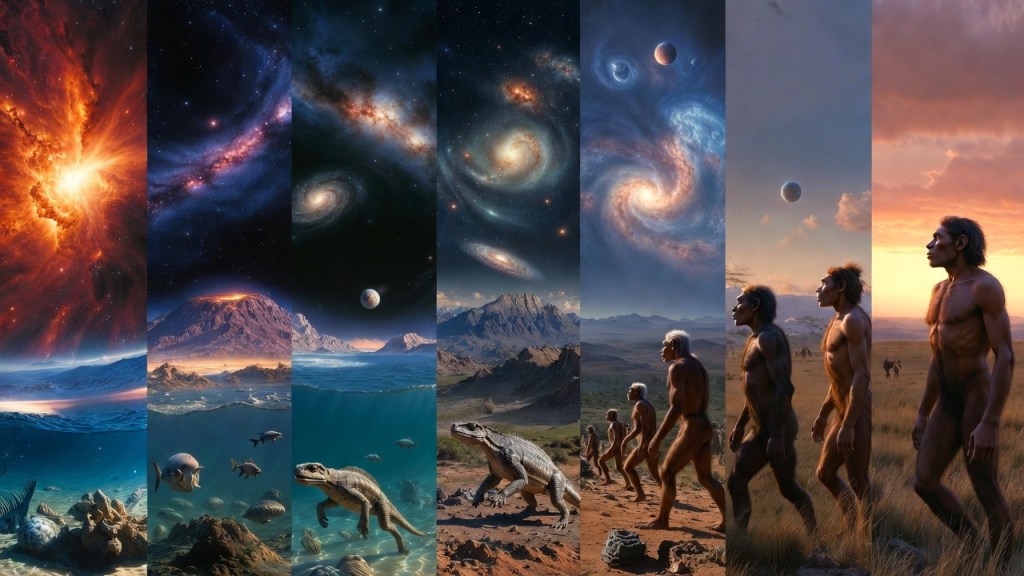
ORIGIN: BIG BANG to HUMANS

About: we have read about the origins of the Universe, our Milky Way Galaxy, the solar system, and our Planet Earth, of the beginning of time; of the beginning of life and everything as we know it today. With so many stories swirling about us, I was fascinated and wanted to pin-down our origins in about 15 minutes. This is an attempt to present how it all began in a simple manner, leaving alone much of evolutionary and scientific jargon – that’s for you to connect the dots. (The image shown is Grok AI generated).

Scientists describe the Universe beginning as an extremely tiny, incredibly hot, and unimaginably-dense point-called Singularity: where density and temperature is infinite. Everything-space, time, matter, and energy-was squeezed into something smaller than an atom. Then, suddenly, it began expanding very rapidly and finding its own ‘Space’. This expansion is what we call the Big Bang – so well explained by astrophysicist and cosmologist Stephen Hawking (almost to the point that we believe he owned it). It wasn’t an explosion in space; it was space itself stretching out everywhere, all at once.

We do not know exactly what caused or triggered the Big Bang, which occurred about 13.70 billion years ago. Current scientific knowledge breaks down at that extreme point, so ‘what came before’ or ‘what caused it’ may not even make sense in the usual way. Time itself began with the Big Bang-there was no ‘before’ because time didn’t, exist yet – like asking what’s north of the North Pole. Hence, Time is Zero, when the Big Bang happened.

The first lively second produces gravity and other forces that govern physics. In less than a minute the Universe is a billion kilometres across and growing fast. All done in about the time it takes to make a sandwich.

Immediately after the Big Bang, things began cooling-down and scale-up, step-by-step: in the first moments and within about 3 minutes a soup of super-hot particles came into being. Then the Universe cooled just enough for the first protons and neutrons to form simple atomic nuclei-mostly hydrogen and helium. About 380,000 years later it cooled more, electrons joined nuclei and the first full atoms formed. Light could travel freely: we see this today as the cosmic microwave background-leftover glow from the early universe. In the next few hundred million years gravity pulled tiny differences in density into bigger clumps. The first stars and galaxies formed from gigantic clouds of hydrogen and helium gas. Stars ‘cooked’ heavier elements. Inside the stars itself, nuclear fusion created carbon, oxygen, iron, etc. When massive stars exploded as supernovae, they spread these elements into space.

About nine billion years after the Big Bang (4.6 billion years ago) in our Milky Way Galaxy, a cloud of gas and dust-enriched with those heavy elements from old stars-collapsed under gravity eventually leading to the formation of the Solar System: the centre became our Sun (a star that started fusing hydrogen). Around it, a spinning disk of leftover gas and dust formed. Tiny particles that stuck together grew into planetesimals (solid, rocky, or icy bodies ranging from a few kilometres to hundreds of kilometres across) collided and merged into planets.

About 4.5 to 4.6 billion years ago Planet Earth formed from rocky material in the inner part of the disk (closer to the Sun). Early Earth was molten from impacts and heat. A big collision with a Mars-sized object blasted debris that formed the Moon and also tilted the Earth’s Axis, causing the seasons we know. Over time, it cooled, water arrived (likely from comets and asteroids), oceans formed, and eventually life began. Then, about 3.8 billion years ago, the first organisms emerged.

Every scenario we know concerning the conditions necessary of life involves water. ‘Origin of Species’ scientist Charles Darwin hypothesised a small, shallow, warm body of water-a pond or tidal pool on early Earth-where a cocktail of simple chemicals could concentrate and react under energy sources like sunlight, heat, and other catalysts to form complex organic molecules, such as proteins, eventually twitching into the first primitive life forms. That’s the ‘warm little pond concept’. And some theories suggest that deep-sea hydrothermal bubbling vents could have done the same.

Once life existed, any new proto-life would be quickly consumed by existing organisms, explaining why such spontaneous generation doesn’t happen today. Everything that has ever lived, plant or animal, began from this primordial twitch. But this ancestral packet of life did something additional and extraordinary: it cleaved itself and produced an heir. And a tiny bundle of genetic material passed from one living entity to another, and has never stopped moving since. It was the moment of creation for all of us. Biologists sometimes call it the Big Birth. All living things use the same code.

The Earth’s surface did not become solid until about 3.9 billion years ago. There was no oxygen to breathe back then than there is on Mars today. About 3.8 billion years ago the first bacterial organisms emerged, and for two billion years they were the only forms of life: they lived, reproduced, and swarmed, but did not show any particular inclination to move on to another more challenging level of existence.

At some point in the first billion years of life on Earth, a kind of bacteria called Cyanobacteria, or blue-green algae, learned to tap into a freely available resource – the hydrogen than exists in spectacular abundance in water. They absorbed water molecules, supped on the hydrogen and released oxygen as waste, and in doing so, invented photosynthesis. This is undoubtedly the most important single metabolic innovation in the history of life on the planet. And it was invented not by plants, but by ‘smart’ bacteria.

Now, finally, we had oxygen in the Earth’s atmosphere, but it took awfully long for life to grow into the mind-boggling complex variety we know today. As the world had to wait until the simpler organisms had oxygenated the atmosphere sufficiently. Animals could not summon up the energy to do work. And it took about 2 billion years for oxygen levels to reach more or less modern levels of concentration in the atmosphere.

With the oxygen stage thus set-up brilliantly, quite suddenly an entirely new type of Cell arose, containing a nucleus and little bodies called organelles. The process is thought to have started when some blundering or over-adventurous bacterium either invaded or was captured by some other bacterium and it turned out that it suited them both. Call it a win-win situation. The captive bacterium became, it is thought, a mitochondrion, which made complex life organisms possible. In plants, a similar invasion produced chloroplasts, which enable plants to photosynthesise.

The uniqueness of mitochondria is that they are powerhouses, which use oxygen to breakdown food and release molecular energy. And without this ability, life on Earth would be nothing more than a sludge of simple microbes. They are also unique in that they have their own genetic material.

With the cell firmly established and having a means- an in-house power plant- of producing energy for its functions through the mitochondria, life naturally took the next step to building complex ‘skyscraper’ beings. Starting with a single cell, splitting to becoming two, and the two becoming four…life raced to build-up like crazy. Each cell carries the complete genetic code-the instruction manual for the living being it makes: it knows how to do its job and every other job of the body of the being. All living beings possess hundred of different types of cells. And the genetic code that enables them to be itself is the molecule called DNA (Deoxyribonucleic Acid)- the stuff of life- a legend in its own right and the blueprint of life. DNA exists for just one reason: to create more DNA.

Quickly, ‘sizing-up’ the DNA: It holds the complete set of instructions for building and operating an organism and carries genetic instructions from parents to offspring ensuring traits are passed down the assembly line. DNA is responsible for making proteins-vital for life. But they do not speak the same language as the proteins they engineer. Enter the RNA (Ribonucleic Acid) which acts as an interpreter between the two, working with a ‘chemical clerk’ called a Ribosome to carry out the instructions of the Big Boss – the DNA. That’s it, we built this animal.

To give a timeline, the great oxygenation event occurred 2.4 billion years ago, which transformed the atmosphere into one capable of enabling life. Multicelluar algae appeared about 1 billion years ago and the first soft-bodied multicellular organisms appeared about 550 million years ago leading to organisms with hard parts (shells, exoskeletons), then marine invertebrates, which dominate for a period of time; then the first vertebrates (jawless fish), first land plants, then we reach the age of fishes, progressing to the first four-limbed vertebrates that venture onto land; forests appear; amphibians diversify, first reptiles evolve. And then the mighty Dinosaurs evolve from archosaur (vertebrate, four-legged)reptiles; early mammals and crocodilian relatives appear.

At the beginning of the age of Dinosaurs, about 230 million years, ago the continents were arranged together as a single supercontinent called Pangea. Dinosaurs lived on Earth for a fabulous 165 million years and during their existence the supercontinent slowly broke apart. Undoubtedly, they are one of the most successful groups of animals to have roamed the planet. But despite their long evolutionary history, the origin of Dinosaurs remains shrouded in mystery. They went extinct when an asteroid the size of a mountain slammed into Mexico’s Yucatan Peninsula with the force of 100 trillion tons of TNT. The impact created a crater about 185 kilometres across and several kilometres deep and sent tons of rock, dust, and debris into the atmosphere. A darkness descended across the planet that, along with other related catastrophes, wiped out an estimated 80% of life on Earth. Whatever the causes, the huge extinction that ended the age of the Dinosaur left gaps in ecosystems around the world. And these were subsequently filled by the only Dinosaurs to survive – birds – and mammals, both of which went on to evolve rapidly.

After the Dinosaurs became extinct small, surviving mammals thrived in the empty ecosystems. Over millions of years, these shrew-like creatures evolved into primates, then Apes, and finally, after about 60–65 million years of evolution, early hominids emerged in Africa around 4 to 7 million years ago, eventually leading to Homo sapiens, 200,000 to 300,000 years ago. Humans did not appear immediately after the dinosaurs; rather, they are the result of a long, 65-million-year, evolutionary process of mammals that survived the Dinosaur extinction event. And Dinosaurs and Humans never lived together – as shown in fantasy movies.

Having come thus from simple organisms to complex Dinosaurs, how did even more complex Humans appear? Human prehistory is still under an intensive investigation with all kinds of discoveries and debatable theories evolving from the pools, vents, mysterious caves, fossils, and what not? Whatever, what we roughly know is that for almost 100% of our history as organisms, we were in the same ancestral line as Chimpanzees. Hardly anything is known about the prehistory of Chimpanzees, but wherever they were, we were.

Then about 7 million years ago something monumental happened: a group of new beings emerged – walked – out of the tropical forests of Africa- somewhere in the Great Rift Valley – and began to move about in the open savanna. They were called the Australopithecines, or Hominina (Southern Ape) and for the next five million years they would be the world’s dominant hominid species. They were capable of walking upright and existed for over a million years. The most famous hominid is the about 3.18 million-year old Australopithecine discovered in Ethiopia, East Africa, in 1974, called Lucy, named after the Beatles song, ’Lucy in the Sky with Diamonds’. Lucy is our earliest ancestor – the missing link between Ape and humans-said Donald Johanson the leader of the team that made the discovery. Lucy was tiny, just three and a half feet tall. She could walk and was evidently a good tree climber. She and her kind came down from the trees and out of the forests and did the walk of life. Now, being out in the open, calls for more survival skills and all the elements would appear to have been in place for rapid evolution of a potent brain, and yet that seems not to have happened. For over three million years Lucy & Co scarcely changed at all. Their brain did not grow and there is no sign of them developing simple tools despite the fact that they lived alongside other early hominids who did use tools.

At one point between three million and two million years ago there were as many as six hominid types co-existing in Africa. Only one outlasted all of them: Homo, which emerged about two million years ago. The relationship between Australopithecines and Homo is unknown, but they co-existed for over a million years before Australopithecine vanished mysteriously, and possibly abruptly. The Homo line begins with Homo habilis and concludes – rather continues – with us, Homo sapiens (the thinking man). In between there have been other Homo species: Homo ergaster, Homo neanderthalensis, Homo denisova, Homo rudolfensis, Homo heidelbergensis, Homo soloensis, Homo antecessor, and Homo erectus.

One group of tool users, Homo erectus, who seemed to arise out of nowhere, overlapped with Homo habilis and is said to be the dividing line: everything that came before them was apelike in character; everything that came after them was humanlike. Homo erectus was around for almost 2 million years, making them the most durable human species ever. Remember we, Homo sapiens are only about 200,000 years old, and we are still a long way from beating the record of Homo erectus.

Homo erectus was the first to hunt, the first to use fire, the first to fashion complex tools… and the first to look after the weak and frail. They were unprecedentedly adventurous and spread across the globe with breathtaking rapidity. Ultimately, Homo erectus and all other human species became extinct and Homo sapiens -outwitting all of them, probably with a thinking brain- was the only surviving human species, from about 13,000 years ago. And that’s all Out Of Africa.

To sum up, human evolution in over five million years from the distant puzzled Australopithecine to the fully modern human, produced a creature that is still 98.4% genetically indistinguishable from the modern chimpanzee.

So finally, what are human beings made-up of? We are fundamentally made of stardust forged inside ancient stars, or during their-supernova- explosive death, of course, billions of years ago. Humans are constructed with about fifty-nine elements. The top being – Carbon, Hydrogen, Nitrogen, Oxygen, Phosphorus, Sulphur, and Calcium, which account for over 99%. They are the building blocks of life. We are incomplete without molybdenum, vanadium, manganese, tin, copper, cobalt, chromium, and others. The biggest component in any human, filling over 60% of available space is, Oxygen, which is bound up with say Hydrogen and other chemicals to stay in the body.

Let’s go back to the mitochondria story and talk about man and woman – the male and female of us, the Homo sapiens species.

I’m not delving into the structure of the DNA, the genome, or the 46 Chromosomes-23 pairs-each half coming to us from Mom & Dad and XX being female and XY being male. That’s for you to read-up. But, remember, each human cell defined by a cytoplasm boundary wall has a nucleus (holding the DNA) and specialised organelles such as Mitochondria, Endoplasmic Reticulum, Golgi, Ribosomes, Lysosomes, Cytoskeleton, among others.

Women are the sacred keepers of human mitochondria. Sperm pass on none of their mitochondria during conception, so all mitochondria information is transferred from generation to generation through mothers alone. Such a system means there were many extinctions along the way. A woman endows all her children with her mitochondria, but only her daughters have the mechanism to pass it onwards to future generations. That leads us all the way to a Mitochondrial Eve from whom all of us descended. And they say, the last common grandmother of humans and chimpanzees was about 6 million years ago.

Mitochondrial Eve is defined as the most recent woman from whom all living humans descend in an unbroken line purely through their mothers and through the mothers of those mothers, back until all lines converge on one woman. Scientific studies place Mitochondrial Eve in Africa, likely in the Great Rift Valley, roughly 160,000 to 200,000 years ago. Mitochondrial Eve was part of a contemporary population of humans. Other women alive at that time may have descendants living today, but their unbroken female lineages failed to persist, or they only had sons who could not pass on her specific mitochondrial DNA.

Here we are, Homo sapiens, with such great ancestry coded in our genes, in every cell of our body-made of star dust. And to be born with all this stuff inside us, is by itself a great achievement. And remember women have a place in the scheme of things, carrying the storyline onwards.

I quote Richard Dawkins’s, Unweaving the Rainbow, “…the set of possible people allowed by our DNA so massively exceeds the set of actual people. In the teeth of these stupefying odds it is you and I, in our ordinariness, that are here”. Make the best of it. Make it count.

The next 15 minutes story coming up is about the first human civilisations, how they evolved, the various ages of human knowledge…up to the Industrial Revolution. Watch this Space-without dust in your eyes.