Dheeran Chinnamalai

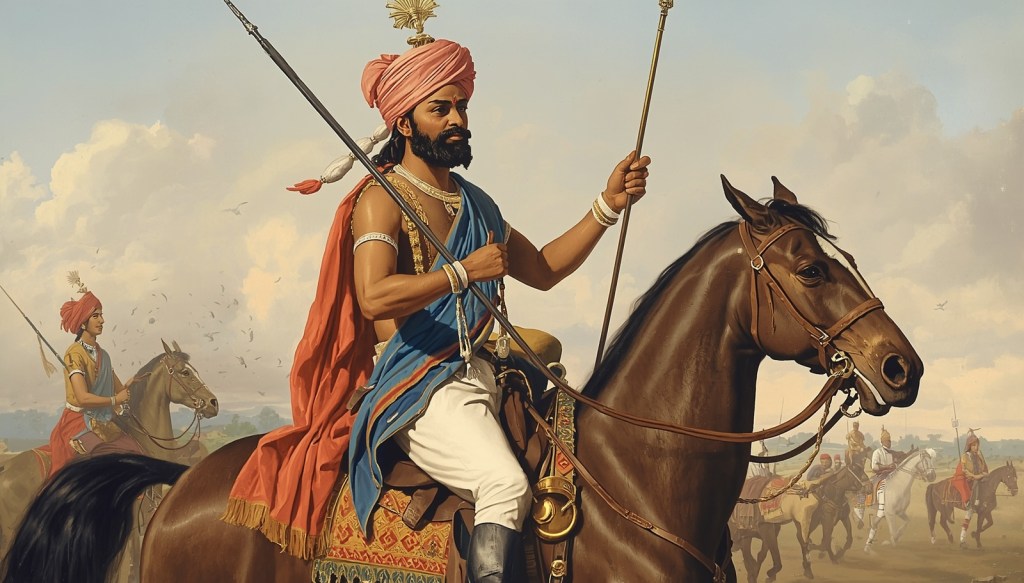
About: This is a fabulous story about one of India’s forgotten heroes, Dheeran Chinnamalai hailing from the Kongu region of western Tamil Nadu, South India. He is an early genuine hero, who fought the British, just when they were beginning to colonise India. The British stung by his courage and aura of invincibility-they finally got him-ensured Chinnamalai’s story did not become a household name by banning books or any re-telling of his challenge to the British, for a long period of time. They feared the example Chinnamalai had set.(Image Courtesy: Canva AI)

The British first arrived on India’s shores in the year 1608, at the port of Surat, Gujarat. India was renowned for its cotton, silk, calicoes, and muslins, and other textiles, which were hugely popular in Europe. As was Indigo, and saltpeter (potassium nitrate)-used for gunpowder-critical for Britain’s military needs. Add spices such as pepper from South India, and the British wanted to trade. They established the East India Company (EIA), as a trading company, to obtain goods from India and send them to Britain for gainful commerce.

The East India Company found its way to the Court of the then Mughal Emperor Jehangir and obtained permission to build trading factories and Forts in costal India, beside roads and bridges to facilitate movement of their goods.

Gradually, over the 1700s the EIA’s focus shifted from trade to political dominance: they spied many an opening to India’s riches. And at the Battle of Plassey in 1757, the British led by Robert Clive defeated a combination of the French East India Company and local Nawabs gaining control of the rich region of Bengal. Clive won by making a secret alliance with Mir Jafar, the Army Commander of the then Nawab of Bengal, Siraj-ud-Daulah. Mir Jafar deliberately held back his troops enabling the British to sneak through a victory. Mir Jafar was installed as a puppet Nawab, marking the beginning of British political dominance in India. Siraj-ud-Daulah escaped the battlefield, but was captured and later executed.

Mir Jafar’s name become synonymous with treachery and betrayal for enabling British colonial expansion through internal conspiracy. If he had not sold his soul to the British, maybe they could have been vanquished and sent back to Britain or at best continued functioning as a trading company. On the sidelines, the British learnt the art of pitting one Indian against another and using it as a vicious weapon to subjugate India. The multiple small Kingdoms, often at war with one another, in India suited that style.

Bolstered by its clever win, the EIA became a ruthless war-machine enjoying unbridled power in India, which eventually led to the first uprising against the British, the Indian Rebellion of 1857, also called the Sepoy Mutiny or the first war of Independence. The British Government watching the East India Company go roque, stepped -in, dissolved the EIA and assumed direct control of the Indian Sub-continent as the British Raj. Thereafter, it was the British Raj, all the way, that further colonised, ruled, and plundered its riches, until India’s independence in August 1947.

In the South of India, during the Robert Clive era, the British East India Company had only small trading enclaves, especially in Madras-now called Chennai. South India was ruled by independent regional powers such as, the Nawab of Hyderabad, the Maratha Confederacy, the Nawab of Carnatic, and the Kingdom of Mysore. These Kingdoms were the fragmented splinters of the glorious dynasties before them: The Vijayanagara Empire and The Chola Empire, to mention a few.

For around 300 years, a large part of present-day Tamil Nadu was ruled by warrior chieftains known locally as ‘Palayakkarars’ (heads of districts) or the Anglicized ‘Polygars’. Forgotten over time, these regional formations produced outstanding warriors who were probably the first to seriously challenge the British in South India, between 1700 and 1850. One of them being, Dheeran Chinnamalai. Others are, Maveeran Alagumuthu Kone -one of the earliest-the indomitable Veerapandiya Kattabomman, the courageous Puli Thevar, the amazing Rani Velu Nachiyar, and the remarkable Maruthu Brothers.

How did the Polygars come into being, who are they?

The Polygars were part of a unique three-tier administrative system created by one of the greatest Vijayanagara Emperors, Sri Krishnadeva Raya, who ruled between 1509 and 1529 CE. This simple but effective structure consisted of the Emperor at the top of the pyramid; the Nayakas or Viceroys, at Madurai, Thanjavur, Gingee, and other regions, forming the second tier; and the Polygars comprising the grassroots leaders, in the hierarchy. This one-of-a-kind system facilitated efficient administration of revenue, as well as created a mechanism for raising an army to meet the King’s war requirements, besides keeping generals, warriors, vassal rulers, and nobles gainfully occupied.

‘Palayam’ in Tamil and ‘Palamu’ in Telugu means an ‘army camp’ later stretched to mean an Administrative Division. At that time in Tamil Nadu, there were about 72 Palayams, each headed by a Polygar, who in turn reported to the Nayaka of Madurai. The Polygars functioned as semi-independent rulers operating from fortified centres, with a standing army-for the King- palaces, forts- in certain cases; they collected taxes, had private estates, dispensed justice, maintained law and order, held durbars, maintained water bodies, while expanding the land under cultivation, built and managed temples, and indulged in philanthropy. Over time, the Polygars became local rulers, ‘little Kings’. The paraphernalia of royalty was maintained by retaining a quarter of the collected revenue, while the rest was sent to the Nayakas.

The Polygars, also at times, founded villages, built dams, constructed tanks and built temples. They taxed regions according to the cultivable nature and fertility of the land. Their armed status served to protect the farming communities, trade & craft artisans, and ordinary civilians from robbers and dacoits who were rampant in those regions. And from invading armies, which often resorted to pillaging the villages and the countryside.

By the 18th century, while the northern Polygars fell under the Kingdom of Mysore, those in southern Tamil Nadu had to deal with the revenue demands of the British East India Company. The Nawab of Arcot had borrowed money from the EIA and had given the Company the right to collect taxes. All the Polygars, except Veerapandiya Kattabomman (1760 to 1799 CE) of Panchalankurichi, submitted to the East India Company.

While the year 1857 is often regarded as the first large-scale revolt against British rule in India, there were many localised revolts that broke out earlier. And one of them was the Polygar Wars, down South, between March 1799 and July 1805. These were some of the bloodiest revolts ever faced by the British, fought primarily in Tamil Nadu and the Malabar region. And the British did not have an easy run. The Polygar Wars were the most serious and deadliest challenge to their dominance in India. The 6 long years, saw a large number of losses on the British side, and they were defeated in many a battle. And the major players in the Polygar Wars actually challenged and outwitted the British, head to head. On the British side, in most cases, it took cunning, deceit, and treachery to capture and execute these warriors: they simply could not match their valour -directly.

The war between the British and Veerapandiya Kattabomman is called the First Polygar War (1799), while the second Polygar War (1800–1805)was fought by a much bigger coalition over the whole of western Tamil Nadu headed by Dheeran Chinnamalai and Maruthu Pandiyar.

In these times, on 17 April 1756, was born Theerthagiri Sarkarai Uthama Kaminda Mandradiaar, also called Theerthagiri Gounder, and later called Dheeran Chinnamalai, at Melapalayam in Erode district. His parents, Rathinaswamy Manradiaar and Periyaatha belonged to a noble, land-owning family of the Palaiyakottai Pattakarar (Mandradiaar title). He was the second of six children: elder brother, Kulandaisamy, younger brothers Thambi, Kilothar, and Kuttisamy, and a sister, Parvatham.

Theerthagiri’s grandfather, Kottravel Sarkkarai Mandradiaar, was one of the largest land owners, in the Kongu region, in present-day western Tamil Nadu. He was childless from his wife and took a second to beget children. However, he was childless from his second wife too; and thereafter he adopted two sons, first Senapathy and second, Rathanasamy, who he entrusted to each one of his two wives for upbringing. Both the sons were educated at the palace. In course of time, Senapathy and Ratanasamy got married and were given separate farm land regions to manage. As was the custom in those days, the first son Senapathi took the title of Manradiaar and continued to control the lands from Palaiyakottai. Rathnaswamy moved out-could be some kind of a partition plan between the Brothers-to a nearby village named Melapalayam and managed the family farm lands in that part.

During his childhood days, Theerthagiri attended the school within the Fort/Palace and was a bright, obedient, and disciplined student, excelling in Tamil literature, poems, and patriotic themes. He was introduced to the Tamil epics and the history of Tamil kings (Chola, Pandya, Chera), bravery, warfare, and governance, which inspired and instilled in him deep patriotism for the land, and leadership qualities from a young age.

Theerthagiri’s brothers, Kulandaisamy and Kuttisamy joined their father in farming, while Theerthagiri, with his other brothers, Thambi and Kilothar took on the responsibility of administration and safety of the villages under their jurisdiction, as Polygars.

The sister Parvatham was given in marriage to Ulagapuram Muthi Thirumalai Gounder, which strengthened the local Kongu Gounder network. Marrying into another Gounder family from nearby Ulagapuram (in the same Erode region) was typical for building alliances among chieftain families. The elder brother Kulandiasamy and the younger, Kuttisamy took wives, while Theertagiri, Thambi, and Kilothar never married, probably given the nature of their responsibilities.

The family managed extensive agricultural lands and ran the local administration. From a young age, Theerthagiri and his brothers received training in martial arts, including silambam, archery, horse riding, and techniques of warfare. Theertagiri gained experience in village panchayats, resolving land (and family) disputes, which further honed his leadership skills.

People of Kongu region traditionally practiced Hinduism under Shaivism- devotion centred on Lord Shiva. They followed Saiva Siddhanta traditions, emphasising Shiva as the supreme deity, along with associated rituals, temples, and philosophical teachings. They worshipped clan-specific kuladeivams (family or lineage deities), avatars of Amman (e.g., Mariamman, Periyachi Amman, or local protective goddesses), alongside major deities like Shiva, Murugan, and village guardian gods (e.g., Ayyanar or Karuppu Sami).

The then Kongu region, in the later half of the 18th century, was part of the Mysore kingdom, under Sultan Hyder Ali. The Diwan, Muhammad Ali, who was in charge of tax collection, followed unfair and unethical practices. He often humiliated farmers by confiscating their lands- their only means of livelihood – when taxes were not paid on time.

During one such tax-collection exercise, Theerthagiri and his brothers confronted Muhammad Ali, in an area between the hills of Sennimalai and Shivanmalai, recovered the forcibly collected taxes, and distributed them to the affected farmers. A furious Muhammad Ali, threatened Theerthagiri with severe consequences, once the Sultan learns about the incident. Theerthagiri shot back, saying Kongu Nadu will not accept Hyder’s rule, and it is capable of governing itself. He famously told the Diwan: “I am Chinnamalai, who reigns between Sennimalai and Shivanmalai” ( I am a small hill between two larger hills). And this was when he got the name of Chinnamalai, which means ‘small hill’ He earned the prefix ‘Dheeran’ meaning brave or valiant, for his courageous defiance.

Enter, Dheeran Chinnamalai.

Hyder Ali, as expected, sent an army to Kongu to teach Dheeran Chinnamalai a lesson. However, Chinnamalai met the Army on the banks of the Noyyal river and routed Hyder Ali’s forces. This only further enraged Muhammad Ali, and he vowed vengeance. Knowing Ali’s intentions, Chinnamalai began to build his own army. However, Hyder was preoccupied with the Nizam, British, and the Marathas, with whom he was in constant conflict, hence the return attack never happened.

Hyder Ali died in 1782 at his military camp near Chittoor during the Second Anglo-Mysore War, while actively fighting the British East India Company. Tipu Sultan, his eldest son, who was away on another military campaign, returned to Chittoor, assumed command, and took over as ruler of the Kingdom of Mysore.

Tipu Sultan adopted an even more aggressive policy towards the British and requested the Tamils of Kongu, to join forces with him to drive them out. Dheeran Chinnamalai responded, along with his brothers and trusted commanders, Velappan and Karuppan. Chinnamalai himself was made the commander of the Kongu regiment in the Mysore Army, and took active part in the 3rd and 4th Mysore Wars that initially helped repel British attacks on Tipu Sultan’s capital, Srirangapatnam. During his stint in Tipu Sultan’s Army, Chinnamalai received arms, combat, and battle training under the French, which served him well in the years ahead.

However, Tipu Sultan died in 1799, valiantly fighting the British, sword in hand, refusing to surrender. With the fall of Tipu Sultan, the British firmly declared, “India is ours”. And Dheeran Chinnamalai retreated home, along with Karuppan, as Velappan was captured by the British and he later became their agent.

Following Tipu Sultan’s defeat and the execution of Veerapandiya Kattabomman, Dheeran Chinnamalai emerged as a key leader in the Second Polygar War (1801 to 1805).

On his return to Kongu, Chinnamalai built a fortress at Odanilai, near Arachalur, south of Erode, Tamil Nadu, and began making recruitments and training his army, waiting for the right time to repeal any attacks by the British. He prepared his troops to use guerrilla tactics, especially hit-and-run warfare, to evade superior British firepower. He also reached out to the rulers of Malabar and Salem, hoping to build a larger alliance against the British.

Recognizing that Chinnamalai was a clear and present danger to their India ambitions, the British attempted to force him to sign a pact, where he was promised favours in return for accepting British sovereignty. He refused, knowing fully well that it would result in war. He mobilized and trained thousands of Kongu youth- up to 40,000-across religious and caste lines with loyal followers.

Chinnamalai’s bold defiance annoyed the British: a man with no title, technically not a ruler, yet refusing to accept their sovereignty, at a time when most of the Rajas, Nawabs, and Sultans had surrendered with much of a whimper.

In 1801, the British sent a troop of soldiers under Colonel Maxwell to tackle Dheeran Chinnamalai. However, Chinnamalai, having got advance information of the attack, defeated the British, again on the banks of the River Noyyal. Maxwell returned in 1802, and after a long siege of Odanilai fort, ended in yet another comprehensive defeat for the British, with Maxwell himself being killed-beheaded.

The British by this time were furious and waited for an opportunity to make a calculated assault. It came in the year, 1804, when having learnt that Chinnamalai and his followers would be attending the Arasalur Amman Temple festival, on a particular day, they made plans.

An army was dispatched to capture Odanilai Fort, under General Harris, who had led successful campaigns in Mysore. Chinnamalai through his network of spies learnt about the plan, and stayed back at the fort, with his main Army, while others went to join the temple festival. General Harris was taken by surprise when he attacked the fort, and Chinnamalai stormed-out, forcing him to retreat.

The British were now more determined than ever, and built a huge army to take down Chinnamalai, with cannons brought over from Madras. With 140 cannons and 30,000 men, Harris came back, attacked Odanilai, and surrounded the fort, demanding that Chinnamalai surrender. However, they found that the fort was abandoned, and that Velappan was acting as a double agent for Chinnamalai, while on the British side. Harris promptly had Velappan executed, and also razed Odanilai fort to the ground-the cannons were put to use.

The story goes that Dheeran Chinnamalai had a personal habit of wearing a new pair of slippers/sandals every day. Loyal informers and messengers exploited this routine to deliver secret notes/chits hiding them inside the soles of the sandals. Velappan would write critical intelligence – details of British troop movements, attack plans etc on a these chits. When he put on the new sandals in the morning, he would take-out and read the hidden messages and promptly destroy them.

One key instance involved storming the Odanilai Fort with cannons. Chinnamalai received the note and evacuated the fort to hide in the forests of Karumalai. After reading the secret note, Chinnamalai accidentally left it behind in the sandals, in the Fort. When the British arrived at the abandoned Odanilai Fort and while searching for Chinnamalai, they came across the discarded pair of sandals. Frustrated at finding the fort empty, General Harris picked up and threw the sandals against a wall in a fit of rage. The sandals broke open, revealing the hidden note. He then had the message read, which clearly pointed to intelligence information passed from Velappan warning Chinnamalai about the British attack plans (including cannons and timing).This exposed Velappan, leading to his execution.

Chinnamalai was deeply hurt by the incident, blaming himself for being careless, leading to the death of a true loyalist. The importance of spying is of paramount importance is getting the better of an enemy, in the asymmetric warfare of those times.

Chinnamalai, his brothers, and soldiers, now lived in exile, at a place called Karumalai near Palani, often disguising themselves to venture into towns. During such forays they became friendly with a local cook called Nallappan, who willingly offered them food, water, and refuge. It turned out that Nallappan was a traitor. He was enticed and bribed by the British to provide information on Chinnamalai’s whereabouts. He secretly informed the British about Chinnamalai’s daily routine of having meals in his house at the foothills. The British dug an underground tunnel leading to the house and waited for Chinnamalai.

One evening, following the usual routine, when Chinnamalai entered Nallappan’s house along with his brothers, and Nallappan proceeded to serve them. This time he cunningly asked all of them to keep aside their weapons as there was no danger while dining. The brothers trusted him and agreed, as they also did not sense an imminent danger. Once their weapons were taken away from them, Nallappan signalled the British who stormed the house both from the underground tunnel and from outside. A total of two hundred soldiers surrounded the house. The British soldiers quickly locked-on to Chinnamalai and his brothers. An enraged Chinnamalai managed to break-free, pounced upon Nallappan and strangulated him to death, on the spot.

The British arrested Chinnamalai and his brothers and kept them in a prison in Sankagiri Fort. Their loyal commander Karuppan who was in hiding at Melapalayam, also surrendered. A four person British Tribunal was formed, which demanded he accept British sovereignty and pay taxes. They also offered him amnesty if he tendered an apology. He refused defiantly and was sentenced to death.

On 31 July 1805, Dheeran Chinnamalai, his brothers, and Karuppan were hanged at Sankagiri Fort. He was about 49 years old. His body was brought back to Odanilai for burial.

The story goes that preparations were made to hang them by rope tied to a Tamarind tree located at the top of the Sankagiri fort. Chinnamalai, his two brothers and Karuppan were brought to the spot on the day of hanging. They asked the escorting British soldiers to move away, and each one tied the rope around their own necks and jumped to embrace death.

The whole of Kongunadu wept for the heroic deed on that day. The British ensured that Chinnamalai did not become a household name by banning books or any information on Chinnamalai for a long period of time.

Dheeran Chinnamalai symbolizes Kongu pride, valour, and early resistance to British rule. Today, statues and memorials stand in places like Odanilai, Sankagiri Fort, Chennai, Erode, Tiruchirappalli, and elsewhere. A commemorative postage stamp was issued by India Post in 2005. Though details vary across oral recounts and sources, his defiance remains a powerful part of Tamil and Indian history.

The story of Dheeran Chinnamalai, and his heroic battles with the British and the eventual sacrifice of his for the cause of freedom would have been completely consigned to oblivion, but of the tradition of oral story telling that existed in Tamil culture. The singular credit goes to Pulavar Kulanthai who heard this story from his grand father during the early 1900s and wrote it down, keeping the story alive.

I started with the treachery of Mir Jafar and ended with another kind of treachery by cook Nallappan. A brave, indomitable India (and sometimes casually over-confident) was defeated mostly from enemies within, rather than for those outside. Indian History is filled with them- like termites in the woodwork. Look around today, the story continues, albeit in different forms, wearing various political labels and colours.

Dheeran Chinnamalai, by any measure, was an extraordinary, fearless hero. He was against subjugation of any kind and stood-up for freedom, on his own free-will. He had no known mentor, nor was he of royal lineage. There is still so much we do not know about him. And the idea of Bharat- however loose it might appear with the many independent small Kingdoms-was long ingrained. Dheeran Chinnamalai could have been selfish ‘sticking himself to reigning between two large hills’, but he dared to fight the British along with Tipu Sultan. It’s now upon us to become our own chinnamalais, be counted, and stand up for India, always -in our own ‘chinna’ way. Small can actually be big. Jai Hind.

FREEWHEELING

About: A break free commentary on events on our Planet, anchored on the news of the world. Any comments beyond the storyline, are entirely mine, without prejudice -take it or leave it. This is a flight of events from 27 July 2025 to 14 August 2025: All kinds of wars; the great Cholas of India; the best of Chess, Football, and Cricket.

Wars: Tariff Included

US President Donald Trump continues his relentless one-minded drive on imposing tariffs on friends and foes alike, ostensibly to improve the US Economy by opening the flood gates of tonnes of cash flow into the country. This time it hit India when he signed an executive order slapping 25% additional tariff over the purchase of Russian oil. This is on top of the 25% tariff that Trump had previously imposed on India on 31st July, as part of the broader rollout of tariffs on more than 60 countries. This will come into effect on 27th August.With this, India faces at total of least 50 %-among the highest in the world. This will come into effect on 27th August. However, for goods shipped before 27th August previous tariff rates will apply until 17th September.

The tariff sledgehammer comes after days of Trump slamming India its purchase of Russian oil and accusing India of funding the Russian war on Ukraine. He said India remains the largest buyer of Russian oil along with China “at a time when everyone wants Russia to stop the killing in Ukraine”. With such purchases, he said India does not care “how many people in Ukraine are being killed by the Russian war machine”. Since Russia launched the full-scale invasion of Ukraine in February 2022, India has bought discounted Russian oil.

India hit back, exposing the hypocrisy and double-standards of the US and Europe. In a clear written statement, India pointed out that the Europe-Russia trade includes not just energy, but also fertilisers, mining products, chemicals, iron & steel and machinery, and transport equipment. The United States itself continues to import Russian uranium hexafluoride for its nuclear industry, palladium for its EV industry, fertilisers, as well as chemicals. India held that it began importing from Russia, in the first place, because traditional supplies from Europe were diverted to within Europe after the outbreak of the Russia-Ukraine War. And India works for the best interests of its people, just as the US does for its people.

On another front, India and the US are engaged in complex negotiations for a free trade agreement. As with trade deals with other countries such as the United Kingdom, India has sought to keep the politically sensitive agriculture and dairy sectors out of a deal, Trump has rejected the proposal and has pushed for their inclusion. He has also pushed for India to import genetically modified (GM) crops under the deal. India considers GM crops illegal.

In the ongoing physical wars, Israel is making plans to take complete control of Gaza City with its cabinet approving the intent. And the 50 hostages still remain in captivity. Meanwhile, Australia announced that it would recognise a Palestinian State in September.I would say that countries -including India -should announced that they would ‘de-recognise’ Palestine, if the 50 Israel hostages are not released by September.

Ukraine and Russia continue making fire and a Trump-Putin Summit scheduled to take place in Alaska on 15 August, hopes to break the ceasefire deadlock. Russia is expected to demand Ukrainian land for a peace deal, which Ukraine steadfastedly refuses. Trump would probably be ‘all ears’ on a listening exercise. And Putin is a tough customer.

The Great Cholas of South India

Indian history does not cut enough into the meat of the mighty Chola Dynasty of South India, which ruled for an unbelievable 1500 years, between 300 BCE and 1279 CE(AD)- one of the longest ruling dynasties in world history. They remain grudgingly unknown, and if at all in bits and pieces. The Cholas ruled Southern India in two stints as, the Early Cholas, and the Medieval or Imperial Cholas.

This is an attempt to shed bright sunlight, on the great Cholas, who considered themselves as descendants of the Sun.

Other names, in common use, for the Cholas are, Choda, Killi, Valavan, Sembiyan and Cenni.Killi comes from the Tamil ‘kil’ meaning dig or cleave- a digger or a tiller of the land. Valavan is connected with the Tamil ‘valam’ fertility and means owner or ruler of a fertile country. Sembiyan means a descendant of King Shibi – a legendary King whose self-sacrifice in saving a dove from the hot-pursuit of a falcon figures among the early Chola legends. The story flies like this, ‘As King Shibi sat in court one day, a sparrow sought refuge in his lap, while being chased by a falcon. The falcon demanded the King release the sparrow, as it constituted its means of subsistence. Accepting the falcon’s right, the King offered his own flesh in order to fulfil his sovereign duty of protecting his subjects’. The later Cholas claimed to have descended from King Shibi. The Tamil name for Shibi is Sembiyan, a name assumed by many Chola kings.

The Early Cholas ruled in Uraiyur (now Tiruchirapalli) and Kaveripattinam, Tamil Nadu, during the period 400 BCE to 200 AD. This includes the Sangam Period, which legendary literature reveals the first authentic evidence of the Chola dynasty. The Sangam is the literary gathering of Tamil poets and scholars who were first patronised by the Pandyan kings of Madurai. The Sangam era is significant in the development of early Tamil literature and provides valuable insights into the social, cultural, and political landscape of the period.

Going back in time, the earliest known Chola King was Kantaman, perhaps mythological, said to be a contemporary of the Hindu Sage Agastya, whose devotion is believed to have brought the River Kaveri into existence (from the water pot of Agastya). Then came the Chola King Dharmavarma who first developed the shrine of the Srirangam Ranganathaswamy Temple– A Vaishnavite shrine dedicated to Lord Ranganatha (a form of Lord Vishnu and his consort Ranganayaki – a form of Goddess Lakshmi) near present day Tiruchi. The temple is a thriving place of Hindu worship of Vaishnavism. Flooding of the River Kaveri destroyed the temple, and later, his descendant, King Killivalavan rebuilt the temple complex. The Temple site is on an island bounded by the Rive Kaveri and River Kollidam. Later Chola Kings built upon and expanded the Temple structure. The Temple is nominated as a UNESCO World Heritage Site and one of the oldest functioning religious complexes in the world.

In 190 AD Karikala Chola or, Karikala The Great, stands out, unsurpassed, along with another King Kocengannan. Karikala was the son of the great warrior Chola King Ilamcetcenni – of many beautiful chariots. Karaikala is mentioned as the descendant of a King who compelled the wind to serve his purposes when he sailed his ships on the great Oceans. ‘Karikala’ means ‘elephant feller’ or ‘charred leg’. He had charred his leg in a fire-accident while escaping when he was deposed and imprisoned. He then fought his way back to the throne to create History.

Karikala Cholan was one of the greatest kings during the Sangam Age in South India. He led the Chola empire successfully to unify the three South Indian kingdoms of Cheras, Cholas, and Pandyas. Karikala gained immense wealth trading with the Roman Empire, which he used to fund his military campaigns and to build towns and cities. He is known for decorating his capital city of Kanchipuram with gold, but his legendary act of fame was building, ‘The Grand Anicut’ – Kallanai Dam – on the River Kaveri.

Kallanai Dam is a massive dam of un-hewn stone, 329m long, 20m wide, and 5.4 m high built across the main stream of the River Kaveri. It is the oldest water-diversion or water-regulating structure in the world, which is still in use. The dam cleverly diverts the waters of the Kaveri River across the Thanjavur delta region for irrigation through a canal system which originally irrigated near about 69,000 acres. In the 18th century, the Kallanai Dam was modified with hydraulic structures and now, after such alterations, irrigates over one million acres.

Upon the end of the Sangam Era, in the period from 300 AD to 600 AD there is almost a total black-out of the history of Southern India, Tamil Nadu in particular. Elsewhere, during this time in India, the Gupta Empire was established and flourished, rising to great heights. Kalidasa, the author of Shakuntala, was a poet in the Gupta court. Mathematician Aryabhata lived in the period. Zero was invented. The ancient Gupta text Kamasutra by Indian scholar Vatsyayana, in Sanskrit, came into being. Nalanda University was established. Chess was developed during this time. Meanwhile, outside India, Islam came into being in the sixth century AD.

Then in the eight century, the Cholas rose from obscurity to hit the headlines, again. Vijayalaya Chola, a descendant of the Early Cholas founded the Imperial Chola Empire in 848 AD, finding his own ground in the then ongoing conflict between the Pandya and Pallava Empires. He captured Thanjavur and made it his capital. His son Aditya-I teamed-up with the Pallavas to defeat the Pandyas of Madurai in 885 AD, and later went-on to defeat the Pallavas themselves. In 925, Aditya’s son Parantaka-I conquered Sri Lanka. Then there was a mild set-back with Cholas’ heir apparent Rajaditya Chola killed in battle. Subsequently, the Cholas quickly found their feet, and recovered power during the reign of Parantaka II (Sundara Chola). Sundara Chola had three children, crown Prince Aditya Karikalan (Aditya -II), Princess Kundavai and Prince Arumozhivarman (the future Raja Raja Chola I) the youngest. The Cholas, under the command of fearsome Aditya-II, defeated the Pandyas and further expanded the kingdom. Aditya-II died under mysterious circumstances -he may have been assassinated. On the death of Sundara Chola, his brother’s son Madhurantakan was crowned King with the title Uttama Chola. Arumozhivarman ascended the throne in mid 985 AD and adopted the regal name Raja Raja, meaning ‘King among Kings’.

The story of Arumozhivarman is the plot of the famous novel Ponniyin Selvan by Tamil author Kalki, which to a great extent brought out and kept alive the story of the Cholas.The story ran through real historical sites and galvanised interest in the Cholas.

When Raja Raja Chola -I came to power, he inherited a small kingdom centred around the Thanjavur–Tiruchirappalli region, the heart of traditional Chola territory.

And under Raja Raja -I and his son Rajendra I, the Chola Empire reach its Imperial state. At its peak, the empire stretched from the northern parts of Sri Lanka northwards to the Godavari–Krishna river basin, up to the Konkan coast, the entire Malabar Coast, in addition to Lakshadweep and the Maldives islands. The Cholas wielded a formidable navy, securing extensive maritime routes and expanding their influence into South East Asia.

Rajaraja Chola I was a dynamic ruler who applied himself to the task of governance with the same diligence and zeal he had shown in waging wars. He integrated his empire into a tight, administrative grid under royal control and strengthened local self-government. In 1000 AD, Raja Raja conducted a land survey to effectively marshal his empire’s resources. He built the iconic Brihadeeswarar Temple, in Thanjavur, in 1010. Raja Raja Chola died of natural causes in 1014 AD, after ruling for 30 years, and was succeeded by his son Rajendra Chola-I.

Rajendra Chola-I took off from the strong shoulders of his illustrious father, scaling even greater heights and is easily the greatest Chola King who ever lived.

Rajendra conquered Odisha and his armies continued north into Bengal, and reached the Ganges river in northern India. Rajendra successfully invaded the Srivijaya kingdom in Southeast Asia, which led to the decline of that empire. This expedition left an indelible impression on the Malay people of the medieval period where his name is mentioned in the corrupted form as Raja Chulan. Rajendra’s territories included the Ganges–Hooghly–Damodar basin, as well as Sri Lanka and the Maldives. The kingdoms along the east coast of India up to the river Ganges acknowledged Chola suzerainty. Diplomatic missions were sent to China in 1016, 1033, and 1077. Rajendra Chola commanded the largest blue water navy in Indian history, which he used it effectively to subdue Srivijaya, a southeast Asian kingdom that lay 3000 km away.

Realising that the traditional Chola capital of Thanjavur was literally bursting at the seams, and could not hold his dreams, Rajendra built himself a new capital called Gangaikonda Cholapuram, which served as the Chola capital for the next 250 years. He built the Gangaikonda Cholapuram Temple in 1025 AD, symbolising Chola victory over the northern kingdoms and the successful Gangetic conquest. To anoint his new capital city with water from the sacred River Ganga he sent his army on a long expedition from Thanjavur all the way to modern day Bangladesh. His army defeated many kingdoms en route, and brought back water from the Ganga. He poured this holy water into a lake he built, the Chola Gangam, one of the largest manmade lakes in India. Gangaikonda Cholan literally means the Chola king who conquered the (plains of) River Ganga. Born on 26 July 971 AD, Rajendra Chola died in 1044 AD at age 73.

Gangaikonda Cholapuram Temple is a masterpiece of Chola architecture with unmatched architectural grandeur, embodying spiritual and cultural brilliance. It reflects Dravidian temple architecture with an emphasis on vertical elevation, axial symmetry, and Shaiva symbolism. It is inspired by the Brihadeeswara Temple at Thanjavur (built by Rajaraja Chola I), but with a shorter yet broader vimana (temple tower). Elaborate sculptural friezes, including depictions of Shiva in various forms, sophisticated hydraulic engineering in temple tank design, showcasing advanced water management techniques, subtle Tamil inscriptions in Grantha (script) and Tamil scripts, preserving Tamil heritage. That the temple is a UNESCO World Heritage site, is a testament to the Chola dynasty’s power and architectural prowess.

Both Saivism (worship of Lord Shiva) and Vaishnavism (worship of Lord Vishnu) flourished during the Chola period. A number of temples were built with the patronage of Chola kings and queens, which remained centres of economic activity.

Much of Tamil classical literature and the greater Tamil architectural monuments belong to the Sangam period, which also saw a revival of Shaivism and the development of southern Vaishnavism.

During the reign of Rajendra Chola, the Chola Empire reached its zenith in the Indian subcontinent; it extended its reach via trade and conquest across the Indian Ocean, making Rajendra one of only a few Indian monarchs who conquered territory beyond South Asia.The Chola fleet represented the peak of ancient Indian maritime capacity. The 1,000-year legacy of the Bhakti movement, maritime diplomacy, and temple-based urban culture that flourished under the Chola Empire.

Around 1070, the Cholas began to lose almost all of their overseas territories but the later Cholas (1070–1279) continued to rule portions of southern India. The Chola empire went into decline at the beginning of the 13th century with the rise of the Pandya dynasty, which ultimately caused the Chola’s downfall.

Now, coming over to the present.

India celebrated, with gusto, the millennium birth anniversary of Rajendra Chola-I on 26 July along with the Aadi Thiruvathirai Festival held between 23rd July and 27th July 2025 at Gangaikonda Cholapuram, near Jayankondam, Ariyalur District, Tamil Nadu.

India’s Prime Minister Narendra Modi inaugurated the celebrations and brought back focus and much deserved ‘attention to the matter’ on the great Cholas. He repeated the Rajendra Chola act of bringing holy water from the Ganges.

Here is a more detailed essay on the outstanding, mind-boggling contribution by the Cholas in art, architecture, and literature. Also to kindle your interest on the unforgettable Cholas. Sit back, and enjoy a time-machine return to India’s magnificent, ancient history.

The Chola reign marked a stupendous golden era in South India, blending religion, culture, and craftsmanship in monumental structures and intricate sculpture. The Cholas mastered metalworking techniques and perfected the art of bronze casting, producing precision detailed sculptures, particularly of deities. The iconic Nataraja sculpture of Lord Shiva, in the cosmic dance pose, is globally recognised for its depiction of motion and balance. Artisans realistically portrayed human figures, capturing physical beauty and emotional expression: the bronze figure of Sambandar – a child saint – is a testimony to this; the bronze figurines of Parvati (the consort of Lord Shiva) and Lord Vishnu showcase skill in representing ornate details such as garments and jewellery.

Art was deeply intertwined with religious themes, portraying complex symbolism in sculptures. The Ardhanareeshvara sculptures, which depict Shiva as half male and half female, symbolise the unity of opposites.

The Chola temples are adorned with magnificent sculptures that portray scenes from mythology and religious epics.The Brihadeeshwara Temple,Thanjavur, features numerous intricate carvings of gods, dancers, and animals. Chola art influenced classical Indian dance forms, particularly through depiction of divine dancers. The Nataraja in ‘Ananda-Tandava’ pose inspired traditional Bharatanatyam dance forms.

Chola art frequently depicted scenes from mythological texts, helping to preserve and propagate religious stories through visual art. Sculptures from the Airavatesvara Temple at Dharasuram, Kumbakonam, show scenes from the lives of saints and deities.

The Cholas perfected the Dravidian style of temple architecture, characterised by towering vimanas or gopurams (towering gateway structures at entrance of Hindu temples) The Brihadeeshwara Temple is a masterpiece of Chola temple architecture, standing as one of India’s largest temples.

The Cholas introduced gopurams – probably first thought of by the Pallavas but developed by the Cholas and later made better and bigger by the Vijayanagar Dynasty – that became an iconic feature of South Indian temples. Chola temples are known for their massive scale and advanced engineering techniques, especially in the construction of monoliths. The granite monolith of Nandi at Brihadeeshwara Temple weighs over 20 tons and is an engineering marvel. Cholas innovated by using both stone and brick in temple construction, allowing for more elaborate designs and stronger structures: again, the Airavatesvara Temple is a prime example.

Chola architecture extended its influence beyond India, particularly in Southeast Asia: The temples of Angkor Wat in Cambodia portray features reminiscent of Chola architectural styles, reflecting their global influence. The Cholas incorporated water management systems like temple tanks and reservoirs into their temple complexes: the pushkarinis (a stepped temple tank) at Gangaikonda Cholapuram were essential for ritual purification and water conservation: The Chola architectural style laid the foundation for later South Indian dynasties, particularly the Vijayanagar Empire, which continued and expanded on Chola architectural innovations, especially the lofty gopuram style.

The Cholas, through their unparalleled contributions to art and architecture, left a legacy that continues to inspire admiration. Their innovations in bronze sculpture, religious iconography, and monumental temple architecture elevated the Dravidian style to its peak, influencing future generations. Although the Chola empire has faded, their artistic achievements remain immortal, showcasing the artistic and architectural brilliance of medieval South India.

The Cholas patronised and advanced Tamil literature, fostering distinguished poets like Kalladanar(Kalladar), Kamban, and Avvaiyar. Kalladanar’s Kalladam (of Lord Muruga) celebrated Lord Shiva, while Thiruttakkadevar’s Seevaka Cinthamani (one of 5 great Tamil Epics) introduced Jainism to Tamil audiences. The epic is the story of a Prince who is a perfect master of all arts, perfect warrior, and perfect lover.

Despite the Chola rulers’ support for Sanskrit, original Tamil works thrived, with Poet Kamban translating Valmiki’s Ramayana – as Kamba Ramayana- enriching Tamil literature’s evolution.

In the beginning of 10th century, a Nayanmar saint Nambi Aandar Nambi wrote the ’Tiruttoonar Tiruvandhadhi, which is a memoir on the lives of the 63 Nayanmars (Tamil Saivite Saints). In 11th century, Nambi Aandar Nambi as the court poet of Raja Raj Chola compiled the hymns of the Nayanmar saints in Tirumurai, which is considered to be one of the greatest text of Nayanmar saints. The Tamil ‘Naalayira Divya Prabandham’ – 4000 divine verses- was composed by Alvar Poigai during the Chola reign. Rajaraja I was instrumental in bringing back Thevaram (the first seven volumes of the Tirumurai, a collection of devotional poetry dedicated to Lord Shiva) in the Shaiva tradition.

Classical dances like Bharatnatyam flourished during the Chola period primarily due to the Devadasi system. Cholas also patronised the bamboo staff fencing marital art Silambam. The representation of Nataraja or Adal Vallan (king of dance) in the form of the idol was the motif of Tamil music, dance and drama with hymns composed by Nayanmars. e.g. Oduvars and Padikam Paduvars: They were appointed to sing in the temples to recite Thirumurai.

The Cholas decentralized administration, allowing local leaders and village assemblies (sabhas) to exercise autonomy. This allowed the empire to maintain control over vast territories while fostering strong local governance. The Kudavolai system was used for local elections. It involved writing names of eligible candidates on palm leaves, which where then dropped into a pot and drawn out by a young boy -selecting representatives.

On the commerce front, Ports like Nagapattinam became thriving centres of international trade, with the Cholas exporting textiles, spices, and jewels.

That’s a breathtaking history of the Great Cholas.

Flash Floods

A massive cloudburst triggered heavy rains and flash floods in the northern Indian state of Uttarakhand. A flood of water came down, swelling the Kheerganga river and sending tonnes of muddy waters gushing downwards on the hilly terrain, covering roads, buildings and shops in Dharali Village – a tourist spot populated with hotels, resorts and restaurants.

Sports

India’s Chess International Master (IM) Divya Deshmukh all of 19 years, won the 2025 FIDE Women’s World Cup beating fellow Indian Grand Master (GM) Humpy Koneru in the tiebreaks. Through this victory she also achieves GM status- and a new star is born. She is now the 44th woman to hold the GM title. It was a magnificent feat for the talented and mentally tough Divya.

Divya Deshmukh was born in Nagpur, Maharashtra and hails from a Marathi family. Her parents are both medical doctors.

England’s Women earned its place in women’s football history with a stunning penalty-shootout victory over Spain to retain their European title at Euro 2025, on 27 July. Chloe Kelly, who scored the iconic winner at UK’s Wembley Stadium in the final of Euro 2022, was the hero again as she converted the decisive spot-kick to seal victory after Spain had missed three in a row – England’s goal-keeper saved two of them. It is the first time an England team has won a major trophy on foreign soil – at St. Jakob-Park in Basel, Switzerland -and seals manager Sarina Wiegman’s status as one of the world’s greatest with her third successive European title – achieved with two countries.

England’s Men came close to the winning ways of the women but India stole their thunder. The enthralling 2-2 draw for the Anderson-Tendulkar Trophy between England and India provided a dramatic start to the new cricket World Test Championship cycle. It was an epic contest, each of the five Tests going into the final day, four in fact into the final session, providing some of the best individual and collective performances the five-day format has seen in recent years.

Cricket pundits had predicted a clean sweep for England, what with the home advantage and India’s pre-series struggles. Whitewashed 0-3 at home by New Zealand, followed by a 3-1 drubbing by Australia down under in two preceding series, India looked vulnerable and wobbly.

The England-India Test series was a five Test one. And with the 4th Test at Old Trafford, Manchester ending in a draw India came to the Oval in London trailing England 1-2 in the series. But then India won by six runs to level the series 2-2 in one of the most dramatic conclusions in Test Cricket history. England were denied a record-breaking run chase by an irresistible India.

How India held their nerve under immense pressure – driven by willpower, ambition, and skill – culminating in a thrilling comeback to win and level the series, is one of Test cricket’s most riveting tales. It also marks this Indian young team’s transition from apprehension and misgivings one of rich promise fuelled by ambition and excellence. The future looks bright for this Indian team.

More captivating stories blending the past with the present, coming-up in the weeks ahead. Stay with Freewheeling.

WORLD INTHAVAARAM, 2024-52

About: the world this week, 22 December to 28 December 2024: Wars of the world; Germany’s terror; France’s horror; A former Indian Prime Minister dies; and death of Japanese small car-maker.

Everywhere

The world is reeking with a lot more violence and mayhem, other than the visible wars rolling in Ukraine, the Middle East-Gaza, and to a lesser degree in Sudan, Myanmar, and some other countries. And the War took yet another deadly turn, with the Iran-backed Houthis of Yemen launching rockets into Israel and Israel returning the favour more in kind. This week, Israel went hammer & thongs on neutralising the ‘Houthis threat’, bombarding their strongholds, besides wiping out key infrastructure in Yemen.

Germany’s Terror

Late last week, on 20th December, Germany’s Magdeburg Christmas Market was the scene of a horrendous terror attack. A 50-year-old man, originally from Saudi Arabia and living in Germany for close to two decades ploughed his car through the Market causing two deaths (including a child) and injuring about 80 people. The man, a Doctor, Taleb Abdulmohsen, was promptly arrested by Police.

Abdulmohsen had fled Saudi Arabia carrying the weight of rape accusations and implications in serious crimes. Saudi Arabia had formally requested that he be extradited, but Germany had denied the request citing human rights concerns, despite clear evidence of his criminal activities.

Post-Asylum in Germany Abdulmohsen reinvented himself as a dissident, publicly declaring himself an atheist and ex-Muslim, perhaps aimed at securing full asylum protection in Germany. And began working in a government hospital as a psychiatrist. Shockingly, while holding this position, he was publicly active in criminal activities, including human trafficking-smuggling young girls. Abdulmohsen made explicit threats against Germany, which authorities dismissed as ‘freedom of expression’.

France’s Horror

After a three-month trial, a French Court found Dominique Pelicot, 72, guilty of repeatedly drugging and raping his wife, Gisele Pelicot, for almost a decade, and inviting more than 70 strangers to rape her unconscious body in a case that horrified the world.

All the ’50 strangers (out of the 70) – the co-defendants, who were traced out – were also found guilty of charges brought on them. Gisele Pelicot, 72, the victim had waived her right to anonymity, and became a symbol of female courage and resilience during the trial.

Dominique Pelicot pleaded guilty to the charges, and a panel of five judges sentenced him to the maximum of 20 years in jail. The court found 46 of the other defendants guilty of rape, 2 guilty of attempted rape and 2 guilty of sexual assault, handing down sentences of between 3 and 15 years in jail.

Dominique Pelicot, denied misleading the men, whom he had met online, saying they knew exactly what they were doing. “I am a rapist like the others in this room,” he said during testimony.

The Pelicots’ children, David, Caroline, and Florian, arrived in court to hear the verdict alongside their mother. The siblings have spoken out forcibly against their father, rejecting his pleas for forgiveness.

The strangers come from all walks of life: lorry drivers, soldiers, firefighters, security guards, farm workers, a supermarket worker, a journalist, and the unemployed. The youngest was just 22 when he entered Gisele Pelicot’s bedroom, while the oldest was in his early 70s. Many had children and were in relationships. Most lived within a 50km radius of the Pelicots’ picturesque village of Mazan, which nestles in the vineyards, below Mont Ventoux.

The case only came to light in 2020, when Dominique was caught trying to take photographs up the skirts of women in a supermarket. Police then discovered more than 20,000 photos and videos on his computer drives revealing the horrifying secrets that he had hidden, from his now ex-wife, for a decade.

Dominique Pelicot had worked as an electrician and an estate agent and was married to Gisele for 50 years. He put powerful tranquilisers into his wife’s food and coffee that put her to sleep for hours. Gisele said she was worried she was developing Alzheimer’s or had a brain tumour because of the memory gaps.

She says she hopes the enormous interest in her case will help other women who have suffered sexual abuse, and brushes off praise for her own bravery in letting the world see her pain. “It’s not courage. It is determination to change things,” she said. “This is not just my battle, but that of all rape victims.”

Meanwhile, in India’s Tamil Nadu, the State BJP President, K Annamalai, took to the ancient Indian technique of self-flagellation -whipping himself six times-to highlight the apathy of the Police and State Government in the case of a sexual assault of a student on the campus of the premier Institute of Anna University, in Chennai. The intent seems to be to shock the political system out of its stupor on horrific acts of sexual violence and Police inaction in the State. It was a powerful a message as it was dramatic. He has vowed to walk barefoot until the State Government is ousted – the next elections are due in 2026, unless we are missing something.

India: a Former Prime Minister Passes

This week, former Indian Prime Minister (PM) Dr Manmohan Singh– the 13th PM of India- died at the ripe age of 92 due to age related illness. He was PM for two five year terms, between 2004 and 2014.

Though, by default, the Leader of the Lok Sabha-Members of Parliament(MP) directly elected by the people – goes on to become the PM, Dr Manmohan Singh is the only long-serving PM who never got himself elected to the Lok Sabha. He was a Rajya Sabha MP throughout his term, having lost the only time he contested as a Lok Sabha candidate in 1999, from South Delhi. The Constitution allows this, but it’s a ‘tacit understanding’ that a PM gets himself elected from the Lok Sabha – The House of the People. In that sense, he was an unelected Prime Minister.

Though he was PM of India for a decade, it was his stint as Finance Minister under former PM, P V Narashima Rao (PVNR) that gained him unforgettable fame for unshackling India’s Economy-the stifling Licence Raj-and unleashing the animal spirits in the Economy. He transformed into action PVNR’s vision of heralding the bold economic reforms of 1991, which forever transformed India. PVNR had inducted the apolitical Economist that Dr Manmohan Singh was, and gave him the ‘freedom’ to do what it takes to get the country out of the severe economic crisis that India faced. A hesitant Dr Manmohan Singh (what would the Party Chief say?) was encouraged by PVNR to deliver, along with his Commerce Minister, P. Chidambaram. As PM he shouldered the responsibility of the managing the politics ‘of whatever tough decisions his Finance Minister had to make’ to get India’s economy on the move.

Over the next few years, Dr Manmohan Singh carried out several path-breaking structural reforms that liberalised India’s highly regulated economy. And these measures proved successful in averting the crisis of the time – pulling India from the brink of bankruptcy.

But in later years as a ‘compromise’ or ‘accidental’ Prime Minister, he failed to capitalise on the stupendous job he did as Finance Minister, and roll out the next generation economic reforms. Maybe, it was because PVNR wasn’t around to lend the backbone?

Dr Manmohan Singh came to be viewed as a weak, remote-controlled (by the Congress Party Chief) Prime Minister. And a record number of scams were uncovered during his second tenure as PM, though he himself had an unblemished record: he was considered, wise, thoughtful, and scrupulously honest. He attributed his failure to be tougher – especially in acting against scam-tainted Ministers-to what to called ‘compulsions of coalition politics – some compromises have to be made’.

Born in Gah in what is today Pakistan, Dr Manmohan Singh’s family migrated to India during its partition in 1947. After obtaining his doctorate in economics from the University of Oxford he worked for the United Nations. He began his bureaucratic career when he was hired as an advisor in the Ministry of Commerce and Industry. During the 1970s and 1980s, Dr Manmohan Singh held several key posts in the Government of India, such as Chief Economic Advisor, Governor of the Reserve Bank, and head of the Planning Commission.

One of the best moments in his tenure as PM, was striking a civil nuclear deal with the United States. Others, such as the important National Rural Employment Guarantee Act (NREGA) and the Right to Information Act (RTI) were passed by the Parliament in 2005. The National Investigation Agency (NIA) was also created soon after the 2008 Mumbai terror attacks, as need for a central agency to combat terrorism was realised- He was criticised for not doing enough by going after (‘hot pursuit’) the perpetrators of the Mumbai terror attack-one of India’ worst ever. The Unique Identification Authority of India (UIDAI)was established in February 2009, an agency which went on to implement the Multipurpose National Identity Card -Aadhaar-with the objective of increasing national security and facilitating e-governance.

Dr Manmohan Singh married Gursharan Kaur in 1958. They have three daughters, Upinder Singh, Daman Singh, and Amrit Singh. Upinder Singh is a professor of history at Ashoka University. Daman Singh is a graduate of St. Stephen’s College, Delhi and the Institute of Rural Management, Anand, Gujarat. Amrit Singh is a Staff Attorney at the American Civil Liberties Union in the United States.

Japan: Death of a Small Car-Maker

Osamu Suzuki, 94, an ingenious ‘penny-pincher’ who led Japan’s Suzuki Motor Corporation for more than four decades and played a key role in turning India into a flourishing auto market, died of lymphoma, on Christmas Day.

He steered the Company ambitiously, during his time as either chief executive or chairman, out of its primary market of mini-vehicles.The inexpensive, boxy, 660cc cars specific to Japan benefited from generous tax breaks, but demanded a stringent reining-in of costs that proved to be a key part of Suzuki Motor’s DNA.

Osamu Suzuki’s thriftiness was legendary: he would order factory ceilings lowered to save on air-conditioning and fly economy class on airplanes even at an advanced age.

“Forever,” or “until the day I die,” were signature humorous responses with which he parried queries about how long he would stay at the company, on which he retained a tight stranglehold into his 70s and 80s.

In the 1970s, he saved the company from the brink of collapse by convincing Toyota Motor to supply engines that met new emissions regulations, but which Suzuki Motor had yet to develop. More success followed with the 1979 launch of the Alto mini-vehicle, which became a massive hit, boosting the automaker’s bargaining power when it tied up with General Motors in 1981.

Osamu Suzuki then took a big and risky decision to invest a year’s worth of the company’s earnings to build a national car maker for India. His personal interest was motivated by a strong desire “to be number one somewhere in the world”.

The Indian Government had just nationalised Maruti, set up in 1971 as a pet project of Sanjay Gandhi, son of then-Prime Minister Indira Gandhi, to produce an affordable, ‘people’s car’, made in India. Maruti needed a foreign partner, but early collaboration with Renault fell through. Team Maruti team knocked on many doors but was snubbed widely by brands including Fiat and Subaru and initially also by Suzuki Motor.

The partnership only came about after a Suzuki Motor Director in India saw a newspaper article about a potential Maruti deal with Japanese small-car rival Daihatsu. On learning that the Maruti team had been turned away he hastily invited the team back to Japan, asking for a second chance. A letter of intent was signed within months. And the rest is history.

The first car, the Maruti 800 hatchback based on the Alto, was launched in 1983, becoming an instant success. Today, Maruti Suzuki majority-held by Suzuki Motor commands roughly 40% of India’s car market.

In class-conscious India, Suzuki also ushered in change, insisting on equality in the workplace, ordering open-plan offices, a single canteen and uniforms for executives and assembly-line workers alike.

Not all endeavours were a success, however, when nearing his 80th birthday, Osamu Suzuki clinched a multi-billion-dollar tie-up with German giant automaker Volkswagen(VW) in December 2009. Touted as a match made in heaven, it soon faltered, with Suzuki Motor accusing its new top shareholder of trying to control it, while VW objected to the Japanese firm’s purchase of diesel engines from Fiat. Suzuki Motor took VW to an international arbitration court in less than two years, eventually succeeding in buying back the stake of 19.9% it had sold to Volkswagen.

Osamu Suzuki, who often cited golf and work as the key to his health, finally passed the baton as CEO to his son Toshihiro in 2016, and stayed on as Chairman for another five years until age 91, keeping an advisory role until the end.

Since 2016, his company has deepened ties with the world’s biggest carmaker Toyota, which acquired a 5% stake in Suzuki Motor in 2019. Maruti Suzuki is set to supply electric cars for Toyota from next year. Said Toyota of him, “He was a father figure who developed Japan’s kei car (mini vehicle) and nurtured it into Japan’s people’s car”.

During Osamu Suzuki’s reign Suzuki Motor was transformed into a global conglomerate successful spreading to 190 countries where it has a significant presence. He had the vision to avoid a direct fight with the other global auto manufacturers who were competing with each other using cutting-edge technology. Instead, he looked out for unexplored markets with small but modern cars which changed the automobile trends in the countries he entered. In India, for example, he introduced small modern cars when the market was dominated by old fashioned, outdated cars, thereby, revolutionising the auto industry.

Osamu Suzuki’s fiscal prudence is one of the reasons behind the rise of Suzuki Motor Corporation to the status of an auto giant by selling small low priced cars, still making a profit.

Born Osamu Matsuda, Osamu started his career as a loan officer in a local bank. His life took a turn when he married Shoko Suzuki, the granddaughter of the patriarch of Suzuki Motor Corporation, Michio Suzuki. As the Suzuki family did not have a male heir, Osamu was married into the family, and following the Japanese custom, Osamu took up the family name of Suzuki, to become Osamu Suzuki. He is the fourth adopted son to run the company. He joined the company in 1958 and worked upwards through the ranks to become President two decades later.

Shoko and Osamu Suzuki have three children and the family lives in Hamamatsu city, in Japan.

More small and big stories coming-up in the weeks ahead. Drive with World Inthavaaram.

Kaakkaa Thukkikittu Poochi

About: a light-hearted look at a failed to take-off arranged marriage adventure, in Tamil Nadu, India in the 1990s.

It’s been one of my favourite childhood lines, ‘Kaakkaa Thukkikittu Poochi’ (The Crow Lifted it Away). When something goes missing – inexplicably or explicably – and someone asks where it is gone, my childhood fantasy reply has always been, ‘Kaakkaa Thukkikittu Poochi’.

These days, when someone asks where my wife is, or someone, or something else for that manner, I jokingly say the same thing. Often it brings forth a bewildering look, an ear-to-ear smile, or a deep sigh, Oh?

Over the years there are many things that have gone missing – down the rabbit hole – allowing the crow to fly-in and do its lifting-off job.

It was the 1990s, in the early days of bride-hunting, in the world of Boy-See-Girl Arranged Marriages, I had just settled into my job in an Indian Government Public Sector Company at Neyveli, Tamilnadu. I had joined as a Graduate Engineer Trainee and powered myself to Executive Engineer level when the family decided I should get married. Of course, with me giving the electric green signal. I had in my possession a nice little new two-bedroom Flat – Company Quarters – they call it, in the Neyveli Township. And my batch of Engineer colleagues were quick to bring their brand-new wives for the living and filling-in the spaces, some had already progressed to having kids. It was my turn.

One day, I was summoned by my family to see a Girl, living in the nearby city of Salem. Her father worked in Dubai or Oman (I’m not sure) and she was an Arts Graduate ‘fully equipped’ to get married. She had one younger brother.

My Mom, Dad, maternal Uncle and Aunt – a whole troupe was ready for the seeing, and we all filed into the Girl’s House at the auspicious time. After the introductions, exchanges of pleasantries, and serving of coffee, I had my chance to talk to the Girl – privately – for a one-to-one unchaperoned chat. It was a pre-condition I had laid for such adventures.

I had built-up a simple dream figure of my future wife: must have long lustrous hair, look reasonably good, and talk fluent English (I reckoned some education comes with that), among other essentials. I was put in an English Boarding School from the age of three, initially staying as a paying guest in an Anglo-Indian family in the nearby hill station of Yercaud and then into boarding in the dormitory. My thinking was wholly in English. And I translated it to Tamil, my mother tongue, whenever I spoke in Tamil resulting in many calling me a Malayalee from the State of Kerala due to my ‘fish smelling’ accent. To top it up, I talked in hypersonic speed!

Well, the girl had long hair cascading to her hips, looked good – in my opinion- and spoke decent English – though not Shakespearean. I am unable to recall the conversation, but I felt awfully good about it and there wasn’t the slightest hesitation in saying a ‘yes’ to the Girl – assuming other matching aspects will be taken care off by the family (and I reckon she understood what I spoke).

When we decided to leave, I wanted to just go over and say, ‘I like the girl, let’s go ahead with finalising the match’. But my family pulled me aside and said let’s not hurry, we can tell them afterward, when all of us have discussed what we saw.

A few days later, my Dad says, the ‘Girl is not fair-enough – she is on the darker side’. I said that cannot be a reason – unacceptable – if there is any other worthwhile reason I can consider it. We were building a new house at that time in our ancestral Village, and Dad was insistent that we order dark-brown wash basins and WCs for the washrooms. I shot it down, saying, ‘nothing doing – we’ll go for the white coloured ones’. He then argues, you are alright with white ceramic basins, but not a ‘white’ bride? Those were the white colour obsessed days. Any my Dad lived up to it.

With no other reasonable objections coming from the family, beyond inaudible grunts and murmurs, I said let’s go ahead. Meanwhile, I made my own enquires through a cousin of mine, known to the Girl’s family, and was satisfied with what I had gathered-Sherlock Holmes would have been proud. And I was assured that the girl is not of the ‘dangerous kind’.

I had to go on a six-month Company work stay in Haridwar in the North of India and left it to the family to ‘finalise the relationship’ and make Wedding plans.

It turned out that, being unable to convince me against the alliance, the family made another trip to the Girl’s House to see her ‘fully’ once again. They listed more skin, eye, and ear faults, which I did not take with a pinch of salt. But seeing the unholy resistance and not knowing more about the Girl, and not yet in love with her, to make a firm decision, I gave up. My family said ‘No’ to the Girl’s family and we moved on.

With the acquired experience, my family was more cautious and I was successful in the next adventure bringing home my now wife (though, I had to cut down the length of the hair – being richly endowed in other departments).

Over the years, I have always wondered what happened to that Girl, who did she marry? Where does she live? How does she look like now? It’s just a foggy memory I have of her, and I am not sure I would recognise her should I run into her again. There is too much dust on the mirror- and I only remember a smiling oval face and long hair – a dusky beauty. The world is certainly round but still not round enough for us to meet again!

A classic, Kaakkaa Thukkikittu Poochi tale?

WORLD INTHAVAARAM, 2023-51

About: the world this week, 17 December to 23 December 2023; Israel and Hamas; Shooting in Prague, Czechia; Earthquake in China; the Pope and LGBTQIA; Parliament shakes in India; Floods in Southern India; and the Coronavirus and Kerala.

Everywhere

Israel-Hamas War

Late last week, in a tragic accident, Israel admitted mistakenly killing three hostages during a search and rescue operation.

An Israeli soldier stationed in a building in Gaza City’s Shejaiya neighbourhood, identified three suspicious people exiting the building several dozen meters away. All three were shirtless, with one of them carrying a stick with a makeshift white flag. The soldier, who believed the men moving toward him was an attempt by Hamas to lure Israeli soldiers into a trap, immediately opened fire and shouted “terrorists!” to the other forces. The hostages either managed to escape Hamas captivity or were abandoned, before they were mistakenly shot dead.

This is in the tense background of the Israel Defence Forces (IDF) having encountered several, seemingly unarmed civilians in the area, who turned out to be Hamas suicide bombers. There have also been countess attempts by Hamas to trick soldiers into an ambush. This is an awfully difficult and unforgiving war.

Over the week, Israel offered the Terrorist Hamas a deal, “Release 40 hostages – the old, woman, and children – and we stop bombing for a week”. Hamas did not take it.

Shooting in the Czech Republic

This week on the 21st December, in the deadliest attack in modern Czech history a gunman shot dead 14 people and injured another 25 at Prague’s Charles University.

The shooting started at the Faculty of Arts building, on Jan Palach Square. The gunman, who was studying Polish history at Charles University, murdered his father before shooting his classmates in a killing spree, and in the end possibly killed himself, after being shot-at by the Police. The motives were not immediately known.

The Police, who discovered a large arsenal of weapons at the building where the shooting took place, were tipped off earlier in the day that the suspect was likely heading to Prague from his town in the Kladno region, outside the capital, with intentions of taking his own life.

The gunman later identified as David Kozak had a gun permit and owned several weapons. He is also suspected of killing a man and his four-month-old daughter in Prague, a week ago. Police are also probing any connection between Kozak and a series of Russian-language messages posted on Telegram. One of the messages indicated that the attack may have been influenced by two previous mass shootings in Russia: one this month at a school in Bryansk near the Ukraine border, and the other in 2021 in Kazan. David Kozak was an excellent student and had not criminal history.

The Czech Republic has relatively liberal gun laws compared to the rest of Europe. To obtain a gun legally, a person needs an official licence, which requires a medical examination, a weapon proficiency exam, and no previous criminal record.

Charles University in Prague, founded in 1347 is the oldest and largest University in the Czech Republic -Czechia – and one of the oldest institutions in Europe.

Bless LGBTQIA

This week, Pope Francis relaxed controls, making the Church a little more LGBTQIA (Lesbian, Gay, Bisexual, Transgender, Queer, Intersex, and Asexual) friendly. He is allowing Priests to bless same-sex couples. This is a forward-looking step, and a walk back on a 2021 Vatican Ruling that banned blessing Gay couples, because ‘God cannot bless sin’. However, reading the fine print, the new rule clarifies that a blessing, which is typically, a prayer, should not be given at a Gay Wedding or Civil Ceremony. It also reaffirmed that marriage is between man and woman.

China’s Earthquake

A powerful 6.2 magnitude earthquake struck a mountainous region in northwestern China, resulting in at least 127 deaths and over 700 injuries, making it the deadliest earthquake in the area in nine years. Gansu province is severely affected, along with the neighbouring Qinghai province.

The affected area in Qinghai province is adjacent to the Tibet Himalayan region, prone to frequent earthquakes because of continental plate shifts.

Preliminary analysis shows that the quake was a thrust-type rupture, one of three above magnitude 6 to have struck within 200 km of the epicentre since 1900. At least 32 aftershocks were reported in the hour after the quake hit.

Infrastructure was severely impacted, leading to power and water supply disruptions, damage to rural roads, railway lines, and the cracking of a bridge across the Yellow River.

India’s Parliament: A Tumultuous Week

This week India’s Opposition Parties created a ruckus in Parliament, displaying placards, shouting, disruption the proceedings, and not allowing Parliament to function – all against the rules. They were demanding a statement from the Home Minister on last week’s ‘Smoke in The Eyes’ security breach, which was not forthcoming. This forced the Speaker of the Lok Sabha, and the Chairman of the Rajya Sabha, respectively, to take punitive action on the errant Members of Parliament (MP) by suspending them.

The string of suspension of Opposition MPs in the Lok Sabha and Rajya Sabha grew to a mammoth total of 146 – a first-time record. That’s almost two-third of the Opposition kicked-out of Parliament, for bad behaviour.

To make matters worse, the suspended MPs sitting on the steps of the Parliament premises got into a ‘College-Times Strike’ mode. They were entertained by one of the MPs mimicking and mocking the Vice-President (VP) of India, who is also the Chairman of the Rajya Sabha. The VP called it an insult on his background as a farmer and Chairman. Another MP was seen nonchalantly filming the episode on his mobile. This created a huge social-media storm that drowned other news, for days.

Meanwhile, the Government cooly went about its law-making business, slipping in path-breaking new Laws to replace the British-era colonial laws. And got them passed, ‘without breaking into a sweat’, in both Houses.

New criminal law reforms, replacing the old are: The Bharatiya Nyaya Sanhita Bill (BNSS) replaces the Indian Penal Code,1860; the Bharatiya Sakshya Bill (BSS) replaces the Indian Evidence Act, 1872; and the Bharatiya Nagarik Suraksha Sanhita Bill (BNSSS) replaces the Code of Criminal Procedure, 1898.

With these changes, the criminal justice system of India is significantly reframed, finally growing out of a colonial mindset. The old laws were centred around punishment and deterrence: the new bills shift the emphasis to justice and reformation, in keeping with the changes of modern-day India.

Some highlights of the new Laws:

Twenty new offences have been included in the BNSS. These include organised crime, terrorist acts, hit-and-run, mob lynching, sexual exploitation of a woman by deceitful means, snatching, abetment outside India, acts endangering the sovereignty, integrity, and unity of India, and publication of false or fake news.

In a first, the government has included ‘community service’ as a punishment for theft of less than INR 5,000 and five other petty offences. Adultery and homosexual sex are not listed as crimes. Attempting to commit suicide will no longer be considered a criminal offence.

The sedition law has been repealed, and the sedition provision has been redefined to contain actions against India-deshdroh– instead of actions against the Government-rajdroh. One is free to criticise the Government, but not say anything to demean the nation.

Police will have to register a First Information Report (FIR) within 3 days of the complaint and in cases involving a punishment of 3 to 7 years, the FIR is to be registered after preliminary investigation. Chargesheets will have to be filed in 180 days and the Magistrate will have to take cognisance within 14 days. Forensic science has been given a lot of importance in evidenced gathering, as is electronic evidence.

The Government said that it had received a total of 3200 suggestions from 18 States, 6 Union Territories, the Supreme Court of India, 16 High Courts, 27 Judicial academics, several MPs, and bureaucrats, in the mammoth exercise to make the new laws. And 158 meetings were held to consider the suggestions.

Also passed was the Telecommunication Bill 2023, replacing the 138-year-old colonial-era Telegraph Act, 1885, and other allied laws.

The Govt will allocate spectrum for telecommunications through the Auction Method and for Satellite communications through an Administrative Method. Companies will require an authorisation to start services instead of Licences that are issued at present. It is mandatory to issue SIMs after capturing verifiable biometric data of the applicant to prevent misuse. Obtaining a SIM or any other telecom resource through fraud, cheating, personation will entail a jail term up to three years or a fine upto INR 50 Lakhs per person.

India’s Down South Floods

The South Indian State of Tamil Nadu is having a tough time. Cyclone Michaung had unleashed mayhem in Chennai more than a week ago and just when the State was limping back to normalcy it was hit by the rains again – this time in the southern districts.

Unprecedented rains caused by a cyclonic circulation in the Bay of Bengal battered the districts of Tirunelveli, Tuticorin, Tenkasi, and Kanyakumari, inundating roads, flooding houses, affecting train services, and leaving authorities scrambling to rescue those stranded. Helicopters in the air, and boats on the water were pressed into service.

Tamil Nadu received almost 50 mm of rainfall between this Sunday and Monday, compared with the 2.50 mm that would be normal at this time of year. Kayalpattinam in Tuticorin received more than 95 cm in 24 hours, which sank the Town. Tuticorin City grappled with about 5 feet of water. More than 10,000 people had to be rescued. About 150 people have died, succumbing to the fury of the floods.

Entire neighbourhoods remained submerged, with houses appearing like lonely islands surrounded by murky, brown water. Lakes were overflowing and rivers were in spate. Towards the end of the week, the waters began receding, slowly.

There is this heart-warming story of a Train, which left Tiruchendur Station on Sunday at about 8.30 pm bound for Chennai. About 34 km into the journey it was stopped at Srivaikuntam Station by alert Railway Staff, when it began raining heavily, following a cloud burst. The Railways decided not to allow the train to go any further, which proved to be a wise decision. The rains then intensified and subsequently it was found that about 12 km of track was washed-away due to land eroded by the rains, in the route ahead of the Station. The Station itself was completely isolated as a water island after about 300 passengers had been evacuated. The remaining had to stay put in the Train as the escape route was cut-off. And the Railway Station staff did their darnest until help came, only after the waters receded. Food was dropped-in by Helicopters. Imagine, about 1000 lives would have been lost that day, if it weren’t for the Railway Men. Cheers to them.

Questions on better preparedness and early warning are being asked and hope to see a flood of improvements next time around.

COVID-19 Again, and Kerala

The SARS.CoV-2 coronavirus is on the prowl again, growing its family and trying to spike our lives. Reminds us that the virus continues to evolve in different ways.

This week, what is called the JN.1 variant of the coronavirus was detected in India for the first time.

The JN.1 is a descendant sub-lineage of BA.2.86 or Pirola sub-variant of Omicron, and carries an additional mutation on its spike protein. After Kerala, the JN.1 was found in Goa, then Maharashtra, Karnataka, and in some other States. A total of over 595 Covid-19 cases have been reported.

The JN.1 was first detected in Luxembourg in August this year and later reported in The United Kingdom, Iceland, France, and the United States.

JN.1 was previously classified a Variant of Interest as part of its parent lineage BA.2.86, but the World Health Organization (WHO) has now classified it as a separate Variant of Interest. Talk about a grown-up leaving the parents’ home, fully armed to take-on the World?

WHO said current vaccines will continue to protect against severe disease and death from JN.1 and other circulating variants of the COVID-19 virus. And it is best to continue to hold on to the masking and hand-washing techniques, learnt and executed so well.

Often, the State of Kerala is the first to detect a disease outbreak, wondered why?

Kerala recorded India’s first JN.1 Covid sub-variant in a 79 years old woman at the beginning of this month. Earlier, the State also recorded the first cases of Nipah virus, Monkeypox, and other diseases. There are many other reasons as to why Kerala is the first to record diseases and subsequently becoming a hotbed of them.

Kerala’s geography contributes to the frequency with its sizeable forest cover and intense monsoon pattern making it prone to outbreaks. The State has witnessed several zoonotic outbreaks owing to the shrinkage of natural habitats and proximity to human settlements, in a densely populated region. Take for example, the Nipah virus: a special investigation found that humanity’s drive for resources is destroying the wildlife habitat of bats – which carry tens of thousands of viruses – and creating conditions ripe for a bat-borne disease to spill over to humanity. Civet cats have almost become urban animals as their natural habitats have been wiped out. These animals are believed to be the mediators for the pathogen that caused Severe Acute Respiratory Syndrome (SARS). Bats, which lost their natural habitats, moved into human habitations. These animals are now considered as the reservoirs of Nipah and Ebola virus.

Another reason for Kerala being the home of such diseases is the State’s population. People of Kerala are spread across the globe, with a large number of students studying medicine and many expatriates working as doctors or nurses around the world. They face the occupational hazard of viral attacks and may unwittingly spread undiagnosed diseases to others when they return to India.

There’s also the State’s management and health system. The State has rigourous testing and its population is also highly aware. For e.g., when the first case of monkeypox was reported from Kollam in Kerala, the concerned person who returned from the United Arab Emirates (UAE) underwent a test. This, after he learnt that his contact abroad had tested positive, even though he was asymptomatic.

Many a time, Kerala has been criticised for reporting an outbreak. Experts say that should not be done. Its active surveillance mechanism, capacity-building exercises for healthcare workers, frontline staff, community engagement and strategic interventions have not just been helpful in detecting viruses, but also in keeping the disease outbreaks in control.

It is left to be seen if COVID-19 does make a strong comeback in the State, but Kerala is known for handling outbreaks and, in fact, virologists and epidemiologists have hailed its robust surveillance.

More stories will rain in the weeks ahead. Hold on to World Inthavaaram.

WORLD INTHAVAARAM, 2023-13

About-the world this week, 26 March to 1 April 2023: Israel erupts, America continues shooting, an ex-American President is indicted, Scotland gets a new First Minister, a local Party in India gets somewhat whole; and plants talking to each other.

Everywhere

Israel saw unprecedented protests and civil unrest ignited by the Government’s plan to bring in judicial reforms, which aims to rein in the powers of an ‘interventionist judiciary’.

The most significant reform would allow a simple majority in the Israeli Parliament, Knesset, to overturn Supreme Court rulings; to change the way judges are selected, and remove government ministries’ independent legal advisers, whose opinions are binding.

This week, Israel’s Defence Minister was promptly sacked when he said that the Government should stop going-ahead with the new legislation and talk to the opposition and protestors: he was fired for not backing the new law. The President of Israel also called upon Prime Minister (PM) Benjamin Netanyahu’s Government to halt the judicial overhaul.

Early this week, embattled PM Netanyahu finally buckled and announced that he would delay the judicial reforms plan, after protests seemed to be only swelling and getting out of hand.

Netanyahu said he would put-off voting on the remaining legislation until after the Knesset’s Passover recess in April 2023 ‘to give time for a real chance for a real debate’. In a televised address, Netanyahu said that he was aware of the tensions and is listening to the people. But he indicated that the pause was only temporary, and insisted that the overhaul was necessary, reiterating criticism of refusal to train or serve in the military in protest at the planned changes. “Refusing is the end of our country,” Netanyahu said. Israel rests in peace for the moment.

Israeli historian, philosopher, and best-selling author Yuval Noah Harari, of ‘Sapiens: A Brief History of Humankind’ fame, feels that Netanyahu may go down in history as the man who destroyed Israel. He added that the PM has divided the country to preserve his political longevity, which has caused rifts that will be difficult to heal. Hope Netanyahu is listening to this one of the Homo Sapiens.

Six people, including three children, were killed in a shooting in Nashville, Tennessee, United States, which just cannot keep its paws off ‘em guns. It’s 129 mass shootings in the past three months and a distinctive American phenomenon. A frightening count says that America also has more guns than it has people!

The Covenant School in Nashville, where the incident took place, is a private Christian school for students in pre-school through the sixth grade, when students are roughly 11 or 12 years old. Nashville police engaged and killed the shooter, a 28 year old woman, Audrey Hale, who was carrying two ‘assault-type’ rifles and a handgun. She is a Nashville resident and was once a student at the school. The motive is unclear and is being investigated. Initial pointers indicate that Audrey had some resentment to having to go to the Covenant School; had a history of mental struggles; and the shooting was planned as a kind of suicidal mission.

This week former United States (US) President Donald Trump was indicted – charged with felony crimes – by a Manhattan Grand Jury in his role of payment of hush money to a porn star. His arrest is imminent. And when it happens, the unprecedented arrest of a former President of the US is likely to be routine with standard procedures for felony offences followed, such as being fingerprinted, photographed, and maybe, even handcuffed.

Donald Trump faces more than 30 counts related to business fraud in the indictment from the Grand Jury – the first time in American history that a current or former President has faced criminal charges. The decision has sent shockwaves across the country, pushing the American political system-which has never seen one of its ex-leaders confronted with criminal charges, let alone while running again for President – into uncharted waters.

The incident pertains to Trump’s role in a hush money payment scheme and cover-up involving adult film star Stormy Daniels that dates to the 2016 presidential election.

Daniels has said she had a sexual encounter – it was consensual sex – with Trump in 2006, the year after he married his third wife Melania. And more than a decade before the businessman-turned-politician-at the time known for a popular reality TV show – became President. Trump has denied the relationship and has said the payment was made to stop false and extortionist accusations.

Stormy Daniels, 44, whose real name is Stephanie Clifford is from Baton Rouge, Louisiana. She has been a well-known personality for more than two decades in the adult film business, appearing in and directing numerous videos.

In October 2016, in the waning days before the presidential election that Trump won, Daniels signed a non-disclosure agreement in which she pledged not to publicly discuss her relationship with him in exchange for a USD 130,000 payment. The pact was signed by Keith Davidson, her lawyer at the time, and Michael Cohen, then Trump’s personal lawyer and fixer. The document included a spot for Trump’s signature, but he never signed it.

On expected lines, Trump released a statement in response to the indictment claiming it was ‘Political Persecution and Election Interference at the highest level in history.’ We heard similar sounds from someone, of India’s Grand Old Party, didn’t we?

Russian President Vladimir Putin took another step in complicating the attack on Ukraine announcing last weekend that Russia would be deploying tactical nuclear weapons in the territory of a ‘very friendly’ neighbour, Belarus, ruled by his long-time buddy Alexander Lukashenko, also the longest-sitting European President.

Meanwhile, Ukraine said it was seeking an emergency meeting of the UN Security Council over the move.

In February this year, the First Minister of Scotland, Nicola Sturgeon, 52 who was also the Leader of the Scottish National Party (SNP) quit both positions in a ‘Jacinda Ardern’ moment. This after over eight years of ‘ruling’ Scotland and trying to get its ‘independence’ from the United Kingdom.

This week, Humza Yousaf was confirmed as Scotland’s new First Minister after a vote in the Scottish Parliament. Yousaf was backed by all 64 SNP Members of the Parliament and the 7 of the Scottish Greens, guaranteeing him a majority. The two parties having a power-sharing agreement in the 129 seat Parliament.

Humza Yousaf, a son of Pakistani-Kenyan immigrants, is the country’s sixth first minister, the youngest at 37, and the first Muslim to lead a major UK party.

Following the vote, Yousaf announced Shona Robison – who has been serving as the social justice secretary and was a close ally of Sturgeon – would be appointed as his Deputy First Minister. He also confirmed he would have a ‘Minister for Independence’ in his government, a role he pledged to create during the leadership campaign.

UK’s Prime Minister Rishi Sunak said he was looking forward to meeting and working together with Yousaf, but the UK Government has already made clear it will continue to refuse to grant formal consent for another independence referendum.

India saw the week filled with protests by Opposition parties over the disqualification of the Congress Party’s, Member of Parliament, Rahul Gandhi following his conviction in a defamation case by the Courts. Quick on the heels was a notice from Parliament to vacate his spacious bungalow. Last heard, he was hunting for a House while his Party continued setting a bad precedent by ‘challenging the judiciary’.

In India’s Tamil Nadu state, the more than the year-long tussle between ‘Two Joint Leaders’ of a once powerful Party, the All India Anna Dravida Munnetra Kazhagam (AIADMK) founded by yesteryear film superstar M G Ramachandran (MGR) and later skilfully steered by his protege Jayalalithaa, was finally resolved. At least, for the time being.

Following the untimely death of Jayalalithaa – fondly called Amma – due to illness, while in office both as the General Secretary (the Supremo) of the AIADMK the top position fell vacant. A minister in the cabinet, Edappadi K Palanisamy (EPS) became Chief Minister of Tamil Nadu, in some smart moves and did a reasonably good job, for the remaining term – over two years. He bypassed the favourite, O Panneerselvam (OPS) who was himself CM twice when he filled-in for the time Jayalalithaa was convicted by Courts and had to quit office under the Rules. Basically, OPS kept the Boss’ seat warm.

High drama followed the passing of Amma when her close friend and confidante Sasikala almost became CM, but a court conviction of corruption sent her packing to jail.

Then for over the past 4 years, EPS & OPS jointly steered the AIADMK dedicating the position of General Secretary to Amma, as ‘eternal’, until the ‘friends with benefits’ turned sour and EPS became tired of the dual-headed control. All the more after the AIADMK lost at the hustings and bitter rival, the DMK, came to power.

The Two Leaves, symbol of the party, began wilting – under stress. After a series of Court cases, clashes between the widening factions, and Court appeals and re-appeal, EPS was finally announced as elected unopposed and the undisputed General Secretary of the AIADMK. Hope to see the two leaves listen to the party cadres and bloom especially with the Lotus (symbol of the Bharatiya Janata Party) having gained lots of water and land in Tamil Nadu.

EPS announced that said the party would continue its alliance with the BJP for the upcoming Lok Sabha Elections in the year 2024, after rumblings from the BJP about ‘going it alone’. Then there is OPS – a leaf cut off from the stem. Tomorrow is another Day!

Please Yourself

An Israeli research team, Tel Aviv U, has in groundbreaking research, recorded plants ‘talking’ for the first time.

It has been known for some time that plants communicate with one another, but Israeli scientists now say they have identified ‘words’ and have found that different species speak in different ‘languages’, according to a new study published this week in the prestigious Scientific Journal, Cell.

Scientists know that plants communicate in a variety of ways when they are stressed. They might change physically -by wilting or changing leaf colour, become bitter to the taste -to deter herbivores- or emit smells -volatile organic compounds-to tell other members of the family that they are under attack, for example by insects.

It turns out that plants talk in clicks, which sounds something like popcorn popping. The sounds are emitted at a volume similar to human speech, but at high frequencies, beyond the hearing range of humans.

The findings suggest that the world is full of plant sounds and that these sounds contain information — for example about water scarcity or injury. It is assumed that in nature the sounds emitted by plants are detected by creatures nearby, such as bats, rodents, various insects, and possibly also other plants that can hear the high frequencies and derive relevant information.

Perhaps humans can also utilize this information, given the right tools — such as sensors that tell growers when plants need watering.

The research team recorded ultrasonic sounds emitted by tomato and tobacco plants that had been deprived of water, suffered a cut to the stem, or have been left alone. Time for new vocabulary building

More plant stories coming up in the weeks ahead. Listen to the clicks and stay with World Inthavaaram.