CAPTURED: BLAZES

About: This is the third in my Captured series; about capturing various stories that blazed the world. Call it Season 1, Episode 3. While actual Wild Fires engulfed Europe – especially in France and Spain, India was blazing on another level – in Transport, Space, and Sport. And a quick short story about Independent India’s first scandal. (Image Credit: Canva AI, 1 August 2026).

WILD FIRES

The month of July 2026 has gone-up in flames, with Wild Fires ignited in France and Spain getting out of control. The reason behind the French fires is accidental -with one linked to a brush-clearing machine; Spanish origins were, extreme heat, drought, dry vegetation, and winds that rapidly spread the fires. Nothing to do with the heat of Spain winning the FIFA Football World Cup 2026 or France losing to Spain in the semi-finals.

Successive, sweltering heatwaves since late May, and a very hot June in Western Europe severely dried vegetation, perhaps inviting the Fire Gods for sumptuous meals: breakfast, lunch, and dinner served. The previous wet winter and spring season promoted abundant plant growth that then became ready fuel, on drying. Strong, shifting winds and low moisture accelerated the spread.

‘Rounding up the usual suspects’ of the ‘fire weather’ conditions is, human-caused climate change.

Typically, these fires become so extreme they create their own giant fire thunderstorm. A rare weather event, storms like these are formed when heat from the wildfires makes the air above the fire rise rapidly, carrying smoke, ash and water vapour high into the atmosphere. As the air rises, it cools, and the water vapour condenses into a cloud. If the fire is powerful enough and the atmosphere is unstable, that cloud can grow into the same type of cloud associated with thunderstorms.

This year’s Wild Fires were centred in southwestern France, especially Gironde near Bordeaux/Cap-Ferret and Landes; and Central Spain, west of Madrid, including Avila and related areas. The fires smoked-out over 200,000–300,000 people forcing them to evacuate, ravaged tens of thousands of hectares, and prompted European Union aid, military support, and emergency declarations.

Fires are also burning in Portugal, in the north-eastern district of Vila Real and also in Greece, on the island of Paros in the Aegean Sea and the southern town of Trifylia on the Greek mainland.

Both France and Spain are now seeing another sharp rise in temperatures, with peaks of 41 to 42 Degrees Centigrade expected in France.

In the United Kingdom, the London Fire Brigade had its busiest 24 hours of 2026 on 29 July, tackling 63 grass fires across the capital as temperatures topped 30 degrees centigrade. Control officers took over 1,300 emergency calls and crews rushed to more than 500 incidents. Almost 1,000 calls about grass fires have been made in the past week. It’s a European rage.

Investigations into the exact causes continue. Most wildfires require an initial spark-lightning is possible, but less common here than human causes, which then becomes catastrophic under the dry weather and plant fuel conditions.

The vast blazes that ripped through southwestern France burned so intensely they created a powerful, fire-generated thunderstorm. This rare phenomenon is sometimes seen in the Megafires that afflict the United States and Canada, but was unprecedented in France, until now. And it’s just one sign that Europe is entering a new fire era.

Europe has always had Wild Fires, but they are becoming increasingly frequent and extreme. Firefighters in France and Spain are currently trying to tame blazes more ferocious and more erratic than anything they have tackled before.

This follows the Europe’s record-breaking fire season last year and enduring back-to-back extreme fire seasons is becoming the norm. Experts say, “We have entered an era of fires that cannot be extinguished. These are fires that burn with the intensity of several atomic bombs.” Who needs Atom Bombs?

A BLAZING INDIA

There was a different kind of fire in normally ‘heat-friendly’ India, with a standout period in mid-to-late July 2026, during which India made spectacular advances in clean transport, private spaceflight, and women’s sports. Fuelling the tracks, burning the courts, blazing the field, and scorching the skies!These triumphs will be etched in India’s history, forever.

On 17 July 2026, Prime Minister Narendra Modi inaugurated India’s first indigenously designed and built hydrogen-powered passenger train under India’s Atmanirbhar Bharat (self-reliant India) mission. It is a 10-coach hydrogen fuel-cell based trainset powered by a 1,200 kW hydrogen fuel cell propulsion system, and currently the world’s longest of its kind. The fuel cells combine hydrogen and oxygen to generate the train’s own in-house electricity, with water vapour (and heat) as the primary emission-making it a zero-carbon alternative. The system rides with a dedicated hydrogen storage, refuelling and other necessary technical systems. It is especially useful for routes that are hard to fully electrify.

The ‘hydrogen train’ ran on the about 89 km Jind–Sonipat section of the Northern Railway in Haryana, covering the route in about two hours with intermediate stops. It has a passenger carrying capacity of 2600 people and operates at a speed of 75 kmph -the top design speed being 110 kmph.

From tracks on land to the free Space above.

On 18 July 2026 Skyroot Aerospace successfully launched Vikram-1, India’s first privately developed orbital-class rocket, from the Satish Dhawan Space Centre in Sriharikota, Andhra Pradesh, in its very first attempt. The mission was called Aagaman (meaning ‘arrival’ in Sanskrit) and Vikram-1 lifted off around midday Indian Standard Time and effortlessly reached the designated Low Earth Orbit- about 450km from the Earth’s surface. It then perfectly deployed technology demonstration payloads from over three customers, and Skyroot’s own satellite.

This made India only the third country (after the US and China) to successfully build a private orbital launch capability. And announced its ‘arrival’ into the commercial space business.

The name Vikram is in honour of Vikram Sarabhai, the father of India’s Space Programme.

Vikram-1 is mostly manufactured from carbon composites, which is five times lighter and stronger than the best rocket steel. Each stage is powered by the Kalam-series of Engines with a single Kalam-1200 engine being used for the first stage. The engines are named after India’s top Rocket Scientist and inspirational Ex-President of India, Dr A P J Abdul Kalam. The engine of the orbital vehicle, that enables orbital insertion, is 100% 3-D printed. The rocket stages are perhaps the longest monolithic carbon composite made in India, and combines with the first of the kind ultra-low-shock pneumatic separation systems. They all worked to perfection.

Skyroot Aerospace is a Hyderabad-based startup, founded in the year 2018 by two scientists-turned-entrepreneurs Pawan Kumar Chandana and Naga Bharath Daka. They asked themselves a simple question, “What if launching into space could be as accessible and routine as commercial air travel?” Skyroot was born from this vision.

A highlight of ‘team Skyroot’ is that the average age of its engineering team is 28 reflecting blazing young talent – Pretty Young Things, rooted to the ground but aiming for the skies.

Skyroot plans to increase launch frequency to one mission every month from next year onwards, while developing heavier launch vehicles and eventually, reusable rockets. And they hope, to be in the next wave of the space economy beyond satellite launches to include satellite broadband, direct-to-mobile communication and space-based computing. Elon Musk has ‘X, to the power India’, competition. Mind it!

Women’s Sports

Several high-profile successes by Indian women athletes clustered around the last weeks of July and called for a bonfire celebration.

On 19 July, India’s ace badminton player P V Sindhu won the Japan Open 2026 women’s singles title (a Super 750 event), defeating Japan’s Akane Yamaguchi in straight games. She became the first Indian shuttler to win the Japan Open crown.

Then on 26 July, in a rare moment, 18-years-old Anahat Singh hailing from Delhi, who is also the top seed, won the 2026 World Junior Squash Championships women’s singles title in Niagara-on-the-Lake, Canada. She defeated Egypt’s Ruqayya Salem 3-0 becoming the first Indian ever to win the junior world title and ending 15 unbroken years of Egyptian dominance in the event. Egypt climbs down from its pyramid top!

A day earlier, 31-years-old Manipuri Mirabai Chanu completed a hat-trick of Gold at the Glasgow 2026 Commonwealth Games, claiming her third consecutive title in the women’s 48 kg weightlifting event with a record-breaking total lift of 190 kg. It was also India’s first at the ongoing Games.

Then came Sharmila Dhankar, who at age 40, won Gold in the women’s shot put with a season’s-best throw of 9.81 m, becoming India’s first-ever Commonwealth Games gold medallist in Para-Athletics. She ended a 20-year wait for a Para-Athletics medal at the Games. Her climb to fame is heart-wrenching: a trail burnt with fire.

Sharmila Dhankar grew up in a poor farming family in a drought-prone Chitrauli village, Mahendragarh District, Haryana. Her father was a small-time farmer, and her mother was visually impaired. At age 2, a high fever led to polio that permanently affected one of her legs, leaving her with a lasting physical impairment. It was an extremely difficult childhood marked by poverty and limited opportunities.

Like many girls in her region, she was married off young at 18 years. The marriage involved severe domestic abuse, including physical violence linked to dowry demands and pressure for giving birth to two daughters, rather than sons. She was beaten for hours (one episode was from 11 pm to 3 am) and thrown out of the house at night. Thereafter, reaching a peak of despair, she left her husband’s house and returned to her parents’ home clutching her daughters.

To support her family she took various jobs, including as a maid, cleaner, and security guard; she briefly worked as a bus conductor during a transport strike.

She later remarried Ajit Singh, a businessman from Rewari, who encouraged her to venture into Para-Athletics, after learning about the immense opportunities. Sharmila then began training in shot-put and discus throw. Financial pressures continued; in the year 2023, the family sold their house in Rewari to fund her training and career. Sport gave her a ‘second birth’ and she hopes to buy a home again while providing better opportunities for her daughters-who are themselves budding athletes in javelin and long jump.

Earlier in the month, the Indian women’s cricket team achieved a landmark 270-run victory over England in the one-off Test at Lord’s—the first women’s Test win for India at the historic ground. Maybe, that heat was too hot for England to handle!

India is now powered by a new Nari Sakthi, which is blazing the tracks of progress and development. Bharat knows to handle its fire.

India’s First Scandal

With Glasgow becoming a Sports Inferno hosting the Commonwealth Games, there is another sidetrack story. I digress to another topic – nothing connected with Sports- that burned well in the late 1940s and early 1950s.

India’s first High Commissioner to the United Kingdom(UK), V K Krishna Menon earned, among other degrees, a Doctor of Laws degree from the University of Glasgow during his extensive higher education in the UK. And once upon a time he was the centre of Independent India’s first scandal, called the Jeep Scandal of 1948.

During the first Indo-Pakistan war, over the ownership of Jammu & Kashmir, the Indian Army found itself in urgent need of 2000 battle-ready Jeeps. India’s then High Commissioner in the UK, V K Krishna Menon bypassed standard procurement protocols to sign a ₹80 lakh contract with a small dubious, little-known firm, Anti-Mistantes, which had a capital of just £600. And India went out of the way to pay 65% of the total amount, upfront. Ultimately only 155 Jeeps were delivered and none were in usable condition. The best part is, then Prime Minister Jawaharlal Nehru shielded the fire than came upon Menon; the case was officially ‘dozed with water’ in 1955, and V K Menon was later appointed (rewarded?) as India’s Defence Minister. Strange are the ways of India’s Grand Old Party -the Indian National Congress (INC).

Today with the Cockroach Janta Party (CJP)- supported by the INC- firing up New Delhi’s streets, protesting ‘Exam paper leaks’ and calling for accountability, demanding (and obtaining) the resignation of India’s Education Minister, the hypocrisy is there for all to see.

After the Blaze come cooler things to capture. Tomorrow is another day.

ABOUT TAGLINES

About: Advertisement taglines, straplines-often with an attached logo- are short, memorable phrases that hope to capture a brand’s distilled essence; some becoming cultural touchstones. Many endure and linger for decades due to their simplicity, emotional resonance, aspirational tone, or clever wordplay. Others achieve massive cultural impact with strong emotional bonding or humorous recall. Here’s an exploration of some of the most iconic ones in India and the world, and also some that have gone horribly wrong. I’m not going too deep into the Agencies- with some exceptions- behind the creations, but the products they advertise. Let’s, Just Do It (credit: Nike).

Product advertisements are delightful examples of human ingenuity, and clever expression: like a juicy worm that draws a bird to swallow it whole, or perhaps pick it up and serve it as a meal to fledgling chicks; or, in these modern times, share on the ‘Bird WhatsApp Group’. Often the advertisement is better than the product itself. And we worm towards making buying decisions influenced by them in mysterious ways. Smell the coffee?

INDIA

Amul stands out with its cheeky one-liners, almost always showing a little girl dipping her paws into butter, cheese, or ice cream, with her tongue curled into the taste, and enjoying the moment. The Amul Girl is a staple mascot, since the 1960s, evoking national pride and buttery joy, and has become as epochal as the silent, watching-from-behind-the-scenes, ‘Common Man’ of the irresistible R K Laxman Cartoons.

The Amul Girl was created in 1966 by advertising executive Sylvester da Cunha and art director Eustace Fernandes as a witty, playful counterpoint to a competitor brand. Known for her red polka-dotted frock, blue hair, it was a response to rival, Polson’s more ‘proper’ butter-girl mascot. Amul’s then Chairman, Verghese Kurien wanted a mischievous child that was easy to draw, and memorable for outdoor hoardings. And he gave the creators complete slippery freedom to do mouth-watering campaigns.

Polson’s butter is no longer available in the market-disappearing in the early 1970’s- losing its monopoly to Amul. These days, Mother Dairy – ‘Like a Mother, and Happy Food, Happy People’- is one of Amul’s biggest rivals in the packaged milk and daily dairy segment.

Amul is an acronym for Anand Milk Union Limited, a cooperative society based in Anand, Gujarat, India, which has become the world’s largest milk producer through the White Revolution (Operation Flood). Amul was founded in 1946 and is the brand name used by the Gujarat Co-operative Milk Marketing Federation Ltd., (GCMMF), which is India’s largest dairy of its kind.

Its classic advertisement Amul -‘The Taste of India’ or ‘Utterly Butterly Delicious’-coined on a prompt by Sylvester da Cunha’s wife, Nisha, teases us to this day. Amul’s first advertisement showed the Amul Girl kneeling in prayer, ‘Give Us This Day Our Daily Bread’, alongside the slogan, ‘Utterly Butterly Delicious’ buttered on the pack.

These days Amul comes out with frequent advertisements, on various media, to reflect the times and events. I caught a recent one, ‘Your ODYSSEY to Great Butter Ends Here. Amul in Every Homer’. It showed film director Christopher Nolan and Actor Matt Demon (dressed as Ulysses) eating a slice of buttered bread, but sadly I missed the Amul Girl-they could have ‘peneloped her’ into the scene, showing her waiting at Ithaca -loaded with tons of butter.Despite being born in 1966, the Amul Girl has not aged at all. Wonder what is the secret of her youth? Your guess is as good as mine!

Adding salt to the butter, India’s sleeping giant, the Tata Group, came up with its iodised salt brand, plainly called Tata Salt, ‘Desh Ka Namak’- declaring it, ‘The Nation’s Salt’. It was simple patriotism tied to an everyday essential.

Evolving with the milk, Cadbury’s Dairy Milk Chocolate ran the line, ‘Kuch Meetha Ho Jaaye’ (Let Something Sweet Happen)- which linked chocolate to celebrations and everyday happiness. Mind the tooth!

In the days before Coca-Cola and Pepsi ‘cola-ed’ into India, Thums Up ruled with its slogan, ‘Happy Days are Here Again’. But when Coca-Cola entered (actually re-entered) India, it drank-up the brand – to counter Pepsi- and came up with the fiery slogan, ‘Taste The Thunder’ and its, ‘Aaj Kuch Toofani Akrte Hain’ (Let’s Do Something Stormy Today) kicked up many a nerve. Then, Coca-Cola swallowed success and rolled out fun and youthful punchlines such as, ‘Thanda Matlab Coca-Cola’ (Cold Means Coca-Cola). It made ‘thanda’ synonymous with refreshment.

If Coca-Cola is near, Pepsi cannot be far behind, and it yelled, ‘Yeh Dil Maange More’ (The Heart Wants More) and ‘Yeh Hai Right Choice Baby’ (This is The Right Choice, Baby)- making an energetic appeal to the youth of India.

After eating butter, chocolates, tasting thunder, and doing stormy things, eventually something spills on to your clothes. India’s washing detergent King, Hindustan Unilever’s, Surf Excel spotted the ‘dirty opportunity’ and actually said, ‘Daag Achhe Hain’ (Stains Are Good): clean reverse psychology that turned messy play into positive parenting moments (the advertisement showed kids returning home to their Moms, dirty from playing). It completely transformed detergent advertising by shifting the focus from a ‘cleaning power’ to emotional storytelling and positive values. Surf Excel became an enabler allowing kids to live freely, because the brand will handle the mess afterward.

Today, Surf rules again, but once upon a time, between the late 1960s and early 1970s, it was challenged by a brand new ‘dirt-cheap’ brand called ‘Nirma’.

Surf had positioned itself as premium, a high-quality, detergent powder and a convenient alternative to traditional washing soaps. It was expensive, making it unaffordable for most middle and lower-income households. Detergent powders were still a somewhat premium category, and Surf enjoyed a near-monopoly among those who could afford it…until Nirma walked in, well actually danced in.

Karsanbhai Patel, a chemist, founded Nirma in 1969 in his backyard-all great things happen in the backyard– in Gujarat. He named it after his daughter Nirupama, who died in a tragic road accident. Karsanbhai Patel developed a phosphate-free synthetic detergent that cleaned well, without being too harsh on hands, and was affordable for the low and middle-class.

The game-changing advertisement, ‘Washing Powder Nirma’, the classic jingle that first on radio in 1975 and Television in 1982, was a real disruptor. ‘Washing Powder Nirma, Doodh Si Safedi Nirma Se Aaye… (Milk-white Brightness Comes from Nirma) featuring a joyful, dancing little girl (in a white frock) and happy housewives spilling its benefits in an upbeat, filmy style with singing and dancing-completely different from Surf’s serious, functional advertisements. It made washing clothes look fun and turned Nirma into a cultural phenomenon. The jingle became one of India’s longest-running and most memorable advertisements, creating massive brand recall and emotional connection across all income groups.

Nirma dominated through the 1990s but declined later due to competition from Surf Excel, Tide, Ariel (better technology), and changing consumer preferences toward premium products including the advent of Washing Machines. Nirma stuck too long to its low-price positioning without enough innovation – missed many dance steps.

Moving to something more solid and stain-free.

The ‘Dimag Ki Batti Jala De’ (Light up Your Brain) campaign is one of India’s most celebrated and long-running advertisement series for Mentos, launched by Perfetti Van Melle-a global leader in the confectionery and gum industry. It transformed the brand from a simple mint into a cultural symbol of clever, quick thinking and witty problem-solving. Imagine the Amul Girl quitting butter, popping a Mentos, and suddenly growing-up!

Mentos entered India in 1999 as ‘The Freshmaker’-its global positioning- focusing on refreshment. It struggled initially in a competitive market. In 2003, the Advertisement Agency, Ogilvy, Mumbai, adapted the global idea into a locally resonant, famous slogan, ‘Dimag Ki Batti Jala De’ . This shifted the focus from physical freshness to mental sharpness.

The core concept became, ‘Aam Zindagi versus Mentos Zindagi’ (Ordinary life versus Mentos life): showing the same problem solved in a dull way, versus a clever, humorous way, after popping a Mentos. A catchy jingle and a glowing lightbulb visual reinforced the brain spark idea.

In the year 2005, it ran the brilliant classroom advertisement: a student arrives late to class and as he tries to sneak in, the teaches catches him and yells, “Coming Now? Get Out”! How often we, or our friends, typically in College, have been in this situation. The student leaves defeated by ‘Aam Zindagi logic’. In the exact situation the student pops a Mentos mint, sparking a moment of genius-Mentos Zindagi logic. Instead of walking-in forward, he walks backward in the classroom. The teacher spots him and thinking he is sneaking out (this time) shouts, “Where are you going? Sit down”! It went viral, boosted sales dramatically, and gave Mentos entry into many a mouth, in India.

Then in the year 2008, evolved another stunning Mentos advertisement, based on Evolution. A monkey, which is bullied by a donkey eats Mentos, evolves through human history (hunting, fire, wheel…), and returns smarter to make the donkey pull a cart. It perfectly captured, ‘Evolution Through Smart Thinking’.

Fevicol — ‘Fevicol ka Mazboot Jod Hai, Tootega Nahi!’ (Fevicol’s Strong Bond Won’t Break) — Humorous, unbreakable glue advertisements made this a household phrase for anything solid. The sticking 1999 Fevi Kwik (instant adhesive from Pidilite-same family as Fevicol) is the most legendary.

The setting is a peaceful lakeside showing a Camping Tent. A well-dressed, Urban-looking man with a fancy fishing rod, reel, bait, etc. sits patiently for a long time, looking frustrated and tired. He hasn’t caught anything despite all his flashy equipment. He even shushes anyone making noise to avoid disturbing the fish.

A simple, local villager-in dhoti and exposed torso with a towel strung on his shoulders, looking excited and carefree-arrives, humming to himself. This irritates the urban man who asks him to stay quiet.

The villager takes a steel rod-with a round at one end, pulls out a Fevi Kwik tube, which he had tucked behind his right ear, and applies four small dots on the rod while cheerfully counting, one, two, three, four… (in the vernacular). He casually dips the rod into the water. Within seconds, the rod starts vibrating wildly. He pulls it out-and four live fish are instantly stuck to the exact spots where he applied the glue! The sophisticated Urban guy looks on in complete shock and disbelief. The villager happily walks away with his catch. Tagline (voice-over): “Chutki Mein Chipkaaye, Fevi Kwik”! (Sticks In A Snap / Sticks Instantly, Fevi Kwik!)

Other stand-out taglines are: Raymond Suiting’s, ‘The Complete Man’- defined aspirational masculinity for generations. Life Insurance Corporation’s, ‘Zindagi Ke Saath Bhi, Zindagi Ke Baad Bhi’ (During Life And After Life Too), captured security and legacy perfectly. Hero MotoCorp (formerly Hero Honda)-‘Desh Ki Dhadkan’ (The Heartbeat Of The Nation) or ‘Hum Mein Hai Hero” (There’s a Hero in Us). Airtel’s, ‘Express Yourself’ or ‘Har Ek Friend Zaroori Hota Hai (Every Friend is Necessary) actually made people rush to stay connected. But Idea Cellular, captivated with its brilliant ideas, when it said, ‘An Idea Can Change Your Life’ or ‘What an Idea Sirji’!

Once there was a vibrant airline called Kingfisher Airlines, which called itself, ‘the King of Good Times’ with its Owner claiming that he personally selected every air-hostess. And no one doubted his extensive knowledge of women.

Most of these lines succeeded due to simplicity, cultural resonance-emotions, patriotism, humour-and consistent advertisement campaigns. Many, like Surf Excel and Fevicol, became part of everyday Indian conversation. Indian advertising excelled at blending wit, heart, and relatability, in just a few words.

Now, let’s look at how the world is doing.

THE WORLD

Without doubt, Nike’s catchy and inspirational ‘Just Do It’ instantly comes to mind when thinking about a global tagline. It’s a call to overcome inertia; one of the most recognized slogans ever, symbolising Nike’s global dominance.

Let’s swoosh into the interesting story of Nike’s logo and tagline.

Nike is the world’s largest supplier of athletic shoes, sports apparel, and maker of sports equipment based in Oregon, the United States of America. It was originally known as Blue Ribbon Sports (BRS) and was founded by University of Oregon track athlete Phil Knight and his coach Bill Bowerman, in 1964. BRS officially became Nike, Inc., in 1971.

Nike’s iconic ‘swoosh’ (often called the tick mark) logo was designed in 1971 by a graphic design student, Carolyn Davidson. Blue Ribbon Sports was transitioning from importing Onitsuka Tiger shoes-a Japanese luxury footwear brand started in 1949- to creating its own products. Phil Knight needed a distinctive ‘stripe’ (the industry term for a shoe side logo) that suggested motion, stood out from Adidas’s three stripes, and worked on a shoe profile. Knight, who was teaching an accounting class part-time at Portland State University, had previously hired Carolyn for freelance work after overhearing she needed money for an oil painting class. He ticked her for the job. Carolyn sketched several options, drawing on tissue paper overlaid on shoe sketches. One was a curved, wing-like checkmark that evoked movement and the wings of the Greek Goddess Nike. Knight reviewed them: none were loved, but the Swoosh was chosen as the ‘least awful’ due to tight production deadlines for a new shoe in Mexico. Knight famously said: “Well, I don’t love it, but it will grow on me.”

The ‘Just Do It’ slogan was coined in 1988 by Dan Wieden of the Advertising Agency Wieden+Kennedy for Nike’s first major TV campaign. It was inspired by the last words, “Let’s do it”, of convicted murderer Gary Gilmore before his execution by a firing squad, in 1977. Wieden adapted it by killing the “Let’s” and adding ‘Just’.

Nike, the name, comes directly from Nike, the ancient Greek goddess of victory in war and peaceful competition. She is often depicted as a winged goddess, symbolizing triumph in battle, sports, or competitions. In Green mythology, Nike is daughter of the titan Pallas and the underworld River Goddess Styx and famously ‘ran’ as Zeus’s charioteer.

While Nike was running its shoes, Steve Jobs had just returned to Apple in 1977 and wanted to revive its declining fortunes, especially with IBM thinking it ruled the world of computers. Apple’s, ‘Think Different’ celebrating rebels and innovators, helped to revive the brand.

Art Director Craig Tanimoto created the tagline as a playful contrast to IBM’s ‘Think’ (and ThinkPad) slogan. He paired ‘Think Different’ with black-and-white portraits of visionary people like Albert Einstein, Mahatma Gandhi, Martin Luther King Jr., and others who ‘changed things’ by defying the status quo.

Apple’s current logo is the simple, bitten apple silhouette (often in monochrome, today), designed in 1977 by graphic designer Rob Janoff, of the Regis McKenna Agency. The original logo of 1976-used briefly-was a detailed, old-fashioned illustration showing Isaac Newton sitting under an apple tree, with a quote from William Wordsworth: “A mind forever voyaging through strange seas of thought… alone.” It was created by Apple’s short-lived third co-founder, Ronald Wayne.

In 1977, for Apple’s first personal computer with a colour display, Steve Jobs commissioned Rob Janoff. The goal was a friendly, approachable, colourful logo to appeal to everyday people. Janoff bought apples from a market, sketched many versions, and simplified to a clean silhouette. The bite was added purely for scale-so it wouldn’t look like a cherry or tomato when small. The logo has evolved (e.g., rainbow until 1998, then simplified), but the core bitten apple shape has remained iconic for nearly 50 years. It’s a story of practical design choices rather than deep symbolism.

Much like the Coca-Cola and Pepsi of the cola-drink world we have the Nike and Adidas in the shoe and sports apparel world.

Adidas’s, ‘Impossible is Nothing’ emphasizes overcoming limits and is inspired by Heavyweight Boxing Champion Muhammad Ali. It has been used for years as the brand’s defining philosophy. Adidas’s current global slogan is ‘You Got This’, introduced in 2024 as a shift from the long-running ‘Impossible is Nothing’. The new slogan focuses on overcoming pressure, building self-belief, support from others, and reclaiming the joy in sports for all kinds of athletes.

Adidas was founded in 1949 by German shoemaker Adolf (Adi) Dassler in Germany. Adolf started Adidas after splitting from his brother Rudolf (Rudi), who went on to start Puma(formerly Ruda).

Adidas is a portmanteau derived from the Adolf’s nickname ‘Adi’ added to ‘Das’ (from Dassler) to make it Adidas. He experimented with leather straps on the sides of shoes for reinforcement and stability. After testing different numbers, three stripes showed up best in photographs-key for visibility from the stands and marketing. Adi even called his company ‘The Three-Stripes Company.’ The design wasn’t entirely original: a Finnish brand called Karhu Sports had used three stripes earlier. In 1952 Adidas bought the rights from Karhu, in one of the best deals in branding history.

People often joke that Adidas stands for things like: ‘All Day I Dream About Sports’ or the more sexy, ‘All Day I Dream About Sex’.

USA, McDonald’s, “I’m Lovin’ It” shows simple, upbeat joy that refreshed the brand globally. KFC’s “Finger Lickin’ Good” was sensory and indulgent. M&M’s (USA): ‘Melts in Your Mouth, not in Your Hands’ was practical humour about mess-free chocolate.

Another scintillating tagline is South Africa’s Diamond major, De Beers, with its, ‘A Diamond is Forever’ slogan. It transformed diamonds into symbols of eternal love; one of the 20th century’s forever best ‘shines’.

Driving back to Germany, BMW’s ‘The Ultimate Driving Machine’ highlighted performance and driving pleasure, while Mercedes-Benz said, ‘The Best or Nothing’ positioning itself on uncompromising excellence. Audi’s ‘Vorsprung Durch Technik’ (Advancement Through Technology) spelt technical superiority, kept in German for prestige. Then of course Volkswagen came up with, ‘Think Small’ — Honest humility that revolutionized car advertisements and was named the best campaign of the 20th century.

To buy big and small things we may need Credit Cards along with some cash, and Visa said, ‘Everywhere You Want to Be’ about ubiquity and convenience, while Master Card chipped-in with, ‘There Are Some Things Money Can’t Buy. For Everything Else, There’s MasterCard’, which valued priceless moments.

And finally, not to be left behind, Disneyland declared itself, ‘The Happiest Place on Earth’.

GONE WRONG: INDIA & THE WORLD

Some of the worst advertisement taglines and campaigns have backfired spectacularly due to poor taste, cultural insensitivity, bad translations, unintended double meanings, or tone-deaf messaging. These examples from India and the world often went viral for the wrong reasons, leading to bans, boycotts, sales drops, or brand damage.

Amul Macho (a popular Indian men’s inner-wear brand, and nothing to do with Amul butter) wore the slogan, “Ye Toh Dada Toing Hai”, which loosely translates to, “Wow, This Is Quite Bouncy”. In the advertisement, the phrase was used as a cheeky double-entendre to imply that the product enhances a man’s attractiveness and confidence. It featured a woman suggestively washing and stretching a man’s underwear with exaggerated ‘toing’ (repeated movement) sound effects and sensual expressions. It was widely criticised as being vulgar and objectifying, leading to bans and heavy backlash from customers.

Hindustan Unilever’s cosmetics brand, Fair & Lovely (now, Unilever’s Glow & Lovely) spent decades on promoting, ‘Fair Is Beautiful’, for success and marriage, reinforcing colourism and faced massive criticism for promoting harmful beauty standards.

Maruti Suzuki’s hatchback car, Wagon R Stingray was wheeled as ‘My Thing Everything’, which was awkward and vague and actually made no sense at all, as did, of all cars, Mahindra Verito Vibe’s (a non-sporty car) which tried a sporty, ‘Everybody Loves A Sport’. Toyota Etios called itself, ‘The Real Sedan’ – implying others are fake?

Nothing beats the Washing Machine brand Electrolux’s tagline, ‘Nothing sucks like an Electrolux’ – Intended to highlight vacuum power in the US market, but ‘sucks’ as slang for ‘terrible’ made it a punchline.The slogan highlighted powerful suction and worked as a pun in the UK market. In the US, ‘sucks’ commonly means ‘is terrible’, turning the boast into an accidental self-goal.

In China, KFC’s, “Finger-lickin’ good” was translated as, ‘Eat your fingers off’ (or similar cannibalistic phrasing). The iconic slogan became grotesque rather than appetizing. Banking giant, HSBC’s ‘Assume Nothing’, translated to ‘Do Nothing’ in multiple languages. The intended message of precision and diligence flipped into apathy. This reportedly cost the bank around $10 million to fix through rebranding.

When Ford launched its car ‘Pinto’ in Brazil, the car’s name became a running joke. ‘Pinto’ is local slang for small male genitalia. Hurriedly, Ford renamed it Corcel (horse) in that market.

Perfectionist, Mercedes-Benzalso messed-up big, in China. Initially its name was ‘Bensi’ translated roughly to, ‘Rush To Die’ or ‘Rush To Your Death’. It was quickly changed to something more positive, ‘Ben Chi’ (dashing speed).

While India is now grappling with Exam-Paper leaks, the most famous Parker Pen advertisement regarding leaks is a legendary 1980s marketing blunder. Aimed at the Mexican market, the campaign’s English slogan was, ‘It Won’t Leak In Your Pocket And Embarrass You’, but translators mistakenly used the Spanish word ‘embarazar’ (get someone pregnant/impregnate) leading to the tagline, ‘It Won’t Leak In Your Pocket And Make You Pregnant.’

In today’s tightly connected world-with social media amplifying gaffes instantly-what is emblematic or works in one place- in once culture, may not work in another. Getting into the skin of local languages and cultures is awfully important. Else, we may end-up remembering a brand and the tagline for all the wrong reasons. Here’s wishing that you, Think Different.

BETWEEN THE LINES

About: a ‘write-down’ comedy on the news of the world. Who watches stand-up comedy?

The United Kingdom is beginning to see more Prime Minister(PM) changes than the infamous English weather. Is there an umbrella for this one? The UK is fast kangaroo-leaping into Australian style politics, where it is awfully hard to remember who the Prime Minister is-or was-with slick changes that’s peculiar only to Australia. Ask the duck-billed Platypus on what’s going on. Football Field player changing -with the name-board number always remaining No. 10-has been put to shame.

British PM Keith Starmer after over two years of wretched, mangled governance decided to quit-another one bites the dust in British Politics. He lost the ball of support of his Labour Party Members of Parliament (MP) and informed team Manager, King Charles that he is resigning-cannot clearly see the goal-post, any longer. Now, the Labour Party will labour to elect a new leader and therefore PM. His likely successor is Andy Burnham-calls himself more British than English-who recently screeched into Parliament in a By-Election and was officially sworn in as Makerfield’s new MP in the House of Commons. The 56-year-old made the right noises about leading the Labour Party and an orderly transition to becoming Prime Minister. There is some history here, when Andy Burnham tells that the ‘turning point’ in his political life came in 2009, when he was booed at a football ground in the north-west of England. Now, it’s three cheers!

The joke doing the rounds is that Airbnb is sponsoring No 10. Downing as perfect for short stays. I am garnishing that: cats and dogs are allowed, at no extra charges

Meanwhile, in a gilded hall at Versailles, Paris, United States President Donald Trump signed a 14-point Memorandum Of Understanding (MOU)with Iran, to halt the ongoing war. Israel never noticed, and not known to playing world-class football, went on with business as usual, trying to kick the militant Hezbollah out of the field. They, who are sprawled all over Lebanon. The Strait of Hormuz opened, closed, opened, closed, open, closed…leaving people in a tizzy and heading to the bar to open a bottle of Hormuz whiskey instead, and drink the Arabian spirits. I wonder, why should Iran bother about Lebanon when it has its own hair to keep and cover safely? Any why does the MOU not include any provisions requiring Iran to stop massaging the butts of the Hezbollah, Hamas, or the Houthis? Unalloyed support-call it bad refereeing? Show the Red Card.

India’s National Eligibility Cum Entrance Test (NEET) exam finally got off the air on 21 June 2026-after a mid-flight scare, the previous time. And India’s Prime Minister, who had just landed from the air, smiling like a Cheshire cat, stayed off the road, parking himself in the Airport, until the Exam started. What an idea, Sirji-helping heavily stressed students reach the exam centres without a sweat. Strange are the ways of India, with the Army, Airforce, among others, called-in to protect the exam question papers. If there is still a leak, the Navy might have to sail-in to plug, provide reinforcement and do further straight shipping.

Moving on to other things, in India, everyday 1200 to 1220 people die in accidents and there is no prize for guessing the killer cause: road accidents. It’s hard to swallow, but the fact is, the price of life in India in ZERO. Remember, India invented the zero, and we cannot help ourselves living up to it- and dying for it. What, with 1.4 billion people in bumper-to-bumper life. There is a story about the high density in the West Bengal’s capital of Kolkatta such that even dogs cannot wag their tail in the usual sideways swagger; instead they are finding space vertically-up and down. Dogs too are learning. Anybody making a movie called, Planet of the Dogs?

Then there is this particular species of Homo Sapiens, which thrives on driving a BMW, an Audi, or a Mercedes-Benz on the pavements meant for the walkers and putting people on them to sleep, forever. Never knew population control can happen this way. The Gates of Heaven are always open.

The Devil is definitely lurking in the details: in the pot-holes, on the great highways and the speed-breaker infested streets; in wedding dowry; in building collapses, in construction sites, in bridge failures; in the railways, trains going berserk, and especially unmanned crossings; in high-rise building fires; animal(street dogs included)-bites; death by suicide, rape, murder…it’s an endless, ever expanding list. Once, a Google Map route took a driver to the end of an unfinished bridge, and there was no looking back.

On 22 June 2026, 15 people, mostly students, were charred to death after a fire broke out in a 3-storey building in the heart of Lucknow, Uttar Pradesh. A day earlier, 8 died in an Ammonia Gas leak in a Food Export company in Tiruvallur, Tamil Nadu. Exporting death?

Joining the blood stream, The International Labour Organization says, every year more than 8.4 Lakh people die globally from health conditions linked to the workplace. It is a dangerous world we live in. We do not need Aliens from Space to conquer us: we are our own best beasts.

I recall a cousin of mine, now permanently living in the United States and making frequent strips to India saying, “Once you step out of your house, there is no guarantee that you will return home alive”. I reckon every day is an adventure! If Christopher Columbus was living in India, he would not have been able to cross the street alive, leave alone sailing through an open sewer. Oh, Santa Maria!

Nothing beats gossip about the Film World-Hollywood, Bollywood, Kollywood, Tollywood-in India and abroad. A top headline is, Actresses getting pregnant, and showing-off that glamorous well-rounded, shining baby bump. Recently, Actress Samantha Ruth Prabhu who was married to a popular Telugu actor and separated, tried again, married Raj Nidimoru-a Producer, Filmmaker Businessman, Writer- and now the home-production has been successfully rolled out. She is in the family way. Sure business works wonders and bumping into the right person definitely produces results. However, we are yet to see that magnificent bump, though the media went crazy over a tiny one, they thought they spied, when the wind was doing the only job it knows-blowing. These guys are unbelievable, in spotting curves and angles you and I just are stone and wind blind to. Hope, a full one appears soon-and the expectations are indeed Space High. Maternity leave is around the corner.

In another part of the world, across the oceans, working hard to keep Samantha company is Hollywood Actress Anne Hathaway-the Princess who kept a Diary. She is married to Actor Producer, and Jewel designer Adam Shulman and the couple probably heard Elon Musk’s clarion call to launch more babies-the American population is seriously declining-and two, they already have, not being enough, went back to production, and a third jewel is on the way. More entries in the Diary?

That’s already two bumps- that I know- to look-up to, all happening in June 2026. And this being football season, it’s raining goals everywhere! Move over Messi & Co.

The FIFA World Cup is kicking about in the United States of America, and it is a fabulous Discovery of America, and of football. Discovery Channel and the National Geographic have lost their footing. There is magic everywhere, on the American streets and on the football grounds. Probably the Greatest of All Time (GOAT), Argentinian footballer Lionel Messi, scored a hattrick, and then in another game scored two more to become the highest goal-scorer in World Cup history. It’s time they make the goal-posts smaller?

I am riveted to watching football and chasing all the clever goals- especially those going between the legs. And between the lines, I have an eye on that speed-breaker, baby-bump. I’m sure there’s much more to come. The dice is heavily loaded.

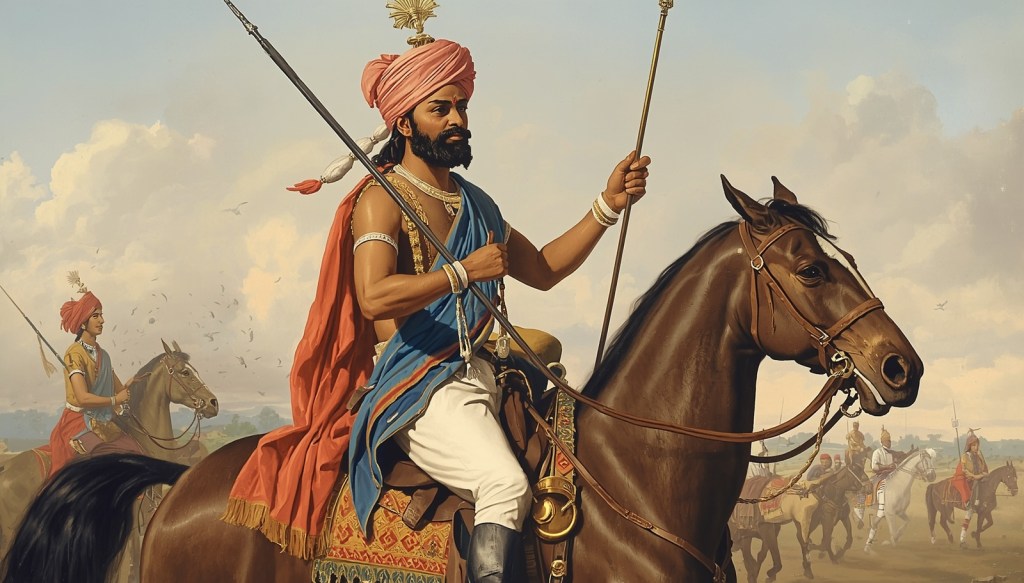
Dheeran Chinnamalai

About: This is a fabulous story about one of India’s forgotten heroes, Dheeran Chinnamalai hailing from the Kongu region of western Tamil Nadu, South India. He is an early genuine hero, who fought the British, just when they were beginning to colonise India. The British stung by his courage and aura of invincibility-they finally got him-ensured Chinnamalai’s story did not become a household name by banning books or any re-telling of his challenge to the British, for a long period of time. They feared the example Chinnamalai had set.(Image Courtesy: Canva AI)

The British first arrived on India’s shores in the year 1608, at the port of Surat, Gujarat. India was renowned for its cotton, silk, calicoes, and muslins, and other textiles, which were hugely popular in Europe. As was Indigo, and saltpeter (potassium nitrate)-used for gunpowder-critical for Britain’s military needs. Add spices such as pepper from South India, and the British wanted to trade. They established the East India Company (EIA), as a trading company, to obtain goods from India and send them to Britain for gainful commerce.

The East India Company found its way to the Court of the then Mughal Emperor Jehangir and obtained permission to build trading factories and Forts in costal India, beside roads and bridges to facilitate movement of their goods.

Gradually, over the 1700s the EIA’s focus shifted from trade to political dominance: they spied many an opening to India’s riches. And at the Battle of Plassey in 1757, the British led by Robert Clive defeated a combination of the French East India Company and local Nawabs gaining control of the rich region of Bengal. Clive won by making a secret alliance with Mir Jafar, the Army Commander of the then Nawab of Bengal, Siraj-ud-Daulah. Mir Jafar deliberately held back his troops enabling the British to sneak through a victory. Mir Jafar was installed as a puppet Nawab, marking the beginning of British political dominance in India. Siraj-ud-Daulah escaped the battlefield, but was captured and later executed.

Mir Jafar’s name become synonymous with treachery and betrayal for enabling British colonial expansion through internal conspiracy. If he had not sold his soul to the British, maybe they could have been vanquished and sent back to Britain or at best continued functioning as a trading company. On the sidelines, the British learnt the art of pitting one Indian against another and using it as a vicious weapon to subjugate India. The multiple small Kingdoms, often at war with one another, in India suited that style.

Bolstered by its clever win, the EIA became a ruthless war-machine enjoying unbridled power in India, which eventually led to the first uprising against the British, the Indian Rebellion of 1857, also called the Sepoy Mutiny or the first war of Independence. The British Government watching the East India Company go roque, stepped -in, dissolved the EIA and assumed direct control of the Indian Sub-continent as the British Raj. Thereafter, it was the British Raj, all the way, that further colonised, ruled, and plundered its riches, until India’s independence in August 1947.

In the South of India, during the Robert Clive era, the British East India Company had only small trading enclaves, especially in Madras-now called Chennai. South India was ruled by independent regional powers such as, the Nawab of Hyderabad, the Maratha Confederacy, the Nawab of Carnatic, and the Kingdom of Mysore. These Kingdoms were the fragmented splinters of the glorious dynasties before them: The Vijayanagara Empire and The Chola Empire, to mention a few.

For around 300 years, a large part of present-day Tamil Nadu was ruled by warrior chieftains known locally as ‘Palayakkarars’ (heads of districts) or the Anglicized ‘Polygars’. Forgotten over time, these regional formations produced outstanding warriors who were probably the first to seriously challenge the British in South India, between 1700 and 1850. One of them being, Dheeran Chinnamalai. Others are, Maveeran Alagumuthu Kone -one of the earliest-the indomitable Veerapandiya Kattabomman, the courageous Puli Thevar, the amazing Rani Velu Nachiyar, and the remarkable Maruthu Brothers.

How did the Polygars come into being, who are they?

The Polygars were part of a unique three-tier administrative system created by one of the greatest Vijayanagara Emperors, Sri Krishnadeva Raya, who ruled between 1509 and 1529 CE. This simple but effective structure consisted of the Emperor at the top of the pyramid; the Nayakas or Viceroys, at Madurai, Thanjavur, Gingee, and other regions, forming the second tier; and the Polygars comprising the grassroots leaders, in the hierarchy. This one-of-a-kind system facilitated efficient administration of revenue, as well as created a mechanism for raising an army to meet the King’s war requirements, besides keeping generals, warriors, vassal rulers, and nobles gainfully occupied.

‘Palayam’ in Tamil and ‘Palamu’ in Telugu means an ‘army camp’ later stretched to mean an Administrative Division. At that time in Tamil Nadu, there were about 72 Palayams, each headed by a Polygar, who in turn reported to the Nayaka of Madurai. The Polygars functioned as semi-independent rulers operating from fortified centres, with a standing army-for the King- palaces, forts- in certain cases; they collected taxes, had private estates, dispensed justice, maintained law and order, held durbars, maintained water bodies, while expanding the land under cultivation, built and managed temples, and indulged in philanthropy. Over time, the Polygars became local rulers, ‘little Kings’. The paraphernalia of royalty was maintained by retaining a quarter of the collected revenue, while the rest was sent to the Nayakas.

The Polygars, also at times, founded villages, built dams, constructed tanks and built temples. They taxed regions according to the cultivable nature and fertility of the land. Their armed status served to protect the farming communities, trade & craft artisans, and ordinary civilians from robbers and dacoits who were rampant in those regions. And from invading armies, which often resorted to pillaging the villages and the countryside.

By the 18th century, while the northern Polygars fell under the Kingdom of Mysore, those in southern Tamil Nadu had to deal with the revenue demands of the British East India Company. The Nawab of Arcot had borrowed money from the EIA and had given the Company the right to collect taxes. All the Polygars, except Veerapandiya Kattabomman (1760 to 1799 CE) of Panchalankurichi, submitted to the East India Company.

While the year 1857 is often regarded as the first large-scale revolt against British rule in India, there were many localised revolts that broke out earlier. And one of them was the Polygar Wars, down South, between March 1799 and July 1805. These were some of the bloodiest revolts ever faced by the British, fought primarily in Tamil Nadu and the Malabar region. And the British did not have an easy run. The Polygar Wars were the most serious and deadliest challenge to their dominance in India. The 6 long years, saw a large number of losses on the British side, and they were defeated in many a battle. And the major players in the Polygar Wars actually challenged and outwitted the British, head to head. On the British side, in most cases, it took cunning, deceit, and treachery to capture and execute these warriors: they simply could not match their valour -directly.

The war between the British and Veerapandiya Kattabomman is called the First Polygar War (1799), while the second Polygar War (1800–1805)was fought by a much bigger coalition over the whole of western Tamil Nadu headed by Dheeran Chinnamalai and Maruthu Pandiyar.

In these times, on 17 April 1756, was born Theerthagiri Sarkarai Uthama Kaminda Mandradiaar, also called Theerthagiri Gounder, and later called Dheeran Chinnamalai, at Melapalayam in Erode district. His parents, Rathinaswamy Manradiaar and Periyaatha belonged to a noble, land-owning family of the Palaiyakottai Pattakarar (Mandradiaar title). He was the second of six children: elder brother, Kulandaisamy, younger brothers Thambi, Kilothar, and Kuttisamy, and a sister, Parvatham.

Theerthagiri’s grandfather, Kottravel Sarkkarai Mandradiaar, was one of the largest land owners, in the Kongu region, in present-day western Tamil Nadu. He was childless from his wife and took a second to beget children. However, he was childless from his second wife too; and thereafter he adopted two sons, first Senapathy and second, Rathanasamy, who he entrusted to each one of his two wives for upbringing. Both the sons were educated at the palace. In course of time, Senapathy and Ratanasamy got married and were given separate farm land regions to manage. As was the custom in those days, the first son Senapathi took the title of Manradiaar and continued to control the lands from Palaiyakottai. Rathnaswamy moved out-could be some kind of a partition plan between the Brothers-to a nearby village named Melapalayam and managed the family farm lands in that part.

During his childhood days, Theerthagiri attended the school within the Fort/Palace and was a bright, obedient, and disciplined student, excelling in Tamil literature, poems, and patriotic themes. He was introduced to the Tamil epics and the history of Tamil kings (Chola, Pandya, Chera), bravery, warfare, and governance, which inspired and instilled in him deep patriotism for the land, and leadership qualities from a young age.

Theerthagiri’s brothers, Kulandaisamy and Kuttisamy joined their father in farming, while Theerthagiri, with his other brothers, Thambi and Kilothar took on the responsibility of administration and safety of the villages under their jurisdiction, as Polygars.

The sister Parvatham was given in marriage to Ulagapuram Muthi Thirumalai Gounder, which strengthened the local Kongu Gounder network. Marrying into another Gounder family from nearby Ulagapuram (in the same Erode region) was typical for building alliances among chieftain families. The elder brother Kulandiasamy and the younger, Kuttisamy took wives, while Theertagiri, Thambi, and Kilothar never married, probably given the nature of their responsibilities.

The family managed extensive agricultural lands and ran the local administration. From a young age, Theerthagiri and his brothers received training in martial arts, including silambam, archery, horse riding, and techniques of warfare. Theertagiri gained experience in village panchayats, resolving land (and family) disputes, which further honed his leadership skills.

People of Kongu region traditionally practiced Hinduism under Shaivism- devotion centred on Lord Shiva. They followed Saiva Siddhanta traditions, emphasising Shiva as the supreme deity, along with associated rituals, temples, and philosophical teachings. They worshipped clan-specific kuladeivams (family or lineage deities), avatars of Amman (e.g., Mariamman, Periyachi Amman, or local protective goddesses), alongside major deities like Shiva, Murugan, and village guardian gods (e.g., Ayyanar or Karuppu Sami).

The then Kongu region, in the later half of the 18th century, was part of the Mysore kingdom, under Sultan Hyder Ali. The Diwan, Muhammad Ali, who was in charge of tax collection, followed unfair and unethical practices. He often humiliated farmers by confiscating their lands- their only means of livelihood – when taxes were not paid on time.

During one such tax-collection exercise, Theerthagiri and his brothers confronted Muhammad Ali, in an area between the hills of Sennimalai and Shivanmalai, recovered the forcibly collected taxes, and distributed them to the affected farmers. A furious Muhammad Ali, threatened Theerthagiri with severe consequences, once the Sultan learns about the incident. Theerthagiri shot back, saying Kongu Nadu will not accept Hyder’s rule, and it is capable of governing itself. He famously told the Diwan: “I am Chinnamalai, who reigns between Sennimalai and Shivanmalai” ( I am a small hill between two larger hills). And this was when he got the name of Chinnamalai, which means ‘small hill’ He earned the prefix ‘Dheeran’ meaning brave or valiant, for his courageous defiance.

Enter, Dheeran Chinnamalai.

Hyder Ali, as expected, sent an army to Kongu to teach Dheeran Chinnamalai a lesson. However, Chinnamalai met the Army on the banks of the Noyyal river and routed Hyder Ali’s forces. This only further enraged Muhammad Ali, and he vowed vengeance. Knowing Ali’s intentions, Chinnamalai began to build his own army. However, Hyder was preoccupied with the Nizam, British, and the Marathas, with whom he was in constant conflict, hence the return attack never happened.

Hyder Ali died in 1782 at his military camp near Chittoor during the Second Anglo-Mysore War, while actively fighting the British East India Company. Tipu Sultan, his eldest son, who was away on another military campaign, returned to Chittoor, assumed command, and took over as ruler of the Kingdom of Mysore.

Tipu Sultan adopted an even more aggressive policy towards the British and requested the Tamils of Kongu, to join forces with him to drive them out. Dheeran Chinnamalai responded, along with his brothers and trusted commanders, Velappan and Karuppan. Chinnamalai himself was made the commander of the Kongu regiment in the Mysore Army, and took active part in the 3rd and 4th Mysore Wars that initially helped repel British attacks on Tipu Sultan’s capital, Srirangapatnam. During his stint in Tipu Sultan’s Army, Chinnamalai received arms, combat, and battle training under the French, which served him well in the years ahead.

However, Tipu Sultan died in 1799, valiantly fighting the British, sword in hand, refusing to surrender. With the fall of Tipu Sultan, the British firmly declared, “India is ours”. And Dheeran Chinnamalai retreated home, along with Karuppan, as Velappan was captured by the British and he later became their agent.

Following Tipu Sultan’s defeat and the execution of Veerapandiya Kattabomman, Dheeran Chinnamalai emerged as a key leader in the Second Polygar War (1801 to 1805).

On his return to Kongu, Chinnamalai built a fortress at Odanilai, near Arachalur, south of Erode, Tamil Nadu, and began making recruitments and training his army, waiting for the right time to repeal any attacks by the British. He prepared his troops to use guerrilla tactics, especially hit-and-run warfare, to evade superior British firepower. He also reached out to the rulers of Malabar and Salem, hoping to build a larger alliance against the British.

Recognizing that Chinnamalai was a clear and present danger to their India ambitions, the British attempted to force him to sign a pact, where he was promised favours in return for accepting British sovereignty. He refused, knowing fully well that it would result in war. He mobilized and trained thousands of Kongu youth- up to 40,000-across religious and caste lines with loyal followers.

Chinnamalai’s bold defiance annoyed the British: a man with no title, technically not a ruler, yet refusing to accept their sovereignty, at a time when most of the Rajas, Nawabs, and Sultans had surrendered with much of a whimper.

In 1801, the British sent a troop of soldiers under Colonel Maxwell to tackle Dheeran Chinnamalai. However, Chinnamalai, having got advance information of the attack, defeated the British, again on the banks of the River Noyyal. Maxwell returned in 1802, and after a long siege of Odanilai fort, ended in yet another comprehensive defeat for the British, with Maxwell himself being killed-beheaded.

The British by this time were furious and waited for an opportunity to make a calculated assault. It came in the year, 1804, when having learnt that Chinnamalai and his followers would be attending the Arasalur Amman Temple festival, on a particular day, they made plans.

An army was dispatched to capture Odanilai Fort, under General Harris, who had led successful campaigns in Mysore. Chinnamalai through his network of spies learnt about the plan, and stayed back at the fort, with his main Army, while others went to join the temple festival. General Harris was taken by surprise when he attacked the fort, and Chinnamalai stormed-out, forcing him to retreat.

The British were now more determined than ever, and built a huge army to take down Chinnamalai, with cannons brought over from Madras. With 140 cannons and 30,000 men, Harris came back, attacked Odanilai, and surrounded the fort, demanding that Chinnamalai surrender. However, they found that the fort was abandoned, and that Velappan was acting as a double agent for Chinnamalai, while on the British side. Harris promptly had Velappan executed, and also razed Odanilai fort to the ground-the cannons were put to use.

The story goes that Dheeran Chinnamalai had a personal habit of wearing a new pair of slippers/sandals every day. Loyal informers and messengers exploited this routine to deliver secret notes/chits hiding them inside the soles of the sandals. Velappan would write critical intelligence – details of British troop movements, attack plans etc on a these chits. When he put on the new sandals in the morning, he would take-out and read the hidden messages and promptly destroy them.

One key instance involved storming the Odanilai Fort with cannons. Chinnamalai received the note and evacuated the fort to hide in the forests of Karumalai. After reading the secret note, Chinnamalai accidentally left it behind in the sandals, in the Fort. When the British arrived at the abandoned Odanilai Fort and while searching for Chinnamalai, they came across the discarded pair of sandals. Frustrated at finding the fort empty, General Harris picked up and threw the sandals against a wall in a fit of rage. The sandals broke open, revealing the hidden note. He then had the message read, which clearly pointed to intelligence information passed from Velappan warning Chinnamalai about the British attack plans (including cannons and timing).This exposed Velappan, leading to his execution.

Chinnamalai was deeply hurt by the incident, blaming himself for being careless, leading to the death of a true loyalist. The importance of spying is of paramount importance is getting the better of an enemy, in the asymmetric warfare of those times.

Chinnamalai, his brothers, and soldiers, now lived in exile, at a place called Karumalai near Palani, often disguising themselves to venture into towns. During such forays they became friendly with a local cook called Nallappan, who willingly offered them food, water, and refuge. It turned out that Nallappan was a traitor. He was enticed and bribed by the British to provide information on Chinnamalai’s whereabouts. He secretly informed the British about Chinnamalai’s daily routine of having meals in his house at the foothills. The British dug an underground tunnel leading to the house and waited for Chinnamalai.

One evening, following the usual routine, when Chinnamalai entered Nallappan’s house along with his brothers, and Nallappan proceeded to serve them. This time he cunningly asked all of them to keep aside their weapons as there was no danger while dining. The brothers trusted him and agreed, as they also did not sense an imminent danger. Once their weapons were taken away from them, Nallappan signalled the British who stormed the house both from the underground tunnel and from outside. A total of two hundred soldiers surrounded the house. The British soldiers quickly locked-on to Chinnamalai and his brothers. An enraged Chinnamalai managed to break-free, pounced upon Nallappan and strangulated him to death, on the spot.

The British arrested Chinnamalai and his brothers and kept them in a prison in Sankagiri Fort. Their loyal commander Karuppan who was in hiding at Melapalayam, also surrendered. A four person British Tribunal was formed, which demanded he accept British sovereignty and pay taxes. They also offered him amnesty if he tendered an apology. He refused defiantly and was sentenced to death.

On 31 July 1805, Dheeran Chinnamalai, his brothers, and Karuppan were hanged at Sankagiri Fort. He was about 49 years old. His body was brought back to Odanilai for burial.

The story goes that preparations were made to hang them by rope tied to a Tamarind tree located at the top of the Sankagiri fort. Chinnamalai, his two brothers and Karuppan were brought to the spot on the day of hanging. They asked the escorting British soldiers to move away, and each one tied the rope around their own necks and jumped to embrace death.

The whole of Kongunadu wept for the heroic deed on that day. The British ensured that Chinnamalai did not become a household name by banning books or any information on Chinnamalai for a long period of time.

Dheeran Chinnamalai symbolizes Kongu pride, valour, and early resistance to British rule. Today, statues and memorials stand in places like Odanilai, Sankagiri Fort, Chennai, Erode, Tiruchirappalli, and elsewhere. A commemorative postage stamp was issued by India Post in 2005. Though details vary across oral recounts and sources, his defiance remains a powerful part of Tamil and Indian history.

The story of Dheeran Chinnamalai, and his heroic battles with the British and the eventual sacrifice of his for the cause of freedom would have been completely consigned to oblivion, but of the tradition of oral story telling that existed in Tamil culture. The singular credit goes to Pulavar Kulanthai who heard this story from his grand father during the early 1900s and wrote it down, keeping the story alive.

I started with the treachery of Mir Jafar and ended with another kind of treachery by cook Nallappan. A brave, indomitable India (and sometimes casually over-confident) was defeated mostly from enemies within, rather than for those outside. Indian History is filled with them- like termites in the woodwork. Look around today, the story continues, albeit in different forms, wearing various political labels and colours.

Dheeran Chinnamalai, by any measure, was an extraordinary, fearless hero. He was against subjugation of any kind and stood-up for freedom, on his own free-will. He had no known mentor, nor was he of royal lineage. There is still so much we do not know about him. And the idea of Bharat- however loose it might appear with the many independent small Kingdoms-was long ingrained. Dheeran Chinnamalai could have been selfish ‘sticking himself to reigning between two large hills’, but he dared to fight the British along with Tipu Sultan. It’s now upon us to become our own chinnamalais, be counted, and stand up for India, always -in our own ‘chinna’ way. Small can actually be big. Jai Hind.

FREEWHEELING

About: A break free commentary on events on our Planet, anchored on the headline news of the world. Any comments beyond the storyline, are entirely mine, without prejudice -take it or leave it. This is a run of events from 30 November to 31 December 2025: War & peace; turmoil in Iran; humanitarian crisis in Sudan; cost of living crisis in Nigeria; and India news – especially about Thiruparankundram Temple in Tamil Nadu.

THE WORLD

December 2025 saw heightened geopolitical tensions, diplomatic efforts towards peace in ongoing conflicts, and military escalations, particularly in Europe and Asia. Many hostilities just meandered on, with probably the sole winners being the arms manufacturers and suppliers.

United States (US) President Donald Trump hosted Ukrainian President Volodymyr Zelenskyy at his Mar-a-Lago Resort, Palm Beach, Florida, on 28th December, for talks on a potential peace deal. It appears that progress was made on 15-year US security guarantees for Ukraine, though territorial issues (with Russia) remained unresolved. Ukrainian negotiators agreed to 90% of a 20-point peace plan cooked by Ukraine, US negotiators, and European countries. A deal seems close at hand?

In Russia, President Putin’s residence came under a drone attack and Ukraine was accused of orchestrating it. This, amid ongoing Russian missile and drone strikes on Ukrainian cities. Meanwhile, the European Union approved a Euro 90 billion loan to Ukraine for defense funding.

In the Israel-Hamas conflict, Trump met Israeli Prime Minister Benjamin Netanyahu on 29th December, to discuss the next phase of the Gaza ceasefire (including international peacekeeping forces) and warned Iran of potential strikes.

Israel approved new West Bank settlements-pushing for more ‘Israel’.

The US military along with Jordan launched airstrikes on multiple sites, targeted ISIS in Syria, following attacks.

Iran is witnessing its largest unrest in three years. And the Government grapples with its most serious challenge in years. Chants of ‘mullahs must leave’ and ‘death to the dictator’ echoed across major Iranian cities as protesters clashed with security forces of the Ayatollah Ali Khamenei-led theocratic regime. The eruption of anger and turmoil has been fuelled by a collapsing Rial, record inflation, and years of sanctions, amid renewed American pressure.

The country’s currency, Rial, plummeted to a record low against the US dollar, and the head of the Central Bank resigned. While traders and shopkeepers rallied in Saadi Street in downtown Tehran as well as in the Shush neighbourhood near Tehran’s main Grand Bazaar. Recall, merchants at the market played a crucial role in the 1979 Islamic Revolution that ousted the monarchy and brought the present crop of Islamists to power.

Turkey and Armenia agreed to simplify visa procedures as a step toward normalising ties between the countries.

China conducted its largest military drills to date, Justice Mission 2025, encircling Taiwan with live-fire exercises, simulated strikes, and port blockades starting late December. This followed a major US arms package to Taiwan and came amid broader regional frictions.

Thailand and Cambodia held talks, mediated by China, to address border clashes. The Southeast Asian neighbours agreed on a ceasefire that took effect at noon on 27th December, stopping 20 days of fighting that killed at least 101 people and displaced more than half a million on both sides. The ceasefire included a halt to fighter-jet sorties, exchanges of rocket fire, and artillery barrages. The Thailand-Cambodia conflict was sparked by a skirmish in late May 2025, that left one Cambodian soldier dead. The incident stemmed from a long-running dispute over ownership of ancient temples and their surrounding land, and contributed to a broader escalation of tensions that later developed into sustained fighting.

The ongoing, seemingly, never-ending humanitarian crises in Sudan persisted with limited international attention (need someone to pay ‘attention to the matter’?) Over 30 million people, almost two thirds of Sudan’s population, are in need of humanitarian assistance. Almost 25 million people, are facing acute hunger, with 637,000 of these classified as on the brink of famine. The civil war erupted amid tensions over the integration of the Rapid Support Forces (RSF)-a Sudanese paramilitary force formerly operated by the Sudanese Government- into the Sudanese Army following the 2021 coup. It started with RSF attacks on government sites in Khartoum and other cities. The capital region was soon divided between the two factions.

Nigeria is experiencing severe security challenges, including a sharp rise in mass abductions of schoolchildren in the north, and ongoing insurgencies by groups like Boko Haram and the Islamic State West Africa Province (ISWAP). This instability, along with other factors, has led to a major hunger crisis, particularly in the northeast, and displacement of millions of people. Economically, the country faces its worst cost of living crisis in 30 years due to 2023 reforms, and has also seen issues like inflation and social unrest.

In late November, armed bandits kidnapped 303 children and 12 teachers from the St. Mary’s Private Catholic school in the country’s north-central Niger State. The students are both male and female, some as young as ten. About 50 managed to escape-soon after the abduction- and during December all students and teachers were released from captivity, first 100, then the remaining. Nigeria is home to some of the world’s largest Muslim and Christian populations with the northern region predominantly Muslim and the southern region largely Christian. Indigenous religions, such as those native to the Igbo and Yoruba ethnicities, are in the minority. The country’s Constitution guarantees freedom of religion.

Myanmar’s civil war intensified in late 2025, with the military junta facing significant setbacks against a unified resistance of Ethnic Armed Groups and People’s Defence Forces, losing control over vast territories, particularly in border areas, leading to major displacement, increased humanitarian needs, and the junta attempting to legitimise its rule through contested elections amidst escalating violence, airstrikes, and ground offensives. Over 3 million people have been displaced, and nearly half the population needs aid, with ongoing conflict disrupting lives and essential services. Triggered by the 2021 military coup, the war is a culmination of long-standing ethnic tensions and resistance to military rule. In essence, Myanmar is in a full-blown civil war where the military is losing ground and struggling to maintain control against a determined, though often fragmented opposition.

INDIA

India came up with a new Rural Employment Law: The Viksit Bharat – Guarantee for Rozgar and Ajeevika Mission (Gramin) (VB-G RAM G) Act, 2025, was enacted to replace MGNREGA (The Mahatma Gandhi National Rural Employment Guarantee Act), guaranteeing 125 days of wage employment per rural household. The Rural Development Ministry began coordinating with States to prevent fake demands during the transition.

The Election Commission extended the Special Intensive Revision (SIR) of electoral rolls in multiple states, amid opposition demands for discussions on voter lists and national security during the Winter Session of Parliament. The SIR is doing the job of weeding-out very well. For e.g., in Tamil Nadu, the Chief Electoral Officer said that 97.37 lakh names have been dropped from the electoral rolls under the categories of Absent, Shifted, and Dead.

India’s Supreme Court stayed the suspension of Kuldeep Singh Sengar’s (a former BJP MLA) life sentence in the Unnao Rape Case. The case is about the gang rape of a 17 year old girl in Unnao Uttar Pradesh State in June 2017. Kuldeep Singh was convicted and sentenced to life imprisonment in December 2019.

The Supreme Court also put its earlier Aravalli Hills definition on hold amid environmental concerns and sought the opinion of an expert committee under the Union Environment Ministry for a fuller, comprehensive, definition. The aim is to prevent unregulated mining in ecologically sensitive areas. The criteria defined ‘Aravalli Hills’ as a landform with an elevation of 100 metres or above the local relief. Two or more such hills within 500 metres of each other constitute an ‘Aravalli Range’. The Aravalli Hills and Ranges are among India’s oldest geological formations stretching from Delhi through Haryana, Rajasthan, and into Gujarat, in a span of about 650-800km.

In business news, the Index of Industrial Production rose 6.7% in November 2025, a 25-month high, driven by manufacturing and capital goods. Australia announced duty-free access for all Indian exports from January 2026 under the ECTA’s (India-Australia Economic Cooperation and Trade Agreement) third anniversary. India’s Lok Sabha passed a bill raising Foreign Direct Investment FDI in insurance to 100%. New Free Trade Agreement, including with New Zealand, were concluded amid global tariff challenges. The Reserve Bank of India stepped in with reductions in the repo rate to 5.25% in December, part of multiple cuts in 2025 supporting economic recovery. New Labour Codes were notified; Digital Personal Data Protection Act implemented.

People in India’s capital ‘continued to see pillar-mounted water tanks as UFOs’, as Delhi vanished under severe Air Pollution, recording its worst December Air Quality Index (AQI) since 2018 (average 349), with ‘severe’ levels persisting.

India’s largest (by passenger traffic and market share) Airline IndiGo faced massive disruptions in early December due to new flight duty rules, and fog, cancelling over 1,600 flights in a day. The Government promptly rolled back the new rules, and looking through the eyes of a stranded passenger in a Terminal Building, the Airline clearly showed the middle finger to the Government.

The Subramaniya Swamy Temple in Thiruparankundram Hill located in a suburb of Madurai, Tamil Nadu, is a Hindu temple dedicated to Hindu God Lord Murugan. It is one of the six abodes (Arupadai Veedu) of Lord Murugan, a set of foremost and sacred Hindu temples, dedicated to the Lord. The original temple was built by the Pandyas during the 6th century CE. It is a rock-cut temple carved into the side of a large monolithic hill. The temple is under the control of the Hindu Religious and Charitable Endowments (HRCE) Department of the Government of Tamil Nadu. According to Hindu mythology, Lord Murugan killed the asura Surapadman at Tiruchendur and later married Deivanai, the daughter of Indra, at Thiruparankundram.

It is customary during the Festival of Karthigai Deepam– a ceremonial holy lamp-to light a lamp (and Diyas) at the Temple. For over a century, the lamp had been lit at a lower elevation near the Uchipillaiyar Temple to avoid the upper peak, which houses a Dargah (Sufi Shrine) containing the grave of Sultan Sikandhar Badushah. The temple’s hilltop includes an ancient Deepathoon pillar, and a year 1923 decree (upheld by the then Privy Council – now abolished, in 1949) confirmed the temple’s ownership of unoccupied portions of the hill.

In early December a petitioner approached the Madras High Court (Madurai Bench) seeking permission to light the lamp at the hilltop Deepathoon pillar, arguing that periodic rituals at the spot assert ownership rights. Justice GR Swaminathan issued an order directing the temple’s executive officer (under the HRCE) to light the lamp at the hilltop by 6pm that day, with Central Industrial Security Force (CISF) protection to ensure safety, emphasising that this would not infringe on the Dargah’s rights and that failure to act could lead to loss of temple claims. The judge stressed the importance of upholding Hindu devotees’ religious rights under the Indian Constitution.

The Tamil Nadu Government under the Dravida Munnetra Kazhagam (DMK), disobeyed the ruling by lighting the lamp only at the traditional lower spot, claiming no historical evidence supported hilltop lighting and that over 100 years of practice justified the lower location. Authorities failed to make arrangements for the hilltop ritual, blocked devotees from accessing the site, imposed prohibitory orders to prevent gatherings, which led to clashes between police and devotees attempting to comply with the order.

The temple administration filed an appeal against the directive on the same day, which the court viewed as a deliberate tactic to evade implementation, noting that the Dargah (the potentially affected party) did not appeal.

Later the High Court accepted contempt petitions against Madurai district authorities, including the District Collector, Superintendent of Police, and temple executive officer, for ‘wilful disobedience’. Justice Swaminathan sharply criticised the state for ‘cocking a snook’ at the court’s authority, stating that the breach was ‘deliberate’ and that defying judicial orders ‘sounds the death knell of democracy itself.’ He warned that no one is above the law, ordered the officials to appear personally to explain the violation, and permitted the petitioner and 10 associates to symbolically light the lamp at the hilltop under CISF escort to affirm the order. The court reiterated that administrative excuses like law and order concerns cannot override judicial directives unless stayed by a higher court, and condemned the actions as a gross infringement on Hindus’ fundamental rights.

Perhaps, taking a cue from IndiGo the Govt of Tamil Nadu looked at its fingers and showed the middle to the Courts. And did not implement the Court Order, a second time.

The worst part is India’s Opposition Members of Parliament moved to impeach Justice Swaminathan. The impeachment will fail because the Opposition does not have the numbers, but the attempt is to browbeat anyone who dares back Hindu rights. However, a group of 56 judges joined together to slam the ill-thought out move. Hope, a better sense of justice prevails in the new year.

I think the Govt at the Centre needs to find its backbone: it should unflinchingly dismiss a State Government that fails to honour a Court Order – not once but twice. Would not this lead to an anarchy stand where one says, “Why should I follow the Laws, Rules and Orders? I’ll appeal to God – wherever he is. Until then, wait”.

Normally, the rowdies on the street are the ‘traditional’ Rule-Breakers. Now, how can we allow a State Govt to become rowdyish? How can a Rule-Maker become a Rule-Breaker?

Lots to think about as we close down the year 2025. Mankind should solve more problems that it creates.

I’ll be transitioning to a newer way of spreading the news of the world in 2026. A forged-on-iron format is in the works. It will be worth the wait.

Happy New Year 2026. Take full responsibility for your life on Earth.

FREEWHEELING

About: A break free commentary on events on our Planet, anchored on the news of the world. Any comments beyond the storyline, are entirely mine, without prejudice -take it or leave it. This is a run of events from 11 October to 31 October 2025: The return of Israel hostages; Ireland’s new PM; the Trump roll in Asia; the heist of the century; and India Women’s Cricket.

HOSTAGE RETURN

On 13th October, after ‘Trumped-up’ efforts and execution of the agreed and signed first phase of the United States mediated 20-Point Peace Plan, all 20 living hostages were released by the terrorist Hamas. They were handed over to the Red Cross and subsequently transported home to Israel for medical check-ups, and rejoining with families. With this, there is not one living hostage under captivity, ending the 736 hostage saga, in the Israel-Hamas War in Gaza.

Recall, the hostages were taken on 7th October 2023 during that barbaric attack on Israel, by Hamas. Israel breathed in relief after two years of unbelievable agony, especially the families of the hostages-dead and alive.

However, Hamas did not fully keep its promise of handing over the bodies of the 28 dead hostages at one time. It delayed, with only 4 bodies being handed over at the start and now the count has tortuously reached 15. And tensions swelled again.

President Donald Trump arrived in Israel to receive the hostages, address Israel’s Parliament, and receive its highest civilian honour-the Israeli Presidential Medal of Honour. This, of course, is for his role in brokering the Gaza ceasefire and securing the release of Israeli hostages.

The honour is to individuals who have made an outstanding contribution to Israel or to humanity. Former US Presidents, Barack Obama received the award in 2013, and Joe Biden in 2022, for promoting friendship between Israel and America and in building up Israel’s military capabilities.

The ceasefire deal moves to more treacherous grounds of-return of the bodies of the remaining dead hostages is a carry forward item- execution and further phases of the Peace Plan. Israel’s forces remain inside the boundary designated by a Yellow Line, as agreed. Any default by Hamas could result in an immediate strike by Israel. And there was indeed a strike in Gaza on the 28th October after Israel accused Hamas of killing a soldier and staging the discovery of a deceased hostage. The strike killed at least 105 people, making it the deadliest day since the ceasefire.

It’s beyond my comprehension on how anybody can take the side of Hamas in the name of Palestine in the present conflict. For e.g., Ireland’s newly elected President (she won by a Landslide), Catherine Connolly has in the past labelled Israel as a ‘Terrorist State’ and defended Hamas as ‘part of Palestine society’. She is an outspoken critic of Israel’s actions in the Gaza and probably needs to be put on ‘a program to change her mindset’ as is envisaged in the Peace-Deal with Israel. A civilisational, transformational, mindset change is require across borders – not only in Gaza.

Staying with Ireland, the 68 years old Catherine Connolly secured 63% first preference votes-a record in Irish presidential election history. She takes over from Michael Higgins who completed two terms. Irish Presidents are elected directly by the people for a seven-year term and can be elected for a maximum of two terms.

Catherine Connolly comes from a family of 14 children. Her mother died when she was nine years old, when the youngest child in the family was a one-year-old baby. Her two elder sisters stepped into the breach, spending their teenage years looking after and raising their younger siblings.

Catherine Connolly has worked as a clinical psychologist before becoming a barrister, and then entering politics. She is a passionate Irish speaker and a keen sportswoman who ran marathons and played competitive badminton. She is married to Brian McEnery-a woodwork teacher-and has two grown-up sons. The couple have been married for a ‘wood solid’ 33 years.

JAPAN: A NEW PM

In September this year, Japan was engulfed in a political crisis when its Prime Minister Shigeru Ishiba stepped down after less than a year in office, following two major election losses. This came a day before his Liberal Democratic Party (LDP) was expected to vote on whether to hold an internal leadership vote that could have forced him out. The LDP has governed Japan for most of the past seven decades, but under Ishiba it lost its majority in the Lower House for the first time in 15 years and then lost its majority in the Upper House, as well, in July, this year.

Then stepped-in Sanae Takaichi, a former government minister and TV host, and once a drummer in a heavy metal band, who announced her candidacy for the LDP Presidency, in the resulting leadership election. Her challenger was the agricultural minister in government, Shinjiro Koizumi.

In the election held on 4th October, Takaichi received 183 votes (31%) during the first round, the most of any candidate. Koizumi came in second with 164 votes (28%). As no candidate achieved a majority in the first round, a run-off election was held between Takaichi and Koizumi. Takaichi won the runoff by a 54.25% to 45.75% margin, becoming the first woman to hold the post of LDP President.

Meanwhile, Tetsuo Saito, the leader of Komeito party announced, on 10th October, that his party would break with the LDP and leave the governing coalition, citing disagreements with Takaichi’s leadership and the LDP’s handling of a recent government scandal. This led to the collapse of the 26-year-old LDP–Komeito coalition: as a result, the parliamentary election to choose Japan’s next prime minister was pushed back from 15th to 20th October.

Takaichi then replaced her coalition partner-Komeito Party-with the right-wing Japan Innovation Party, known as Ishin, led by Hirofumi Yoshimura. The leaders of both parties signed a coalition agreement on 20th October, clearing Takaichi’s path to the premiership.

At the 21st October meeting of Japan’s Parliament-the Diet-both houses nominated Takaichi to be the country’s first female prime minister. Takaichi avoided a runoff in the Lower House, garnering 237 votes against Constitutional Democratic Party leader Yoshihiko Noda’s 149. She was officially appointed Prime Minister by Emperor Naruhito in a ceremony at the Imperial Palace later that day.

Japan’s first female leader is an admirer of Britain’s conservative Prime Minister ‘Iron Lady’ Margaret Thatcher, and hopes to take some leaves out of her book. In her first speech as PM, Takaichi said that defence is a priority for her country as the region experiences uncertainty with Russia, China and North Korea.

THE HEIST OF THE CENTURY

If you haven’t heard by now, the Louvre-the world’s busiest museum-was cooly robbed on Sunday, 19th October. But this wasn’t the stuff of an Ocean’s Eleven film or The Da Vinci Code, conducted in the middle of the night and avoiding laser security systems.

In a daring well-planned operation, lasting less than 10 minutes, a group of four thieves broke into the Louvre Museum, in broad daylight, within an hour of opening. They parked a truck right out front with a retractable ladder, did a smash-and-grab of the King’s Jewels, and then drove away from the centre of Paris on scooters: in what can be described as the ‘slowest escape and the one with the highest visibility’.

The four Robbers arrived with a vehicle-mounted mechanical lift to gain access to the Gallery of Apollo, leading to the first-floor, via a balcony, close to the River Seine.

Two of the thieves got inside by cutting through the window with power tools, including an angle grinder, to smash two display cases containing priceless jewels. This after threatening the guards, who evacuated the premises.

It was later revealed that one in three rooms in the area of the museum raided had no CCTV cameras. The thieves were inside for four minutes and made good their escape on two Yamaha TMax scooters promptly waiting outside.

Eight items were stolen including diadems (a jewelled headband), necklaces, ear-rings and brooches. All are from the 19th century, and once belonged to French royalty or imperial rulers. A tiara and brooch belonging to Empress Eugenie, wife of Napoleon III; an emerald necklace and a pair of emerald earrings from Empress Marie Louise; a tiara, necklace, and single earring from the sapphire set that belonged to Queen Marie-Amelie and Queen Hortense; a brooch known as the ‘reliquary brooch’. Between them, these pieces are adorned with thousands of diamonds and other precious gemstones.

Empress Eugenie’s crown was found damaged on the escape route, apparently having been dropped during the escape. The stolen jewels are described as priceless and of immeasurable heritage value.

What will the thieves do? The jewel thieves are not going to keep them intact; they are going to break them up, melt down the valuable metal, re-cut the valuable stones and hide evidence of their crime. Crowns and diadems can easily be broken apart and sold in small parts. If the Police cannot recover the stolen jewels within a week’s time they are probably gone forever!

Let’s look at the history of similar Museum thefts. And it’s quite interesting.

In 1911, an Italian museum employee was able to make off with the Mona Lisa under his coat after lifting the painting-which was then little-known to the public-straight off the wall of a quiet gallery. It was recovered after two years and the culprit later said he was motivated by the belief the Leonardo da Vinci masterpiece belonged in Italy. Fewer chances are taken with the Mona Lisa these days: the painting, one of the most renowned in the museum’s collection, hangs in a high-security glass compartment. In 1998, the Le Chemin de Sevres – a 19th century painting by Camille Corot – was stolen and has never been found. The incident prompted a massive overhaul of museum security. In November 2024, seven items of ‘great historic and heritage value’ were stolen from the Cognacq-Jay Museum in Paris. Only five were recovered recently. The same month, armed robbers raided the Hieron Museum in Burgundy, firing shots before escaping with millions of pounds worth of 20th century artworks.

Sometimes the truth is stranger, or in this case, funnier than fiction, and the ‘snakes & ladders were out’ on social media. There were plenty of references to Inspector Clouseau of the famous Pink Panther series, others climbed to Knives Out’s, Benoit Blanc (starring Daniel Craig), and of course, Agatha Christie’s legendary Hercule Poirot. I had Sherlock Holmes, Enola Holmes, and even James Bond, in mind, as the best fit to catch the thieves!

While thieves made merry and decamped with French Jewels former French President Nicolas Sarkozy become the first French ex-President to go to jail, and he started a five-year sentence for conspiring to fund his election campaign with money from late Libyan dictator Muammar Gaddafi. His singer, songwriter, and fashion model wife, Carla Bruni, walked him down the steps leading to jail, holding his hand. Sarkozy, who was President from 2007-2012, has appealed against his jail term at La Sante prison, where he will occupy an unfashionable small cell in the jail’s isolation wing. Lots to think over!

US President Donald Trump’s on a roll, literally. He arrived in Asia for a whirlwind week of diplomacy which included a much-anticipated meeting with China’s President Xi Jinping on trade-and area where tensions between the countries has been soaring.

He first landed in the Malaysian capital, Kuala Lumpur as a summit of the Association of Southeast Asian Nations (ASEAN) began on Sunday, 26th October.

He oversaw the signing of a ‘historic Peace Deal’ between Thailand and Vietnam on a long standing border dispute-that’s another step closer the next Nobel?

He then flew to Japan where the newly-minted Japanese PM rolled out the red carpet, promising-you said it-a Nobel nomination, and foreign investments in the US. The also signed a deal on rare earth minerals and a document heralding a new golden age of US-Japan ties. Sanae Takaichi basked in Trump’s sunshine and it was a show of white teeth and cryptic smiles all over.

In the last leg, finally Trump met Xi Jinping in the City of Busan, South Korea – a first in over 5 years. Trump declared that the US’ dispute with China over the supply of rare earths had been settled, China would resume buying US soybeans, and the US would reduce its tariffs on China. He said President Xi Jinping had agreed to work ‘very hard’ to prevent the production of the synthetic opioid fentanyl – blamed for many American deaths. And in exchange the US would reduce fentanyl-linked tariffs from 20% to 10%, lowering China’s overall tariff burden from 57% to 47%.

WATER WORLD

Cyclone Montha and Hurricane Melissa occupied space and news in the sky.

Rains before, during, and after Montha got into the skin of people living in Tamil Nadu-off the Bay of Bengal- especially the capital Chennai. Despite promises of usefully using INR 4000 crore, many parts of the city went underwater and people were left searching for the money that went down the drain.

Not to be left unnoticed, Hurricane Melissa ripped a path of destruction in the Caribbean storming through Jamaica after making landfall as one of the most powerful and devastating hurricanes on record. It lashed the Island nation with brutal winds- at speeds of about 200km per hour-and torrential rain before taking aim at Cuba.

INDIA’s WOMEN

India stunned title holders, Australia, in a record run-chase to reach the final of the 13 edition of the ICC Women’s World Cup. The One Day International (ODI), Cricket World Cup is being hosted jointly by India and Sri Lanka. It is India’s fourth time hosting -after the 1978, 1997, and 2013 editions- and Sri Lanka’s first. The tournament began on 30th September and will close on 2nd November.

In the opening ceremony, Bollywood singer Shreya Ghoshal performed the official World Cup anthem, ‘Bring it Home’ and it looks like India’s women have taken the theme song seriously. India hopes to dance to it on 2nd November!

Set 339 runs to win after a wonderful century from Australia’s opener Phoebe Litchfield, India’s women cooked their nerves well in a mammoth pursuit, with Jemimah Rodrigues and skipper Harmanpreet Kaur firing the way with a 167-run stand. This game in Navi Mumbai will go down as an instant classic and with the defending champions dumped out, there will be a new name on this year’s trophy.

Harmanpreet fell for 89, with 113 runs still needed, but Rodrigues remained, reaching her hundred from 115 balls, and she was there up to the very end as the highest successful chase in women’s ODI history was achieved with nine balls to spare.

This will be the first Women’s World Cup final to not feature either Australia or England, as India will face South Africa on Sunday, 2nd November, at the DY Patil Sports Academy, Navi Mumbai.

More thrilling stories playing-out in the weeks ahead. Watch the world with Freewheeling.

FREEWHEELING

About: A break free commentary on events on our Planet, anchored on the news of the world. Any comments beyond the storyline, are entirely mine, without prejudice -take it or leave it. This is a run of events from 1 September to 15th September: the churn and restlessness in the world; Gen Z in Nepal; India pulls up its sleeves; and the passing of fashion designer Armani.

The World on a Spin

The World is definitely spinning-now it seems more on the inside-churning and in a multi-dimensional whirl!

France dived into a political crisis when its Prime Minister (PM) Francois Bayrou was defeated in a confidence vote in the National Assembly: 364 votes against to 194 for. He submitted his government’s resignation to President Emmanuel Macron, who quickly decided to replace him with close ally Sebastien Lecornu. This is France’s seventh PM under Macron, and the fifth in less than two years: a pointer to the disenchantment and full-grown frustration with Macron’s second term.

Lecornu, 39, has spent the past three years as Minister of the Armed Forces focusing on France’s response to Russia’s war in Ukraine. He has now been given the task of consulting political parties, probably on a war-footing, with the aim of adopting France’s next budget.

In the United Kingdom, the British seem to have taken US Vice-President J D Vance’s words -said in jest-seriously. He joked that Britain could well become the “first truly Islamist country to get a nuclear weapon,” following the Labour Party’s election victory. And with the appointment of a Pro-Palestine rabble-rouser as Home Secretary, along with the climbing incidents of Islamic lawlessness, they are on course to achieving that status. Shabana Mahmood has been appointed new UK Home Secretary, replacing Yvette Cooper following a major Cabinet reshuffle in the Labour-led government, triggered by the resignation of Deputy Prime Minister Angela Rayner.

Meanwhile, in recent times, Central London has become the stage of many protests. ‘Unite the Kingdom’ march, organised by anti-immigrant activist Tommy Robinson, was attended by around 110,000 people. Then there was the ‘Stand Up to Racism’ counter-protest, besides the ever-so-often, running-on-your-screens, pro-Palestine protests.

Looks like it’s back to old assassination ways in the United States of America: the guns were always there; many are finding the trigger more often than before.

Charlie Kirk, 31, a close associate of US President Donald Trump was assassinated on 10th September while on stage at Utah Valley University in Orem, Utah, for a Turning Point USA (TPUSA) event, ‘The American Comeback Tour’. Kirk was fatally shot in the neck, around 20 minutes after the event began, in front of an audience of about 3,000 people.

Charlie was a political activist, author, and media personality. He co-founded the student organisation TPUSA in 2012, which caters to conservative youth on American university campuses and was its Executive Director. He was one of the most prominent voices of the populist MAGA movement and exemplified the growth of Christian nationalism in the Republican Party. He leaves behind two young kids and his wife Erika Kirk who pledged to keep his legacy alive.

The suspect, Tyler Robinson, 22 was arrested for the killing, turned in by his own father, to who he admitted the crime. This, after the father saw released photos of the suspect and confirmed that was it was his son. It is said that despite a good upbringing, Tyler Robinson was radicalised ‘in a fairly short amount of time’. Tyler is a third-year student in the electrical apprenticeship program at Dixie Technical College, Utah Valley University, where Kirk was killed.

On the same day, 10th September Indian origin Chandra Nagamallaiah was brutally beheaded in a Dallas Motel by an undocumented immigrant, an illegal alien from Cuba, Yordanis Cobos Martinez, in front of his wife and son. The gruesome act took place at the Downtown Suites Motel in Dallas where Chandra Nagamallaiah and Cobos-Martinez were workers. Nagamallaiah had approached Cobos-Martinez and a female colleague while they were cleaning a room, telling them not to use a broken washing machine. Cobos-Martinez became enraged as Nagamallaiah had asked the female colleague to translate what he was saying instead of addressing him directly. Cobos-Martinez left the room, pulled out a machete ‘from his person’ and launching the assault. Nagamallaiah ran through the motel’s car park screaming for help, but the suspect chased him down and struck him repeatedly.

In late August Ukrainian refugee Iryna Zarutska was killed on a train at the East/West Boulevard light rail station on the Lynx Blue Line in Charlotte, North Carolina. Iryna Zarutska, a Ukrainian refugee who had fled her country because of the Russian invasion, was fatally stabbed. Her assailant, Decarlos Brown Jr., was arrested upon exiting the train and charged with first-degree murder. The 34-year-old Brown was arrested 14 times before the stabbing; he was convicted of breaking and entering. While on probation, he was arrested for armed robbery. And was incarcerated for more than five years in state prison

What’s happening in the United States of America?

Generation Z (Gen Z) is the generation born in the late 1990s or the early 21st century, perceived as being familiar with the use of digital technology, the internet, and social media from a very young age.

It was student and youth-led, Generation Z’s simmering churn in Sri Lanka some time ago, which spread to Bangladesh and leaders of both countries flying-out to escape the fury of the mobs. This time it was the turn of Nepal.

Nepal is in the grip of its worst political turmoils in decades after Gen Z led protests over a social media ban erupted and transformed into a nationwide uprising against corruption and entrenched political leadership. At least 70 people have been killed in clashes with security forces, which appears to have ignited latent fury. Demonstrators scorched the streets, torched the homes of senior leaders, and stormed (burnt it as well) Parliament leading to the resignation of the Prime Minister.

In events leading to the chaos, Nepal banned social media sites, including Facebook and Instagram, after they did not register with the Ministry of Communication and Information Technology. A notice said social media giants are given a week to register with the government, starting 28th August. But none, Meta (Facebook, Instagram, WhatsApp), Alphabet (YouTube), X, Reddit, and LinkedIn – had submitted applications, by the deadline.

The number of Facebook users in Nepal can be put at around 13.5 million, and Instagram at around 3.6 million. Many rely on social media for their business. As the social media platforms went down in Nepal, those affected started protesting. The demonstrations against social media ban then snowballed into an anti-corruption protest.

There have been a series of corruption scams and allegations against high-ranking political leaders in Nepal, with little action taken and hardly anyone brought to book. Another factor is the ‘Nepo kids’ phenomenon. The children of political leaders flaunted their wealth and lavish lifestyles, which fuelled resentment among young people.

The turmoil appears to have subsided for the moment, with the ‘social media’ selection of former Chief Justice Mrs Sushila Karki, as interim Prime Minister. Karki took the oath of office after an agreement with protest leaders from the Gen Z movement. Nepal’s newly-appointed interim PM says she will be in the post for no longer than six months. “I did not wish for this job. It was after voices from the streets that I was compelled to accept,” Sushila Karki said, speaking for the first time since being sworn into office on Friday. She said she would hand over to the new government which will emerge after elections on 5th March, next year. Incidentally, Karki’s husband, Durga Prasad Subedi, is a Nepalese democracy fighter, author, and politician who was one of the three youth wing leaders of the Nepali Congress involved in the 1973 Royal Nepal Airlines DHC-6 hijacking. We sure have a potboiler in Nepal.

In keeping with the ‘World tempo’ the other two ‘good old wars’ have become a part of everyday life. Russia continues slamming Ukraine with gunfire, and Israel is working hard on its plan to take full control of Gaza City. Israel says it has over 40% of the city under its control.

On 8th September six people were killed on the outskirts of Jerusalem. Hamas’ armed wing, the Al-Qassam Brigades claimed responsibility for the shooting. In a lightening response, on 9th September, Israel make a tactical surgical strike on Hamas’s headquarters in Doha, Qatar, targeting the Hamas leadership based in the city, which was getting together for a meeting. The usual noises of violating international law, sovereignty, were made by Qatar, Saudi Arabia… and of course the decaying United Nations.

India

Thanks to US President Donal Trump’s belligerent stance on Tariffs, India began hugging the Russian Bear and kissing the Chinese Dragon to counter the draconian measures. And then, there is also no denying the ‘nudge’ to become self-reliant.

Russia has always been a friend-through thick and thin times; China is different with ‘bone-of-contention’ border issues, often drawing blood. Maybe, India’s Prime Minister and Foreign Minister have read the story from the Epic Mahabharata and are following through. The story is narrated by Bhishma to Yudhishthira, to illustrate the principle of forming temporary, self-interested, mutually-beneficial Alliances, during times of crisis. It goes like this.

In a large forest, there lived a Rat in a hole at the base of a Banyan Tree, while a Cat lived on the Tree. One day, the Rat ventured out of its hole only to bump into the Cat. Rats being a traditional meal for cats, the Rat, in question, sought to quickly dart away, but was stopped on its tracks by the Cat. “Let’s be friends”, said the Cat. “No” said the Rat, “how is that possible with rats being something cats always eat for dinner?” Meanwhile, a Hunter in the Forest set a trap-spreading a net under the tree-to trap birds and animals for his dinner, and the Cat got caught in it. Hearing its cries, the Rat came out of its hole. “Help Me”, cried the Cat, bite the net with your strong teeth and release me before the Hunter arrives. I promise I will not attempt to eat you”. About this time, an Owl and a Mongoose arrived on the scene and the Rat was rattled. It proposed a deal to the Cat, “Allow me to hide in your fur until the ‘clear and present danger’ passes and then I shall release you from the net”. All right, said the Cat and allowed the Rat to hide in its fur while the Owl and Mongoose went their own ways. When the Rat got out, the Cat asked it to gnaw the net and release him, as promised. “I’ll do it, said the Rat, but at a time of my choosing as you can still hunt me down for a meal. I will release you just before the Hunter arrives so that both of us have enough time to escape and we have no other motive other than saving ourselves. And you will be fully focussed on escaping without bothering to eat me”. The Rat did just that – the Hunter lost his meal. Thereafter, the Cat and the Rat went their separate ways.

India should treat China like the Rat treated the Cat. Enjoy the ‘alliance’ for mutual benefit, but be wary of China’s Dragon Fire. China cannot be trusted – at least at the Borders.

India’s Epics, especially the Mahabharata and the Ramayana, are a cornucopia of knowledge- ‘the distilled essence of solutions’ to problems plaguing mankind. They are waiting to be read, understood, and applied sensibly in today’s context. Did not someone say, ‘Old is Gold’?

US President Donald Trump’s rant was typical, “Looks like we’ve lost India and Russia to deepest, darkest, China. May they have a long and prosperous future together”. Thanks for your attention to the matter? He seems to have mellowed down later and began making overtures of India. No love lost?

Meanwhile, there is another Politician in India’s Tamil Nadu: the Opposition Leader Edappadi Palanisamy who is fighting to hold his Party (AIADMK) together with fragments falling off. Maybe he needs to pay attention to the cat & rat matter?

Goods & Services Tax (GST)

India’s PM promised a deluge of tax reliefs in the form of ‘Next Generation GST Reforms’ during his 15th August, Independence Day Address: seems to have worked it out beforehand. On 3rd September the GST Council met and unanimously accepted a two-tier tax structure of 5% and 18% plus a topping of 40% for ‘Sin Goods’. Many items were pushed down to the 5% slab and 18 % slabs from the previous 12% and 24% slabs respectively. There was cheers all-around and Industry had an ear-to-ear grin. Now they must pass-on the benefit to the common-man. A stellar achievement was the 18% GST on health Insurance was made ‘Nil’ on a quite vociferous demand through the year.Ouch, that hurt. I had just renewed my Health Insurance paying over 10,000 as GST!

Vice President of India

India got itself a new Vice President, C P Radhakrishnan, who took oath on 12 September. In the Vice Presidential elections he secured 452 votes for a maximum possible 437 votes of the ruling National Democratic Alliance (NDA). Of the 767 votes cast votes, 15 were invalid votes and the opposition candidate secured 300 votes – of a possible 315.

ARMANI

Legendary, iconic, Italian designer Giorgio Armani, a master of style and elegance who reimagined fashion for a modern audience, died on 4 September 2025 at the ripe ‘unfashionable’ age of 91. Armani was indefatigable, driven by relentless curiosity and a deep attention to the present, and to people. He is regarded as one of the most influential figures in modern fashion forever changing the way people think about clothes, something that most fashion designers rarely accomplish. Armani leaves behind one of the most successful business empires in fashion history. The superlatives are deadly.

Armani elevated red carpet fashion to the aura of brightness we see it today. He was the first to ban underweight models-of Body Mass Index (BMI) under 18- from the runway, after model Ana Carolina Reston starved herself to death due to anorexia nervosa, in 2006.

The Armani Fashion House diversified and expanded from fashion into an empire spanning beauty, fragrance, music, sport, and even luxury hotels, earning billions of dollars a year.

Armani revolutionised fashion in the 1970s with minimalist, deconstructed silhouettes (intentionally unfinished), embodied in his famous soft jackets and unstructured suits. He transformed masculine and feminine elegance into a contemporary, sober and sophisticated form. He loosened the restrictions of stiffer styles of suit wear, helping to make men wearing suits feel sophisticated while empowering women in formal settings such as work. In summary, he reinvented the suit: softened menswear making it more sensual and hardened womenswear.

Armani was born in Piacenza, Northern Italy, in July 1934. He was one of three children. His father worked as an accountant. His family’s comfortable middle-class lifestyle was destroyed by the war. He endured a difficult childhood, when there wasn’t very much food on the table, and his mother had a difficult time feeding the children. Going back, his earliest memory was hunger. And he recalled playing with unexploded artillery shells in the street, until one suddenly went off: which severely burnt him, and a close friend was killed.

As a young man, Armani drifted. In 1956, he began a medicine degree, but dropped out after three years, and joined the Army. Swiftly tiring of life in the military, he found a job as a window dresser at La Rinascente – a department store in Milan – where he moved swiftly through the ranks.

Soon, Armani was working for Nino Cerruti – an influential haute couture designer. Within months, Cerruti asked him to restructure the company’s approach. He also went on to design the company’s Hitman Menswear Collection. His work at Cerruti was a crucial period that shaped his future aesthetic, and was also foundational to his knowledge of fabrics. Most designers learn their trade as apprentices or at fashion school, but Armani’s education took place on the shop floor. He learned what fabrics the customers liked, and went to the textile mills to buy them. He became an expert in how cloth was constructed, and used his knowledge to perfect tailoring. While at Cerruti, Armani began to strip away the stiff, traditional Italian tailoring. He created softer, less structured suits that offered men a more modern attitude and freedom of movement.

In 1966, Armani met Sergio Galeotti, a young apprentice architect and fashion designer. Galeotti and Armani began a long personal relationship that would serve as the backbone of their future professional relationship as well. Galeotti prodded Armani to start on his own believing in his potential, and in turn making Armani believe in himself and see the bigger picture in starting his own fashion line.

Then at the age of 41, in 1975, having enough experience and self-belief, and with his partner Sergio Galeotti at his side, he launched his own label, Giorgio Armani. The story goes that Galeotti convinced Armani to sell his Volkswagen Beetle- for start-up capital, to hire staff and secure office space in Milan. They started small: their first office was so dingy that Armani took the shades off the lamps in order to see the fabrics. But their work was nothing short of a revolution in fashion.

Galeotti was the force behind the Armani machine, masterminding the business side, leading the financial sector and administrative aspects of the company.

The 1960s middle classes could not afford haute couture, but yearned for a stylish, distinctive look of their own. With his expertise in fabrics, Armani provided an answer. His fine cloths made possible a menswear range with neat, precise cuts that could be manufactured at scale. Its distinctively Italian style began to influence the way the fashionable dressed. And with more women entering the workplace, Armani spotted an opportunity. “I realised that they needed a way to dress that was equivalent to that of men,” he said. “Something that would give them dignity in their work life.”

With Armani’s elegantly tailored power suits, women were offered an alternative to the stiff and stuffy dresses their mothers had worn to work. They exuded femininity, but were a powerful statement of equality.

Armani received his breakthrough in the 1980s when Hollywood Actor Richard Gere donned Armani suits in the film ‘American Gigolo’. This propelled the brand into the global spotlight, cementing Armani as a household name. Soon, stars from Michelle Pfeiffer to John Travolta embraced his creations, making him the designer of choice for both red carpets and everyday luxury. He broadcast his collection live on the Internet, the first in the world of haute couture, on 24 January 2007.

Armani famously collaborated with model Vittoria Ceretti a prominent Italian supermodel who has frequently worked with Armani throughout her career, appearing in campaigns and wearing his designs at major events.

But Armani didn’t stop at clothes. He expanded into perfumes, eyewear, and multiple lines such as Emporio Armani and Armani Exchange, targeting different segments of the global market. His company’s revenue soared into billions, while his boutiques multiplied across continents. He also built a global hospitality business, spanning hotels, cafes, restaurants and bars, that carried the same elegance as his fashion line. The centrepiece of his hospitality business is the Armani Hotels developed in partnership with Dubai’s Emaar Properties.

As a sports fan, he designed suits for Chelsea and the England football team, and made the uniforms for Italy’s Olympic team in 2012. Working tirelessly Armani through his fashion and hospitality businesses built an empire worthy of a king.

Though Armani remained CEO and sole shareholder right until his death, in his lifetime, Armani drew up a succession plan consisting of a gradual transition of the responsibilities that he had always handled to those closest to him, such as Leo Dell’Orco, the members of his family, and the entire working team. He wanted the succession to be organic and not amount to rupture.

Beyond his family, his heirs will include his long-term collaborator and right-hand man, Pantaelo Dell’Orco, and a foundation. This foundation was established in 2016 and plays a significant role in the preservation of Armani’s legacy and is designed to protect the company. The will instructs heirs to sell a 15% stake in the Italian fashion house within 18 months and later transfer an additional stake to the same buyer between three and five years after his death, or pursue an initial public offering.

His family members, consist of his nieces, Silvana and Roberta Armani, his nephew, Andrea Camerana. Silvana worked at Armani designs, running the womenswear collections. Meanwhile, Roberta, the daughter of his late brother Sergio, has been the director of Armani’s public relations, becoming the bridge between the brand and Hollywood. Roberta orchestrated Tom Cruise and Katie Holmes’ wedding in an Italian castle in 2006, with Armani personally designing both the bride’s and groom’s attire. Andrea, Armani’s nephew, joined the company in 2000 and worked as both a counsellor and licensing director. He eventually became Armani’s sustainability managing director, and focuses on the brand’s policy toward the environment.

Dell’Orco, described as Armani’s right-hand man, has been involved in the company since 1977 and currently heads the men’s style office. He frequently appears by the designer’s side at various fashion shows, and events. In fact, in June 2025, when Armani missed the menswear show during Milan Fashion Week for the first time in 50 years due to an undisclosed illness, Dell’Orco took over.

Remaining independent his entire life, Armani has also stated in his will no major mergers or IPOs would be permitted until five years after his death, providing a period of stability. With this, he sought to protect his brand against potential acquisitions by other giants in the Industry.

Armani was an intensely private man. He never married or had children. And had relationships with both men and women. He had a longstanding personal relationship with Sergio Galeotti, who died of complications from AIDS in 1985. Reflecting in 2015, Armani said of Galeotti: “when I travel, I bring his photograph. There is something that remains. His spirit lingers. For sure. He lives on. I see Sergio everywhere, and I am sure he sees me. And I have hope that whatever I have done, he knows about it”. Armani described his inability to prevent Galeotti’s death as the greatest failure of his career.

In later years, Armani spent much of his time on his yacht, and loved sailing. He had been in declining health in the months leading up to his death.

More well-dressed stories coming-up in the weeks ahead. Suit and boot yourself with Freewheeling.

FREEWHEELING

About: A break free commentary on events on our Planet, anchored on the news of the world. Any comments beyond the storyline, are entirely mine, without prejudice -take it or leave it. This is a flight of events from 27 July 2025 to 14 August 2025: All kinds of wars; the great Cholas of India; the best of Chess, Football, and Cricket.

Wars: Tariff Included

US President Donald Trump continues his relentless one-minded drive on imposing tariffs on friends and foes alike, ostensibly to improve the US Economy by opening the flood gates of tonnes of cash flow into the country. This time it hit India when he signed an executive order slapping 25% additional tariff over the purchase of Russian oil. This is on top of the 25% tariff that Trump had previously imposed on India on 31st July, as part of the broader rollout of tariffs on more than 60 countries. This will come into effect on 27th August.With this, India faces at total of least 50 %-among the highest in the world. This will come into effect on 27th August. However, for goods shipped before 27th August previous tariff rates will apply until 17th September.

The tariff sledgehammer comes after days of Trump slamming India its purchase of Russian oil and accusing India of funding the Russian war on Ukraine. He said India remains the largest buyer of Russian oil along with China “at a time when everyone wants Russia to stop the killing in Ukraine”. With such purchases, he said India does not care “how many people in Ukraine are being killed by the Russian war machine”. Since Russia launched the full-scale invasion of Ukraine in February 2022, India has bought discounted Russian oil.

India hit back, exposing the hypocrisy and double-standards of the US and Europe. In a clear written statement, India pointed out that the Europe-Russia trade includes not just energy, but also fertilisers, mining products, chemicals, iron & steel and machinery, and transport equipment. The United States itself continues to import Russian uranium hexafluoride for its nuclear industry, palladium for its EV industry, fertilisers, as well as chemicals. India held that it began importing from Russia, in the first place, because traditional supplies from Europe were diverted to within Europe after the outbreak of the Russia-Ukraine War. And India works for the best interests of its people, just as the US does for its people.

On another front, India and the US are engaged in complex negotiations for a free trade agreement. As with trade deals with other countries such as the United Kingdom, India has sought to keep the politically sensitive agriculture and dairy sectors out of a deal, Trump has rejected the proposal and has pushed for their inclusion. He has also pushed for India to import genetically modified (GM) crops under the deal. India considers GM crops illegal.

In the ongoing physical wars, Israel is making plans to take complete control of Gaza City with its cabinet approving the intent. And the 50 hostages still remain in captivity. Meanwhile, Australia announced that it would recognise a Palestinian State in September.I would say that countries -including India -should announced that they would ‘de-recognise’ Palestine, if the 50 Israel hostages are not released by September.

Ukraine and Russia continue making fire and a Trump-Putin Summit scheduled to take place in Alaska on 15 August, hopes to break the ceasefire deadlock. Russia is expected to demand Ukrainian land for a peace deal, which Ukraine steadfastedly refuses. Trump would probably be ‘all ears’ on a listening exercise. And Putin is a tough customer.

The Great Cholas of South India

Indian history does not cut enough into the meat of the mighty Chola Dynasty of South India, which ruled for an unbelievable 1500 years, between 300 BCE and 1279 CE(AD)- one of the longest ruling dynasties in world history. They remain grudgingly unknown, and if at all in bits and pieces. The Cholas ruled Southern India in two stints as, the Early Cholas, and the Medieval or Imperial Cholas.

This is an attempt to shed bright sunlight, on the great Cholas, who considered themselves as descendants of the Sun.

Other names, in common use, for the Cholas are, Choda, Killi, Valavan, Sembiyan and Cenni.Killi comes from the Tamil ‘kil’ meaning dig or cleave- a digger or a tiller of the land. Valavan is connected with the Tamil ‘valam’ fertility and means owner or ruler of a fertile country. Sembiyan means a descendant of King Shibi – a legendary King whose self-sacrifice in saving a dove from the hot-pursuit of a falcon figures among the early Chola legends. The story flies like this, ‘As King Shibi sat in court one day, a sparrow sought refuge in his lap, while being chased by a falcon. The falcon demanded the King release the sparrow, as it constituted its means of subsistence. Accepting the falcon’s right, the King offered his own flesh in order to fulfil his sovereign duty of protecting his subjects’. The later Cholas claimed to have descended from King Shibi. The Tamil name for Shibi is Sembiyan, a name assumed by many Chola kings.

The Early Cholas ruled in Uraiyur (now Tiruchirapalli) and Kaveripattinam, Tamil Nadu, during the period 400 BCE to 200 AD. This includes the Sangam Period, which legendary literature reveals the first authentic evidence of the Chola dynasty. The Sangam is the literary gathering of Tamil poets and scholars who were first patronised by the Pandyan kings of Madurai. The Sangam era is significant in the development of early Tamil literature and provides valuable insights into the social, cultural, and political landscape of the period.

Going back in time, the earliest known Chola King was Kantaman, perhaps mythological, said to be a contemporary of the Hindu Sage Agastya, whose devotion is believed to have brought the River Kaveri into existence (from the water pot of Agastya). Then came the Chola King Dharmavarma who first developed the shrine of the Srirangam Ranganathaswamy Temple– A Vaishnavite shrine dedicated to Lord Ranganatha (a form of Lord Vishnu and his consort Ranganayaki – a form of Goddess Lakshmi) near present day Tiruchi. The temple is a thriving place of Hindu worship of Vaishnavism. Flooding of the River Kaveri destroyed the temple, and later, his descendant, King Killivalavan rebuilt the temple complex. The Temple site is on an island bounded by the Rive Kaveri and River Kollidam. Later Chola Kings built upon and expanded the Temple structure. The Temple is nominated as a UNESCO World Heritage Site and one of the oldest functioning religious complexes in the world.

In 190 AD Karikala Chola or, Karikala The Great, stands out, unsurpassed, along with another King Kocengannan. Karikala was the son of the great warrior Chola King Ilamcetcenni – of many beautiful chariots. Karaikala is mentioned as the descendant of a King who compelled the wind to serve his purposes when he sailed his ships on the great Oceans. ‘Karikala’ means ‘elephant feller’ or ‘charred leg’. He had charred his leg in a fire-accident while escaping when he was deposed and imprisoned. He then fought his way back to the throne to create History.

Karikala Cholan was one of the greatest kings during the Sangam Age in South India. He led the Chola empire successfully to unify the three South Indian kingdoms of Cheras, Cholas, and Pandyas. Karikala gained immense wealth trading with the Roman Empire, which he used to fund his military campaigns and to build towns and cities. He is known for decorating his capital city of Kanchipuram with gold, but his legendary act of fame was building, ‘The Grand Anicut’ – Kallanai Dam – on the River Kaveri.

Kallanai Dam is a massive dam of un-hewn stone, 329m long, 20m wide, and 5.4 m high built across the main stream of the River Kaveri. It is the oldest water-diversion or water-regulating structure in the world, which is still in use. The dam cleverly diverts the waters of the Kaveri River across the Thanjavur delta region for irrigation through a canal system which originally irrigated near about 69,000 acres. In the 18th century, the Kallanai Dam was modified with hydraulic structures and now, after such alterations, irrigates over one million acres.

Upon the end of the Sangam Era, in the period from 300 AD to 600 AD there is almost a total black-out of the history of Southern India, Tamil Nadu in particular. Elsewhere, during this time in India, the Gupta Empire was established and flourished, rising to great heights. Kalidasa, the author of Shakuntala, was a poet in the Gupta court. Mathematician Aryabhata lived in the period. Zero was invented. The ancient Gupta text Kamasutra by Indian scholar Vatsyayana, in Sanskrit, came into being. Nalanda University was established. Chess was developed during this time. Meanwhile, outside India, Islam came into being in the sixth century AD.

Then in the eight century, the Cholas rose from obscurity to hit the headlines, again. Vijayalaya Chola, a descendant of the Early Cholas founded the Imperial Chola Empire in 848 AD, finding his own ground in the then ongoing conflict between the Pandya and Pallava Empires. He captured Thanjavur and made it his capital. His son Aditya-I teamed-up with the Pallavas to defeat the Pandyas of Madurai in 885 AD, and later went-on to defeat the Pallavas themselves. In 925, Aditya’s son Parantaka-I conquered Sri Lanka. Then there was a mild set-back with Cholas’ heir apparent Rajaditya Chola killed in battle. Subsequently, the Cholas quickly found their feet, and recovered power during the reign of Parantaka II (Sundara Chola). Sundara Chola had three children, crown Prince Aditya Karikalan (Aditya -II), Princess Kundavai and Prince Arumozhivarman (the future Raja Raja Chola I) the youngest. The Cholas, under the command of fearsome Aditya-II, defeated the Pandyas and further expanded the kingdom. Aditya-II died under mysterious circumstances -he may have been assassinated. On the death of Sundara Chola, his brother’s son Madhurantakan was crowned King with the title Uttama Chola. Arumozhivarman ascended the throne in mid 985 AD and adopted the regal name Raja Raja, meaning ‘King among Kings’.

The story of Arumozhivarman is the plot of the famous novel Ponniyin Selvan by Tamil author Kalki, which to a great extent brought out and kept alive the story of the Cholas.The story ran through real historical sites and galvanised interest in the Cholas.

When Raja Raja Chola -I came to power, he inherited a small kingdom centred around the Thanjavur–Tiruchirappalli region, the heart of traditional Chola territory.

And under Raja Raja -I and his son Rajendra I, the Chola Empire reach its Imperial state. At its peak, the empire stretched from the northern parts of Sri Lanka northwards to the Godavari–Krishna river basin, up to the Konkan coast, the entire Malabar Coast, in addition to Lakshadweep and the Maldives islands. The Cholas wielded a formidable navy, securing extensive maritime routes and expanding their influence into South East Asia.

Rajaraja Chola I was a dynamic ruler who applied himself to the task of governance with the same diligence and zeal he had shown in waging wars. He integrated his empire into a tight, administrative grid under royal control and strengthened local self-government. In 1000 AD, Raja Raja conducted a land survey to effectively marshal his empire’s resources. He built the iconic Brihadeeswarar Temple, in Thanjavur, in 1010. Raja Raja Chola died of natural causes in 1014 AD, after ruling for 30 years, and was succeeded by his son Rajendra Chola-I.

Rajendra Chola-I took off from the strong shoulders of his illustrious father, scaling even greater heights and is easily the greatest Chola King who ever lived.

Rajendra conquered Odisha and his armies continued north into Bengal, and reached the Ganges river in northern India. Rajendra successfully invaded the Srivijaya kingdom in Southeast Asia, which led to the decline of that empire. This expedition left an indelible impression on the Malay people of the medieval period where his name is mentioned in the corrupted form as Raja Chulan. Rajendra’s territories included the Ganges–Hooghly–Damodar basin, as well as Sri Lanka and the Maldives. The kingdoms along the east coast of India up to the river Ganges acknowledged Chola suzerainty. Diplomatic missions were sent to China in 1016, 1033, and 1077. Rajendra Chola commanded the largest blue water navy in Indian history, which he used it effectively to subdue Srivijaya, a southeast Asian kingdom that lay 3000 km away.

Realising that the traditional Chola capital of Thanjavur was literally bursting at the seams, and could not hold his dreams, Rajendra built himself a new capital called Gangaikonda Cholapuram, which served as the Chola capital for the next 250 years. He built the Gangaikonda Cholapuram Temple in 1025 AD, symbolising Chola victory over the northern kingdoms and the successful Gangetic conquest. To anoint his new capital city with water from the sacred River Ganga he sent his army on a long expedition from Thanjavur all the way to modern day Bangladesh. His army defeated many kingdoms en route, and brought back water from the Ganga. He poured this holy water into a lake he built, the Chola Gangam, one of the largest manmade lakes in India. Gangaikonda Cholan literally means the Chola king who conquered the (plains of) River Ganga. Born on 26 July 971 AD, Rajendra Chola died in 1044 AD at age 73.

Gangaikonda Cholapuram Temple is a masterpiece of Chola architecture with unmatched architectural grandeur, embodying spiritual and cultural brilliance. It reflects Dravidian temple architecture with an emphasis on vertical elevation, axial symmetry, and Shaiva symbolism. It is inspired by the Brihadeeswara Temple at Thanjavur (built by Rajaraja Chola I), but with a shorter yet broader vimana (temple tower). Elaborate sculptural friezes, including depictions of Shiva in various forms, sophisticated hydraulic engineering in temple tank design, showcasing advanced water management techniques, subtle Tamil inscriptions in Grantha (script) and Tamil scripts, preserving Tamil heritage. That the temple is a UNESCO World Heritage site, is a testament to the Chola dynasty’s power and architectural prowess.

Both Saivism (worship of Lord Shiva) and Vaishnavism (worship of Lord Vishnu) flourished during the Chola period. A number of temples were built with the patronage of Chola kings and queens, which remained centres of economic activity.

Much of Tamil classical literature and the greater Tamil architectural monuments belong to the Sangam period, which also saw a revival of Shaivism and the development of southern Vaishnavism.

During the reign of Rajendra Chola, the Chola Empire reached its zenith in the Indian subcontinent; it extended its reach via trade and conquest across the Indian Ocean, making Rajendra one of only a few Indian monarchs who conquered territory beyond South Asia.The Chola fleet represented the peak of ancient Indian maritime capacity. The 1,000-year legacy of the Bhakti movement, maritime diplomacy, and temple-based urban culture that flourished under the Chola Empire.

Around 1070, the Cholas began to lose almost all of their overseas territories but the later Cholas (1070–1279) continued to rule portions of southern India. The Chola empire went into decline at the beginning of the 13th century with the rise of the Pandya dynasty, which ultimately caused the Chola’s downfall.

Now, coming over to the present.

India celebrated, with gusto, the millennium birth anniversary of Rajendra Chola-I on 26 July along with the Aadi Thiruvathirai Festival held between 23rd July and 27th July 2025 at Gangaikonda Cholapuram, near Jayankondam, Ariyalur District, Tamil Nadu.

India’s Prime Minister Narendra Modi inaugurated the celebrations and brought back focus and much deserved ‘attention to the matter’ on the great Cholas. He repeated the Rajendra Chola act of bringing holy water from the Ganges.

Here is a more detailed essay on the outstanding, mind-boggling contribution by the Cholas in art, architecture, and literature. Also to kindle your interest on the unforgettable Cholas. Sit back, and enjoy a time-machine return to India’s magnificent, ancient history.

The Chola reign marked a stupendous golden era in South India, blending religion, culture, and craftsmanship in monumental structures and intricate sculpture. The Cholas mastered metalworking techniques and perfected the art of bronze casting, producing precision detailed sculptures, particularly of deities. The iconic Nataraja sculpture of Lord Shiva, in the cosmic dance pose, is globally recognised for its depiction of motion and balance. Artisans realistically portrayed human figures, capturing physical beauty and emotional expression: the bronze figure of Sambandar – a child saint – is a testimony to this; the bronze figurines of Parvati (the consort of Lord Shiva) and Lord Vishnu showcase skill in representing ornate details such as garments and jewellery.

Art was deeply intertwined with religious themes, portraying complex symbolism in sculptures. The Ardhanareeshvara sculptures, which depict Shiva as half male and half female, symbolise the unity of opposites.

The Chola temples are adorned with magnificent sculptures that portray scenes from mythology and religious epics.The Brihadeeshwara Temple,Thanjavur, features numerous intricate carvings of gods, dancers, and animals. Chola art influenced classical Indian dance forms, particularly through depiction of divine dancers. The Nataraja in ‘Ananda-Tandava’ pose inspired traditional Bharatanatyam dance forms.

Chola art frequently depicted scenes from mythological texts, helping to preserve and propagate religious stories through visual art. Sculptures from the Airavatesvara Temple at Dharasuram, Kumbakonam, show scenes from the lives of saints and deities.

The Cholas perfected the Dravidian style of temple architecture, characterised by towering vimanas or gopurams (towering gateway structures at entrance of Hindu temples) The Brihadeeshwara Temple is a masterpiece of Chola temple architecture, standing as one of India’s largest temples.

The Cholas introduced gopurams – probably first thought of by the Pallavas but developed by the Cholas and later made better and bigger by the Vijayanagar Dynasty – that became an iconic feature of South Indian temples. Chola temples are known for their massive scale and advanced engineering techniques, especially in the construction of monoliths. The granite monolith of Nandi at Brihadeeshwara Temple weighs over 20 tons and is an engineering marvel. Cholas innovated by using both stone and brick in temple construction, allowing for more elaborate designs and stronger structures: again, the Airavatesvara Temple is a prime example.

Chola architecture extended its influence beyond India, particularly in Southeast Asia: The temples of Angkor Wat in Cambodia portray features reminiscent of Chola architectural styles, reflecting their global influence. The Cholas incorporated water management systems like temple tanks and reservoirs into their temple complexes: the pushkarinis (a stepped temple tank) at Gangaikonda Cholapuram were essential for ritual purification and water conservation: The Chola architectural style laid the foundation for later South Indian dynasties, particularly the Vijayanagar Empire, which continued and expanded on Chola architectural innovations, especially the lofty gopuram style.

The Cholas, through their unparalleled contributions to art and architecture, left a legacy that continues to inspire admiration. Their innovations in bronze sculpture, religious iconography, and monumental temple architecture elevated the Dravidian style to its peak, influencing future generations. Although the Chola empire has faded, their artistic achievements remain immortal, showcasing the artistic and architectural brilliance of medieval South India.

The Cholas patronised and advanced Tamil literature, fostering distinguished poets like Kalladanar(Kalladar), Kamban, and Avvaiyar. Kalladanar’s Kalladam (of Lord Muruga) celebrated Lord Shiva, while Thiruttakkadevar’s Seevaka Cinthamani (one of 5 great Tamil Epics) introduced Jainism to Tamil audiences. The epic is the story of a Prince who is a perfect master of all arts, perfect warrior, and perfect lover.

Despite the Chola rulers’ support for Sanskrit, original Tamil works thrived, with Poet Kamban translating Valmiki’s Ramayana – as Kamba Ramayana- enriching Tamil literature’s evolution.

In the beginning of 10th century, a Nayanmar saint Nambi Aandar Nambi wrote the ’Tiruttoonar Tiruvandhadhi, which is a memoir on the lives of the 63 Nayanmars (Tamil Saivite Saints). In 11th century, Nambi Aandar Nambi as the court poet of Raja Raj Chola compiled the hymns of the Nayanmar saints in Tirumurai, which is considered to be one of the greatest text of Nayanmar saints. The Tamil ‘Naalayira Divya Prabandham’ – 4000 divine verses- was composed by Alvar Poigai during the Chola reign. Rajaraja I was instrumental in bringing back Thevaram (the first seven volumes of the Tirumurai, a collection of devotional poetry dedicated to Lord Shiva) in the Shaiva tradition.

Classical dances like Bharatnatyam flourished during the Chola period primarily due to the Devadasi system. Cholas also patronised the bamboo staff fencing marital art Silambam. The representation of Nataraja or Adal Vallan (king of dance) in the form of the idol was the motif of Tamil music, dance and drama with hymns composed by Nayanmars. e.g. Oduvars and Padikam Paduvars: They were appointed to sing in the temples to recite Thirumurai.

The Cholas decentralized administration, allowing local leaders and village assemblies (sabhas) to exercise autonomy. This allowed the empire to maintain control over vast territories while fostering strong local governance. The Kudavolai system was used for local elections. It involved writing names of eligible candidates on palm leaves, which where then dropped into a pot and drawn out by a young boy -selecting representatives.

On the commerce front, Ports like Nagapattinam became thriving centres of international trade, with the Cholas exporting textiles, spices, and jewels.

That’s a breathtaking history of the Great Cholas.

Flash Floods

A massive cloudburst triggered heavy rains and flash floods in the northern Indian state of Uttarakhand. A flood of water came down, swelling the Kheerganga river and sending tonnes of muddy waters gushing downwards on the hilly terrain, covering roads, buildings and shops in Dharali Village – a tourist spot populated with hotels, resorts and restaurants.

Sports

India’s Chess International Master (IM) Divya Deshmukh all of 19 years, won the 2025 FIDE Women’s World Cup beating fellow Indian Grand Master (GM) Humpy Koneru in the tiebreaks. Through this victory she also achieves GM status- and a new star is born. She is now the 44th woman to hold the GM title. It was a magnificent feat for the talented and mentally tough Divya.

Divya Deshmukh was born in Nagpur, Maharashtra and hails from a Marathi family. Her parents are both medical doctors.

England’s Women earned its place in women’s football history with a stunning penalty-shootout victory over Spain to retain their European title at Euro 2025, on 27 July. Chloe Kelly, who scored the iconic winner at UK’s Wembley Stadium in the final of Euro 2022, was the hero again as she converted the decisive spot-kick to seal victory after Spain had missed three in a row – England’s goal-keeper saved two of them. It is the first time an England team has won a major trophy on foreign soil – at St. Jakob-Park in Basel, Switzerland -and seals manager Sarina Wiegman’s status as one of the world’s greatest with her third successive European title – achieved with two countries.

England’s Men came close to the winning ways of the women but India stole their thunder. The enthralling 2-2 draw for the Anderson-Tendulkar Trophy between England and India provided a dramatic start to the new cricket World Test Championship cycle. It was an epic contest, each of the five Tests going into the final day, four in fact into the final session, providing some of the best individual and collective performances the five-day format has seen in recent years.

Cricket pundits had predicted a clean sweep for England, what with the home advantage and India’s pre-series struggles. Whitewashed 0-3 at home by New Zealand, followed by a 3-1 drubbing by Australia down under in two preceding series, India looked vulnerable and wobbly.

The England-India Test series was a five Test one. And with the 4th Test at Old Trafford, Manchester ending in a draw India came to the Oval in London trailing England 1-2 in the series. But then India won by six runs to level the series 2-2 in one of the most dramatic conclusions in Test Cricket history. England were denied a record-breaking run chase by an irresistible India.

How India held their nerve under immense pressure – driven by willpower, ambition, and skill – culminating in a thrilling comeback to win and level the series, is one of Test cricket’s most riveting tales. It also marks this Indian young team’s transition from apprehension and misgivings one of rich promise fuelled by ambition and excellence. The future looks bright for this Indian team.

More captivating stories blending the past with the present, coming-up in the weeks ahead. Stay with Freewheeling.

Kaakkaa Thukkikittu Poochi

About: a light-hearted look at a failed to take-off arranged marriage adventure, in Tamil Nadu, India in the 1990s.

It’s been one of my favourite childhood lines, ‘Kaakkaa Thukkikittu Poochi’ (The Crow Lifted it Away). When something goes missing – inexplicably or explicably – and someone asks where it is gone, my childhood fantasy reply has always been, ‘Kaakkaa Thukkikittu Poochi’.

These days, when someone asks where my wife is, or someone, or something else for that manner, I jokingly say the same thing. Often it brings forth a bewildering look, an ear-to-ear smile, or a deep sigh, Oh?

Over the years there are many things that have gone missing – down the rabbit hole – allowing the crow to fly-in and do its lifting-off job.

It was the 1990s, in the early days of bride-hunting, in the world of Boy-See-Girl Arranged Marriages, I had just settled into my job in an Indian Government Public Sector Company at Neyveli, Tamilnadu. I had joined as a Graduate Engineer Trainee and powered myself to Executive Engineer level when the family decided I should get married. Of course, with me giving the electric green signal. I had in my possession a nice little new two-bedroom Flat – Company Quarters – they call it, in the Neyveli Township. And my batch of Engineer colleagues were quick to bring their brand-new wives for the living and filling-in the spaces, some had already progressed to having kids. It was my turn.

One day, I was summoned by my family to see a Girl, living in the nearby city of Salem. Her father worked in Dubai or Oman (I’m not sure) and she was an Arts Graduate ‘fully equipped’ to get married. She had one younger brother.

My Mom, Dad, maternal Uncle and Aunt – a whole troupe was ready for the seeing, and we all filed into the Girl’s House at the auspicious time. After the introductions, exchanges of pleasantries, and serving of coffee, I had my chance to talk to the Girl – privately – for a one-to-one unchaperoned chat. It was a pre-condition I had laid for such adventures.

I had built-up a simple dream figure of my future wife: must have long lustrous hair, look reasonably good, and talk fluent English (I reckoned some education comes with that), among other essentials. I was put in an English Boarding School from the age of three, initially staying as a paying guest in an Anglo-Indian family in the nearby hill station of Yercaud and then into boarding in the dormitory. My thinking was wholly in English. And I translated it to Tamil, my mother tongue, whenever I spoke in Tamil resulting in many calling me a Malayalee from the State of Kerala due to my ‘fish smelling’ accent. To top it up, I talked in hypersonic speed!

Well, the girl had long hair cascading to her hips, looked good – in my opinion- and spoke decent English – though not Shakespearean. I am unable to recall the conversation, but I felt awfully good about it and there wasn’t the slightest hesitation in saying a ‘yes’ to the Girl – assuming other matching aspects will be taken care off by the family (and I reckon she understood what I spoke).

When we decided to leave, I wanted to just go over and say, ‘I like the girl, let’s go ahead with finalising the match’. But my family pulled me aside and said let’s not hurry, we can tell them afterward, when all of us have discussed what we saw.

A few days later, my Dad says, the ‘Girl is not fair-enough – she is on the darker side’. I said that cannot be a reason – unacceptable – if there is any other worthwhile reason I can consider it. We were building a new house at that time in our ancestral Village, and Dad was insistent that we order dark-brown wash basins and WCs for the washrooms. I shot it down, saying, ‘nothing doing – we’ll go for the white coloured ones’. He then argues, you are alright with white ceramic basins, but not a ‘white’ bride? Those were the white colour obsessed days. Any my Dad lived up to it.

With no other reasonable objections coming from the family, beyond inaudible grunts and murmurs, I said let’s go ahead. Meanwhile, I made my own enquires through a cousin of mine, known to the Girl’s family, and was satisfied with what I had gathered-Sherlock Holmes would have been proud. And I was assured that the girl is not of the ‘dangerous kind’.

I had to go on a six-month Company work stay in Haridwar in the North of India and left it to the family to ‘finalise the relationship’ and make Wedding plans.

It turned out that, being unable to convince me against the alliance, the family made another trip to the Girl’s House to see her ‘fully’ once again. They listed more skin, eye, and ear faults, which I did not take with a pinch of salt. But seeing the unholy resistance and not knowing more about the Girl, and not yet in love with her, to make a firm decision, I gave up. My family said ‘No’ to the Girl’s family and we moved on.

With the acquired experience, my family was more cautious and I was successful in the next adventure bringing home my now wife (though, I had to cut down the length of the hair – being richly endowed in other departments).

Over the years, I have always wondered what happened to that Girl, who did she marry? Where does she live? How does she look like now? It’s just a foggy memory I have of her, and I am not sure I would recognise her should I run into her again. There is too much dust on the mirror- and I only remember a smiling oval face and long hair – a dusky beauty. The world is certainly round but still not round enough for us to meet again!

A classic, Kaakkaa Thukkikittu Poochi tale?